
Courage

Today’s post will be short and sweet as unfortunately my internet is playing up and keeps having long disconnection periods. I have barely been able to post anything today due to this, so my apologies if this blog post is a little short. I think short and sweet, will be the theme of this day! 🙂

I wanted to write a little bit about why I chose Courage as the name of my Coaching business.
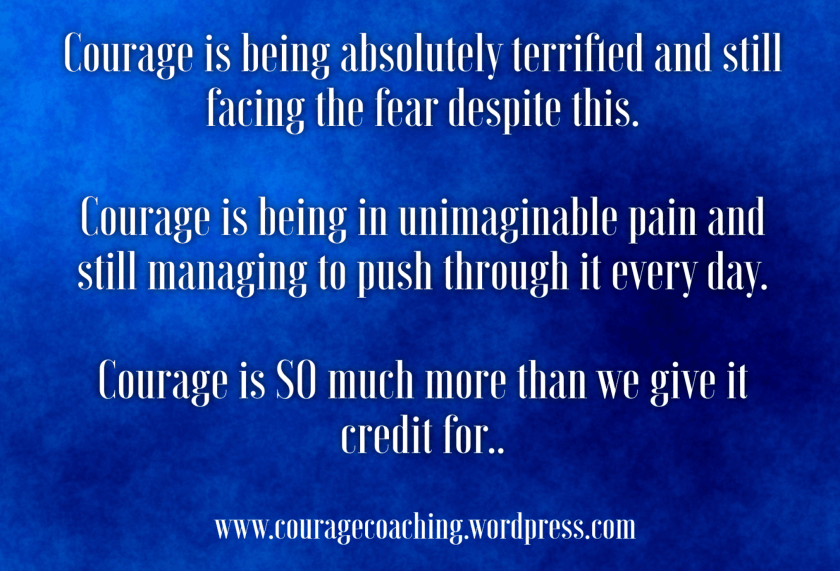
FontCandy (76)

First of all, courage is very important when challenging ourselves at times where we need to make big changes in our personal life, our work or our health.

Courage is necessary when we deal with grief, physical & emotional pain or overwhelming fear.

As survivors of abuse would agree, courage is crucial for getting through the trauma and emotional pain that starts with the abuse, continues throughout the abuse and then unfortunately becomes a part of the long journey of recovery after the abuse.

For those affected by war & overwhelming grief, courage is what keeps them going every day, when all they want is to stop feeling so frightened & devastated.

Courage is important for survival, for better quality of life, for the ability to self-reflect and for getting through adversity.

Below are some definitions that I found online when I was deciding on COURAGE as a name for my business.

Courage is:

  • The ability to do something that frightens one; bravery.
  • Strength in the face of pain or grief
  • The choice and willingness to confront agony, pain, danger, uncertainty or intimidation.
  • The power or quality of dealing with or facing danger, fear, pain, etc..
  • Courage, also called fortitude, is the ability to confront fear, pain, danger, uncertainty or intimidation. It can be divided into “physical courage” — in face of physical pain, hardship, and threat of death — and “moral courage” — in the face of shame, scandal, and discouragement..
  • The state or quality of mind or spirit that enables one to face danger, fear, or vicissitudes with self-possession, confidence, and resolution; bravery.

 I also selected a few of the most inspiring quotes about courage, in my opinion.

”You gain strength, courage, and confidence by every experience in which you really stop to look fear in the face. You are able to say to yourself, ‘I lived through this horror. I can take the next thing that comes along”.
Eleanor Roosevelt
”I learned that courage was not the absence of fear, but the triumph over it. The brave man is not he who does not feel afraid, but he who conquers that fear”.
Nelson Mandela
”Inaction breeds doubt and fear. Action breeds confidence and courage. If you want to conquer fear, do not sit home and think about it. Go out and get busy”.
Dale Carnegie
”You will never do anything in this world without courage. It is the greatest quality of the mind next to honor”.
Aristotle

 What is it about courage that inspires you the most?

Love Athina ♥
© All blog posts and images are owned by me and Courage Coaching. Please don’t use without consent and only re-blog if you would like to use the information on here.

Complicated grief for adult survivors of abuse

Societal mandates assert that loss is accompanied by a conventional paradigm of grief, replete with ceremonial rituals and a finite process of mourning. Yet when the loss pertains to more intangible sources of grief such as prolonged abuse and trauma, one size does not fit all.

Adult survivors of child abuse, beset by complex post-traumatic stress disorder often grapple with persistent complicated bereavement disorder. They are plagued by persistent yearnings for the love and normalcy they never had. They are weighed down by innumerable intangible losses such as safety, dignity, belonging and a cohesive sense of self.

Family as Sacrosanct

For adult survivors of chronic child abuse the notion of ‘family as sacrosanct’ is a principle that fosters confusion, alienation, shame and outrage. Within the context of familial sacredness doctrines are explicit. Love thy mother and father and honor their function and authority.

However, when that mother or father robbed that child of his/her birthright, their innocence, their childhood, even their Self, who gets to determine how that child should ‘appropriately’ respond to sundry losses or the most glaringly pivotal loss of a parent’s passing? How is the survivor to measure up to a proclamation that has no bearing on her history or her reality?

Anecdotal Forgiveness

Anecdotal forgiveness seems to be the standard advice handed out to survivors of abuse. Survivors are advised to offer absolution to the abusive parent regardless of whether the abuser has attempted any sort of restitution. Ostensibly, this will set the abuse survivor free and concomitantly confer them the designation of good son/daughter. With religious zeal, this approach is considered a crowning achievement.

As you can see from everything written in this article  http://pro.psychcentral.com/complicated-bereavement-for-adult-survivors-of-abuse/0011089.html# asking someone to forgive their abusive parent, is like throwing salt into an already extremely painful wound, especially when that parent never apologised or felt remorse.

Recipient of the Lifetime Achievement Award from the International society for Traumatic Stress Studies, Dr. Judith Herman, refers to the aforementioned construct as the forgiveness fantasy. Dr. Herman states:

“Forgiveness is a relational process. “‘I forgive you’ is the response to a heartfelt apology and request for forgiveness. If the apology is never made, the process of forgiveness cannot take place. And “genuine contrition in a perpetrator is a rare miracle.”

I completely agree with Dr Herman’s words!

Those of you who feel that you have to forgive, don’t!

Inspired by https://bodyelectricweb.wordpress.com/ on expressing anger and the topic of forgiveness. If I were her, I don’t think a perpetrator deserves forgiveness if there is no remorse.