Dealing with a pandemic of this magnitude, we are all understandably becoming anxious and uncertain about the future.
All the little things that consumed our life previously are no longer as important.
There is a new reality now.. One of survival, planning and isolating.
For those of you who are already living with C-PTSD, anxiety, depression and other mental health conditions, this time is especially triggering..
For those of you in the ‘at risk groups’, life can feel terrifying..
Here are a few tips that are keeping me sane and might help you too!
We are dealing with an unprecedented reality, it is normal to feel overwhelmed.
How are you coping with this in your country?
I hope you are looking after yourselves at this difficult time dear readers.
Just remember, we are all in this together!
Lots of love
Athina ♥♥

I wanted to share the great news that Complex Post Traumatic Stress Disorder is recognised by the World Health Organization’s (WHO) eleventh revision of the International Statistical Classification of Diseases and Related Health Problems (ICD-11).
As someone who has openly spoken about living with the symptoms of CPTSD, it feels extremely validating to know that it is actually recognised formally. I wasn’t aware of this until very recently so for those of you who already knew this, please forgive my delayed discovery. For those of you who live with CPTSD and are aware of this, I hope this news finds you well.
In my personal opinion, a diagnosis of CPTSD could easily replace many other diagnoses. CPTSD is the result of child abuse, neglect and any other prolonged and repeated traumatic experiences.
Symptoms of anxiety and depression are in most cases part of having CPTSD, as well as the following (in the context of childhood trauma & abuse).
”Attachment – problems with relationship boundaries, lack of trust, social isolation, difficulty perceiving and responding to others’ emotional states”
”Biology – sensory-motor developmental dysfunction, sensory-integration difficulties, somatization, and increased medical problems”
”Affect or emotional regulation – poor affect regulation, difficulty identifying and expressing emotions and internal states, and difficulties communicating needs, wants, and wishes”
”Dissociation – amnesia, depersonalization, discrete states of consciousness with discrete memories, affect, and functioning, and impaired memory for state-based events
”Behavioural control – “problems with impulse control, aggression, pathological self-soothing, and sleep problems”
”Cognition – difficulty regulating attention; problems with a variety of ‘executive functions’ such as planning, judgement, initiation, use of materials, and self-monitoring; difficulty processing new information; difficulty focusing and completing tasks; poor object constancy; problems with ’cause-effect’ thinking; and language developmental problems such as a gap between receptive and expressive communication abilities.”
”Self-concept – fragmented and disconnected autobiographical narrative, disturbed body image, low self-esteem, excessive shame, and negative internal working models of self”.
Formal recognition and diagnosis will greatly help CPTSD sufferers with more appropriate treatment options:
Some current treatments are:
It is also worth mentioning that CPTSD has also been referred to as DESNOS (Disorders of Extreme Stress Not Otherwise Specified).
DTD (Developmental trauma disorder) is also proposed as the alternative equivalent to childhood CPTSD.
”Dr. Judith Lewis Herman, in her book, Trauma and Recovery, proposed that a complex trauma recovery model that occurs in three stages:
If you live with CPTSD and have had experience with any of the above treatment options, I would love to hear what you found helpful.
Thanks for reading
This blog post includes direct text from Wikipedia:
https://en.wikipedia.org/wiki/Complex_post-traumatic_stress_disorder
Love Athina ♥♥
Oversharing is something that I have also been guilty of on more than one occasion.
Why do many of us overshare whereas most people only share what is necessary when meeting new people?
In the video below, I explain a little bit about oversharing and why we do it.
Love Athina ♥
Just a quick post to update you on what I am up to at the moment. I am currently studying my first Counselling module with the Open University alongside my work. I am very excited about this and hoping to complete a whole Diploma in Counselling or a full on Bachelors. I am studying separate modules at a time, which enables me to be more flexible in my choices.
I am still making youtube videos on my channel and also still taking on new clients for coaching.
I have a few new coaching options now, which include 30 min coaching sessions instead of hourly sessions. You can find these new options here: https://couragecoaching.net/availabilitycost/
My latest video is based on Dependent Personality disorder.
A lot of survivors of narcissistic abuse can sometimes develop this disorder or at least have a lot of the symptoms present.
Infantilization by parents and/or early loss or abandonment can cause Dependent Personality.
If you can relate, then please feel free to comment or share this video!
Much love to you all!
♥
© All blog posts and images are owned by me and Courage Coaching. Please don’t use without consent and only re-blog if you would like to use the information on here
A lot of research has gone into this video which has a questionnaire about helping people identify whether they might be suffering with CPTSD. I set up a poll on my youtube page, asking my subscribers to choose a video topic out of 4 options and this video was the most popular choice.
As I myself have answered ‘Yes’ to around 34 out of the 40 questions on this questionnaire and have also been diagnosed with CPTSD from 3 different therapists, I know that this questionnaire is very accurate. I created it to help my clients feel validated and to provide a stepping stone in the right direction towards their healing journey.
It is highly important to stress that there are 2 different types of abuse that a child can suffer in their family home. Overt abuse and covert abuse. Most abuse survivors, who have experienced a combination of these 2 types of abuse, will answer ‘YES’ to all 40 questions and will have all CPTSD symptoms, as well as visual, physical and other sensory flashbacks, along with extreme dissociation. Those survivors who have only suffered from covert abuse, also score high on this questionnaire (as much as 38 out of 40). This proves the severity of both types of abuse and sadly many therapists don’t take covert abuse seriously, when they should.
I wholeheartedly hope you find it helpful and if you think others will find it useful and validating, then please share this post as much as possible, .
Also please feel free to add your answers in the comments below this post, or on my youtube channel! Please specify whether you experienced overt abuse or covert abuse or both.
Thank you!
Love Athina ♥
Outsmarting the narcissist is important for your sanity and so you can feel in control of your life. Narcissists are experts at controlling your life with different manipulation tactics and they are very skilled at turning empaths into codependents.
This video will help those of you who deal with a covert narcissist, to feel empowered and strong again. The ‘deflect’ technique that I talk about in this video is especially good when dealing with a covert narcissist however isn’t advisable when dealing with a physically abusive narcissist.
Love Athina ♥
© All blog posts and images are owned by me and Courage Coaching. Please don’t use without consent and only re-blog if you would like to use the information on here.
What does it mean when narcissists give you the fleas?
Fleas comes from the adage “He that lieth down with dogs shall rise up with fleas”, which has been attributed to Benjamin Franklin. According to Wikipedia, the quote has an almost universally agreed meaning of “You should be cautious of the company you keep. Associating with those of low reputation may not only lower your own but also lead you astray by the faulty assumptions, premises and data of the unscrupulous”
When a victim has the fleas, it means that they have picked up behaviours of the narcissist. This is mainly because they have been exposed to the narcissist’s behaviours for a prolonged period of time and have ended up feeling helpless and hopeless.
The victim will look for ways to escape and sometimes will resort to behaviours which are not characteristic but serve as a way to demonstrate their anger and alleviate the powerlessness they have been feeling.
The good thing is, that victims that use narcissistic behaviours against their abusers, quickly back down and feel ashamed and remorseful. This shows that they don’t need to be afraid of turning into a narcissist themselves.
Some examples of getting fleas can be when a victim shows passive aggressive behaviours when feeling cornered or triggered by someone close to them.
They could also at times become aggressive towards a narcissistic partner or parent.
Lastly, they may even shout at their parent or partner and even end up calling them names.
These are just maladaptive behaviours that can be changed by being self-reflective and by asking a therapist for support. Victims of narcissistic abuse live with C-PTSD so they will not always be able to cope in a healthy way. They just need the right guidance to makes changes by turning unhealthy coping mechanisms into healthy ones.
Thanks for reading!
Love Athina ♥
© All blog posts and images are owned by me and Courage Coaching. Please don’t use without consent and only re-blog if you would like to use the information on here.
Ever since I made my youtube video ‘How does PTSD affect intimate relationships’, I have had so many of you contact me with questions about how to cope and support your partners. The reality is that it takes a very strong person to love someone who lives with PTSD, as they also live with it indirectly.
Loving someone with PTSD can easily takes its’ toll on the relationship and on the partner doing all the supporting. It can affect intimacy, communication & the expression of emotion.
The person with PTSD may not be able to work full time or may not be able to work at all.
It is of course very different for each individual relationship, as the severity of the PTSD is unique to each individual.
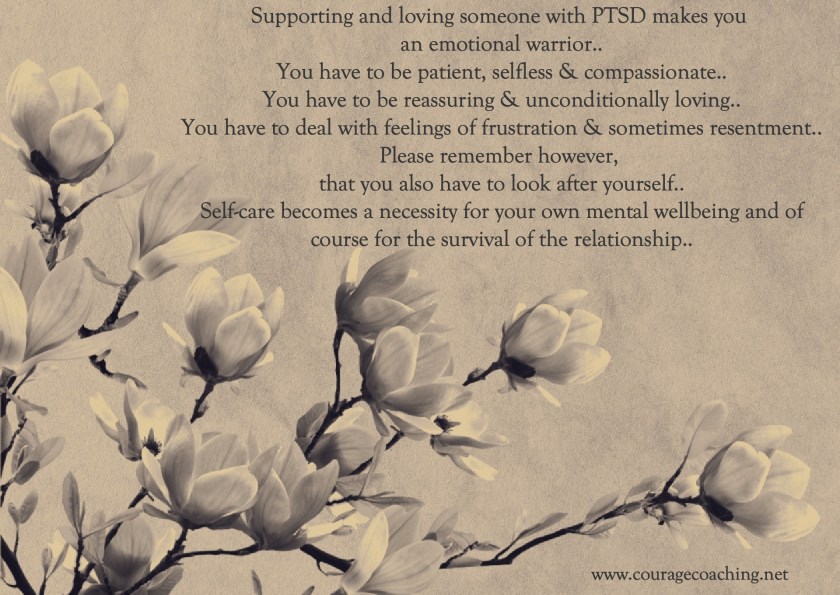
The most important thing to remember is that both partners have to practice self-care..
The one doing the supporting can also end up suffering from depressive episodes or anxiety..They may also generally feel mentally exhausted..
Breaks are very important and the partner of someone with PTSD, may at times need to take a mental holiday away from their partner..This is completely OK and almost necessary for the survival of the relationship.
Thanks so much for reading and please share this post if you think it may help someone!
Love Athina ♥♥
© All blog posts and images are owned by me and Courage Coaching. Please don’t use without consent and only re-blog if you would like to use the information on here.
If you have noticed the following red flags in a person close to you, then you need to take precautions. Below is a check list which you need to pay close attention to. The more of these you can relate to, the quicker you need to remove yourself from a relationship with such a disordered person.
Narcissists are everywhere and can be both male or female. They can be partners, family members, friends, teachers, managers, therapists, coaches, spiritual advisors, neighbours and any person in a position of power.
PATTERNS TO WATCH OUT FOR
If you think you are indeed dealing with a narcissist and need support, then please feel free to contact me. Detaching from or dealing with a narcissist is not an easy task, especially if they are a partner or family member.
If you feel you are in danger, then please contact your nearest Refuge or move to a location the narcissist doesn’t know about. Record all conversations if you can (stick to texts or emails) so nothing can be used against you.
Most of all, look after yourself. Self-care is extremely important!
Love Athina ♥♥♥
© All blog posts and images are owned by me and Courage Coaching. Please don’t use without consent and only re-blog if you would like to use the information on here.

