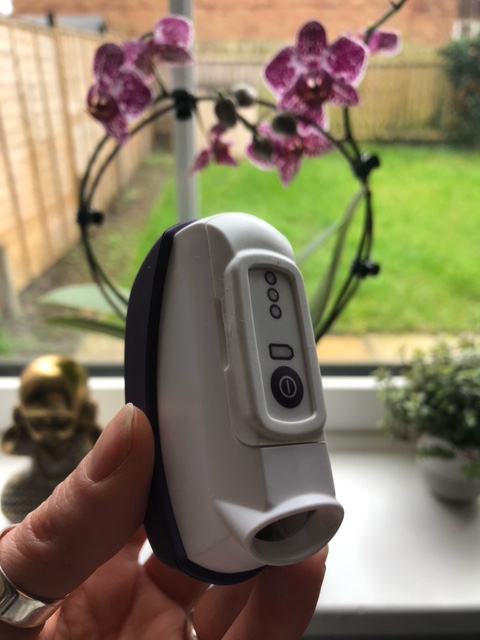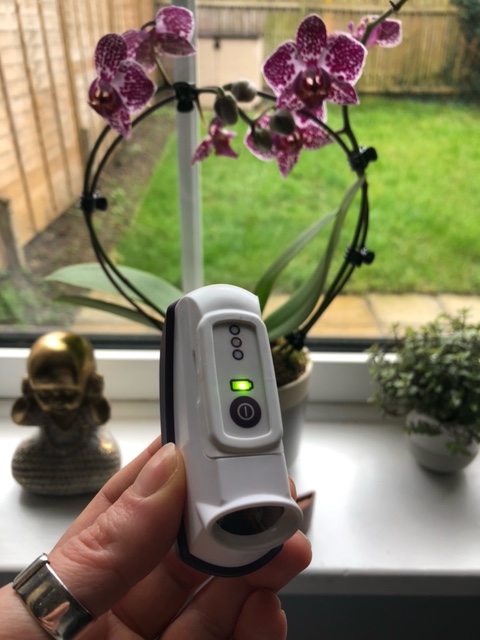
Happy New Year! This is how I have greatly reduced my anxiety levels.

Dear readers,

I hope you have all survived the holiday period and are feeling optimistic about this year. I am very much hoping we will see the end of the Covid pandemic this year and our lives can return to a semi-normal state. I also hope that our mental health will improve and that we will find ways to feel more in tune with ourselves, our needs, our bodies and our minds.

Mental health has been affected so much over the last couple of years due to the pandemic but it has been even tougher for those of us who have had numerous other struggles due to a traumatic past, toxic family members, grief, financial insecurity and other physical health issues.

For those of us specifically, who struggle with anxiety and CPTSD, we know all too well how tricky it is to keep our emotions regulated when we are triggered or scared.

Personally, as a lot of you may already know, I have always struggled with anxiety and low mood. Over the last couple of years however, I have been able to manage my symptoms much more successfully. This has made it easier for me to support others through my coaching and Youtube channel and to also continue to work on my own personal development through more training. Yoga has become a big part of my life, as is walking my dog and trying to keep active. Deep breathing and mindfulness has also helped immensely but the one thing I still struggled with until recently, was getting myself to an immediate state of calm when in the grips of anxiety.

The worst of my anxiety is usually when I travel by plane or when I have to do something that puts me in the spotlight. I also get extremely anxious when I think about losing someone I am attached to. Just before Christmas, I decided to try something completely different and was gifted something that eases anxiety. Although I was rather skeptical at first, after reading so many good reviews about it, I decided to give it a go.

This device is called CalmiGO.
@mycalmigo

CalmiGO is scientifically proven and uses 3 methods to lower anxiety levels:

-Relaxing scent

-Multi-sensory stimulation or grounding

-Breathing regulation (exhalation prolongation)

These 3 methods combined, activate the parasympathetic nervous system and lower stress level hormones.

CalmiGO is drug free and safe to use and if you would like to find out more about it, then feel free to click on this link:

www.calmigo.com/pages/about-me

My experience with using CalmiGO so far has been absolutely brilliant.

After trying this device for 3 minutes as recommended, I immediately noticed a reduction in my anxiety levels.

The most important part of the device for me is that it encourages you to prolong your exhalation. This is scientifically proven to decrease those awful symptoms of anxiety such as dizziness, accelerated heart rate, nausea and chest pain. When we are anxious, we end up breathing much too fast which results in a decrease of PCO2 levels. CalmiGO reverses this with exhalation prolongation. Since prolonging my exhalation was always the trickiest part for me, CalmiGO has been incredibly helpful in getting me to do this successfully. It vibrates and lights up whenever you reach a long enough exhalation, so this helps immensely when you are doing this for 3 minutes or more. Take a look at the photos below for an idea of what CalmiGO looks like and how to use it.
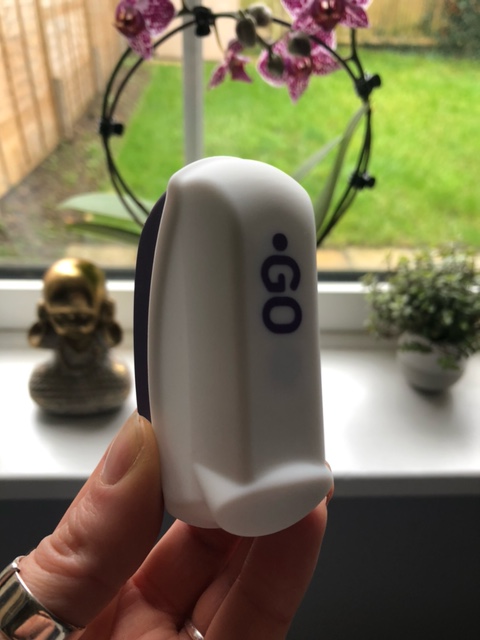
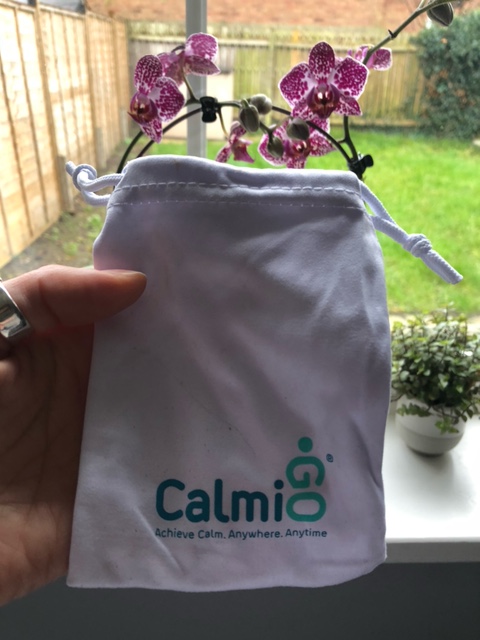
When I ordered CalmiGO, it arrived wonderfully packaged and came with a very detailed guide on how to use it effectively. It came with a little rubber cover and also an easy to use pouch to carry it in. There was also a pack of AAA batteries, a small screwdriver and a pack of 2 scented element attachments. One of these scented element attachments is placed on the front of the device near the ‘on and off’ switch. My preferred choice was lavender but you can also choose peppermint or bergamot if you prefer.

Although there is a detailed guide on how to use it effectively, there is also a tutorial video which you can watch here:

http://www.calmigo.com/pages/tutorial

Since I have found CalmiGO so incredibly useful in my personal life, I decided to collaborate with the founders of CalmiGO and I am offering a $30 discount on every purchase made through their website.

By adding the code COURAGE as a voucher when you add CalmiGO to your shopping cart, you get the above discount on the total price. Go to the link below to gets yours 🙂

http://www.calmigo.com

CalmiGO really is an investment in a life with less anxiety.

For those of you who live with CPTSD or PTSD, CalmiGO will help ground you and if used every day for a month during a time where you are really struggling with panic and anxiety, you will see a huge decrease in your symptoms.

If you have any questions or would like to share your experience using CalmiGO, then please feel free to leave a comment below.

Much love

Athina

High functioning and low functioning narcissists

If you have experienced narcissistic abuse or had close contact with someone that has narcissistic personality disorder, then it may interest you to know that there are 2 types of narcissists. High functioning and low functioning.

Over my life time I have had experience with mostly high functioning narcissists but I have also witnessed these same high functioning narcissists move to low functioning at times.

What is your experience?

Love Athina

THE MAIN BEHAVIOUR PATTERNS OF A NARCISSISTIC PARENT

Growing up in a dysfunctional family completely changes the way we relate to the world, the way we behave and feel in relationships, the way we regulate our emotions and how secure we feel in ourselves.

Although I have talked about the traits of a narcissist in an older video, I wanted to do an updated video on this which you can view below.

Love Athina ❤

Complex PTSD is recognised as a disorder in the ICD-11

IMG_0530

I wanted to share the great news that Complex Post Traumatic Stress Disorder is recognised by the World Health Organization’s (WHO) eleventh revision of the International Statistical Classification of Diseases and Related Health Problems (ICD-11).

As someone who has openly spoken about living with the symptoms of CPTSD, it feels extremely validating to know that it is actually recognised formally. I wasn’t aware of this until very recently so for those of you who already knew this, please forgive my delayed discovery. For those of you who live with CPTSD and are aware of this, I hope this news finds you well.

In my personal opinion, a diagnosis of CPTSD could easily replace many other diagnoses. CPTSD is the result of child abuse, neglect and any other prolonged and repeated traumatic experiences.

Symptoms of anxiety and depression are in most cases part of having CPTSD, as well as the following (in the context of childhood trauma & abuse).

”Attachment – problems with relationship boundaries, lack of trust, social isolation, difficulty perceiving and responding to others’ emotional states”

”Biology – sensory-motor developmental dysfunction, sensory-integration difficulties, somatization, and increased medical problems”

”Affect or emotional regulation – poor affect regulation, difficulty identifying and expressing emotions and internal states, and difficulties communicating needs, wants, and wishes”

”Dissociation – amnesia, depersonalization, discrete states of consciousness with discrete memories, affect, and functioning, and impaired memory for state-based events

”Behavioural control – “problems with impulse control, aggression, pathological self-soothing, and sleep problems”

”Cognition – difficulty regulating attention; problems with a variety of ‘executive functions’ such as planning, judgement, initiation, use of materials, and self-monitoring; difficulty processing new information; difficulty focusing and completing tasks; poor object constancy; problems with ’cause-effect’ thinking; and language developmental problems such as a gap between receptive and expressive communication abilities.”

”Self-concept – fragmented and disconnected autobiographical narrative, disturbed body image, low self-esteem, excessive shame, and negative internal working models of self”.

Formal recognition and diagnosis will greatly help CPTSD sufferers with more appropriate treatment options:

Some current treatments are:

  • biofeedback
  • dyadic resourcing (used with EMDR)
  • emotionally focused therapy
  • emotional freedom technique (EFT) or tapping
  • Equine-assisted therapy
  • expressive arts therapy
  • internal family systems therapy
  • dialectical behavior therapy(DBT)
  • family systems therapy
  • group therapy
  • neurofeedback
  • psychodynamic therapy
  • sensorimotor psychotherapy
  • somatic experiencing
  • yoga, specifically trauma-sensitive yoga

It is also worth mentioning that CPTSD has also been referred to as DESNOS (Disorders of Extreme Stress Not Otherwise Specified).

DTD (Developmental trauma disorder) is also proposed as the alternative equivalent to childhood CPTSD.

”Dr. Judith Lewis Herman, in her book, Trauma and Recovery, proposed that a complex trauma recovery model that occurs in three stages:

  1. establishing safety,
  2. remembrance and mourning for what was lost,
  3. reconnecting with community and more broadly, society.”

If you live with CPTSD and have had experience with any of the above treatment options, I would love to hear what you found helpful.

Thanks for reading

This blog post includes direct text from Wikipedia:

https://en.wikipedia.org/wiki/Complex_post-traumatic_stress_disorder

Love Athina ♥♥

Oversharing

Oversharing is something that I have also been guilty of on more than one occasion.

Why do many of us overshare whereas most people only share what is necessary when meeting new people?

In the video below, I explain a little bit about oversharing and why we do it.

Love Athina ♥


Update & video on Dependent Personality Disorder

Just a quick post to update you on what I am up to at the moment. I am currently studying my first Counselling module with the Open University alongside my work. I am very excited about this and hoping to complete a whole Diploma in Counselling or a full on Bachelors. I am studying separate modules at a time, which enables me to be more flexible in my choices.

I am still making youtube videos on my channel and also still taking on new clients for coaching.

I have a few new coaching options now, which include 30 min coaching sessions instead of hourly sessions. You can find these new options here: https://couragecoaching.net/availabilitycost/

My latest video is based on Dependent Personality disorder.

A lot of survivors of narcissistic abuse can sometimes develop this disorder or at least have a lot of the symptoms present.

Infantilization by parents and/or early loss or abandonment can cause Dependent Personality.

If you can relate, then please feel free to comment or share this video!

Much love to you all!

© All blog posts and images are owned by me and Courage Coaching. Please don’t use without consent and only re-blog if you would like to use the information on here


How to outsmart a narcissist once and for all!

Outsmarting the narcissist is important for your sanity and so you can feel in control of your life. Narcissists are experts at controlling your life with different manipulation tactics and they are very skilled at turning empaths into codependents.

This video will help those of you who deal with a covert narcissist, to feel empowered and strong again. The ‘deflect’ technique that I talk about in this video is especially good when dealing with a covert narcissist however isn’t advisable when dealing with a physically abusive narcissist.

Love Athina ♥

© All blog posts and images are owned by me and Courage Coaching. Please don’t use without consent and only re-blog if you would like to use the information on here.

How to heal from childhood abuse

A lot of my followers on this blog and also subscribers from my youtube channel keep coming to me with the same question ‘How do I heal from childhood abuse?’.

Although this is something I have already addressed previously, I have decided to actually explore this in as much detail as I possibly can.

I will address this with reference to my own recovery journey and also by looking at research done by psychologists, psychotherapists and trauma specialists such as Pete Walker, Wilhelm Reich, Dr Bessel Van Der Kolk and many more.

Healing from childhood abuse isn’t a simple process. It takes a huge amount of courage, inner strength & resilience. It requires a willingness to become more self-aware of our own dysfunctional coping mechanisms, that we may have learnt from our primary caregivers.

If our parents were high on the narcissism spectrum, we will have endured years of all or some of the following:

  • neglect
  • hypercriticism
  • parentifying
  • infantilising
  • pathological envy
  • blaming
  • patronising
  • mood swings
  • pathological lying
  • aggression or passive aggression
  • gaslighting
  • controlling behaviour
  • emotional blackmail
  • scapegoating
  • silent treatment
  • shaming
  • invalidation
  • isolation
  • intimidation
  • verbal abuse
  • sexual abuse
  • physical abuse
  • engulfment

Living in a household with abuse, causes the child to develop Complex Post Traumatic Stress Disorder.

Complex post traumatic stress disorder is a more severe form of PTSD and has the following 5 features:

  1. Toxic shame
  2. Self-abandonment
  3. Emotional flashbacks
  4. A extremely harsh inner critic
  5. Social anxiety

Emotional flashbacks are the most characteristic part of CPTSD. They are sudden and sometimes prolonged age regressions to the overwhelming feelings of being abused or neglected as a child. Emotional flashbacks don’t have a visual component. These flashbacks do however include an overwhelming feeling of fear, shame, alienation, abandonment, depression and emotional pain. They can range in intensity from subtle to unbearable.

Toxic shame is the when an individual has an overwhelming feeling that they are flawed, loathsome or stupid. It completely destroys a person’s self-esteem and causes the person to abandon themselves emotionally. This creates a feeling of hopelessness and helplessness.

The inner critic is the internalised punishing voice of our abusive parent. If we had a parent who was a bully and constantly called us names such stupid, pathetic, too sensitive, ugly etc, then we will have this voice within us, even if our abusive parent isn’t in our life anymore. It will be a habitual inner bully that punishes us instead of supports us.

Other symptoms of CPTSD are:

  • Feelings of loneliness and abandonment
  • Fragile self-esteem
  • Attachment disorder
  • Developmental Arrests
  • Relationship difficulties ( Fear of forming relationships or forming relationships that are too dysfunctional)
  • Hyper-arousal / extreme flight/fight response
  • Suicidal ideation
  • Oversensitivity to stress
  • Dissociation
  • Exhaustion
  • Body armouring  (which involves tensing of muscle tissue whenever stress or emotion is experienced. To protect itself, the body takes a defensive, tight, and stiff stance. On a tissue level it enters into a muscular holding pattern that resists change and release. Unexpressed emotions such as anger, fear, and grief are common causes of this phenomenon. This was first described by psychologist Wilhelm Reich).
  • Impulsivity
  • Inappropriate anger


The stages of recovering

To recover from abuse and trauma, we must first educate ourselves on a cognitive level. We must understand that we most likely suffer with CPTSD and that it isn’t our fault that we are suffering. We have to put the blame where it belongs – to our abusive primary caregivers.

Secondly we must find a qualified therapist/specialist coach that will help us with the very difficult task of shrinking the inner critic. The inner critic can be a very difficult part of recovery to tackle, as the negativity from this critic has become automatic over our lifetime. It may take a long time to stop the inner critic from affecting us. Constant awareness of when the critic is present will help us stop him in his tracks and try and replace the negative criticisms with positive affirmations and self-compassion.

The next step in recovery is verbal ventilation and the very painful process of grieving our childhood losses. Verbal ventilation is when we speak in a way that releases our painful emotions with a safe person. Grieving our childhood losses means that we actually allow ourselves to cry, be angry and really feel the deep pain of not having had healthy parents. Grieving can take a long time and can sometimes last for a couple of years. In grieving, it is important for us to also grieve our loss of self-esteem and safety.

Once we have successfully grieved, we then must deal with the feelings of abandonment via somatic healing and via learning how to become self-compassionate in moments of depression or anxiety.

Lastly, we will need help with dissecting all our defences, especially those that no longer serve us. We may have picked up defences and behaviours from our abusive parents that are dysfunctional and we will now need support in stopping these defences and practicing more healthy ways of coping.

A very important part of recovery is to learn how to be patient with our progress, as sometimes it isn’t straightforward. Recovery is a journey and self compassion is crucial.

A great mantra according to Pete Walker, is

‘Progress not perfection’

Expecting perfection in recovery isn’t going to help us move forward..

Progress however is key!

Thanks for reading!

Love Athina ♥

© All blog posts and images are owned by me and Courage Coaching. Please don’t use without consent and only re-blog if you would like to use the information on here.