
Working with children who have been abused

Working with children is something that I have very much enjoyed doing on and off for 9 years.

After graduating from University 14 years ago, I spent part of my time running my jewellery business and the other part of my time was spent working as a nanny with children aged 3-11 years of age.

Being a part-time nanny, allowed me to have enough time to work on my jewellery whilst also earning a little extra money to keep things stable financially.

At present, I find myself in slightly different circumstances.

Although I will not be pursuing anymore nanny jobs, I am considering coaching a young teenager in the next few days.

In a few hours, I am meeting her and her mum for an initial consultation, to see if she would feel comfortable enough opening up to me.

Here in the UK, when you work with vulnerable individuals, such as children, special needs adults or the elderly, you need to make sure you get a DBS done.

The Disclosure and Barring Service (DBS), is able to provide information about an individual as to whether or not he or she has a criminal conviction or has been charged with a criminal conviction which has expired. This provides the employer, which in my case is the mother of this girl, with peace of mind.

I haven’t actually applied for this yet as I will ask the mother how she feels about this.

Although I have never had a conviction in my life, it is still important to do things properly.

Coaching a young girl, who has just been through an abusive situation at home with her stepmom, is vulnerable territory.

Things have to be dealt with very carefully and I will have to refer her to a psychotherapist, if I see that her symptoms are serious. As a coach, I can only guide her with compassion and validation of her feelings but I can’t offer much more. Her mother has said that her daughter hasn’t found any of the counsellors at school helpful and that child services are happy that she will be talking to me, due to my background and focus of my business.

If I can help this young girl, I will be extremely grateful.

When I was that age, I had no idea that I was actually suffering from abuse. I thought my life was normal, even though I had no confidence and felt empty and unloved.

All children deserve a chance to be supported and have their feelings acknowledged. All children deserve to feel safe, loved and to feel happy.

Thanks for reading

Love Athina ♥

© All blog posts and images are owned by me and Courage Coaching. Please don’t use without consent and only re-blog if you would like to use the information on here.
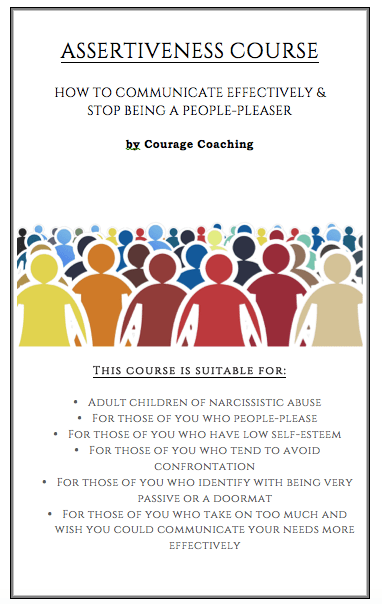
New assertiveness PDF course-How to communicate effectively & stop being a people-pleaser

My new assertiveness PDF course is finally ready to buy.

Being assertive isn’t something that comes naturally to all of us, especially for those of us who grew up in dysfunctional homes. As I myself, also struggled with this due to my background, assertiveness training helped me immensely. For this reason, I wanted to create a course that would help others as much as my assertiveness training helped me!

Being assertive as a child with narcissistic parents meant that we would get punished or have love and affection withdrawn from us. Protecting ourselves didn’t usually go down well with such disordered individuals.

As adults, we continued having trouble being assertive as we may have felt frightened of peoples’ reactions or we may have at times felt guilty that we were letting people down.

Assertiveness however is important in many ways, especially as it encourages respectful & honest communication and promotes equality in relationships.

Here is a sneak peak of the course cover and its’ contents.

assertiveness front cover

In this assertiveness course, I will include the following things:

  • What assertiveness is and what it isn’t.
  • When & how to be assertive
  • The 4 different ways of communicating
  • What rights we have in our interactions with others
  • The differences between aggressiveness & assertiveness
  • How it feels to be assertive
  • Examples of assertive communication
  • Handing criticism assertively
  • Handling anger assertively
  • Expressing criticism assertively
  • What changes when we become assertive
  • The inner critic and how it affects us
  • Emotional Flashbacks
  • Practicing assertiveness with some exercises

If you are interested in this PDF course,

then please click here: —–>>>>>     ASSERTIVENESS PDF COURSE

The PDF is 30 pages long, so it has enough material to help you become an expert at assertiveness.

This course is ideal if you are an introvert or an avoidant! It is a great first step before you actually attend an assertiveness training class!

Thanks so much for your attention and I am very much looking forward to sharing my knowledge with you!

Love Athina ♥♥

© All blog posts and images are owned by me and Courage Coaching. Please don’t use without consent and only re-blog if you would like to use the information on here.

Relocation back to the UK and new Youtube video – ‘Signs you are dating a narcissist’

After a long absence, due to my recent relocation back to the UK from Germany, I am ready to start working again and embrace the world of change and healing.

I have just created a new video for my youtube subscribers and I am very grateful to be back home, so I am able to take on more face to face clients. Although Germany was very international, not everyone I encountered spoke English well.

Now that I am home, it is truly lovely to be able to communicate effectively and clearly and to not have to worry about the language barrier. There are many more opportunities for me in the UK and I am very much looking forward to getting involved with charities that support narcissistic abuse survivors.

In this new video, I talk about the most common signs that you are dating a narcissist.

If you have had experience dating a narcissist, then you will relate to this video. If you are currently in a relationship and feel undermined and confused, then this video might help answer some questions.

If you need support, then please feel free to contact me or another mental health professional. Leaving a relationship where the other person may be a narcissist, is not the same as leaving a healthy relationship. It has to be done very carefully, with reliable support and a clear plan. Victims tend to develop signs of C-PTSD and can suffer greatly with depression & anxiety.

Some narcissists can become dangerous and physically abusive.

The relationship dynamics although similar in most cases, can have unique circumstances, where the abusive partner may also be physically or sexually abusive. In worst cases, the abuse is so severe, that the narcissist may even kill their partner.

Last but not least, trauma bonding makes it very difficult for the victim to leave their abuser so the right support is absolutely necessary.

Please share this blog post or video, if you think it will help someone!

Thanks for reading and watching!

Love Athina ♥

© All blog posts and images are owned by me and Courage Coaching. Please don’t use without consent and only re-blog if you would like to use the information on here.
Vulnerability & the dangers of predators

33073121_1538935199604808_8797525179052851200_n

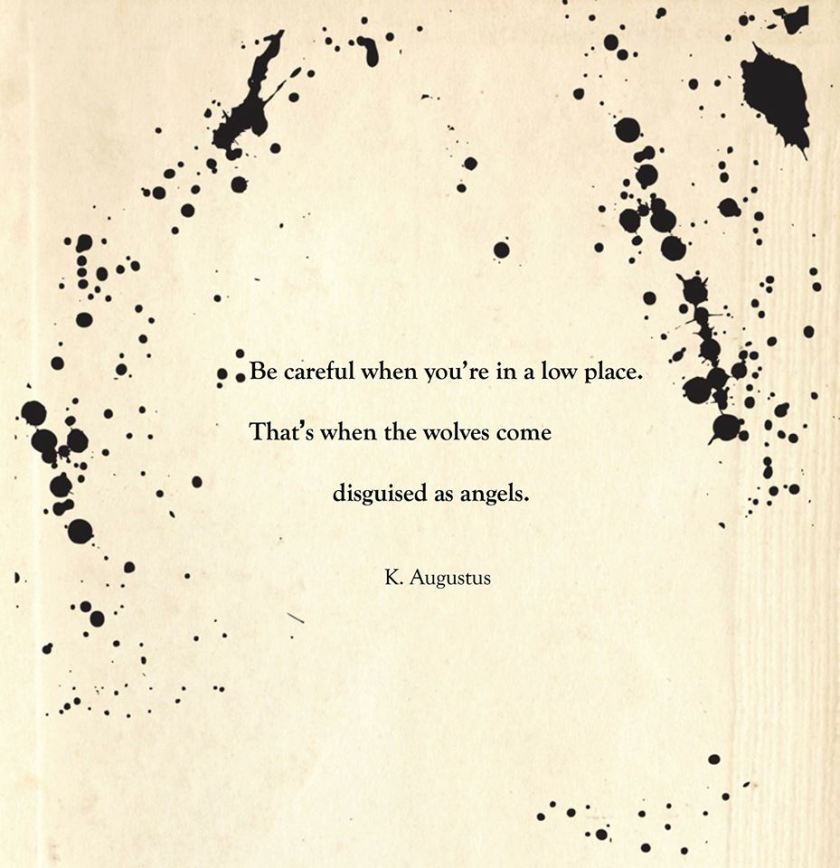
There are countless times in my own personal life, where my own vulnerability got me into trouble.

At times where all I wanted was genuine comfort & love, I met people who took advantage of my vulnerable state of mind. Those people in particular had narcissistic traits and I only realised this of course when it was a little too late!

If you are in the middle of grieving, or fresh out of a bad relationship, be sure to tread carefully.

If you grew up in a dysfunctional home and now live with Complex PTSD, then you will always be vulnerable to the wrong person. Unless you have had a chance to work through your childhood trauma and come out of therapy healthier, choosing the wrong people to associate with, will be familiar but dangerous.

The trauma bond is what makes survivors of abuse more susceptible to predators in sheep’s clothing. Especially when it comes to romantic interests or intimate encounters.

A lot of survivors of abuse will settle for sex when in reality they really want love and a sense of acceptance.

Narcissists are experts at hiding their true colours at the beginning. They are also attracted to empaths & sensitive people like magnets.

If you have had an experience like this that has affected you, then please feel free to share it in the comments below.

Feel free to re-blog this post, if you think it will help others.

Thank you

Love Athina ♥

© All blog posts and images are owned by me and Courage Coaching. Please don’t use without consent and only re-blog if you would like to use the information on here.

Narcissistic selective amnesia

There are so many occasions from my own personal experience, where I have witnessed this type of amnesia. In most of these occasions, it was with a parent.

Narcissistic selective amnesia is real and extremely damaging.

If you have not heard of this before, then my latest youtube video below, will hopefully help.

When you are in the depths of emotional despair, it can be extremely upsetting dealing with this sort of reaction from the narcissist in your life.

Before you are aware that you are being abused by a narcissist, you are usually blind to the narcissist’s ways of abusing you. You have no idea that you are a dealing with a very harmful individual.

When the narcissist practices selective amnesia in response to something you have pointed out, you feel completely at a loss. The frustration can be infuriating to not feel heard & and to not be understood.

The narcissist isn’t always conscious of their selective amnesia unfortunately, but this doesn’t make it any less harmful.

If you have had experience with a narcissist’s selective amnesia, please share it in the comment section below.

Feel free to share this blog post, if you think it will help others.

Thank you

Love Athina ♥

© All blog posts and images are owned by me and Courage Coaching. Please don’t use without consent and only re-blog if you would like to use the information on here.

Narcissistic fathers & their sons

In my latest youtube video, I discuss the relationship between narcissistic fathers and their sons. This was requested by some of my viewers.It is just as important to raise awareness about how damaging a narcissistic father can be towards their son.

Thanks for watching!

© All blog posts and images are owned by me and Courage Coaching. Please don’t use without consent and only re-blog if you would like to use the information on here.

Love Athina ♥

Narcissistic mother types

Awhile back, I wrote a blog post on my other site about the effects of narcissistic abuse and the different narcissistic mother types out there, according to respected psychotherapist Michelle Piper. You can find this blog post here:

https://mychildwithin.wordpress.com/2016/03/24/narcissistic-mother-types/

After reading through Michelle’s website, I wanted to share the information she provides with my subscribers on youtube. With a growing audience, I felt it was the right thing to do.

In the following video, I talk a little bit about the roles children take on in a dysfunctional home and I list the 53 types of narcissistic mother that Michelle came up with. Most people can relate to quite a few of them, with their mother fitting into many different types.

If you find this blog post or video useful, then please feel free to share it.

Love Athina ♥

New youtube video-I have discovered my parents are narcissists.What now?

It is important to know the steps of what to expect after realising your parents are abusive. It is crucial to finally understand why and how you were & are affected by narcissistic abuse. Giving what you have been through a name, is the beginning of your healing journey. It allows for validation of your feelings and to finally KNOW that it wasn’t your fault – It was your parents fault!

To actually work through the emotions, the acceptance of not having had healthy parents and the grief that goes with it, is a whole different challenge however. To reach a better state of mental health, you have to dig deep and allow a lot of painful feelings to come to the surface. Only after working through these painful emotions, will you then have the opportunity to look at your life through a different lens. To look at yourself with more self-compassion & understanding and to learn to set boundaries, takes practice and you need an experienced therapist on your side.

A psychological coach, which is what I have trained as, can support you in changing self-defeating thoughts or behaviours and can support you in the present to move forward with goal setting. A coach is not qualified to guide you through your grieving or acceptance in depth. That is a therapist’s job.

I have had a lot of teenagers watch my youtube videos and I am very much aware that I have to post videos carefully and support these children appropriately.

With empathy & unconditional positive regard, a child can feel a little bit better.

I know that if I had had this support as a child, it probably would have made a world of difference to my mental health.

This is the main reason I am passionate about supporting young people. They need someone to have their back with no strings attached. With narcissistic parents/step-parents, there are always strings attached. There is always some nasty remark waiting to be used against their child/step-child.

Children deserve unconditional love, acceptance, validation of their feelings and a safe environment to call home. This has to become a priority in our society.

Thanks for reading/watching!

Love Athina ♥♥

© All blog posts and images are owned by me and Courage Coaching. Please don’t use without consent and only re-blog if you would like to use the information on here.


What healthy parenting looks like versus narcissistic parenting

family-1517192_1920

In healthy parenting, the following things are needed to bring up a healthy & emotionally stable child.

Love and affection.  “You support and accept the child, are physically affectionate, and spend quality one-on-one time together.”

Stress Management.  “You take steps to reduce stress for yourself and your child, practice relaxation techniques, and promote positive interpretations of events.”

Relationship skills.  “You maintain a healthy relationship with your spouse, significant other, or co-parent and model effective relationship skills with others.”

Autonomy and Independence.  “You treat your child with respect and encourage him or her to become self-sufficient and self-reliant.”

Education and learning.  “You promote and model learning and provide educational opportunities for your child.”

Life skills.  “You provide for your child, have a steady income, and plan for the future.”

Behavior management.  “You make extensive use of positive reinforcement and punish only when other methods of managing behavior have failed.”

Health.  “You model a healthy lifestyle and good habits, such as regular exercise and proper nutrition.

Religion.  “You support spiritual or religious development and participate in spiritual or religious activities.”

Safety.  “You take precautions to protect your child and maintain awareness of the child’s activities and friends.

As listed directly from:

https://www.leelanauchildrenscenter.org/98/articles-and-reading/10-skills-of-competent-parents

Narcissistic parents on the other hand do the following:
  • Their needs have priority over those of the children.
  • They view their children as an extension of their own personal wishes, so the child’s individuality is diminished. They don’t nurture their childrens’ own thoughts, emotions or goals.
  • Their ego needs are unquenchable.
  • Due to their own low self-worth they put their childrens’ accomplishments down, so they can always remain on top (as smarter, more capable etc)
  • They are completely unaware of the grief or discomfort their children are experiencing and are not aware of when they have been neglectful or abusive towards their children.
  • They do not feel empathy, and they will only pay interest in the child if the child is achieving or giving them an ego boost.
  • Shame is at the core of a narcissistically run family, so they will shame, ridicule, tease or criticise their children often. They will also use guilt-tripping, blaming, negative comparisons, emotional blackmail and so much more!
  • They create codependent children and expect them to always look after them and cater to their needs & wants.
  • The parents are possessed by their narcissistic ego, and nothing the child ever does will be good enough. The child tries and tries, but never quite manages to receive their narcissistic parents’ love and affection.
When the child gives the narcissistic parent(s) enough of an ego boost and meets their ego needs, the narcissistic parent(s) will reward their child with approval. This approval, however, is not genuine love.
Children of narcissists grow up feeling unloved, ashamed, unlovable and inferior.
Children of narcissists grow up thinking that there is something seriously wrong with them, (because their parent wasn’t able to love them in a healthy way).
Children learn that the focus isn’t on them (as it should be) but on their narcissistic parent(s). They learn to painfully accept this although don’t know that this isn’t normal.
Children learn to do whatever their narcissistic parents want, in hope that their needs for love, comfort and approval are one day met. This approval seeking behaviour follows them into adulthood where they continue to people please to gain approval.

If you found this blog post helpful, please feel free to comment, share or like!

© All blog posts and images are owned by me and Courage Coaching. Please don’t use without consent and only re-blog if you would like to use the information on here.

Love Athina ♥

Healing from abuse

The sad thing about healing from abuse is that many people who haven’t themselves been abused, can’t possibly understand the survivor’s journey.

Healing from abuse is unique to each individual who has experienced it. The survivor will be emotionally damaged and/or physically hurt and unfortunately this damage is sometimes irreversible. Abuse leaves behind scars unique to each survivor’s experience.

Although healing means that your mind and body are able to recover, this doesn’t mean that the person can return to being ‘normal’.

The aftermath of abuse is usually permanent.

There might be long-lasting Complex PTSD for those who suffered child abuse, human trafficking, kidnapping or other severe types of abuse.

For some individuals abuse might be all they have known. They don’t have a pre-trauma or pre-abuse identity. They might not know what it is truly like to feel safe.

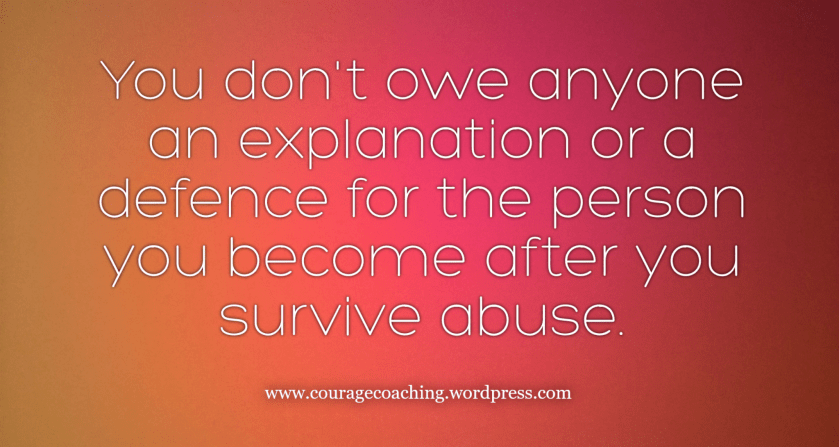
To all survivors of abuse or trauma,it is very important to remember this:

FontCandy (3)

Love Athina ♥

© All blog posts and images are owned by me and Courage Coaching. Please don’t use without consent and only re-blog if you would like to use the information on here.