
I provide empowerment, empathy & support.
I specialise in dealing with dysfunctional relationships, particularly narcissistic abuse & encouraging self-compassion.
Have you ever felt like you were the parent instead of the child? Growing up as a parentified daughter means carrying emotional burdens too heavy for a child to bear. In this video, we explore the experience of daughters who had to step into a parental role—providing comfort, stability, and care at the expense of their own childhood.
This video is inspired by my own experience of being a parentified daughter and I share a deeply personal poem I wrote in my early twenties when I was struggling with my mother.
The poem in the video is written below:
***Please only re-use this poem by giving credit and asking for permission.***
As I am currently studying to be an art therapist alongside my coaching, I have been exploring art journaling as a way to get more in touch with my own creativity.
Art (therapy) journaling is a wonderful way to explore your emotional wellbeing, to understand what keeps you grounded and to see what comes to the surface through exploration of different materials, colours and techniques. Being creative is a great way to start 2025 and give yourself something that is just for you!

Art journaling can be very relaxing and enjoyable when you have already dabbled in some form of creative expression on paper. If, however, you are completely new to expressing yourself through the use of art materials, drawing, painting or collage, it can feel a little overwhelming at first. When you are new to being creative and aren’t familiar at all with where and how to start, then please let me know and I would be more than happy to help!

More specifically, art therapy is a technique rooted in the idea that creative expression can foster healing and mental well-being. As clients create art, they may analyze what they have made and how it makes them feel. Through exploring their art, people can look for themes and conflicts that may be affecting their thoughts, emotions, and behaviors.
If you feel that you would like to explore one to one art therapy sessions online, then please let me know. I would be happy to guide you on this new journey and support you in expressing yourself in a new way.
Wishing you all a Happy New Year with lots of love, prosperity and good health!
Self-silencing is much more common that people think.
Feeling too afraid to express your true thoughts, desires, and emotions often stems from childhood experiences in environments where self-expression didn’t feel safe. This behavior is frequently shaped by generational patterns passed down unconsciously, where parents, influenced by their own upbringing and unresolved trauma, lacked the tools to create a space for open and secure communication.
If you recognize that you have a tendency to self-silence, it’s essential to take proactive steps toward building healthier habits and learning to express yourself more openly and authentically.
Watch my video below, to gain more clarity on self-silencing.
Navigating the relationship with a mother-in-law can be challenging under normal circumstances, but when she exhibits narcissistic traits, it can feel like walking a tightrope. A narcissistic mother-in-law often demands to be the center of attention, thrives on control, and struggles to respect boundaries. She may use manipulation, guilt, or passive-aggressive comments to maintain her perceived dominance in the family dynamic.
Dealing with a narcissistic mother-in-law requires patience, clear boundaries, and a strong sense of self. While it can be tempting to appease her or avoid conflict altogether, addressing the behavior with kindness and firmness is key to maintaining a healthy relationship—not just with her, but also with your spouse. If of course the relationship becomes unbearable, then it is time to discuss things with your partner about how to set boundaries and make things more comfortable in the long run.
For a more detailed account of the 14 signs of a narcissistic mother in-law, please watch my new YouTube video below! Please like, share and subscribe if you appreciate my content!
When you grew up in a home with dysfunction, chaos and unpredictable emotional outbursts, your mind and body is constantly thrown into a state of emotional dysregulation. Home didn’t feel safe, so you also didn’t feel safe. When unpredictable and unfair demands were placed on you as a child, this will have caused long term problems with hyper vigilance, low self-worth, shame, anxiety and depression. CPTSD will be the end result of growing up with emotionally immature and/or toxic parents.
As an adult, you will struggle with certain very basic every day things. Normal changes that are very much a part of life, may feel huge for someone with CPTSD. A sudden change in plans, a packed train, an illness or a delayed flight can all create immense anxiety in someone with a history of trauma.
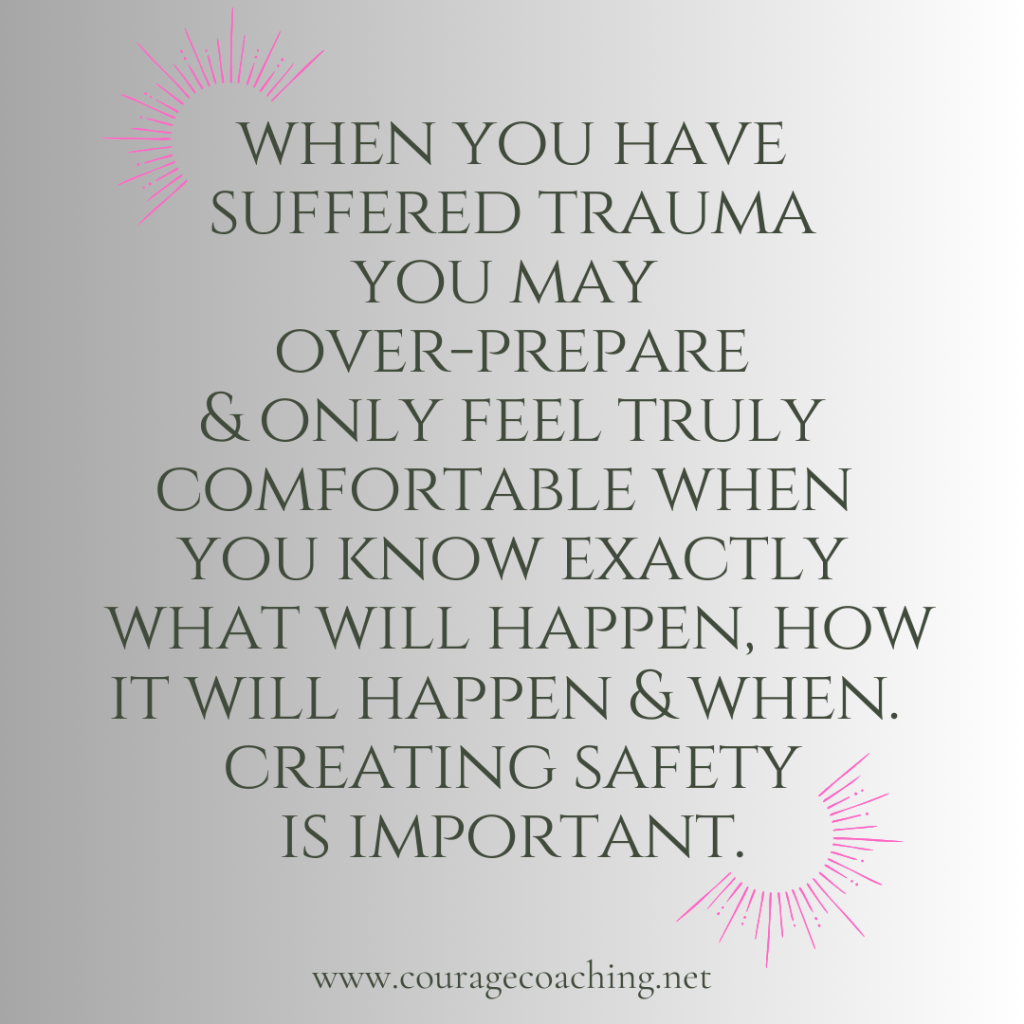
When you live with CPTSD, over-preparing and knowing the details of things in advance, can ease your anxiety and help you feel more comfortable.
Creating safety as much as possible, helps trauma survivors feel better.
Creating regular routines and predictable outcomes can also be very helpful.
It is of course impossible to control everything in your environment, but being prepared can very much help.
When things don’t go as planned, having a back-up plan can create a safety net. Having certain objects with you that provide comfort, can also be extremely helpful.
What is your experience with this? I would love to know in the comments below!
When we grow up with dysfunctional parents, we have no comparison to what is supposed to be healthy. We just know what we know and we take these experiences with us into adulthood. We are moulded by these experiences and we carry the trauma with us when we try to function in relationships with others.
There may have been instances when we were teenagers, where we spent time in our friends’ family homes and we caught a glimpse of what ‘healthy’ looked like. Maybe there was a level of calmness that we didn’t see in our own family. Maybe there was mutual respect, support and validation of our friends’ emotions. Maybe our friends’ parents asked us lots of questions and showed genuine interest in us when our own parents never did. Maybe we felt ‘safe’ in our friends’ family home. Maybe this helped us survive our own childhood or maybe we genuinely never had this experience and were completely alone in our suffering.
Whatever your experience, know that you are not alone anymore. There are so many resources online to help you put the pieces of the puzzle together and help you understand why you may struggle so much in your current relationships. It is not your fault you are struggling and repeating the same dysfunctional patterns of behaviour you witnessed growing up.
Change can only happen when you commit to figuring out what needs to shift and what steps you need to take to heal and recover from your dysfunctional upbringing.
Cognitive Bypassing is the practice of avoiding feelings by detouring into cognitive ideas or beliefs. It means that we tend to overthink in order to avoid uncomfortable emotions such as grief, fear or anger.
There is nothing wrong with using cognitive strategies as part of your emotional well-being. However, when every negative emotion must be analysed, changed or explained cognitively, this is counterproductive. Compulsively adding cognition to emotion means that you don’t ever allow your traumas to fully heal. The uncomfortable truth is that there is a component of painful emotions that simply must be felt, as hard as that may be to hear.
Healing trauma has more to do with embracing the feeling in the body than holding on to the thoughts of the mind. Somatic healing is crucial in recovery from trauma when you live with CPTSD. Allowing yourself to grieve the losses of your childhood is also a huge part of the healing process. Throwing CBT techniques at clients who suffer with trauma just isn’t enough!
Different therapies that enable us to somatically process trauma are very important in healing childhood trauma. Art therapy, dance therapy, drama therapy, play therapy as well as somatic healing, EMDR, sensorimotor therapy and accelerated experiential dynamic psychotherapy are all very important.
Most of us who have experienced trauma, find ways to constantly avoid our emotions by overthinking but also by comfort eating, doing drugs or drinking alcohol, being compulsive, dissociating and so much more.
How many of us actually just sit with our uncomfortable emotions and allow ourselves to self soothe, allow ourselves to have a good cry and share what we are actually feeling? Do we actually allow ourselves to feel our sadness or fear and just give it the space to be present without analysing it? This isn’t easy for many of us. As much as it isn’t easy, we have to find ways to make room for it and really feel whatever comes up.
In narcissistic relationships, the narcissist is an expert at shifting the blame onto others. For this reason alone, you shouldn’t apologise to a narcissist.
In most cases, you are usually not at fault. They’ve been shifting the blame onto you, and they want to make you believe that YOU are doing what THEY’RE doing.
By apologising to them for something you DIDN’T DO, you’re giving into their delusion, and giving them more power to falsely accuse you.
Weaponized incompetence is a form of passive-aggressive behavior where an individual deliberately performs tasks poorly or pretends to be incapable of completing certain tasks. This manipulation tactic is often used to avoid responsibility, forcing others to take over. It doesn’t always come from a bad place because it can stem from a lack of confidence or self-esteem. They may genuinely believe that they’re unable to perform a certain action or task.
When it comes to narcissists however, the intent is much more malicious. It is much more calculated and intentional.
Feel free to watch my YouTube video below to find out more about it.
For one to one coaching, please email me at courageisallyouneed@gmail.com
If you hate being the center of attention and constantly worry about what people are saying about you, then you may have what is known as the spotlight effect, a term coined by social psychologists.
The spotlight effect is a cognitive bias and it refers to the tendency to overestimate how much other people notice about us.
If you have social anxiety, then you most likely also struggle with the spotlight effect.
The spotlight effect can be detrimental to living your life fully, as it holds you back from allowing yourself to be ‘seen’ by others.
Watch the video to find out more and please feel free to share your experiences in the comments.
For one to one coaching, please feel free to email me at: courageisallyouneed@gmail.com