Women’s only support group – Daughters of narcissistic mothers

For those of you who didn’t manage to join my 1st support group for adult children of narcissistic mothers, I am also starting a 2nd online support group which is exclusively for daughters of narcissistic mothers.

If you struggle with symptoms of trauma, with feeling isolated on your healing journey and with feelings of shame or low self-worth, then this support group will help you!

Growing up with a narcissistic mother can leave deep wounds — confusion, guilt, low self-worth, and complex grief. This safe online support group is here for daughters recovering from narcissistic maternal abuse, offering understanding, validation, and tools for healing.

💜 What you’ll find here:

A safe, judgment-free space to share your story

Connection with others who truly “get it”

Support for breaking cycles of guilt, shame, and gaslighting

Gentle strategies for boundaries, self-care, and inner healing

There will be two 90min online video calls per month with a maximum of 8 people. This will be a closed support group which fosters a safe, confidential and deeper level of intimacy and trust among members. This means that the same people only will be a part of this group, without any new people joining.

Talking to others in support groups reduces anxiety, improves self-esteem, and helps members’ sense of well-being overall.

It will initially run for a total of 6 sessions, over a period of 3 months and we will then reassess how to move forward.

If you are interested in joining this online support group, please email me at courageisallyouneed@gmail.com or leave a comment below with your name and email.

I will be facilitating this online group and I very much look forward to welcoming you!

Love Athina

Grieving a parent who is still alive

When a parent is emotionally immature, abusive, or neglectful, it can be incredibly painful and confusing for the adult child. These patterns often make it difficult—sometimes even impossible—to maintain a healthy or meaningful relationship with that parent. The adult child may find themselves caught between loyalty and self-preservation, longing for love or validation while also needing to protect their emotional wellbeing.

Over time, repeated invalidation, manipulation, or emotional absence can erode trust, leaving the adult child to grieve the parent they never truly had—not because the parent is gone, but because the relationship cannot meet the basic needs of safety, respect, or mutual care.

Setting boundaries or choosing distance in these cases is not a sign of failure or selfishness—it’s often an act of deep inner strength, rooted in a desire to heal, grow, and break cycles of emotional harm.

If you relate to the above, then my newest video below might be just the right thing for you!

Love Athina
How do you tell a friend about your childhood trauma?

Talking about childhood trauma can feel overwhelming, especially when opening up to a friend for the first time. How do we explore sharing our story in a way that feels safe and empowering, while also setting boundaries and managing expectations? How do we prepare ourselves for possibly being let down and invalidated by the person we tell?

Talking about something so difficult will never come easy to us, because safety was compromised in our childhood. Sharing the full range of our emotions, wasn’t acceptable and we may have been punished or invalidated a lot. That is why this feels scary and trust doesn’t come easy to us.

The first step to consider, could be to assess our friendship so far with the person we want to tell. Test the waters, so to speak.

Do we feel safe in their presence and can we truly be ourselves with this person?

Does this person listen to us empathetically?

Will we feel relieved by telling a (safe) friend about our trauma?

What will we do if they don’t respond in a validating way? Have there been any instances in the past where they may have invalidated us?

These are all good questions we can ask ourselves.

A safe person or ‘friend’ is one that listens and validates our experience, by saying something like ‘I am sorry to hear you went through that’.

In the above video, I talk about this tricky topic in a little more detail, so please watch it or share it if you think it will help someone.

Love Athina

The difference between a toxic person and a narcissist

The word narcissist is unfortunately thrown around a little too much nowadays, so it’s important to explore the key differences between narcissistic individuals and toxic individuals.

All narcissists are toxic but not all toxic people are narcissistic. Just because someone has a toxic behaviour, it doesn’t mean that they have a personality disorder. Let’s not forget that someone who is a narcissist, has NPD, which means they meet the criteria as listed in the DSM. Also, seeing someone as toxic is a subjective experience. Something that you may consider toxic, someone else may not have a problem with.

Check out the latest video above for more detailed information.

Love Athina

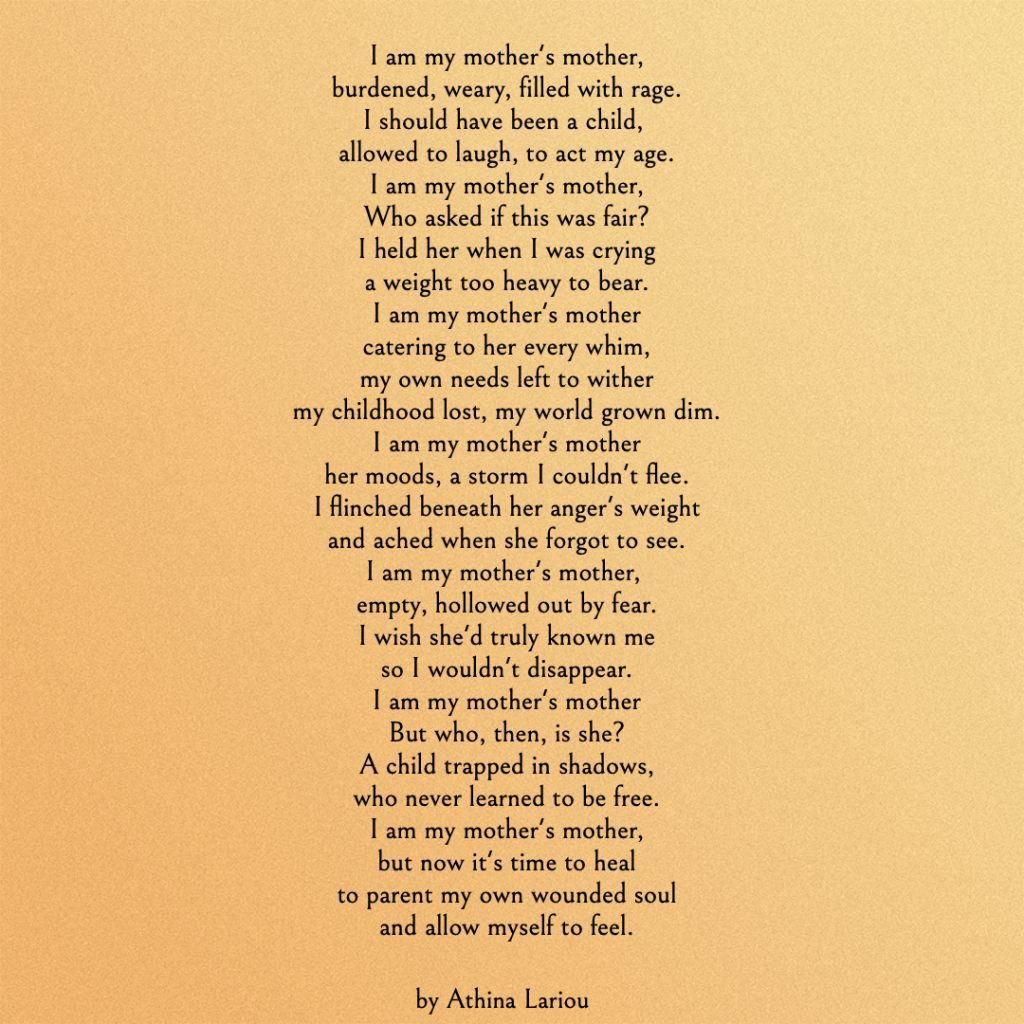
I am my mother’s mother

Have you ever felt like you were the parent instead of the child? Growing up as a parentified daughter means carrying emotional burdens too heavy for a child to bear. In this video, we explore the experience of daughters who had to step into a parental role—providing comfort, stability, and care at the expense of their own childhood.

This video is inspired by my own experience of being a parentified daughter and I share a deeply personal poem I wrote in my early twenties when I was struggling with my mother.

The poem in the video is written below:

***Please only re-use this poem by giving credit and asking for permission.***

Do you self-silence?

Self-silencing is much more common that people think.

Feeling too afraid to express your true thoughts, desires, and emotions often stems from childhood experiences in environments where self-expression didn’t feel safe. This behavior is frequently shaped by generational patterns passed down unconsciously, where parents, influenced by their own upbringing and unresolved trauma, lacked the tools to create a space for open and secure communication.

If you recognize that you have a tendency to self-silence, it’s essential to take proactive steps toward building healthier habits and learning to express yourself more openly and authentically.

Watch my video below, to gain more clarity on self-silencing.

Love Athina

Creating safety – Living with CPTSD

When you grew up in a home with dysfunction, chaos and unpredictable emotional outbursts, your mind and body is constantly thrown into a state of emotional dysregulation. Home didn’t feel safe, so you also didn’t feel safe. When unpredictable and unfair demands were placed on you as a child, this will have caused long term problems with hyper vigilance, low self-worth, shame, anxiety and depression. CPTSD will be the end result of growing up with emotionally immature and/or toxic parents.

As an adult, you will struggle with certain very basic every day things. Normal changes that are very much a part of life, may feel huge for someone with CPTSD. A sudden change in plans, a packed train, an illness or a delayed flight can all create immense anxiety in someone with a history of trauma.

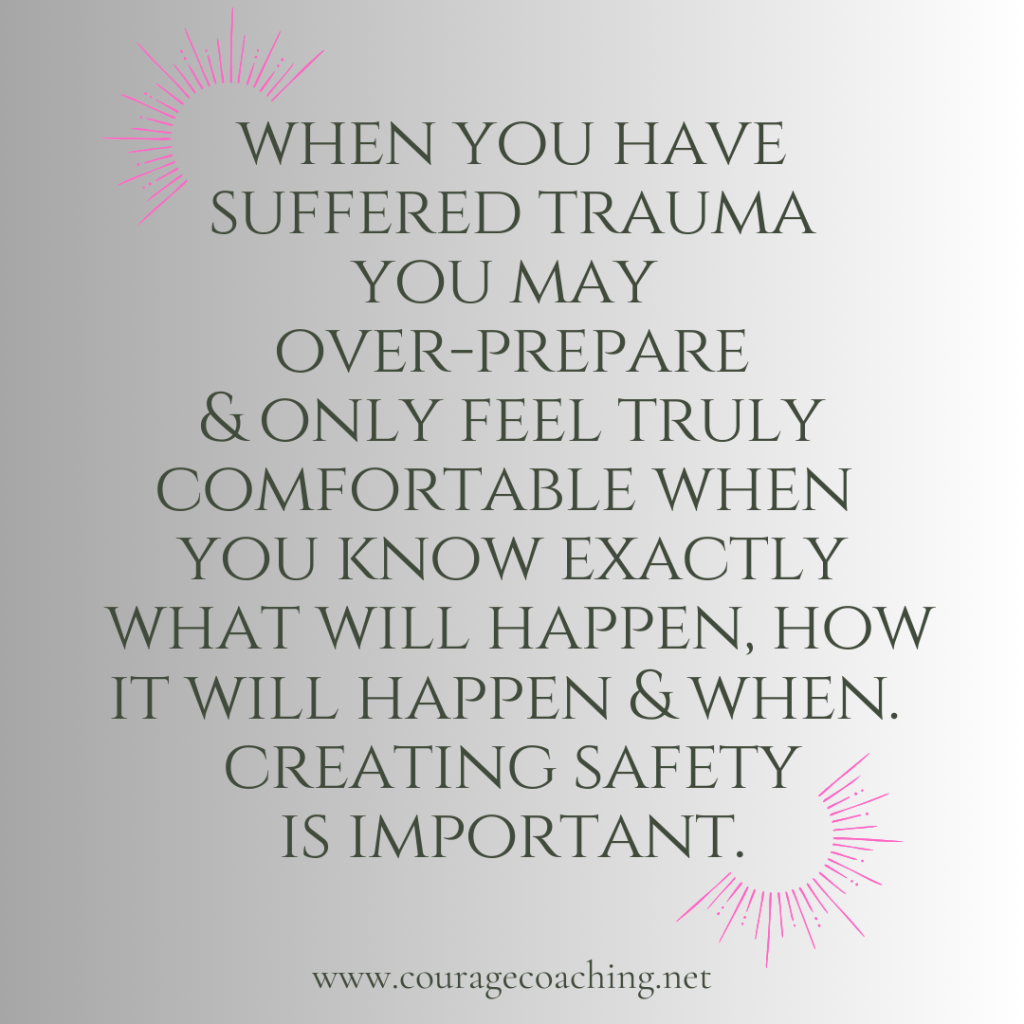
When you live with CPTSD, over-preparing and knowing the details of things in advance, can ease your anxiety and help you feel more comfortable.

Creating safety as much as possible, helps trauma survivors feel better.

Creating regular routines and predictable outcomes can also be very helpful. 

It is of course impossible to control everything in your environment, but being prepared can very much help.

When things don’t go as planned, having a back-up plan can create a safety net. Having certain objects with you that provide comfort, can also be extremely helpful.

What is your experience with this? I would love to know in the comments below!

Love Athina

The grief of not having a healthy family

When we grow up with dysfunctional parents, we have no comparison to what is supposed to be healthy. We just know what we know and we take these experiences with us into adulthood. We are moulded by these experiences and we carry the trauma with us when we try to function in relationships with others.

There may have been instances when we were teenagers, where we spent time in our friends’ family homes and we caught a glimpse of what ‘healthy’ looked like. Maybe there was a level of calmness that we didn’t see in our own family. Maybe there was mutual respect, support and validation of our friends’ emotions. Maybe our friends’ parents asked us lots of questions and showed genuine interest in us when our own parents never did. Maybe we felt ‘safe’ in our friends’ family home. Maybe this helped us survive our own childhood or maybe we genuinely never had this experience and were completely alone in our suffering.

Whatever your experience, know that you are not alone anymore. There are so many resources online to help you put the pieces of the puzzle together and help you understand why you may struggle so much in your current relationships. It is not your fault you are struggling and repeating the same dysfunctional patterns of behaviour you witnessed growing up.

Change can only happen when you commit to figuring out what needs to shift and what steps you need to take to heal and recover from your dysfunctional upbringing.

The video below, may help with this journey!

Much love, Athina

Cognitive Bypassing & trauma

Cognitive Bypassing is the practice of avoiding feelings by detouring into cognitive ideas or beliefs. It means that we tend to overthink in order to avoid uncomfortable emotions such as grief, fear or anger.

There is nothing wrong with using cognitive strategies as part of your emotional well-being. However, when every negative emotion must be analysed, changed or explained cognitively, this is counterproductive. Compulsively adding cognition to emotion means that you don’t ever allow your traumas to fully heal. The uncomfortable truth is that there is a component of painful emotions that simply must be felt, as hard as that may be to hear.

Healing trauma has more to do with embracing the feeling in the body than holding on to the thoughts of the mind. Somatic healing is crucial in recovery from trauma when you live with CPTSD. Allowing yourself to grieve the losses of your childhood is also a huge part of the healing process. Throwing CBT techniques at clients who suffer with trauma just isn’t enough!

Different therapies that enable us to somatically process trauma are very important in healing childhood trauma. Art therapy, dance therapy, drama therapy, play therapy as well as somatic healing, EMDR, sensorimotor therapy and accelerated experiential dynamic psychotherapy are all very important.

Most of us who have experienced trauma, find ways to constantly avoid our emotions by overthinking but also by comfort eating, doing drugs or drinking alcohol, being compulsive, dissociating and so much more.

How many of us actually just sit with our uncomfortable emotions and allow ourselves to self soothe, allow ourselves to have a good cry and share what we are actually feeling? Do we actually allow ourselves to feel our sadness or fear and just give it the space to be present without analysing it? This isn’t easy for many of us. As much as it isn’t easy, we have to find ways to make room for it and really feel whatever comes up.

Why you mustn’t apologise to a narcissist

In narcissistic relationships, the narcissist is an expert at shifting the blame onto others. For this reason alone, you shouldn’t apologise to a narcissist.

In most cases, you are usually not at fault. They’ve been shifting the blame onto you, and they want to make you believe that YOU are doing what THEY’RE doing.

By apologising to them for something you DIDN’T DO, you’re giving into their delusion, and giving them more power to falsely accuse you.

Watch the video to find out more.

Love Athina