Narcissistic mother & son enmeshment is real and is something that affects many adult sons of narcissistic mothers.
If you feel that your mother is overly controlling towards you, doesn’t allow you to form relationships & is envious of your partner, then you must watch this video to educate yourself on this destructive dynamic.
If you have any questions at all or need support talking about your experience with a mother like this, then please get in touch by emailing me at courageisallyouneed@gmail.com
Passive aggressiveness is very common in dysfunctional relationships and families where covert narcissists are in control. This is my most recent video.
Have you experienced passive aggressive behaviour?
Boundaries protect us. Boundaries tell others what we are not comfortable with and what we don’t want. Boundaries remind others to respect us. What happens when you are dealing with a narcissist? Do they understand boundaries?
Narcissists are notorious for wanting to always be in control of every situation, especially in close relationships. Sadly, this is happening more often than not, especially behind closed doors.
Many viewers have resonated with the content of this video sadly.
If you resonate with the content too, please feel free to leave a comment and share your experience.
I hope you have all survived the holiday period and are feeling optimistic about this year. I am very much hoping we will see the end of the Covid pandemic this year and our lives can return to a semi-normal state. I also hope that our mental health will improve and that we will find ways to feel more in tune with ourselves, our needs, our bodies and our minds.
Mental health has been affected so much over the last couple of years due to the pandemic but it has been even tougher for those of us who have had numerous other struggles due to a traumatic past, toxic family members, grief, financial insecurity and other physical health issues.
For those of us specifically, who struggle with anxiety and CPTSD, we know all too well how tricky it is to keep our emotions regulated when we are triggered or scared.
Personally, as a lot of you may already know, I have always struggled with anxiety and low mood. Over the last couple of years however, I have been able to manage my symptoms much more successfully. This has made it easier for me to support others through my coaching and Youtube channel and to also continue to work on my own personal development through more training. Yoga has become a big part of my life, as is walking my dog and trying to keep active. Deep breathing and mindfulness has also helped immensely but the one thing I still struggled with until recently, was getting myself to an immediate state of calm when in the grips of anxiety.
The worst of my anxiety is usually when I travel by plane or when I have to do something that puts me in the spotlight. I also get extremely anxious when I think about losing someone I am attached to. Just before Christmas, I decided to try something completely different and was gifted something that eases anxiety. Although I was rather skeptical at first, after reading so many good reviews about it, I decided to give it a go.
This device is called CalmiGO.
@mycalmigo
CalmiGO is scientifically proven and uses 3 methods to lower anxiety levels:
-Relaxing scent
-Multi-sensory stimulation or grounding
-Breathing regulation (exhalation prolongation)
These 3 methods combined, activate the parasympathetic nervous system and lower stress level hormones.
CalmiGO is drug free and safe to use and if you would like to find out more about it, then feel free to click on this link:
My experience with using CalmiGO so far has been absolutely brilliant.
After trying this device for 3 minutes as recommended, I immediately noticed a reduction in my anxiety levels.
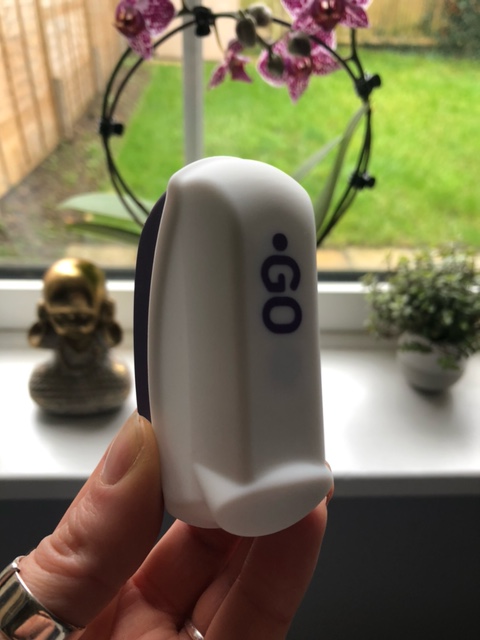
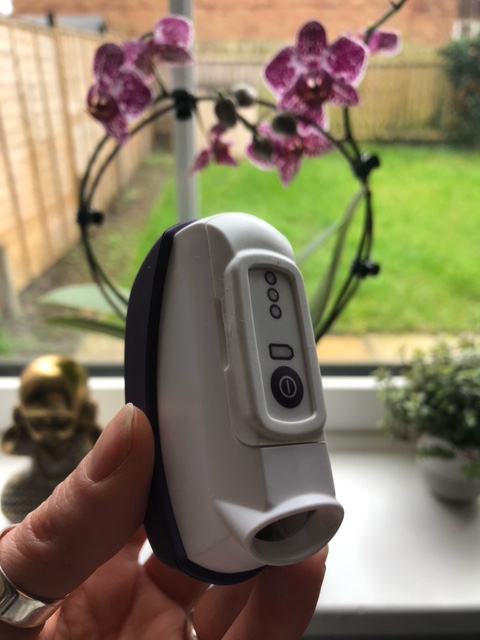
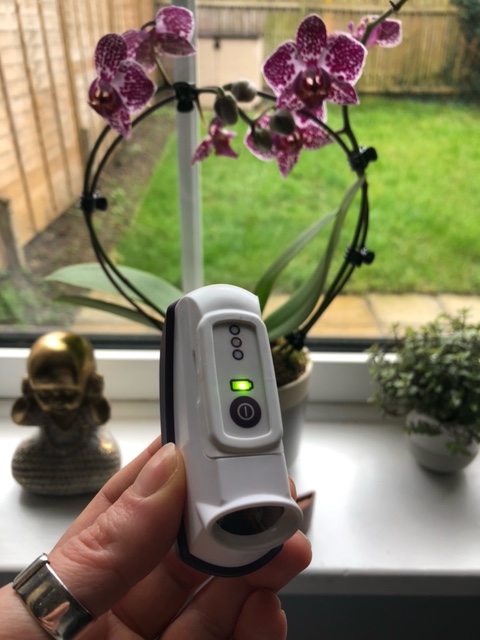
The most important part of the device for me is that it encourages you to prolong your exhalation. This is scientifically proven to decrease those awful symptoms of anxiety such as dizziness, accelerated heart rate, nausea and chest pain. When we are anxious, we end up breathing much too fast which results in a decrease of PCO2 levels. CalmiGO reverses this with exhalation prolongation. Since prolonging my exhalation was always the trickiest part for me, CalmiGO has been incredibly helpful in getting me to do this successfully. It vibrates and lights up whenever you reach a long enough exhalation, so this helps immensely when you are doing this for 3 minutes or more. Take a look at the photos below for an idea of what CalmiGO looks like and how to use it.
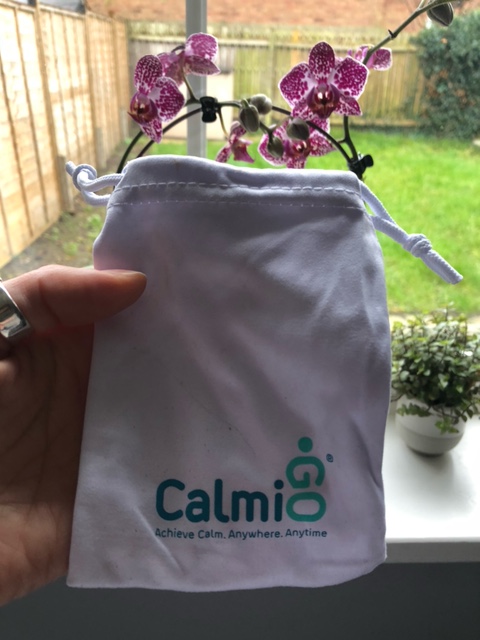
When I ordered CalmiGO, it arrived wonderfully packaged and came with a very detailed guide on how to use it effectively. It came with a little rubber cover and also an easy to use pouch to carry it in. There was also a pack of AAA batteries, a small screwdriver and a pack of 2 scented element attachments. One of these scented element attachments is placed on the front of the device near the ‘on and off’ switch. My preferred choice was lavender but you can also choose peppermint or bergamot if you prefer.
Although there is a detailed guide on how to use it effectively, there is also a tutorial video which you can watch here:
Since I have found CalmiGO so incredibly useful in my personal life, I decided to collaborate with the founders of CalmiGO and I am offering a $30 discount on every purchase made through their website.
By adding the code COURAGE as a voucher when you add CalmiGO to your shopping cart, you get the above discount on the total price. Go to the link below to gets yours 🙂
CalmiGO really is an investment in a life with less anxiety.
For those of you who live with CPTSD or PTSD, CalmiGO will help ground you and if used every day for a month during a time where you are really struggling with panic and anxiety, you will see a huge decrease in your symptoms.
If you have any questions or would like to share your experience using CalmiGO, then please feel free to leave a comment below.
I wanted to share the great news that Complex Post Traumatic Stress Disorder is recognised by the World Health Organization’s (WHO) eleventh revision of the International Statistical Classification of Diseases and Related Health Problems (ICD-11).
As someone who has openly spoken about living with the symptoms of CPTSD, it feels extremely validating to know that it is actually recognised formally. I wasn’t aware of this until very recently so for those of you who already knew this, please forgive my delayed discovery. For those of you who live with CPTSD and are aware of this, I hope this news finds you well.
In my personal opinion, a diagnosis of CPTSD could easily replace many other diagnoses. CPTSD is the result of child abuse, neglect and any other prolonged and repeated traumatic experiences.
Symptoms of anxiety and depression are in most cases part of having CPTSD, as well as the following (in the context of childhood trauma & abuse).
”Attachment – problems with relationship boundaries, lack of trust, social isolation, difficulty perceiving and responding to others’ emotional states”
”Biology – sensory-motor developmental dysfunction, sensory-integration difficulties, somatization, and increased medical problems”
”Affect or emotional regulation – poor affect regulation, difficulty identifying and expressing emotions and internal states, and difficulties communicating needs, wants, and wishes”
”Dissociation – amnesia, depersonalization, discrete states of consciousness with discrete memories, affect, and functioning, and impaired memory for state-based events
”Behavioural control – “problems with impulse control, aggression, pathological self-soothing, and sleep problems”
”Cognition – difficulty regulating attention; problems with a variety of ‘executive functions’ such as planning, judgement, initiation, use of materials, and self-monitoring; difficulty processing new information; difficulty focusing and completing tasks; poor object constancy; problems with ’cause-effect’ thinking; and language developmental problems such as a gap between receptive and expressive communication abilities.”
”Self-concept – fragmented and disconnected autobiographical narrative, disturbed body image, low self-esteem, excessive shame, and negative internal working models of self”.
Formal recognition and diagnosis will greatly help CPTSD sufferers with more appropriate treatment options:
Some current treatments are:
biofeedback
dyadic resourcing (used with EMDR)
emotionally focused therapy
emotional freedom technique (EFT) or tapping
Equine-assisted therapy
expressive arts therapy
internal family systems therapy
dialectical behavior therapy(DBT)
family systems therapy
group therapy
neurofeedback
psychodynamic therapy
sensorimotor psychotherapy
somatic experiencing
yoga, specifically trauma-sensitive yoga
It is also worth mentioning that CPTSD has also been referred to as DESNOS (Disorders of Extreme Stress Not Otherwise Specified).
DTD (Developmental trauma disorder) is also proposed as the alternative equivalent to childhood CPTSD.
”Dr. Judith Lewis Herman, in her book, Trauma and Recovery, proposed that a complex trauma recovery model that occurs in three stages:
establishing safety,
remembrance and mourning for what was lost,
reconnecting with community and more broadly, society.”
If you live with CPTSD and have had experience with any of the above treatment options, I would love to hear what you found helpful.
Thanks for reading
This blog post includes direct text from Wikipedia:



 couragecoaching.net