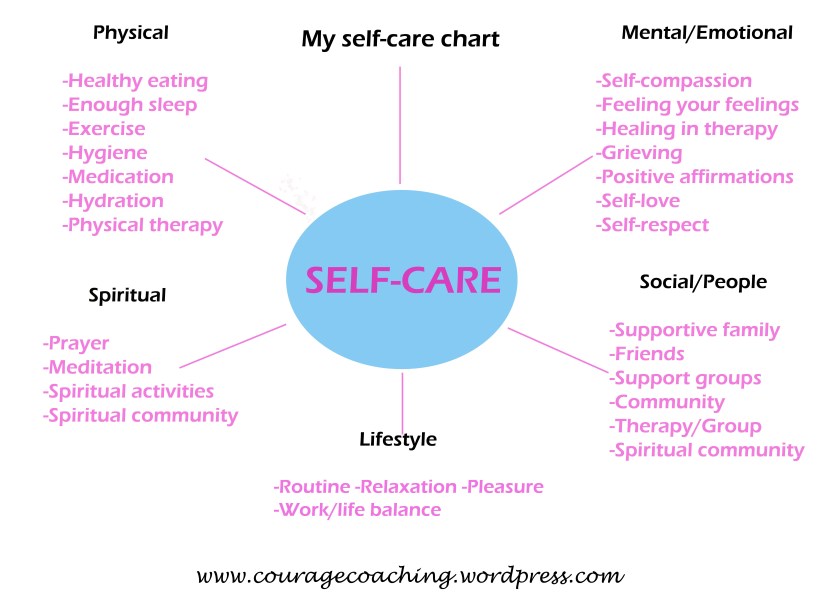
Self-care chart

my self-care chart - courage coaching

When you are struggling from a mental illness, self-care can sometimes take a back seat.

You forget or are unable to eat properly. You have trouble sleeping which then results in not having the motivation and energy to do much at all. You can become more isolated when trying to cope and can even forget to ask for support.

This little chart above gives you a little insight into the important things to consider.

The 2 most important areas in my opinion are physical and mental self-care but a balance amongst all 5 of these areas is crucial, as they are interlinked.

If you feel that there are any areas of self-care that you are particularly struggling with, then please let me know in the comments below. I would be happy to help you come up with an easy action plan, that might enable you to move forward.

Love Athina ♥

Surround yourself with supportive people

When you suffer from a mental illness it is very difficult to feel hopeful when you are really struggling.Every day can be a battle and those negative thoughts can be very hard to silence. Sometimes feelings can overcome you at the most inappropriate times and others may think you are overreacting or being a drama queen. Paying close attention to the people in your life can determine how much your overall mood is affected. If you are an empath or highly sensitive person, you suck in other peoples’ emotions like a sponge. For this reason, you need to have the right kind of people around you or limit your time with those who aren’t enriching to your life.

Think about how the people in your life make you feel 80% of the time? Are they supportive & uplifting? Are they encouraging and empathetic? Do they understand your struggles and offer to help?

This is very important when you have a low tolerance for stressful situations due to a history of toxic child abuse. When complex trauma is part of your life, you need to feed your brain with the things you were starved of as a child. You should provide yourself with unconditional love, acceptance, validation and comfort. It is also important to have friends and family that can also provide these things for you.  It might feel unnatural at first and almost feel silly to tell yourself that you are worthy and lovable every day, however this is what your brain needs. It needs a new healthy habit!

Recent studies have shown that victims of childhood abuse and combat veterans actually experience physical changes to the hippocampus, a part of the brain involved in learning and memory, as well as in the handling of stress. The hippocampus also works closely with the medial prefrontal cortex, an area of the brain that regulates our emotional response to fear and stress. PTSD sufferers often have impairments in one or both of these brain regions. Studies of children have found that these impairments can lead to problems with learning and academic achievement.

We know that psychotherapy can really help survivors of severe trauma and also we know that EMDR is very helpful for reducing nightmares, flashbacks & overwhelming emotions.What you do for yourself however is equally important as you are the person that feels, thinks and reacts to your surroundings 24/7! It has been proven that with a mixture of validating affirmations, manageable goal setting, therapy and loving relationships, people can improve the quality of their life dramatically, especially in regards to their overall outlook.

FontCandy (29).png

Unhelpful thinking styles/Cognitive distortions

This link below gives you a useful list of all the unhelpful thinking styles that we might use in our daily lives.For those of you who suffer from depression or anxiety, keeping an eye on your thinking style is really important. Try and challenge those negative thoughts by replacing them with more positive or helpful alternative thoughts. With practice, this should help you feel better.

http://media.psychology.tools/worksheets/english_us/unhelpful_thinking_styles_en-us.pdf

Love Athina ♥

Anxiety-The thing we all hate but must embrace!

anxiety-1157437_1920

Have you watched the film The Babadook? It is an incredibly powerful horror film that has a very strong psychological message. ****If you haven’t seen it then this might be a spoiler *****

The important thing I want to state before including a quoted review of the film is that although mental illness and specifically an anxiety disorder cannot be completely cured, we can choose to live with it rather than fight it. The more you fight something that scares you, the bigger the fear becomes. This is something that happens with anxiety. If you are experiencing anxiety and you tell yourself ‘don’t be anxious’ this usually results in your anxiety getting worse..It’s a bit like telling yourself to not think of a donut.The more you tell yourself to not think about a donut, the more you actually think about the donut! It doesn’t work! This is why with mental illness and in this case with anxiety, it makes much more sense to accept it and even say something like ‘Hello anxiety, I see you are back again.I am not scared of you anymore and I know you will eventually subside. I can manage you by taking a few deep breaths and changing my thoughts to more helpful ones”.

You may adjust this slightly to however you prefer or in whatever way makes it helpful to you. Of course mental illness is debilitating at its worst but with a few coping techniques it becomes manageable.

The film introduces us to mother and son, Amelia and Samuel, who are terrorised by a monster called the Babadook. The Babadook monster is introduced through a book called Mister Babadook and a very important line in this book is ” You can’t get rid of the Babadook”. The Babadook figure appears over and over in the film and it’s presence gets stronger and stronger, as Amelia and Samuel get more fearful of it.

”Whilst it occasionally threatens to overwhelm her (Amelia), as evidenced in the scene where she takes it food, her acknowledgment and understanding of it is what gives her the power to control it.The Babadook hasn’t gone away, and it hasn’t been defeated. Much like a chronic mental illness, it is not something that can be “cured”, and so the most important weapon against it is knowledge and acceptance. For Amelia, the realisation of how she is hurting her son is the moment where she finds the strength to separate herself from the Babadook”.

Sourced from this review:

http://the-artifice.com/the-babadook-mental-illness/