Pet loss grief & CPTSD

On the 21st of August, I sadly had to euthanise my beloved 8 year old dachshund. It all happened within 24 hours and it came out of nowhere. She collapsed after vomiting and we rushed her to the emergency vet hospital. They stabilised her over night, they did an x-ray and ultrasound and the only thing they could see initially was a little liquid in her ovaries which means she may have had the early signs of an infection.

The next morning, they called us and told us she was doing better and even managed a tiny walk. They said they would do a routine spaying operation just to be on the safe side and then she would be home with us in the evening.

A few hours later, after waiting in suspense to hear back from the vet, we got a phone call to say that they needed permission to take more blood, as she was showing unfavourable neurological issues. Unfortunately, the blood test showed high inflammation in her little body, severe anemia and essentially her body was shutting down. Her blood was no longer clotting so they couldn’t operate anymore. She had also had an aneurysm and we were told that the kindest thing we could do was euthanise her. The vet suspected that her body was shutting down due to a tick borne disease which is hard to spot and progresses rapidly. Even though she had been on anti-tick medication, the vet said it is not reliable in preventing disease.

This was an incredible shock, especially after we thought she was coming home to us. Our gorgeous little Daola, was the light of our life, our best friend and our emotional support. For 8 wonderful years, she filled our life with such joy, comfort and unconditional love.
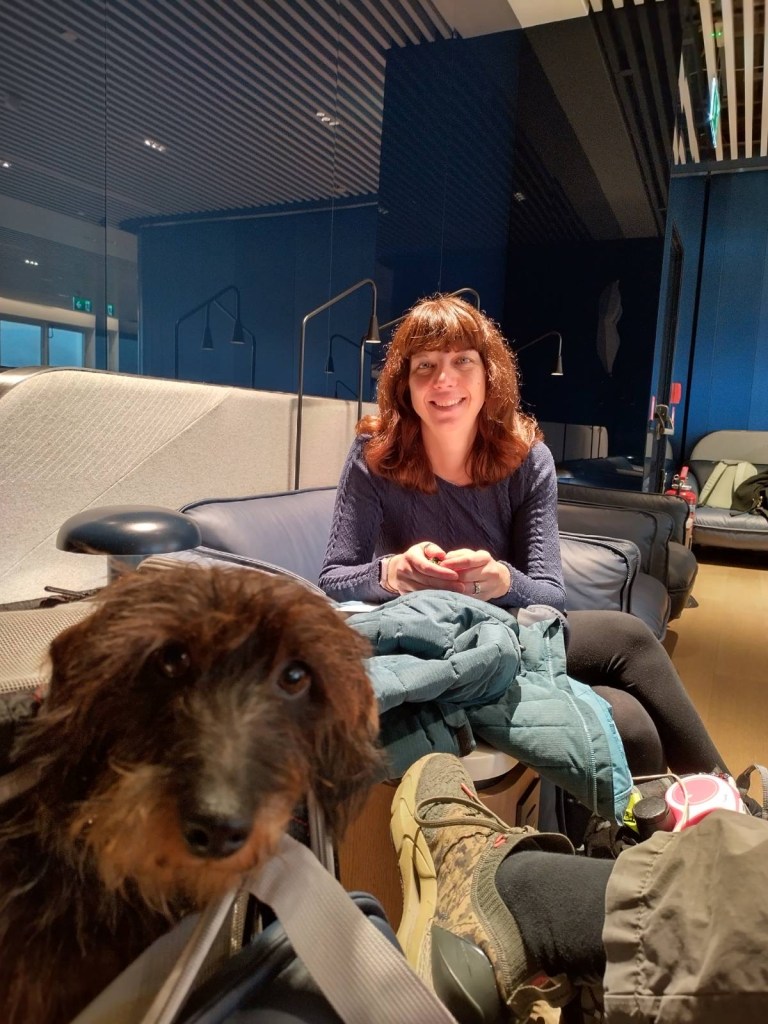
Losing a pet when you also live with CPTSD, is incredibly hard, especially because you already struggle so much with regulating your emotions, self-soothing and hyper vigilance. As someone who lives with this myself, I have had a solid couple of weeks of increased anxiety alongside my grief for my little girl.

It is important to understand that an unexpected death, whether this is a pet or a person, is very hard to navigate. The circumstances may even be traumatic, so when you already live with trauma, your body and mind need time to adjust.

The loss is profound, so the sadness and despair you may feel is completely normal under the circumstances. The stronger the bond and attachment you had to your pet, the stronger the grief and the longer it may take for the intensity of those feelings to subside.

It has been nearly 3 weeks since I lost my gorgeous dog and the grief is still intense. Life feels dull and being at home feels very empty. I am allowing myself to cry and think of her and I am resting as much as possible where I can. Grief can be exhausting, so it is important to practice good self-care.

Many emotions have been present through my grief journey such as guilt, anger, despair and many ‘What if’s’. What if I had gone to the vet earlier? What if I had noticed the signs sooner? All emotions are valid. We try to make sense of the shock and instead of feeling helpless, we try to fill our minds with thoughts that distract us from feeling the pain. This doesn’t work however. Our pet is gone and there is nothing we can do to bring them back. We must grieve that loss and the deep love we felt. The only way to grieve in a healthy way, is through acceptance that they are gone.
‘Meet your authentic self’- 4 week online art therapy group

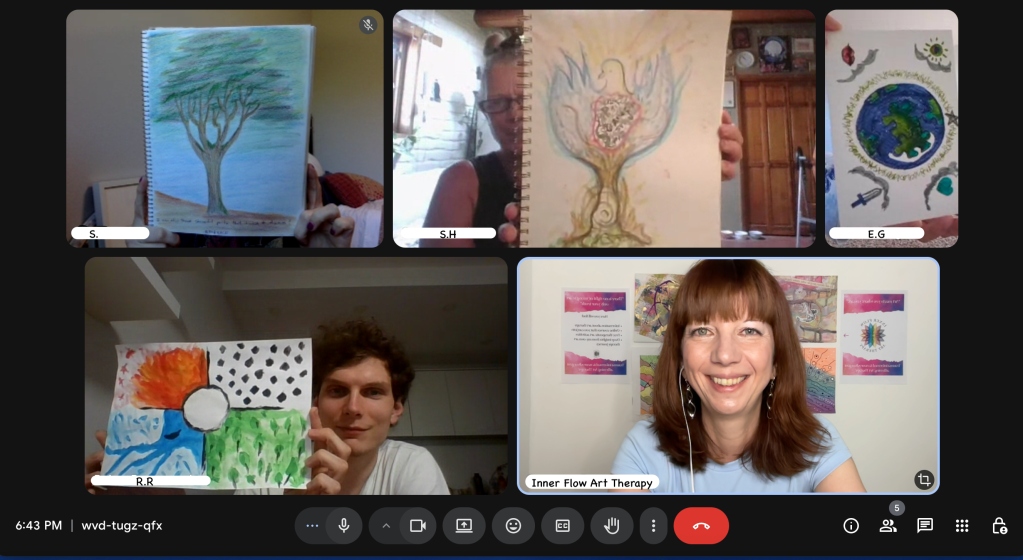
A group of courageous souls came together in my first online art therapy group ‘Meet your authentic self’ — exploring creativity, connection, and self-discovery through the gentle power of art therapy.

They created and reflected in ways that helped them peel back the layers of “shoulds” and “expectations,” making space for the truest parts of themselves to shine. They pushed through any uncertainty they were feeling and bravely shared their honest emotions and how they viewed themselves throughout this therapeutic experience and in general.

Group art therapy offers significant benefits, including improved mental health outcomes, enhanced social connections, and increased self-esteem. It provides a safe space for individuals to explore emotions, develop coping mechanisms, and build a sense of community. 

Benefits of Group Art Therapy:

  • Emotional Expression and Processing: Art therapy provides a non-verbal outlet for expressing and processing emotions, which can be particularly helpful for individuals who struggle with verbal communication or have experienced trauma. 
  • Social Connection and Support: Group settings foster a sense of community and belonging, reducing feelings of isolation and providing a supportive network for emotional healing. 
  • Increased Self-Esteem and Self-Awareness: Creative activities can lead to self-discovery, enhancing self-esteem and promoting a more positive self-image. 
  • Reduced Anxiety and Stress: Engaging in art therapy can be calming and relaxing, helping to reduce anxiety and stress levels. 
  • Development of Coping Mechanisms: Art therapy techniques can help individuals develop healthier coping mechanisms for managing difficult emotions and situations. 
  • Improved Communication and Interpersonal Skills: Collaborative art projects and group interactions can enhance communication and build stronger relationships among participants. 
  • Enhanced Creativity and Self-Expression: Art therapy encourages individuals to explore their creative potential and express themselves in new and meaningful ways. 

I’m so grateful for each participant’s openness and presence. Thank you for trusting me on this journey! Here’s to carrying these insights forward — and to continuing to meet yourselves with curiosity, compassion, and courage.

If you are interested in joining future online art therapy groups, or one to one art therapy sessions at a discounted price, please leave a comment below!

I will be announcing new dates for online art therapy groups starting in October 2025. If you would like to explore the benefits of one to one art therapy sessions, then I am offering these immediately at only 48euros per session.

You can of course join me from anywhere in the world and I am happy to accommodate your time zone as much as this is possible. I am currently in the CEST time zone.

Love Athina

How do you tell a friend about your childhood trauma?

Talking about childhood trauma can feel overwhelming, especially when opening up to a friend for the first time. How do we explore sharing our story in a way that feels safe and empowering, while also setting boundaries and managing expectations? How do we prepare ourselves for possibly being let down and invalidated by the person we tell?

Talking about something so difficult will never come easy to us, because safety was compromised in our childhood. Sharing the full range of our emotions, wasn’t acceptable and we may have been punished or invalidated a lot. That is why this feels scary and trust doesn’t come easy to us.

The first step to consider, could be to assess our friendship so far with the person we want to tell. Test the waters, so to speak.

Do we feel safe in their presence and can we truly be ourselves with this person?

Does this person listen to us empathetically?

Will we feel relieved by telling a (safe) friend about our trauma?

What will we do if they don’t respond in a validating way? Have there been any instances in the past where they may have invalidated us?

These are all good questions we can ask ourselves.

A safe person or ‘friend’ is one that listens and validates our experience, by saying something like ‘I am sorry to hear you went through that’.

In the above video, I talk about this tricky topic in a little more detail, so please watch it or share it if you think it will help someone.

Love Athina

Do you self-silence?

Self-silencing is much more common that people think.

Feeling too afraid to express your true thoughts, desires, and emotions often stems from childhood experiences in environments where self-expression didn’t feel safe. This behavior is frequently shaped by generational patterns passed down unconsciously, where parents, influenced by their own upbringing and unresolved trauma, lacked the tools to create a space for open and secure communication.

If you recognize that you have a tendency to self-silence, it’s essential to take proactive steps toward building healthier habits and learning to express yourself more openly and authentically.

Watch my video below, to gain more clarity on self-silencing.

Love Athina

Creating safety – Living with CPTSD

When you grew up in a home with dysfunction, chaos and unpredictable emotional outbursts, your mind and body is constantly thrown into a state of emotional dysregulation. Home didn’t feel safe, so you also didn’t feel safe. When unpredictable and unfair demands were placed on you as a child, this will have caused long term problems with hyper vigilance, low self-worth, shame, anxiety and depression. CPTSD will be the end result of growing up with emotionally immature and/or toxic parents.

As an adult, you will struggle with certain very basic every day things. Normal changes that are very much a part of life, may feel huge for someone with CPTSD. A sudden change in plans, a packed train, an illness or a delayed flight can all create immense anxiety in someone with a history of trauma.

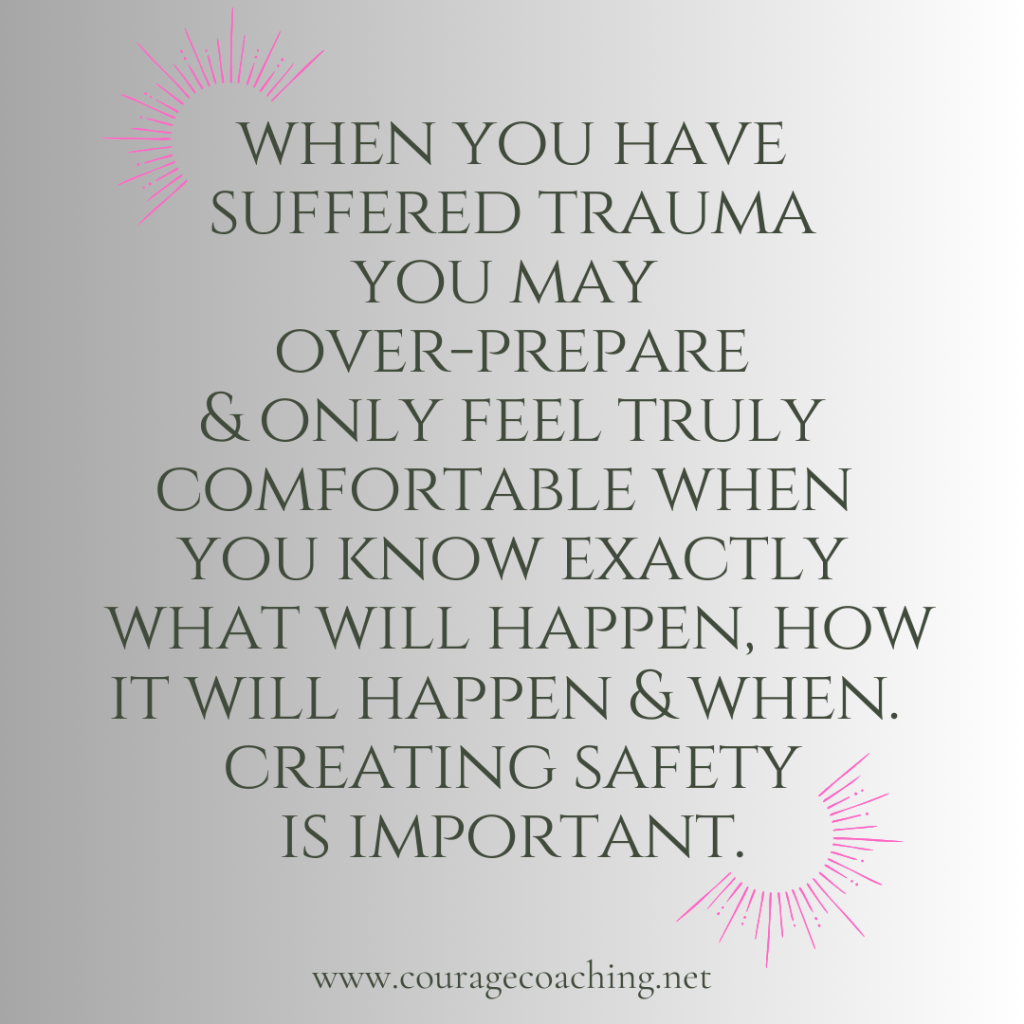
When you live with CPTSD, over-preparing and knowing the details of things in advance, can ease your anxiety and help you feel more comfortable.

Creating safety as much as possible, helps trauma survivors feel better.

Creating regular routines and predictable outcomes can also be very helpful. 

It is of course impossible to control everything in your environment, but being prepared can very much help.

When things don’t go as planned, having a back-up plan can create a safety net. Having certain objects with you that provide comfort, can also be extremely helpful.

What is your experience with this? I would love to know in the comments below!

Love Athina

Self Sabotage-A result of childhood narcissistic abuse

Self-sabotage isn’t something we are necessarily aware of yet it can create havoc in our lives and it can stop us from reaching our full potential.

When we have grown up in an environment where there was constant chaos and drama and where our parents shamed us and criticised the majority of the time, it will feel more familiar to us to continue this dynamic in adulthood. We may lead equally chaotic lives with dysfunctional relationships and poor choices.

If we were constantly given the message that we weren’t smart enough, strong enough, attractive enough and in more general terms good enough, then this becomes our internalised voice and it pops up every time we try and take a step forward in our careers, relationships and day to day life.

Even if this internalised voice is negative and not true, it has been our mind’s companion for as far back as we remember. We took on this identity and it is harder to change it when it is all we have known.

If you can relate to this topic, then please watch the video to find out more.

I offer one to one coaching to those of you who struggle with this, so please feel free to get in touch by emailing me at: courageisallyouneed@gmail.com

Love Athina

Echoism – A result of narcissistic abuse

Have you heard of echoism? Echoism isn’t commonly talked about but is very real and a lot of individuals who have suffered narcissistic abuse in childhood actually live with it.

Echoism is very common with individuals who live with Avoidant Personality Disorder or who have many avoidant traits. Echoists find it extremely uncomfortable being the centre of attention.

Watch the video to find out more.

Love Athina

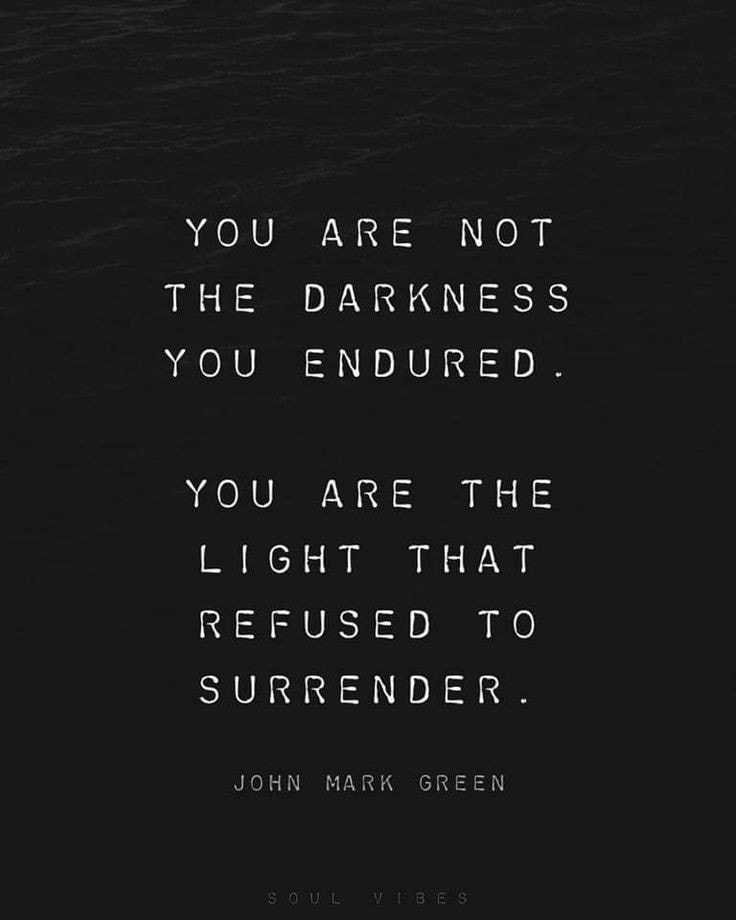
You are the light that refused to surrender

‘You are the light that refused to surrender’ is a wonderful way to look at your healing journey after experiencing trauma.

If you, like me, have a history of trauma, you will be very familiar with the ups and downs of living with CPTSD. For me personally, having hope in my lowest moments, was the 1 thing that kept me going when things truly felt hopeless. 

Having hope means that you allow yourself to believe that the day WILL come where you WILL feel better, where things will feel less scary, less isolating and less depressing.

It’s important to never stop hoping when things get tough and to allow yourself to embrace that feeling wholeheartedly. 

Practicing gratitude is also extremely important for improving mental health. Be grateful for any tiny steps of progress you make, even if you managed to do 1 additional thing today that you didn’t manage to do the day before.

Living with mental illness is never easy but it can be manageable. Living with mental illness means that you might have to constantly make adjustments to the way you live your life, in order to feel better. These adjustments may look like the following: Changing your diet, adding more exercise to your daily routine, cutting out sugar, moving to the countryside, ending a relationship, leaving a stressful job, practicing meditation, seeking out support from a specialised therapist, going on a retreat, taking supplements and/or using medication. Each journey with mental illness is unique so what might work for one person may not necessarily work for another. Try things out, see what works and go from there.

Darkness may have been a big part of your past and may still creep up on you in the present. This is realistic as life can be tough even when you don’t live with a mental illness.The only way through this darkness however is to find the light. The light could be anything: a therapist, a close friend, a partner, a beloved pet, being in nature, a safe space, art, music or anything else that brings you comfort.

Most importantly however, you must try and find the light within yourself, within your heart and soul. 

In those moments of relentless anxiety, depression or emotional flashbacks, love yourself unconditionally.  Take yourself by the hand, like you would a small child and tell yourself  ‘ I’ve got you, you are not alone’… ‘ I am there for you, unconditionally’.

If you are having a tough day, then I hope this post helps a little.

Keep going..keep living..you’ve got this!

Love Athina x

Happy New Year! This is how I have greatly reduced my anxiety levels.

Dear readers,

I hope you have all survived the holiday period and are feeling optimistic about this year. I am very much hoping we will see the end of the Covid pandemic this year and our lives can return to a semi-normal state. I also hope that our mental health will improve and that we will find ways to feel more in tune with ourselves, our needs, our bodies and our minds.

Mental health has been affected so much over the last couple of years due to the pandemic but it has been even tougher for those of us who have had numerous other struggles due to a traumatic past, toxic family members, grief, financial insecurity and other physical health issues.

For those of us specifically, who struggle with anxiety and CPTSD, we know all too well how tricky it is to keep our emotions regulated when we are triggered or scared.

Personally, as a lot of you may already know, I have always struggled with anxiety and low mood. Over the last couple of years however, I have been able to manage my symptoms much more successfully. This has made it easier for me to support others through my coaching and Youtube channel and to also continue to work on my own personal development through more training. Yoga has become a big part of my life, as is walking my dog and trying to keep active. Deep breathing and mindfulness has also helped immensely but the one thing I still struggled with until recently, was getting myself to an immediate state of calm when in the grips of anxiety.

The worst of my anxiety is usually when I travel by plane or when I have to do something that puts me in the spotlight. I also get extremely anxious when I think about losing someone I am attached to. Just before Christmas, I decided to try something completely different and was gifted something that eases anxiety. Although I was rather skeptical at first, after reading so many good reviews about it, I decided to give it a go.

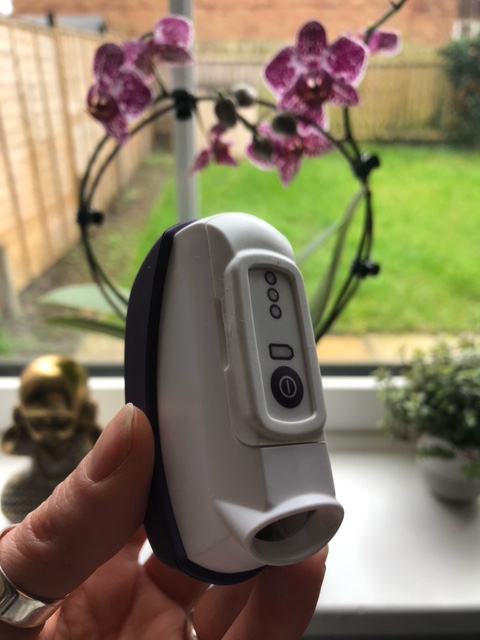
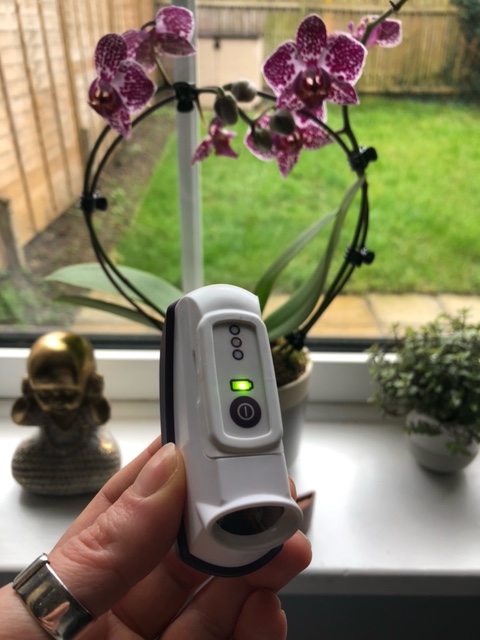
This device is called CalmiGO.

@mycalmigo

CalmiGO is scientifically proven and uses 3 methods to lower anxiety levels:

-Relaxing scent

-Multi-sensory stimulation or grounding

-Breathing regulation (exhalation prolongation)

These 3 methods combined, activate the parasympathetic nervous system and lower stress level hormones.

CalmiGO is drug free and safe to use and if you would like to find out more about it, then feel free to click on this link:

www.calmigo.com/pages/about-me

My experience with using CalmiGO so far has been absolutely brilliant.

After trying this device for 3 minutes as recommended, I immediately noticed a reduction in my anxiety levels.

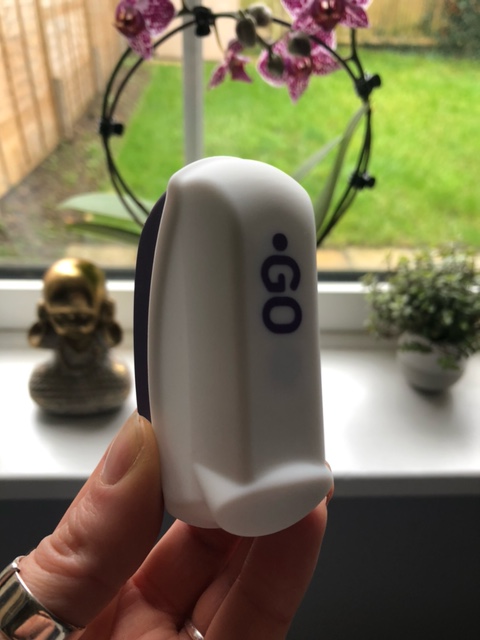
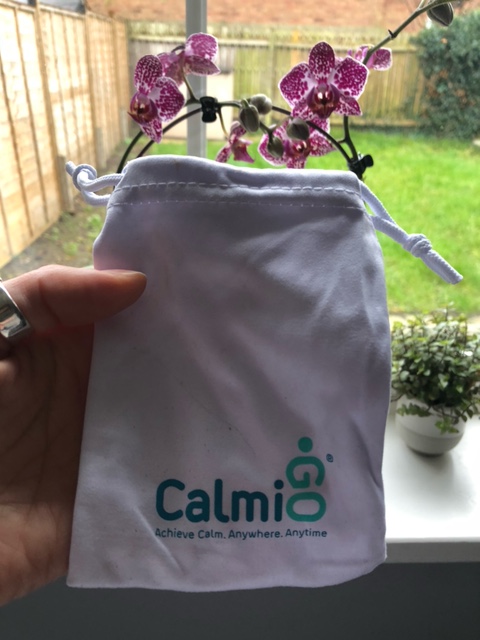
The most important part of the device for me is that it encourages you to prolong your exhalation. This is scientifically proven to decrease those awful symptoms of anxiety such as dizziness, accelerated heart rate, nausea and chest pain. When we are anxious, we end up breathing much too fast which results in a decrease of PCO2 levels. CalmiGO reverses this with exhalation prolongation. Since prolonging my exhalation was always the trickiest part for me, CalmiGO has been incredibly helpful in getting me to do this successfully. It vibrates and lights up whenever you reach a long enough exhalation, so this helps immensely when you are doing this for 3 minutes or more. Take a look at the photos below for an idea of what CalmiGO looks like and how to use it.

When I ordered CalmiGO, it arrived wonderfully packaged and came with a very detailed guide on how to use it effectively. It came with a little rubber cover and also an easy to use pouch to carry it in. There was also a pack of AAA batteries, a small screwdriver and a pack of 2 scented element attachments. One of these scented element attachments is placed on the front of the device near the ‘on and off’ switch. My preferred choice was lavender but you can also choose peppermint or bergamot if you prefer.

Although there is a detailed guide on how to use it effectively, there is also a tutorial video which you can watch here:

http://www.calmigo.com/pages/tutorial

Since I have found CalmiGO so incredibly useful in my personal life, I decided to collaborate with the founders of CalmiGO and I am offering a $30 discount on every purchase made through their website.

By adding the code COURAGE as a voucher when you add CalmiGO to your shopping cart, you get the above discount on the total price. Go to the link below to gets yours 🙂

http://www.calmigo.com

CalmiGO really is an investment in a life with less anxiety.

For those of you who live with CPTSD or PTSD, CalmiGO will help ground you and if used every day for a month during a time where you are really struggling with panic and anxiety, you will see a huge decrease in your symptoms.

If you have any questions or would like to share your experience using CalmiGO, then please feel free to leave a comment below.

Much love

Athina