
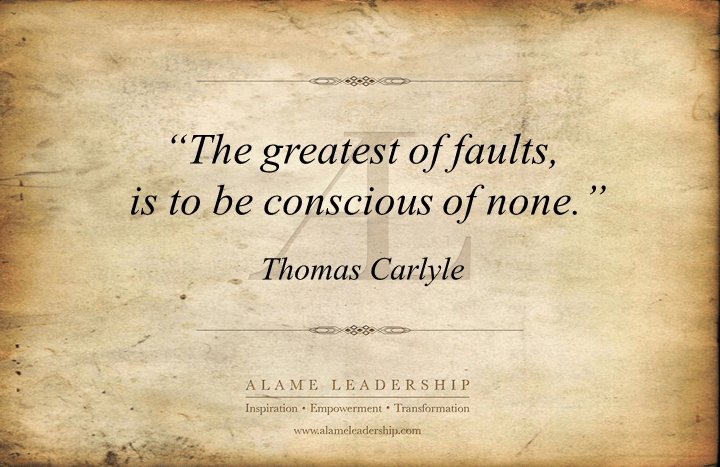
The importance of self-reflection & self-awareness

69125-quotes-about-self-reflection

This quote speaks to me in so many ways..

Through coaching, I aim to guide people find their answers through enabling them to self-reflect on where they are at currently and where they want to be. Self-reflection is very important in the process of change, as is persistence (which I talked about in this previous blog post- The importance of persistence).

The driving force behind change, is when an individual is able to look at their current life and notice that there is something negative popping up for them. If we feel negative or sad about something, then this can be the one thing that pushes us to make lasting change. If we don’t have self-awareness however, we remain stuck in a sad or negative existence and just keep repeating the same mistakes or habits over and over again.

As a survivor of complex trauma, I luckily became self-aware from a young age. I noticed I was struggling more than other children at school and had really low confidence. I found it very difficult to focus on school work the older I got and when I hit 15 I was already very depressed.I used art & poetry as a way to self-soothe and manage my emotional pain and luckily sought therapy when I was 17.

Over the years, with extensive therapy, I learned to tap into my emotional self-awareness even more. I continued to question my choices and behaviours and realised that actually it wasn’t my fault I was so sensitive and depressed but actually that my parents were both narcissistic, specifically with NPD. I was diagnosed at 29 as having Complex Post Traumatic stress and was told by my therapist that I was incredibly resilient and able to self-reflect a lot more than most of her clients. I left the session that day happy to be someone with self-awareness and wouldn’t change this for the world!

Self-awareness is incredibly hard for people with NPD, as well as the ability to feel empathy for others. When a healthy individual hurts others and causes them distress, they usually genuinely apologise and try to make a change for the better. For people that are aware of their actions, of their flaws, are sensitive to their body sensations, sensitive to their health and are also able to make sensible choices, change comes more easily.

What are your thoughts? How destructive have you found people that lack self-awareness?What difficulties have you had? Are their times when it took you a few failed attempts to finally have an epiphany about an unhelpful behaviour you may have had?

Thanks for reading

Much love Athina ♥

© All blog posts and images are owned by me and Courage Coaching. Please don’t use without consent and only re-blog if you would like to use the information on here.
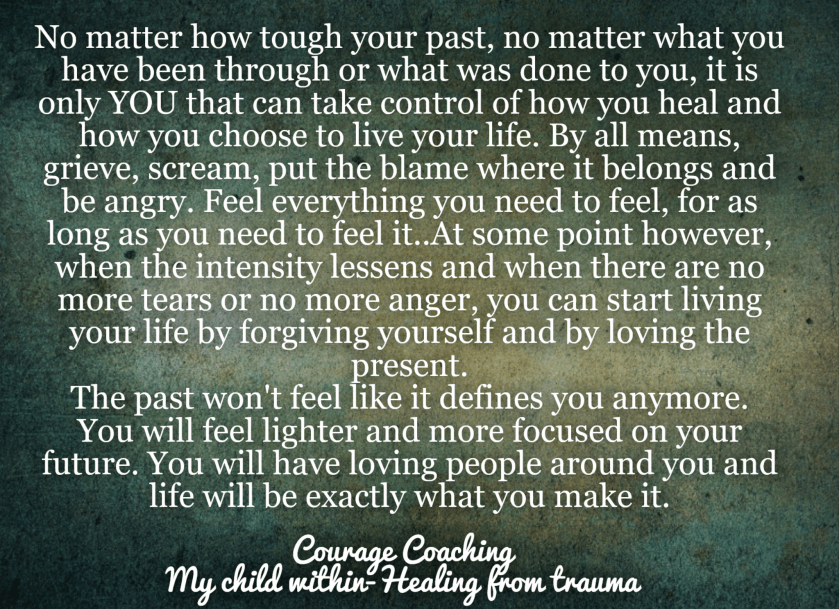
 

Take control of your own healing

FontCandy (38)

Every healing journey is unique to each person. No journey should be judged, minimised or discounted.

Whether it is childhood abuse, emotional, sexual or physical abuse, domestic abuse, grief, a single trauma or multiple traumas, nobody has the right to criticize someone else’s journey.

If you have compassion and maybe share what helped you, it doesn’t necessarily mean it will help others in the same way. Having compassion and empathy is so crucial. Listening, without trying to fix is also important.

After you reach a certain point in your healing, you will notice that things get easier. The intensity of certain emotions lessen and your sense of self-protection and boundaries are solid. If you suffer from a mental illness, it doesn’t necessarily mean it will go away. You eventually just learn to accept that it is a part of you and that you can handle it in a self-compassionate way.

What is your experience with healing?

Do you believe you will reach a point in your recovery where things eventually feel better?

Are you persistent in practicing self-care and healing with appropriate professional support?

Don’t forget that healing is a very up and down process. It isn’t always straightforward. Sometimes just as you are starting to feel better, something else comes along which needs processing. It might feel that you are back to square one again but this really isn’t the case.

Changes happen in very small ways sometimes and it depends on whether you have regular support.

Always be kind to yourself and others going through a process of healing ♥

Love Athina ♥

© All blog posts and images are owned by me and Courage Coaching. Please don’t use without consent and only re-blog if you would like to use the information on here.
 

Breaking the cycle of your childhood abuse-Start being kind to yourself

FontCandy (24)

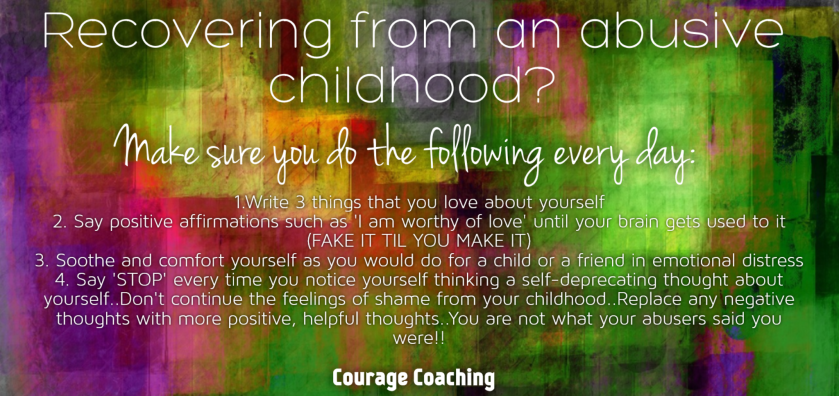
Of course it isn’t as simple as the 4 things written in the photo but it is definetely true that in order to break the horrible pattern of abuse from your childhood, you have to stop abusing yourself. YOU hold the answers to how much you will recover and it is up to you to start changing your thought patterns day by day..Nobody ever said it would be easy but it is possible..

The internalised messages of ‘You are not good enough, you are stupid’ are just repeats of what your abusers told you. They aren’t the ‘real’ you! The real you is a worthwhile person who deserves love and happiness.The real you is a person who deserves to heal and doesn’t need a nasty inner critic. With the help of a therapist or a coach, you can keep yourself on track. By having someone to report to, this might help you be more motivated. It is very important to keep trying as your brain needs sustained effort to learn ‘new, healthier messages’. That is why it is important to practice the above steps every day.

Your brain needs time to destroy the old habit wiring already in existence and then build new wiring for your new empowering positive affirmations.

Whatever your mind keeps hearing, it will eventually accept as truth. So what you want to do is to start repeating your new positive thoughts to yourself. Do it constantly. Do it repeatedly. Do it daily. Do it with passion, conviction and belief.

Anxiety-The thing we all hate but must embrace!

anxiety-1157437_1920

Have you watched the film The Babadook? It is an incredibly powerful horror film that has a very strong psychological message. ****If you haven’t seen it then this might be a spoiler *****

The important thing I want to state before including a quoted review of the film is that although mental illness and specifically an anxiety disorder cannot be completely cured, we can choose to live with it rather than fight it. The more you fight something that scares you, the bigger the fear becomes. This is something that happens with anxiety. If you are experiencing anxiety and you tell yourself ‘don’t be anxious’ this usually results in your anxiety getting worse..It’s a bit like telling yourself to not think of a donut.The more you tell yourself to not think about a donut, the more you actually think about the donut! It doesn’t work! This is why with mental illness and in this case with anxiety, it makes much more sense to accept it and even say something like ‘Hello anxiety, I see you are back again.I am not scared of you anymore and I know you will eventually subside. I can manage you by taking a few deep breaths and changing my thoughts to more helpful ones”.

You may adjust this slightly to however you prefer or in whatever way makes it helpful to you. Of course mental illness is debilitating at its worst but with a few coping techniques it becomes manageable.

The film introduces us to mother and son, Amelia and Samuel, who are terrorised by a monster called the Babadook. The Babadook monster is introduced through a book called Mister Babadook and a very important line in this book is ” You can’t get rid of the Babadook”. The Babadook figure appears over and over in the film and it’s presence gets stronger and stronger, as Amelia and Samuel get more fearful of it.

”Whilst it occasionally threatens to overwhelm her (Amelia), as evidenced in the scene where she takes it food, her acknowledgment and understanding of it is what gives her the power to control it.The Babadook hasn’t gone away, and it hasn’t been defeated. Much like a chronic mental illness, it is not something that can be “cured”, and so the most important weapon against it is knowledge and acceptance. For Amelia, the realisation of how she is hurting her son is the moment where she finds the strength to separate herself from the Babadook”.

Sourced from this review:

http://the-artifice.com/the-babadook-mental-illness/