Johnna Janis makes documentary “Invisible Scars” to heal her and others’ childhood trauma

I wanted to re-blog this as I know it will be incredibly helpful to many of you currently healing from child abuse.

Christine Cissy White's avatarACEs Too High

Invisible Scars“It’s about so much more than childhood sexual abuse,” says Johnna Janis about her feature documentary, Invisible Scars, a remarkable film about her own sexual abuse and her journey of recovery.

Janis produced and directed the film with long-time friend, Sergio Myers, an award-winning filmmaker and owner of 7Ponies Productions. Together, they took on topics many would consider too triggering or taboo to address and did so without sensationalizing sexual abuse or trivializing trauma. The result is a personal, powerful and informative movie.

Invisible Scars, which has been a six-year labor of love, will have a red-carpet premiere March 29 at the Harmony Gold Theater in Los Angeles, CA. It received an Award of Merit at IndieFest 2015.

What started in 2010 as a “small little project” about one woman’s healing journey “expanded” when Janis learned about the CDC-Kaiser Permanente Adverse Childhood Experiences Study (ACE…

View original post 1,725 more words

Be an inspiration

FontCandy (75)

Dear friends,

I am back from my brief holiday in Athens and feel happy to get back into blogging, YouTubing & Coaching. I have a 2nd follow up session with a coachee tomorrow and I am hoping she has managed to make some progress and feels a little better about things.

I hope I haven’t missed out on too much in the world of blogging but I definetely aim to catch up on your blog posts and interact with some of you lovely people.This holiday was a little mixed with being ill and dealing with a low mood because of this, but otherwise it felt good to have a change of scenery.

I thought it would be good to start the new week with an uplifting post. How often do you try to be an inspiration to others? How often do you strive to be an overall, good human?!

Some people are just naturally good at spreading positivity, love & and support but others do this less. Does this mean they are bad people? Not necessarily. It might be that they are suffering or overwhelmed by life’s challenges and just have nothing left to give at times..Just because someone isn’t supportive or understanding some of the time, this doesn’t mean that they are bad. On the other hand however, If someone is disrespectful, is always negative, is underminding towards others and generally goes around trying to ruin other peoples’ joy, then you want to stay clear of these people.

There is nothing wrong with having a bad day or feeling a little negative but if you purposely set out to bring others down with you, then this isn’t good.

In my day to day life, I hope to try and bring joy to others, even in the tiniest way. Even if I am struggling emotionally, I find that by spreading positivity in the smallest way, can make such a difference to my mood. This could be anything from leaving a positive comment on a great post, holding the door open for someone or smiling at the cashier in the supermarket.I am not superhuman obviously and neither are you, so we are all allowed days where we are less than perfect. As long as we are not hurting anybody, then it doesn’t really matter what we get up to.

If you had a choice to choose 2 of the 12 things listed in the above photo, which would you choose and why?

Love Athina ♥

© All blog posts and images are owned by me and Courage Coaching. Please don’t use without consent and only re-blog if you would like to use the information on here.

Existential Depression in Gifted adults

Existential depression is a topic I would like to write about today, as it might be useful to some of you who might be feeling depressed and don’t know why. My darling husband has been struggling with this for quite awhile and it is currently affecting our holiday.I just wanted to shed some light on a topic that many people experience but isn’t talked about much.

Existential Depression is very common amongst highly gifted adults and is defined as:

” A depression that arises when an individual confronts certain basic issues of existence. Yalom (1980) describes four such issues (or “ultimate concerns”)–death, freedom, isolation and meaninglessness.”

Source:http://sengifted.org/archives/articles/existential-depression-in-gifted-individual

Gifted adults usually start to experience this in young adulthood and it includes feelings of:

  • Isolation
  • Meaninglessness
  • Lack of focus and direction
  • Alienation

Existential depression is generally understood to be caused by personal, environment and professional mismatches: Typically
A gifted adult’s inability to find a place and/or relationships where “deeper issues” and “bigger problems” can be shared, explored and mastered. This includes the difficulty gifted young adults have in finding inspiring mentors and coaches with whom they can identify
These deeper issues and bigger problems can be:
Social/political
Moral/ethical
Aesthetic/artistic
Spiritual/religious
Philosophical

Rarely described elsewhere but often expressed by our gifted adult patients are other causes of existential depression:
The meaninglessness of accomplishments and achievements
Precocious and impressive as they may be to others, success that occurs without serious challenge and effort can feel worthless
Resolving conflicts between the need for personal gain and the desire to be altruistic:
Feelings of pride, pleasure and the financial rewards that come from actual hard work can conflict with the need to help others and make meaningful social contributions
Conflicts and anxieties about becoming a leader:
Admiration and praise of parents, peers, teachers and even mentors can make a gifted adult feel “too powerful.” This is especially true of gifted young adults who may feel this unusual power is “too much” and has come “ too soon”
Working out fears about the use and misuse of the power and charisma that can often accompany giftedness is vital — unwarranted feelings of guilt can cause the passionate pursuit of a grand vision to feel empty and meaningless
Balancing time for private thought and investigation with the need for social contact with others is an important task
Finding a way to depend on others that does not seem false
Getting comfortable with the intuitive ( sometimes called “extra-cognitive”) aspects of giftedness.
Special abilities to see beyond the ordinary and the capacity for having immediate and spontaneous insights can make gifted adults feel detached, removed and strangely different from others.
For a detailed discussion of the “extra-cognitive” aspects of Giftedness please go to ( create link to the Psychodynamic Psychotherapy article p.117 )
The capacity for unusual insight may extend beyond the academic and artistic to the psychological: At times gifted individuals feel they can “see” beyond social facades and understand what “really” motivates other people. This capacity can begin to develop in childhood and become quite sophisticated in young adulthood but it can also make a gifted young adult feel guilty: possibilities for helping other people can get confused with possibilities for manipulating them. Resolving these conflicts is important so that gifted adults do not abandon their giftedness by concluding that it is too dangerous.

Source: http://psychotherapyservicesforthegifted.com/personality-characteristics-gifted-children-gifted-adolescents-gifted-adults.html

From the above source, you can see that there are specialist psychotherapists that deal with the difficulties gifted adults have, but I must admit that in regards to my husband finding support, it hasn’t been easy.

From my experience, encouraging him to do the things he loves the most, helps his overall mood.

Do you have any experience with someone who suffers with existential depression?

Or are you maybe someone yourself who struggles with it.

I’d love to hear your thoughts

Love Athina ♥

© All blog posts and images are owned by me and Courage Coaching. Please don’t use without consent and only re-blog if you would like to use the information on here.

Start Living

I am currently on holiday in Greece and unfortunately I have also caught my husband’s virus..I am not feeling up to writing proper blog posts, so I thought I would re-blog a few excellent posts from blogs I follow! 🙂 Have a great Sunday dear readers! ❤

itsmesaraa's avatarIt's Me Saraa

What’s up with the “ I’ll do it on Monday” or the  “ Next month I’ll start going to the gym” or “I’ll call him tomorrow”

We all know –and I mean ALL OF US- know that Monday, next month, tomorrow, are just our living lies.

We never seem to start out diet on Monday, we never seem to go to the gym at the start of next month, we never seem to call our friend and hang out tomorrow.. we never do the things we wanna do when we post-pone them.

So to this issue.. I say ENOUGH.

Stop convincing yourself that you’ll do all of the things you wanna do “tomorrow” or “later”, cause next thing you know you’re 70 sitting in your chair watching the news and remembering nothing… cause you have nothing to remember. You spent your days thinking and planning for “tomorrow”, and when “tomorrow”…

View original post 245 more words

The stages of healing-Victim, Survivor, Thriver

For those of you healing from child abuse (narcissistic abuse), this video includes the differences between each healing stage, as listed by Barbara Harris & Charles Whitfield. I found this very useful in my own healing. I am luckily mostly thriving now, with the exception of a few hiccups, here and there. Where do you see yourself on your journey of recovery?

If you find this video useful in any way, then please share on social media ♥

Love Athina ♥

© All blog posts and images are owned by me and Courage Coaching. Please don’t use without consent and only re-blog if you would like to use the information on here.
 

Dealing with elderly narcissistic parents

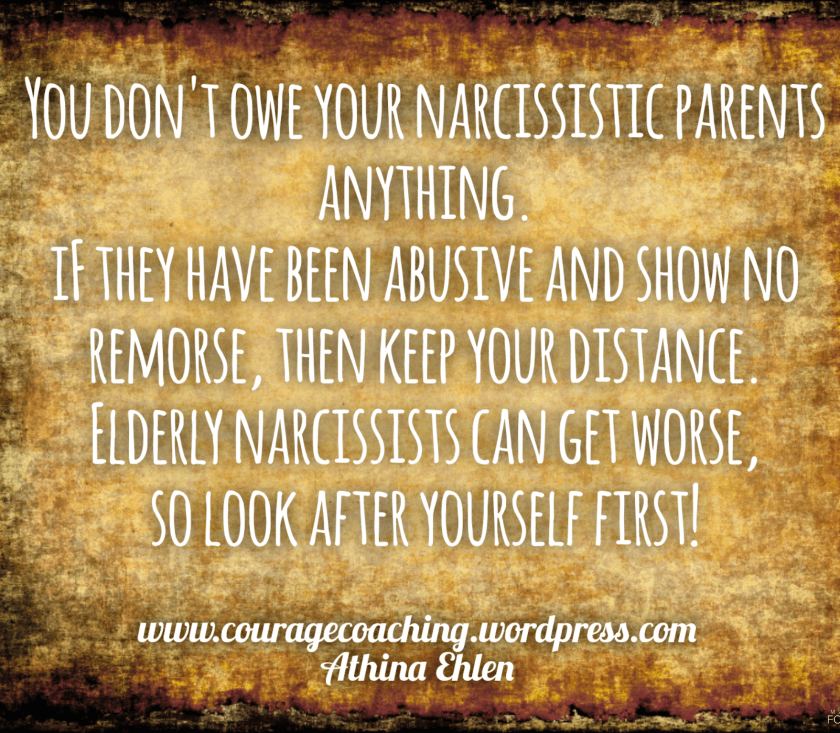
As narcissists start ageing, things actually get much much worse.When they are no longer able to charm others with their good looks, good health & successful business, they start losing control over others and their mask starts to fall.

FontCandy (69)

Narcissistic people live their life as pathological liars and bullies, so as they age further, instead of maturing, they just get worse. They become more demanding, more cruel and more horrible in their elderly years.They still try to manipulate others but aren’t very good at remembering the lies they have told, so people  catch them out in their lies.Their immaturity and tantrums become even more evident and healthy colleagues,friends & family start distancing themselves even more.

If you are someone who is emotionally struggling with an ageing narcissistic parent, just remember that you don’t owe them anything. You didn’t ask to be born into a family that was abusive. You don’t have to look after them when they are dying or when they are seriously ill. As a healthy son or daughter, your love is unconditional so they might exploit that for their own gain and still treat you like crap.

No matter what you decide to do, don’t do it out of guilt or because you feel you owe them for providing you with food and shelter.

You always have the right to walk away and look after yourself first.It doesn’t mean you stop loving them. It just means that you put your own health first.

Love Athina ♥

© All blog posts and images are owned by me and Courage Coaching. Please don’t use without consent and only re-blog if you would like to use the information on here.
What is hoovering?and why you have to protect yourself


A lot of my posts recently are dedicated to dealing with dysfunctional relationships. I don’t want to lower your mood by any means, but feel it is important to talk about issues that are more common than people think.

woman-74596_1920

For those of you who have unfortunately experienced dysfunctional relationships in your private life, you might have heard of the term ‘silent treatment’. People who suffer from narcissistic personality disorder, usually will shut people out that they are supposed to care about for long periods of time. This usually comes after an argument where the victim (spouse, partner, family member, friend) says or does something that the narcissist doesn’t like. This can be anything from a simple disagreement, to a criticism or to just refusing to do what the narcissist wants.

When the narcissist isn’t getting his/her way, he/she will use the ‘silent treatment’ to control his victim.

The silent treatment is a form of punishment, a way of attempting to control a partner or others into doing what he/she wants them to do. It’s a withdrawal of approval, and can generate much fear in people who are vulnerable to this.

Giving people the silent treatment means that a narcissist shuts down to them, closing his/her heart and refusing to interact with them or acknowledge their presence. He/she acts as if they’re invisible, not responding to them at all or giving them a very minimal and withheld response.

He/she hopes that in treating them this way it will give them the message that they have displeased him/her. They have done something wrong in his/her eyes and deserve punishment, deserve to have his/her “love” taken away.

Of course, what he/she is taking away is not love at all, since love is unconditional. What he/she is taking away is his/her approval, and for approval-dependent people, it is a powerful form of control.

When the narcissistic person decides that the silent treatment is over, usually because they need something from you again, they will then start to use what is known as ”hoovering”.

What is hoovering?

Hoovering is a technique that is named after the Hoover vacuum cleaner, and is used by Narcissists (and other manipulative people) in order to “suck” their victims back into a relationship with them. Hoovering is often done after the silent treatment is given or the victim has left them. This behavior often starts off subtle and unassuming, and is done through voicemail, text messages, email, phone calls, notes, other people, or through any other form of possible communication with the victim. Because the Narcissist knows the victim’s weak spots, they will generally tend to target these areas in order to reopen communication.  Once communication is reopened, the Narcissist generally promises change–which never, ever happens for any length of time.

  • Text messages pretending to be concerned: “How are you?”, “Hey, I’m thinking about you”, “I know things didn’t work out, but you really do mean a lot to me. I just want you to know that.”
  • Text messages acting like nothing happened: “Hey stranger, long time no talk” or “Hey what’s going on?”
  • Text messages on or about special occasions/holidays: “Merry Christmas”, “Hope you are having a good birthday–wish I could be there”, “Are you going to Molly’s wedding next weekend? If you’re going, I won’t go–I don’t want to upset you.”
  • Text messages about the kids (especially if they’re not his): “I was at the park today and saw a cute kid that looked just like Jason. Just wanted to say I miss you guys.” or “I know you hate me, but please tell Ava that I wish her a happy birthday and I’m sorry I can’t be there.”
  • Text messages about an upcoming event: “Hey, I know you said you never wanted to talk to me again, but Disney on Ice is this weekend, I was thinking about taking the kids.” or “Aerosmith is playing next weekend and I have an extra ticket–you wanna go?”
  • Text messages about things you like to do that he’s never been interested in doing with you before: “Hey, there’s a vegetarian cooking class this weekend, you wanna go?” or “Wanna go wine tasting this weekend?”
  • Text messages about bogus family illnesses or some sort of crisis (including his own): “I think I might have cancer, can you talk?” or, “OMG my mom just had a stroke.” or “What does a heart attack feel like? My left arm really hurts,” or, “I can’t handle this anymore, I’m going to kill myself.”
  • Text messages that are supposedly meant for someone else, but sent to you by mistake: “See you in ten minutes xoxo” (Supposedly for his current girlfriend–sent to upset you.) “The boss just moved the meeting to Wednesday at 3pm.” (Supposedly for his coworker–sent so you feel a sense of obligation for the coworker.) Or, “Sam called and said John is in the hospital and to call him immediately.” (Supposedly sent to someone else, but sent to you so you feel a sense of urgency to get back to him.)
  • Text messages that are guilt or pity inducing: “Can’t we work this out? Please give us another chance.” “What about the kids? You know how hard it is having divorced parents–why would you want to do that to them?” “I have a lot of issues. I get that now. I’ll get into therapy. I promise.” “My alcoholism is out of control. I need help.”
  • Text messages about sex/deep connection: “I miss snuggling with you.” “You always be the love of my life.” “You are my soul mate, I’m sorry I let you down.”
  • Text messages that attempt to flip the hoover back on you: “Did u just text me?” or “Did you just call me?” or “Did I just see you drive by?”
  • Text messages, when all else fails, making bogus accusations to get some type of emotional response:  “Why are you calling my mom and bugging her?” or “I just found out you cheated on me.” “I’ve moved on. You need to quit stalking me.”

All of these examples are just one big fat manipulation for you to open the door and let them back into your life. Don’t fall for it!

Source: http://narcissistsupport.com/narcissists-hoovering-techniques/

So far, in my personal life I have had recent contact from my narcissistic father, after a year of the silent treatment. Luckily I have decided on ‘NO CONTACT’ and even though it is still incredibly painful to see how destructive and insensitive my father is, being in control of what happens has been incredibly powerful in my recovery.

I have received 2 voicemail messages so far : Wishing me Happy birthday and asking me how I am.

I haven’t replied to either of them, as I know he doesn’t genuinely mean them..

He using ”Hoovering” as I am the only person ‘he thinks’ will help him. He is abusing my unconditional love & kindness to get his needs met.

Luckily I am recovered and will no longer play a part in his games.

Have you had an experience similiar to this? If not, do you have any friends that might benefit from this information?

Please re-blog this post if you think it could help someone.

Love Athina ♥

© All blog posts and images are owned by me and Courage Coaching. Please don’t use without consent and only re-blog if you would like to use the information on here.


Trauma bonding & love addiction

depression-1241819_1280

In all my previous relationships, I always thought that intensity equaled love. I fell for the same abusive partners over & over again, that were mostly narcissistic & emotionaly unavailable. I had this deep desire within me, to fix and rescue and fight for their love. For many years I thought this was normal! In each relationship, I hoped that they would change and be able to offer me this unconditional love I was so desperately craving. What I didn’t realise at the time however, was that I was only trying to fill the void my parents’ had left after years of neglect and abuse. I was trying to resolve this feeling of not being lovable, through choosing further unsuitable partners that resembled the normality of my childhood abuse.

Each time a relationship ended I felt utterly crushed and devastated. I relived my abandonment over and over again and still had this intense feeling of  bonding with each and every one of my abusive ex’s.

The article in the link below, explains this bonding very well.

The part where it says ”there is a biological craving for intensity than no normal relationship will satisfy” is something that I deeply felt for 20 years and could never shake off..The more excited and addicted I felt to these men, the better..

I was always easily bored and not in any way attracted to healthy & stable men..I felt anxious and uncomfortable around them..This wasn’t my normal..I wasn’t normal..I was traumatised and stuck with what felt comfortable..and unfortunately comfortable for someone who has suffered abuse and trauma, is to crave more abuse and trauma..Sticking with what is familiar is more comfortable than doing something that feels unfamiliar, as us humans are creatures of habit & conditioning.

Growing up in an unsafe home makes later unsafe situations have more holding power. This has a biological basis beyond any cognitive learning. It is trauma in one’s history that makes for trauma bonding. Because trauma (and developmental trauma or early relational trauma is epidemic) cause numbing around many aspects of intimacy, traumatized people often respond positively to a dangerous person or situation because it makes them feel. It is neither rational nor irrational.

..the survivor can come to find that it can be almost impossible to relate to anyone, even family or old friends, except superficially. There is a biological craving for intensity that no normal relationship will satisfy.

http://www.abuseandrelationships.org/Content/Survivors/trauma_bonding.html

When I was first diagnosed as codependent in therapy, in 2008, I started attending a codependents anonymous group in London. I found it helpful inititially when I was recently out of a relationship but as time went on, my therapy was enough. Through the codependent meetings I also learnt about love addiction and being addicted to the need for love..This is something that I remember from the very young age of 13 where I would fantasize about my prince charming taking me away from my family and giving me everything I needed emotionally..As I got older, this intense need transformed into the most important thing in my world..Each boyfriend I subsequently had, became my everything and I felt completely hopeless and depressed without them..

This link below might be useful for some of you to identify whether you might be a love addict..This usually stems from childhood abuse, so don’t be too harsh on yourself! Healing is possible!

https://www.addiction.com/addiction-a-to-z/love-addiction/love-addiction-101/

In 2012 I was healed enough to be attracted to a healthier partner.With the help of more therapy I persevered through the anxiety of unfamiliarity and eventually got married. Marriage was something I was completely against after my parents got divorced.I never believed I could achieve healthy love let alone a marriage. I am still amazed at how much my life has changed. In 2008 I thought that life would never get better again..Now I sit across my husband and feel incredibly blessed to be loved and cherished for the first time in my life..My friends always felt more like family and I can truly say that I finally have a family in my friends and husband.

Any recovery process requires effort, patience and self-insight. It requires commitment, painful exploration and courage. It is possible to reach a deeper level of contentment, so each step forward is extremely important..

 My experience is vast in regards to relationship dynamics and overcoming narcissistic abuse. I am humbled to offer loads of advice on this blog and through my YouTube videos, as I believe that it is important to assist others on their journey. We all heal together..and we can all help each other..Whether some of you are only just starting your recovery process and whether others are ‘healed’, makes no difference..The connection and knowledge is crucial..The exchange of information is powerful..

Love Athina ♥

© All blog posts and images are owned by me and Courage Coaching. Please don’t use without consent and only re-blog if you would like to use the information on here.