Women’s only support group – Daughters of narcissistic mothers

For those of you who didn’t manage to join my 1st support group for adult children of narcissistic mothers, I am also starting a 2nd online support group which is exclusively for daughters of narcissistic mothers.

If you struggle with symptoms of trauma, with feeling isolated on your healing journey and with feelings of shame or low self-worth, then this support group will help you!

Growing up with a narcissistic mother can leave deep wounds — confusion, guilt, low self-worth, and complex grief. This safe online support group is here for daughters recovering from narcissistic maternal abuse, offering understanding, validation, and tools for healing.

💜 What you’ll find here:

A safe, judgment-free space to share your story

Connection with others who truly “get it”

Support for breaking cycles of guilt, shame, and gaslighting

Gentle strategies for boundaries, self-care, and inner healing

There will be two 90min online video calls per month with a maximum of 8 people. This will be a closed support group which fosters a safe, confidential and deeper level of intimacy and trust among members. This means that the same people only will be a part of this group, without any new people joining.

Talking to others in support groups reduces anxiety, improves self-esteem, and helps members’ sense of well-being overall.

It will initially run for a total of 6 sessions, over a period of 3 months and we will then reassess how to move forward.

If you are interested in joining this online support group, please email me at courageisallyouneed@gmail.com or leave a comment below with your name and email.

I will be facilitating this online group and I very much look forward to welcoming you!

Love Athina

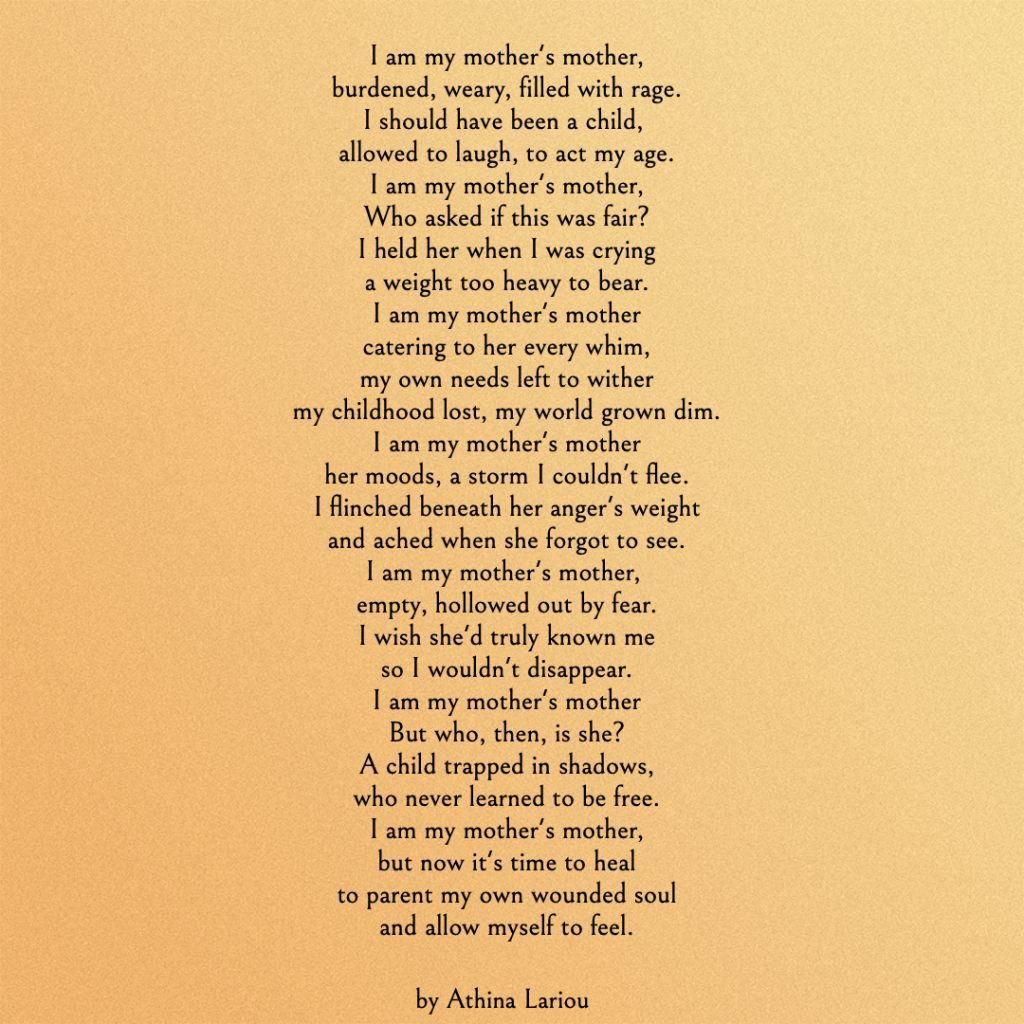
I am my mother’s mother

Have you ever felt like you were the parent instead of the child? Growing up as a parentified daughter means carrying emotional burdens too heavy for a child to bear. In this video, we explore the experience of daughters who had to step into a parental role—providing comfort, stability, and care at the expense of their own childhood.

This video is inspired by my own experience of being a parentified daughter and I share a deeply personal poem I wrote in my early twenties when I was struggling with my mother.

The poem in the video is written below:

***Please only re-use this poem by giving credit and asking for permission.***

Weaponised incompetence

Weaponized incompetence is a form of passive-aggressive behavior where an individual deliberately performs tasks poorly or pretends to be incapable of completing certain tasks. This manipulation tactic is often used to avoid responsibility, forcing others to take over. It doesn’t always come from a bad place because it can stem from a lack of confidence or self-esteem. They may genuinely believe that they’re unable to perform a certain action or task.

When it comes to narcissists however, the intent is much more malicious. It is much more calculated and intentional.

Feel free to watch my YouTube video below to find out more about it.

For one to one coaching, please email me at courageisallyouneed@gmail.com

Love Athina

Self Sabotage-A result of childhood narcissistic abuse

Self-sabotage isn’t something we are necessarily aware of yet it can create havoc in our lives and it can stop us from reaching our full potential.

When we have grown up in an environment where there was constant chaos and drama and where our parents shamed us and criticised the majority of the time, it will feel more familiar to us to continue this dynamic in adulthood. We may lead equally chaotic lives with dysfunctional relationships and poor choices.

If we were constantly given the message that we weren’t smart enough, strong enough, attractive enough and in more general terms good enough, then this becomes our internalised voice and it pops up every time we try and take a step forward in our careers, relationships and day to day life.

Even if this internalised voice is negative and not true, it has been our mind’s companion for as far back as we remember. We took on this identity and it is harder to change it when it is all we have known.

If you can relate to this topic, then please watch the video to find out more.

I offer one to one coaching to those of you who struggle with this, so please feel free to get in touch by emailing me at: courageisallyouneed@gmail.com

Love Athina

Echoism – A result of narcissistic abuse

Have you heard of echoism? Echoism isn’t commonly talked about but is very real and a lot of individuals who have suffered narcissistic abuse in childhood actually live with it.

Echoism is very common with individuals who live with Avoidant Personality Disorder or who have many avoidant traits. Echoists find it extremely uncomfortable being the centre of attention.

Watch the video to find out more.

Love Athina

Carrying your parents’ shame

Growing up in abuse means that you may have carried feelings of shame for the way you witnessed your parents acting or treating others.

Growing up in a dysfunctional family may mean that you witnessed your parents use, manipulate and control other people, just to get certain needs met. The people that these things were done to, were people that you genuinely liked and couldn’t believe had been treated in such a selfish and immoral way.

Growing up in a dysfunctional family, where one or both your parents had NPD, you will most likely have witnessed aggressive behaviour, socially inappropriate behaviour, victim playing, scapegoating, lying, manipulation and so much more. There will have been many times, where you felt ashamed that you were the son or daughter of such a parent. You would have literally felt like you were ‘bad’ or ‘toxic’ just by association. You would have felt like you had to constantly apologise for your parents’ awful behaviour. This was never your fault or ‘burden’ to carry however.

When dysfunction like this had always been your ‘normal’, you may have found yourself over-compensating somehow in adulthood. You may have noticed how much you are always trying to be kind, selfless and helpful to others. You may have noticed how much you people-please because you don’t want to be thought of as ‘bad’.

Your inner child took on your parents’ shame and this shame wasn’t yours to carry.

Your inner child may still need healing in regards to the abuse it witnessed and experienced.

Self-awareness is so important when trying to heal the trauma you experienced as a child.

You may not have awareness of certain behaviours you carry or even certain behaviours you still repeat because of what you were taught in your childhood.

To start healing, it is crucial to observe your emotions and pay attention to the intensity of your reactions in your body. What things trigger you and why? Why do some things upset you a lot? Why do you have low confidence in some areas but not in others? What things happened in your childhood that may remind you of the present?

Childhood trauma caused from abuse creates a lot of shame and emotional dysregulation.

If you want to start healing or figure out where things may be going wrong in your life, book an introductory call with me by emailing me at courageisallyouneed@gmail.com

Love Athina

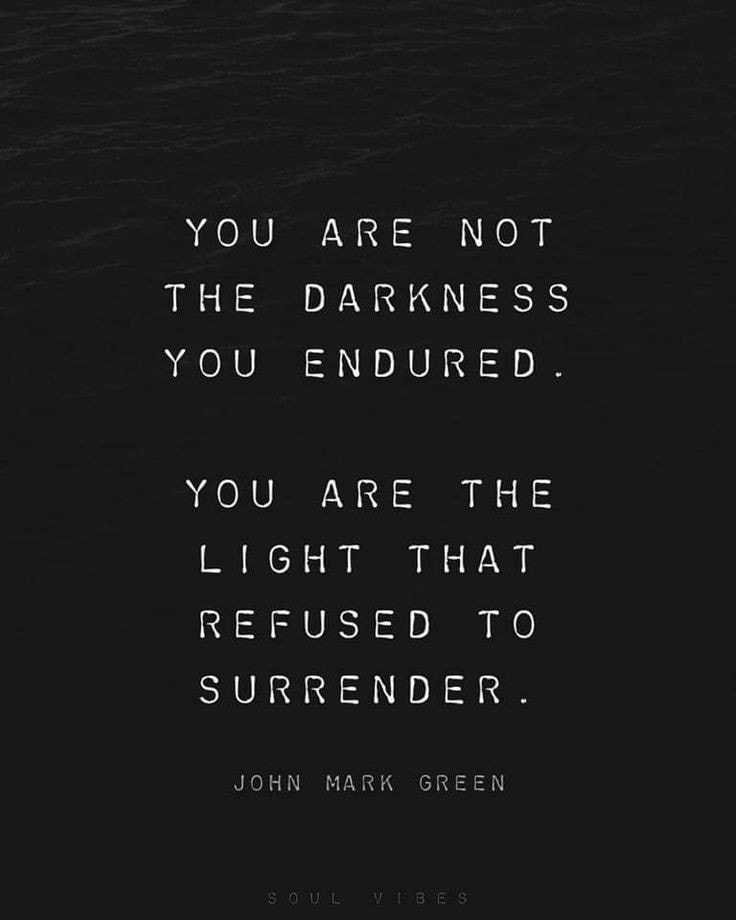
You are the light that refused to surrender

‘You are the light that refused to surrender’ is a wonderful way to look at your healing journey after experiencing trauma.

If you, like me, have a history of trauma, you will be very familiar with the ups and downs of living with CPTSD. For me personally, having hope in my lowest moments, was the 1 thing that kept me going when things truly felt hopeless. 

Having hope means that you allow yourself to believe that the day WILL come where you WILL feel better, where things will feel less scary, less isolating and less depressing.

It’s important to never stop hoping when things get tough and to allow yourself to embrace that feeling wholeheartedly. 

Practicing gratitude is also extremely important for improving mental health. Be grateful for any tiny steps of progress you make, even if you managed to do 1 additional thing today that you didn’t manage to do the day before.

Living with mental illness is never easy but it can be manageable. Living with mental illness means that you might have to constantly make adjustments to the way you live your life, in order to feel better. These adjustments may look like the following: Changing your diet, adding more exercise to your daily routine, cutting out sugar, moving to the countryside, ending a relationship, leaving a stressful job, practicing meditation, seeking out support from a specialised therapist, going on a retreat, taking supplements and/or using medication. Each journey with mental illness is unique so what might work for one person may not necessarily work for another. Try things out, see what works and go from there.

Darkness may have been a big part of your past and may still creep up on you in the present. This is realistic as life can be tough even when you don’t live with a mental illness.The only way through this darkness however is to find the light. The light could be anything: a therapist, a close friend, a partner, a beloved pet, being in nature, a safe space, art, music or anything else that brings you comfort.

Most importantly however, you must try and find the light within yourself, within your heart and soul. 

In those moments of relentless anxiety, depression or emotional flashbacks, love yourself unconditionally.  Take yourself by the hand, like you would a small child and tell yourself  ‘ I’ve got you, you are not alone’… ‘ I am there for you, unconditionally’.

If you are having a tough day, then I hope this post helps a little.

Keep going..keep living..you’ve got this!

Love Athina x

6 Lies narcissistic parents tell their children

Narcissistic parents are incredibly destructive to a child’s emotional & mental wellbeing. The 6 lies I talk about in this video, are very common in most narcissistically abusive households.

If this is your background or if you suspect that your upbringing may have been dysfunctional, then this video is for you!

Love Athina

CPTSD – Hybrid trauma types

As well as the 4 F trauma types: Fight, flight, freeze and fawn we also have hybrid trauma types.

In this video, I talk about the whole spectrum of trauma types as mentioned by Pete Walker.

If you live with complex ptsd, can you relate to any of these?

Love Athina

Emotional abandonment – A result of narcissistic parental abuse

Emotional abandonment is a huge part of growing up with emotionally unavailable parents. Parents who in many cases have NPD but also parents who are alcoholics or addicts or just too immature to have brought a child into this world.

Is this a topic you can relate to?

Did you feel emotionally abandoned and still suffer with people-pleasing tendencies, perfectionism or avoidant tendencies?

Feel free to share your experience in the comments below.

Love Athina x