
Trauma bonding & love addiction

depression-1241819_1280

In all my previous relationships, I always thought that intensity equaled love. I fell for the same abusive partners over & over again, that were mostly narcissistic & emotionaly unavailable. I had this deep desire within me, to fix and rescue and fight for their love. For many years I thought this was normal! In each relationship, I hoped that they would change and be able to offer me this unconditional love I was so desperately craving. What I didn’t realise at the time however, was that I was only trying to fill the void my parents’ had left after years of neglect and abuse. I was trying to resolve this feeling of not being lovable, through choosing further unsuitable partners that resembled the normality of my childhood abuse.

Each time a relationship ended I felt utterly crushed and devastated. I relived my abandonment over and over again and still had this intense feeling of  bonding with each and every one of my abusive ex’s.

The article in the link below, explains this bonding very well.

The part where it says ”there is a biological craving for intensity than no normal relationship will satisfy” is something that I deeply felt for 20 years and could never shake off..The more excited and addicted I felt to these men, the better..

I was always easily bored and not in any way attracted to healthy & stable men..I felt anxious and uncomfortable around them..This wasn’t my normal..I wasn’t normal..I was traumatised and stuck with what felt comfortable..and unfortunately comfortable for someone who has suffered abuse and trauma, is to crave more abuse and trauma..Sticking with what is familiar is more comfortable than doing something that feels unfamiliar, as us humans are creatures of habit & conditioning.

Growing up in an unsafe home makes later unsafe situations have more holding power. This has a biological basis beyond any cognitive learning. It is trauma in one’s history that makes for trauma bonding. Because trauma (and developmental trauma or early relational trauma is epidemic) cause numbing around many aspects of intimacy, traumatized people often respond positively to a dangerous person or situation because it makes them feel. It is neither rational nor irrational.

..the survivor can come to find that it can be almost impossible to relate to anyone, even family or old friends, except superficially. There is a biological craving for intensity that no normal relationship will satisfy.

http://www.abuseandrelationships.org/Content/Survivors/trauma_bonding.html

When I was first diagnosed as codependent in therapy, in 2008, I started attending a codependents anonymous group in London. I found it helpful inititially when I was recently out of a relationship but as time went on, my therapy was enough. Through the codependent meetings I also learnt about love addiction and being addicted to the need for love..This is something that I remember from the very young age of 13 where I would fantasize about my prince charming taking me away from my family and giving me everything I needed emotionally..As I got older, this intense need transformed into the most important thing in my world..Each boyfriend I subsequently had, became my everything and I felt completely hopeless and depressed without them..

This link below might be useful for some of you to identify whether you might be a love addict..This usually stems from childhood abuse, so don’t be too harsh on yourself! Healing is possible!

https://www.addiction.com/addiction-a-to-z/love-addiction/love-addiction-101/

In 2012 I was healed enough to be attracted to a healthier partner.With the help of more therapy I persevered through the anxiety of unfamiliarity and eventually got married. Marriage was something I was completely against after my parents got divorced.I never believed I could achieve healthy love let alone a marriage. I am still amazed at how much my life has changed. In 2008 I thought that life would never get better again..Now I sit across my husband and feel incredibly blessed to be loved and cherished for the first time in my life..My friends always felt more like family and I can truly say that I finally have a family in my friends and husband.

Any recovery process requires effort, patience and self-insight. It requires commitment, painful exploration and courage. It is possible to reach a deeper level of contentment, so each step forward is extremely important..

 My experience is vast in regards to relationship dynamics and overcoming narcissistic abuse. I am humbled to offer loads of advice on this blog and through my YouTube videos, as I believe that it is important to assist others on their journey. We all heal together..and we can all help each other..Whether some of you are only just starting your recovery process and whether others are ‘healed’, makes no difference..The connection and knowledge is crucial..The exchange of information is powerful..

Love Athina ♥

© All blog posts and images are owned by me and Courage Coaching. Please don’t use without consent and only re-blog if you would like to use the information on here.


Narcissistic abuse survivors

FontCandy (58)

As some of you already know, I have great insight into narcissistic abuse, after a tumultuous life with 2 narcissistic parents, many narcissistic ex-partners and narcissistic ex friends. Before my father discarded my mother in 2000 and filed for divorce, he had already met his second narcissistic wife. He had already lined her up to fill his emptiness and later had a child with her. The cycle of abuse unfortunately continued and there was nothing I could do to prevent it.He has been married to her for 16 years now and it has been the most destructive, soul destroying relationship I have ever witnessed.

My histrionic/covert narcissistic mother, on the other hand, luckily didn’t re-marry. She just had 2 relationships which didn’t work out.She has remained irritable, negative and critical. She still blames everything & everyone else for her misery and struggles to cope with her own depression.

My childhood in general was always hot & cold.One minute things were relatively normal and my parents would be kind & thoughtful and the next they would be extremely hurtful & abusive. This almost made coping with the abuse harder, as the kind moments would give me hope as a child and then when the abusive moments would come around, I was utterly devastated and confused. I then learnt that whenever my parents were kind, there were always strings attached to this kindness. I was told many times as a child ‘After everything I have done for you, this is how you treat me?’. I felt guilty and ashamed. I felt worthless and no good.

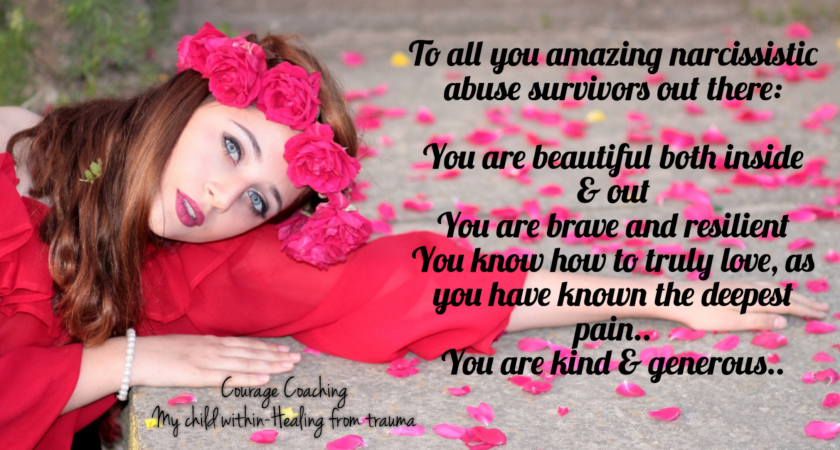
The one thing I know for certain is that for those of you who have also been affected by narcissistic abuse, you have developed a deep sense of self-awareness, a sense of gratefulness for the tiny moments of kindness that others have shown you and a high level of empathy from a young age. Most of you sought out therapy and have always helped and be-friended the shy or needy. Yes you have made many mistakes along the way, by getting involved with people who resembled your family of origin, however this is a logical result of growing up in an abusive or neglectful home.

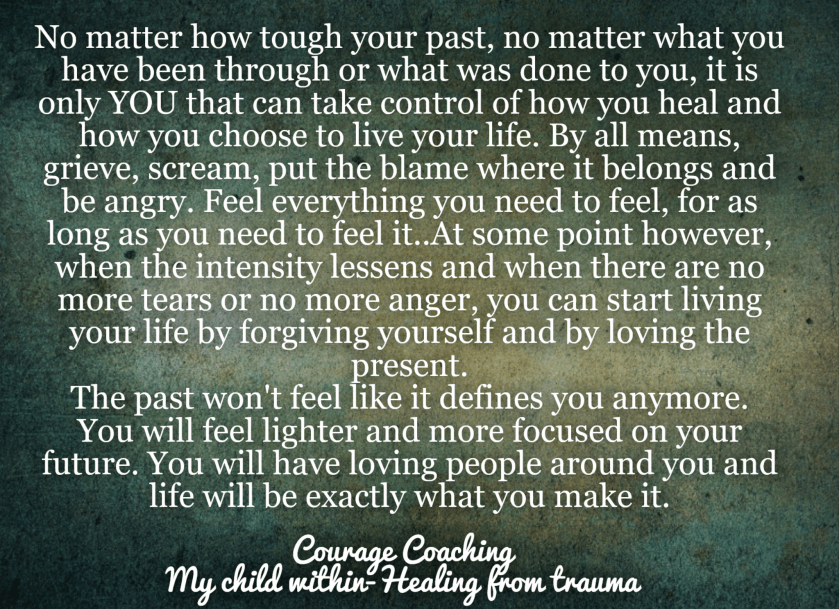
The thing that helped me the most in my recovery was forgiving myself for struggling so much in my life. Self-compassion is the best gift you can give yourself as an abuse survivor.Recovering from narcissistic abuse means that you have to dig deep to reveal the many layers of trauma. You have to acknowledge that it isn’t going to be easy to go through all the painful realisations of your past but that is extremely important to work through each layer and grieve your losses. Trusting that others won’t hurt you is a huge struggle for those who have been abused. If your primary caregivers let you down so badly, why on earth would you trust complete strangers?

The most important thing to remember is that there is no time frame on healing and that everyone copes and heals differently.

My advice will always be to ask yourself ‘What do I need’? ‘What am I scared of’? ‘How can I look after myself’?

For those of you who can relate and understand, just remind yourselves daily that you survived an unfair childhood and that from now on you can give yourself the unconditional love your parents weren’t able to give you. In every low moment, remind yourself that you are brave and resilient.

Now in my 30’s I have already been through the darkest moments of despair and have healed extensively through many years of trauma therapy. I am now armed with knowledge,coping skills and the most important thing: the knowledge that healing is possible and that you ARE able to live a more fulfilling life. If you had asked me this same question 2 years ago, I wouldn’t be feeling so optimistic.

Now I am putting all my knowledge into helping others and it feels good! It feels good to see that others feel validated & comforted, because this is a feeling I missed out on a lot! It feels good to be there and pass on information, even if it only helps one other person. Free advice is so valuable and we can all do it! So many of us are already doing it!

Love Athina ♥

© All blog posts and images are owned by me and Courage Coaching. Please don’t use without consent and only re-blog if you would like to use the information on here.
 

Take control of your own healing

FontCandy (38)

Every healing journey is unique to each person. No journey should be judged, minimised or discounted.

Whether it is childhood abuse, emotional, sexual or physical abuse, domestic abuse, grief, a single trauma or multiple traumas, nobody has the right to criticize someone else’s journey.

If you have compassion and maybe share what helped you, it doesn’t necessarily mean it will help others in the same way. Having compassion and empathy is so crucial. Listening, without trying to fix is also important.

After you reach a certain point in your healing, you will notice that things get easier. The intensity of certain emotions lessen and your sense of self-protection and boundaries are solid. If you suffer from a mental illness, it doesn’t necessarily mean it will go away. You eventually just learn to accept that it is a part of you and that you can handle it in a self-compassionate way.

What is your experience with healing?

Do you believe you will reach a point in your recovery where things eventually feel better?

Are you persistent in practicing self-care and healing with appropriate professional support?

Don’t forget that healing is a very up and down process. It isn’t always straightforward. Sometimes just as you are starting to feel better, something else comes along which needs processing. It might feel that you are back to square one again but this really isn’t the case.

Changes happen in very small ways sometimes and it depends on whether you have regular support.

Always be kind to yourself and others going through a process of healing ♥

Love Athina ♥

© All blog posts and images are owned by me and Courage Coaching. Please don’t use without consent and only re-blog if you would like to use the information on here.


Breaking the cycle of your childhood abuse-Start being kind to yourself

FontCandy (24)

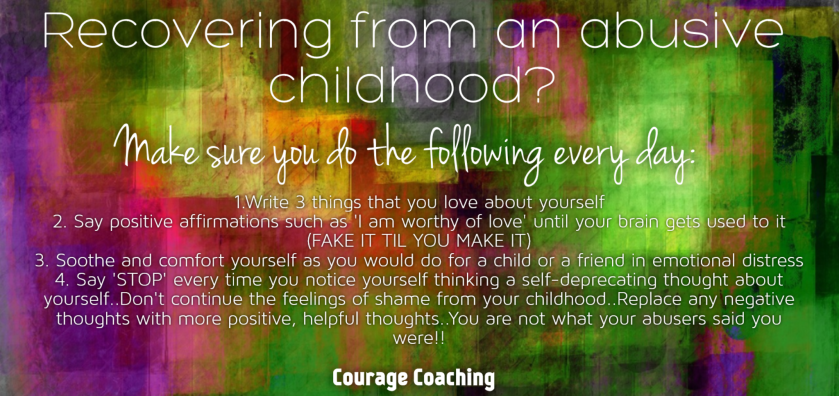
Of course it isn’t as simple as the 4 things written in the photo but it is definetely true that in order to break the horrible pattern of abuse from your childhood, you have to stop abusing yourself. YOU hold the answers to how much you will recover and it is up to you to start changing your thought patterns day by day..Nobody ever said it would be easy but it is possible..

The internalised messages of ‘You are not good enough, you are stupid’ are just repeats of what your abusers told you. They aren’t the ‘real’ you! The real you is a worthwhile person who deserves love and happiness.The real you is a person who deserves to heal and doesn’t need a nasty inner critic. With the help of a therapist or a coach, you can keep yourself on track. By having someone to report to, this might help you be more motivated. It is very important to keep trying as your brain needs sustained effort to learn ‘new, healthier messages’. That is why it is important to practice the above steps every day.

Your brain needs time to destroy the old habit wiring already in existence and then build new wiring for your new empowering positive affirmations.

Whatever your mind keeps hearing, it will eventually accept as truth. So what you want to do is to start repeating your new positive thoughts to yourself. Do it constantly. Do it repeatedly. Do it daily. Do it with passion, conviction and belief.