Complicated grief for adult survivors of abuse

Societal mandates assert that loss is accompanied by a conventional paradigm of grief, replete with ceremonial rituals and a finite process of mourning. Yet when the loss pertains to more intangible sources of grief such as prolonged abuse and trauma, one size does not fit all.

Adult survivors of child abuse, beset by complex post-traumatic stress disorder often grapple with persistent complicated bereavement disorder. They are plagued by persistent yearnings for the love and normalcy they never had. They are weighed down by innumerable intangible losses such as safety, dignity, belonging and a cohesive sense of self.

Family as Sacrosanct

For adult survivors of chronic child abuse the notion of ‘family as sacrosanct’ is a principle that fosters confusion, alienation, shame and outrage. Within the context of familial sacredness doctrines are explicit. Love thy mother and father and honor their function and authority.

However, when that mother or father robbed that child of his/her birthright, their innocence, their childhood, even their Self, who gets to determine how that child should ‘appropriately’ respond to sundry losses or the most glaringly pivotal loss of a parent’s passing? How is the survivor to measure up to a proclamation that has no bearing on her history or her reality?

Anecdotal Forgiveness

Anecdotal forgiveness seems to be the standard advice handed out to survivors of abuse. Survivors are advised to offer absolution to the abusive parent regardless of whether the abuser has attempted any sort of restitution. Ostensibly, this will set the abuse survivor free and concomitantly confer them the designation of good son/daughter. With religious zeal, this approach is considered a crowning achievement.

As you can see from everything written in this article  http://pro.psychcentral.com/complicated-bereavement-for-adult-survivors-of-abuse/0011089.html# asking someone to forgive their abusive parent, is like throwing salt into an already extremely painful wound, especially when that parent never apologised or felt remorse.

Recipient of the Lifetime Achievement Award from the International society for Traumatic Stress Studies, Dr. Judith Herman, refers to the aforementioned construct as the forgiveness fantasy. Dr. Herman states:

“Forgiveness is a relational process. “‘I forgive you’ is the response to a heartfelt apology and request for forgiveness. If the apology is never made, the process of forgiveness cannot take place. And “genuine contrition in a perpetrator is a rare miracle.”

I completely agree with Dr Herman’s words!

Those of you who feel that you have to forgive, don’t!

Inspired by https://bodyelectricweb.wordpress.com/ on expressing anger and the topic of forgiveness. If I were her, I don’t think a perpetrator deserves forgiveness if there is no remorse.
How to be assertive-Steps to healthy self-assertion

This post is the last one on assertion and hopefully the most useful to those of you who struggle with being a people-pleaser and/or are quite passive in your relationships with others.There is also a YouTube video attached for those of you who are auditory & visual learners.

Here is a quick guide on how to be assertive:

  1. Firstly get the person’s full attention when you are trying to make an important point. This may seem like a given however it is important to ensure there are no distractions.
  2.  Describe in an objective way, what you are having difficulty with in regards to the other person’s behaviour. EXAMPLE: ” I said I wanted to speak to you and you have just turned on the tv”.
  3. Express constructive feelings using ”I” statements. Don’t say ”You completely ignored me”.Instead, choose to say ” I feel upset that you are not listening to me”. It is ok to state feelings of disappointment & annoyance, as these are constructive feelings.
  4. Check your statements & make sure the other person gives you a response. This will hopefully enable some sort of resolution later on. EXAMPLE: ”I feel that you are hiding something from me. What do you think about this”?
  5. Listen to the other person’s response with an open mind and give feedback in a controlled manner.  Avoid dismissing the reply as soon as it is given.
  6. State your preferences clearly. EXAMPLE: ”I would like if you could always be honest with me”.
  7. Request agreement from the other person.If they don’t agree or try to avoid the subject, clearly state ”Are you willing to make any changes?”
  8. Communicate any relevant information concerning future occurences.State what you will do if the same problem re-occurs.

Child abuse, Complex PTSD & managing emotional flashbacks

****Please share & re-blog this post to help as many others as possible****

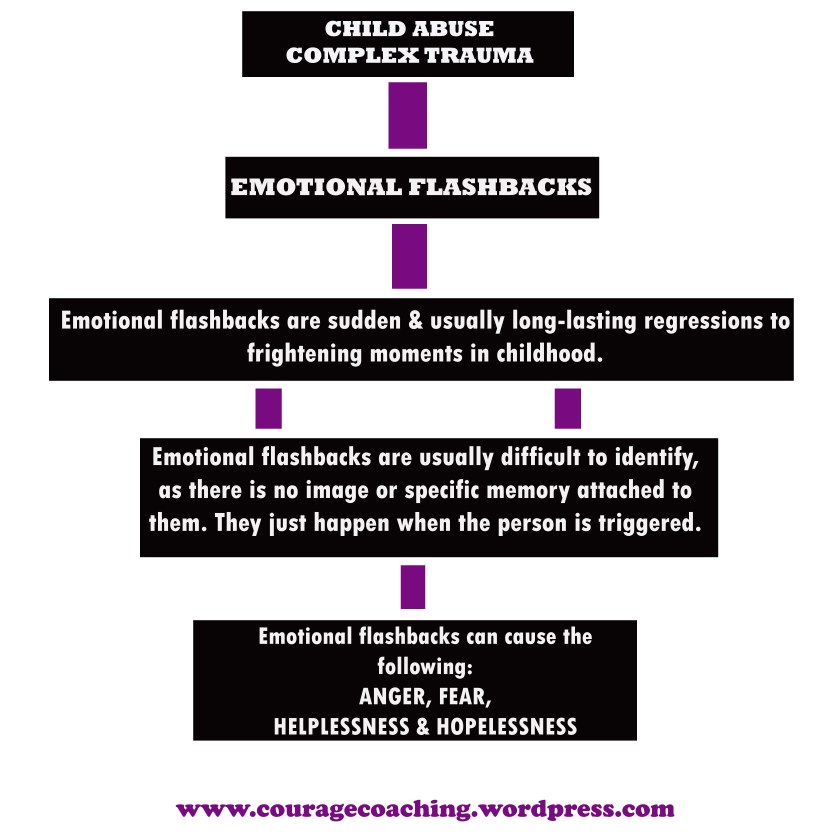
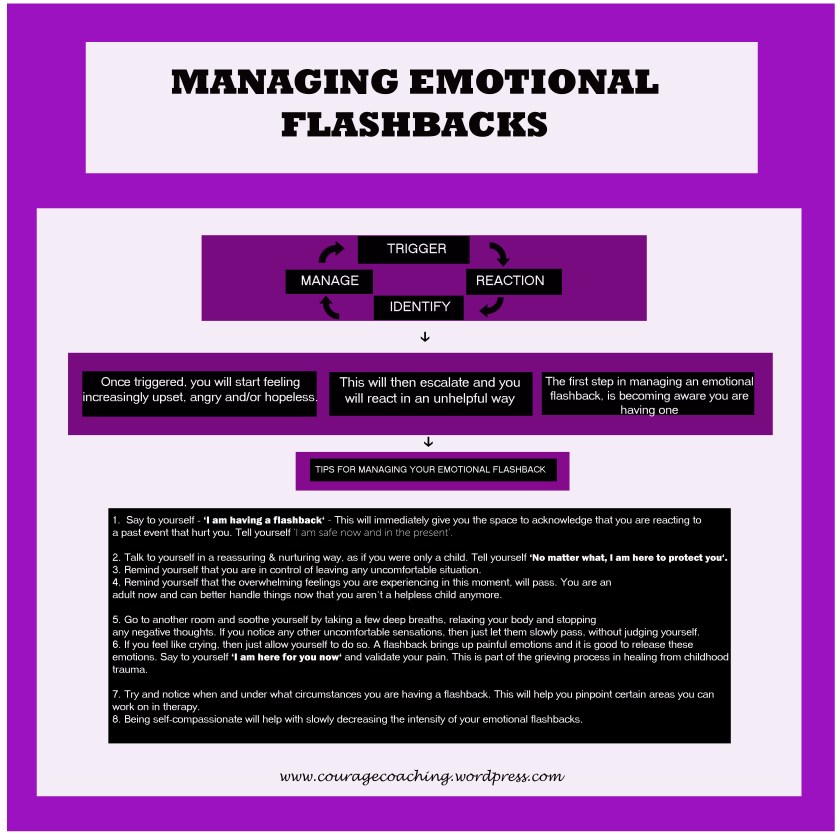
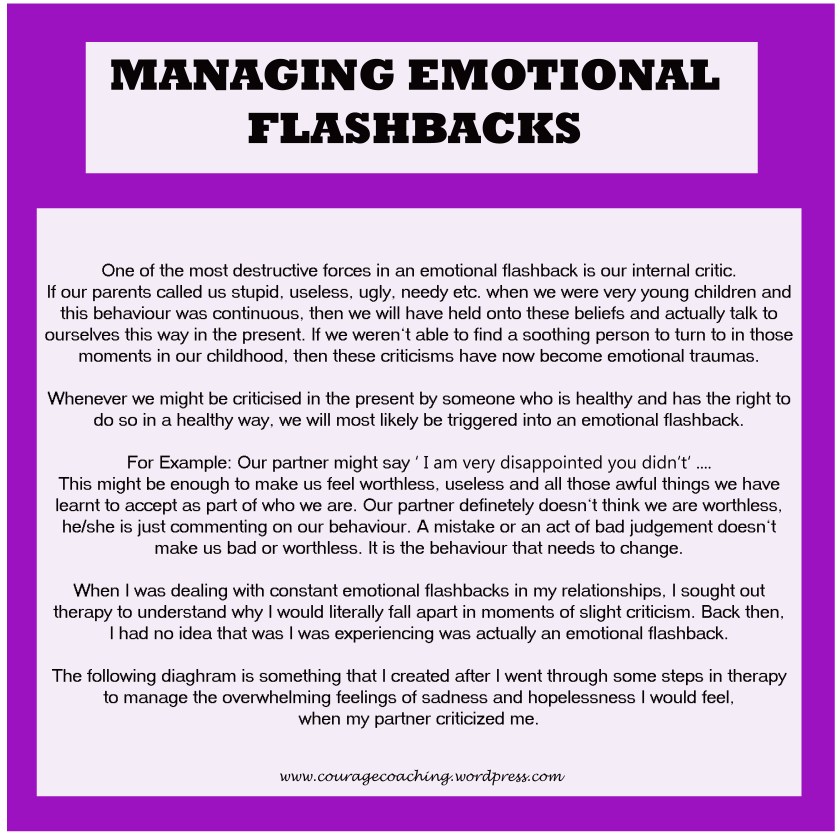
This blog post might be useful to anybody out there who suffers with Complex PTSD, who has suffered from childhood abuse or who has a loved one who suffers with a mental illness. I have created the below charts to assist those of you who might need a clearer map of how complex trauma affects individuals and why they might have moments of overreacting to criticism, an angry tone of voice or a stern look. Emotional flashbacks are explained and a list of coping skills are included, which I have used extensively throughout my own healing over the last 4 years. I find that boxes, colours and diagrams are very useful for me to remember things, especially because my own Complex PTSD affects my memory and cognitive function. Forgive me if there are any errors.

Please note that I have also added links under each image, so you can download these diagrams for your own free use.

Below is also a video I just did on YouTube! It is around 7 minutes long, if you can bare it 😉

emotional flashbacks 2

https://drive.google.com/file/d/0B7k454c6xtmnUWJxaFJZd1VILTQ/view?usp=sharing


emotional flashbacks


https://drive.google.com/file/d/0B7k454c6xtmnQ3VXZmVzOU9fZk0/view?usp=sharing

diagram of emot

https://drive.google.com/file/d/0B7k454c6xtmnMDNDdnQyRUlEeXM/view?usp=sharing


Thanks for reading

Much love Athina ♥

© All blog posts and images are owned by me and Courage Coaching. Please don’t use without consent and only re-blog if you would like to use the information on here.

YouTube video-How to protect yourself from a narcissist

Dealing with a narcissist in a safe way is very important for your well-being, especially if you aren’t able to avoid them and go ‘no contact.

Child abuse

A poem about Child abuse ❤

mychildwithin's avatarmy child within

OLYMPUS DIGITAL CAMERA

You gave me life

yet took my light

and always thought that you were right.

No matter what

I tried to do

your actions always made me blue.

I needed love

I needed protection

you gave me fear

and constant rejection.

I always wanted to shine my own light

you kept me small and scared of the night..

I yearned for love

I yearned for safety

I wanted a family

to hold me gently.

Instead I found more toxic pain

with men who treated me the same.

Child abuse is very real

you can’t just ‘get over it’

you need to heal.

My Child within

View original post

10 tips – How to choose a healthy partner after an emotionally abusive relationship


Blocks to healthy self-assertion

Being assertive can come very easily to many of us whilst some of us might have an extreme difficulty in this area, due to many of the following blocks as stated by Hauck (1981b):

FontCandy (49)

1.Fear of injury -Physical violence may be threatened or unleashed in order to keep you in line. This might be the case in an abusive relationship.

2. Fear of failure

3. Fear of hurting other people’s feelings-For example, if I tell him that ‘his gift wrapping is not very good, I might hurt his feelings’

4. Fear of rejection– For example: I couldn’t cope if they criticised me or abandoned me

5.Fear of financial insecurity- For example, you stay in a job you hate because you are worried about financial instability if you leave.

According to Trower et al (2011)there are these 2 blocks:

1.GuiltYou believe it is wrong to assert your own wishes because you believe this is selfish behaviour or you don’t feel worthy enough.

2.Damning anger– You end up blaming others for frustrating you by insulting or hurting them. For example, you might say ‘You are such a lazy and slow worker’ rather than saying ‘I would like to talk about how we could equally distribute the work load between yourself and Adam’

According to Gilbert (2000) there are these blocks to being assertive:

1.Loss of control– Assertion can involve high psychological arousal which might lead to shouting at your partner.

2.Fear of counter attack– After you have asserted your complaints, you fear being overwhelmed by the other person’s response. You fear blushing, you mind going blank or maybe even getting tongue tied. You fear looking worse off after asserting your wishes.

3.Self-blame– You might blame yourself for causing tension or conflict by asserting your needs.

4.Positive self– You view lack of assertiveness as having positive qualities of being kind and caring.

Assertiveness in general will help you get more of what you want and less of what you don’t want but there is the possiblity that it might not always work out in the way that you hope. If you have been someone who isn’t assertive and suddenly start asserting yourself with familiar people in your life, things may become increasingly uncomfortable with those people, as they aren’t used to you being assertive. People don’t like change!

Which of these blocks do you struggle with? If not, feel free to share your experience of being self-assertive.

Thanks for reading

Much love Athina ♥

© All blog posts and images are owned by me and Courage Coaching. Please don’t use without consent and only re-blog if you would like to use the information on here.

The importance of self-reflection & self-awareness

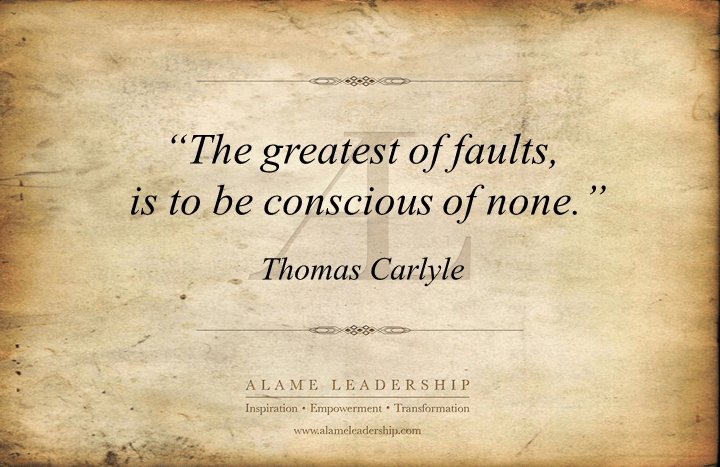
69125-quotes-about-self-reflection

This quote speaks to me in so many ways..

Through coaching, I aim to guide people find their answers through enabling them to self-reflect on where they are at currently and where they want to be. Self-reflection is very important in the process of change, as is persistence (which I talked about in this previous blog post- The importance of persistence).

The driving force behind change, is when an individual is able to look at their current life and notice that there is something negative popping up for them. If we feel negative or sad about something, then this can be the one thing that pushes us to make lasting change. If we don’t have self-awareness however, we remain stuck in a sad or negative existence and just keep repeating the same mistakes or habits over and over again.

As a survivor of complex trauma, I luckily became self-aware from a young age. I noticed I was struggling more than other children at school and had really low confidence. I found it very difficult to focus on school work the older I got and when I hit 15 I was already very depressed.I used art & poetry as a way to self-soothe and manage my emotional pain and luckily sought therapy when I was 17.

Over the years, with extensive therapy, I learned to tap into my emotional self-awareness even more. I continued to question my choices and behaviours and realised that actually it wasn’t my fault I was so sensitive and depressed but actually that my parents were both narcissistic, specifically with NPD. I was diagnosed at 29 as having Complex Post Traumatic stress and was told by my therapist that I was incredibly resilient and able to self-reflect a lot more than most of her clients. I left the session that day happy to be someone with self-awareness and wouldn’t change this for the world!

Self-awareness is incredibly hard for people with NPD, as well as the ability to feel empathy for others. When a healthy individual hurts others and causes them distress, they usually genuinely apologise and try to make a change for the better. For people that are aware of their actions, of their flaws, are sensitive to their body sensations, sensitive to their health and are also able to make sensible choices, change comes more easily.

What are your thoughts? How destructive have you found people that lack self-awareness?What difficulties have you had? Are their times when it took you a few failed attempts to finally have an epiphany about an unhelpful behaviour you may have had?

Thanks for reading

Much love Athina ♥

© All blog posts and images are owned by me and Courage Coaching. Please don’t use without consent and only re-blog if you would like to use the information on here.