How does codependency start?

Hello to all of you 🙂

I hope you are all well or at least trying to be.

Thank you to those of you who have recently followed my blog and youtube channel.I am very grateful. Tomorrow I have the morning off my German class so will be catching up as much as possible on all your posts and comments.Despite my busy schedule at the moment, I have still been managing to upload videos to Youtube every week and luckily the topics I talk about are still helping a few of you.

The Q & A videos have been a success and I still have quite a few unanswered emails to sort through, so please bear with me.

The Christmas break (although most definetely not my favourite time of year) will give me the opportunity to do more videos in response to your questions.

Today’s YouTube video focuses on the cycle of codependence and how is starts & worsens over time.

tumblr_mrdkpzygce1s43hlxo1_500

Codependency is very real and is a result of living in a home with an alcoholic parent, an abusive parent or a parent with a mental illness. Codependency develops when you put your own needs & feelings aside as a child, to care for & comfort a sick parent. Not everyone agrees with this point of view, however I have been through it and know the challenges associated with it.

Reaching out to all of those who struggle with their mental health means the world to me, especially to those who have suffered trauma and live with the result of this trauma.

I know how it feels to be invalidated.

I know how it feels to be called too sensitive or to just get over it.

Stigma towards mental illness is very much alive.

By sharing your experiences and spreading awareness in any way possible, this helps others understand better what it might be like for those who struggle.

If you can relate to this video, or think it will help someone you care about, then please share it with love ♥

Hugs Athina ♥

© All blog posts and images are owned by me and Courage Coaching. Please don’t use without consent and only re-blog if you would like to use the information on here.

Question & Answer- YouTube videos

Today I am starting off my series of Q & A videos, where my viewers and subscribers are able to get their questions answered by me, in a video each week. Please feel free to ask me questions on the following topics:

  • Complex PTSD
  • Narcissistic abuse
  • Dysfunctional relatioships
  • Negative thinking
  • Dealing with emotional flashbacks
  • Anxiety
  • Depression
  • Trauma Bonding
  • Toxic shame
  • Codependency

I also am happy to answer questions on how to :

  • Better manage your time
  • Practice self-compassion
  • Develop resilience
  • Stop self-defeating thinking patterns
  • Better manage your workload
  • Build confidence
  • Set boundaries
  • Deal with toxic people

Here is the first video on a question asked by one of my viewers:

Please note: **I will always keep the identity of my viewers confidential**

Thanks for reading and watching

Love Athina ♥

© All blog posts and images are owned by me and Courage Coaching. Please don’t use without consent and only re-blog if you would like to use the information on here.


Recovery from abuse- 3 basic stages & how to identify whether you have reached the acceptance stage of recovery

Happy Monday fellow bloggers. This is quite a late post, so I hope it reaches some of you.

I have just done another video on YouTube, where I talk about the 3 main stages of recovery that someone goes through, in particular concerning the recovery from childhood narcissistic abuse. I also talk a little bit about the acceptance stage of recovery, which I personally found the toughest in my own recovery.

Acceptance that you parents weren’t able to love you unconditionally, is a painful, rejecting reality. It is easier to spend most of your adult life being in denial of this, as it is such an incomprehensible reality to accept.

Once you are able to reach this stage of acceptance however, you feel like a huge burden has been lifted off you.

I wish all of you who struggle with this sort of realisation, to be able to finally reach this stage one day.

Love Athina ♥

© All blog posts and images are owned by me and Courage Coaching. Please don’t use without consent and only re-blog if you would like to use the information on here.

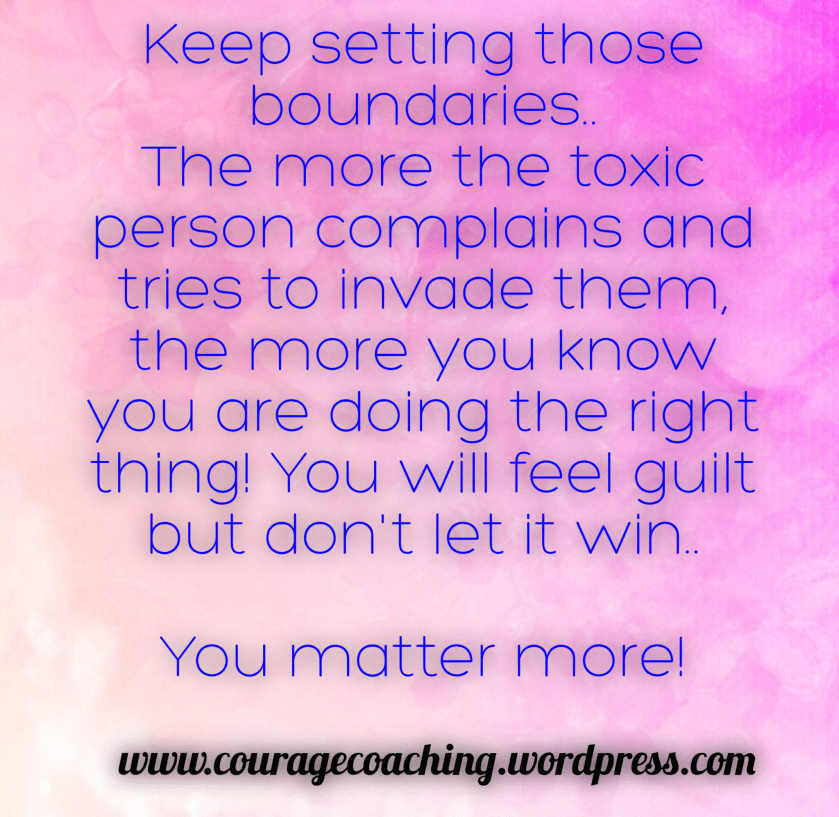
Setting boundaries with toxic people

FontCandy (86)

Love Athina ♥

© All blog posts and images are owned by me and Courage Coaching. Please don’t use without consent and only re-blog if you would like to use the information on here.

5 tips on healing codependency & dysfunctional relationships

This video is the 2nd one of my codependent series on my Youtube channel.

It is mostly informational in text, with the help of a few cute characters! Just the way I like it! ♥

Feel free to re-blog or share 🙂

I love cute things and music…so here you go ♥

Love Athina ♥

© All blog posts and images are owned by me and Courage Coaching. Please don’t use without consent and only re-blog if you would like to use the information on here.

Codependents & Narcissists in a relationship. Why are they so attracted to each other?

Happy Monday to all of you! It’s the 1st of August today and time seems to have flown by so quickly!

Today’s post is about another topic very close to my heart, due to my own healing journey from codependency to healthy love. It most definetely wasn’t easy to get to where I am. It required perseverance, determination and a little bit of hope.

To heal from dysfunctional relationships & codependency, there are 5 steps that are important to take.Having a therapist who specialises in healing from codepedency, is important in guiding you.

  • The first step is becoming AWARE that your choices or actions are dysfunctional.
  • The second step to changing dysfunction is understanding the source of the dysfunction, so where did it come from?
  • The 3rd step is grieving the loss of a healthy childhood. An abusive childhood usually leads to poor choices in relationships & life in general. Without a stable & nurturing childhood you never learn healthy love, healthy boundaries & your emotional regulation is damaged.
  • The 4th step is understanding the complexity of changing self-defeating behaviours & changing certain defense mechanisms, that protected you in your childhood but no longer serve you in adulthood. It takes time, patience and self-compassion.
  • The 5th step is actually trying out new relationships when you have made progress in your healing. You have to make a few more mistakes and discuss these with a therapist by your side, so you can see where you went wrong and how to improve this next time.

When I first found out I was codependent back in 2008, it was like the blindfold was taken off my eyes for the first time. Before learning this, I had a suspicion that something wasn’t right in my relationships but I had no idea how to change this.

I felt like I was in an emotional maze and had no idea which way to go. Everytime I thought I was making better choices in regards to who I was in a relationship with, the more unbearable the heartbreak became.I desperately wanted to be loved but wasn’t able to figure out this painful puzzle! At some point I was so exhausted from the traumatic end of each relationship & the subsequent self abandonment, that I decided to move countries! I wanted a new start…I hoped that I might meet my future husband if I moved away but I never in a million years thought I actually would..Sometimes you need a little bit of luck too!

When I moved back home to Greece after 11 years of living in the UK, I was met with more drama, a flare up of my CPTSD and a father who abandoned me over and over again. I was back in therapy again with a new therapist and was finally diagnosed with CPTSD. I was told both my parents were ’emotionally handicapped’ but that therapist never told me my parents were narcissistic. Maybe she decided at the time that it wasn’t relevant to me.

Despite this she looked after me very well. Each step I took into uncertainty, she held my hand.

I was also entered into a group psychotherapy group and it was extremely beneficial. I was in a group with 5 other people that also had similar backgrounds and it was very healing.

Support is crucial in healing. Without all this I would never have made progress.

The video above is a simple explanation (I hope) of the general dynamics of a codependent & narcissist in a relationship. Maybe you will see yourself in this and get curious. If you do, then please connect with me and I would be happy to have a chat with you.

Please feel free to re-blog this post so it reaches more people! Thank you 🙂

Much Love Athina ♥

© All blog posts and images are owned by me and Courage Coaching. Please don’t use without consent and only re-blog if you would like to use the information on here.


Are you a chronic over-explainer?

Where does over-explaining stem from?

People naturally feel the need to make sure their point of view is clearly understood when in conversation with someone else. Nobody wants to be misunderstood when expressing an opinion or thought.

What happens however when someone feels the need to always over-explain something?

IMG_0926

Is this something that stems from an underlying anxiety, that they will be misunderstood?

Yes

Is this also something that happens because in the past they might have been misunderstood quite a lot and for this reason they have to make sure it doesn’t happen again?

Absolutely..

Does over-explaining ever make you think, that the person doing the over-explaining, must think that the person they are over-explaining to must be stupid. Does this make sense?

I have been on both sides of this. I have over-explained to someone who got what I was saying from the first sentence and said I didn’t need to explain further. They said, I am not stupid, I get it. I have also been over-explained to and could immediately tell that the other person was anxious and insecure about something.

In my experience, many individuals who suffer from low self-esteem or people-pleasing, have an almost compulsive need to over-explain. This usually stems from childhood abuse, where either 1 or both parents were unable to meet the child’s needs and were unable to understand the child’s feelings. If parents don’t have empathy, are self-centered and dont have the ability to genuinely listen and understand, then a child will chronically feel frustrated, misunderstood and alone.

Have you ever tried to explain a simple concept such as sadness or feeling alone to a person who lacks empathy?

The reply is usually uncaring and hurtful.

Have you ever tried to reason with someone who has a low IQ and has intellectual disabilities?

They are not able to understand certain simple concepts because they just aren’t able to and if you insist on trying to make them understand, you can make yourself feel crazy with frustration.

When does over-explaining become chronic?

This usually happens when someone is unable to simply state something, that doesn’t need explaining, to someone who hasn’t even asked for an explanation. It becomes chronic when a person feels the need to explain in great detail and repeats themselves over and over again.It becomes chronic when it is a habitual thing that someone does all the time, even with people that are understanding and empathetic.

The particular thing I would like to highlight in this post, is that over-explaining becomes habitual for people who have suffered narcissistic abuse. If you are constantly around someone who makes you doubt yourself by gaslighting you, who doesn’t validate and understand your feelings and always tries to manipulate you, then it is only natural that you will be chronically frustrated when communicating..

I would love to hear your thoughts on this..

© All blog posts and images are owned by me and Courage Coaching. Please don’t use without consent and only re-blog if you would like to use the information on here.

Much Love Athina ♥

How to be assertive-Steps to healthy self-assertion

This post is the last one on assertion and hopefully the most useful to those of you who struggle with being a people-pleaser and/or are quite passive in your relationships with others.There is also a YouTube video attached for those of you who are auditory & visual learners.

Here is a quick guide on how to be assertive:

  1. Firstly get the person’s full attention when you are trying to make an important point. This may seem like a given however it is important to ensure there are no distractions.
  2.  Describe in an objective way, what you are having difficulty with in regards to the other person’s behaviour. EXAMPLE: ” I said I wanted to speak to you and you have just turned on the tv”.
  3. Express constructive feelings using ”I” statements. Don’t say ”You completely ignored me”.Instead, choose to say ” I feel upset that you are not listening to me”. It is ok to state feelings of disappointment & annoyance, as these are constructive feelings.
  4. Check your statements & make sure the other person gives you a response. This will hopefully enable some sort of resolution later on. EXAMPLE: ”I feel that you are hiding something from me. What do you think about this”?
  5. Listen to the other person’s response with an open mind and give feedback in a controlled manner.  Avoid dismissing the reply as soon as it is given.
  6. State your preferences clearly. EXAMPLE: ”I would like if you could always be honest with me”.
  7. Request agreement from the other person.If they don’t agree or try to avoid the subject, clearly state ”Are you willing to make any changes?”
  8. Communicate any relevant information concerning future occurences.State what you will do if the same problem re-occurs.

Blocks to healthy self-assertion

Being assertive can come very easily to many of us whilst some of us might have an extreme difficulty in this area, due to many of the following blocks as stated by Hauck (1981b):

FontCandy (49)

1.Fear of injury -Physical violence may be threatened or unleashed in order to keep you in line. This might be the case in an abusive relationship.

2. Fear of failure

3. Fear of hurting other people’s feelings-For example, if I tell him that ‘his gift wrapping is not very good, I might hurt his feelings’

4. Fear of rejection– For example: I couldn’t cope if they criticised me or abandoned me

5.Fear of financial insecurity- For example, you stay in a job you hate because you are worried about financial instability if you leave.

According to Trower et al (2011)there are these 2 blocks:

1.GuiltYou believe it is wrong to assert your own wishes because you believe this is selfish behaviour or you don’t feel worthy enough.

2.Damning anger– You end up blaming others for frustrating you by insulting or hurting them. For example, you might say ‘You are such a lazy and slow worker’ rather than saying ‘I would like to talk about how we could equally distribute the work load between yourself and Adam’

According to Gilbert (2000) there are these blocks to being assertive:

1.Loss of control– Assertion can involve high psychological arousal which might lead to shouting at your partner.

2.Fear of counter attack– After you have asserted your complaints, you fear being overwhelmed by the other person’s response. You fear blushing, you mind going blank or maybe even getting tongue tied. You fear looking worse off after asserting your wishes.

3.Self-blame– You might blame yourself for causing tension or conflict by asserting your needs.

4.Positive self– You view lack of assertiveness as having positive qualities of being kind and caring.

Assertiveness in general will help you get more of what you want and less of what you don’t want but there is the possiblity that it might not always work out in the way that you hope. If you have been someone who isn’t assertive and suddenly start asserting yourself with familiar people in your life, things may become increasingly uncomfortable with those people, as they aren’t used to you being assertive. People don’t like change!

Which of these blocks do you struggle with? If not, feel free to share your experience of being self-assertive.

Thanks for reading

Much love Athina ♥

© All blog posts and images are owned by me and Courage Coaching. Please don’t use without consent and only re-blog if you would like to use the information on here.

Dealing with criticism

shame-799099_1920

When someone criticizes us, it tends to touch a nerve and can sometimes leave us feeling very vulnerable, very angry and sometimes both!

This may be because there is absolutely no truth in the criticism and we feel it is completely unfair or actually because there is some truth in the criticism and we are just not ready to deal with it.

Being criticized is also especially difficult when the person criticizing us is someone we hold in high regard. It could be our boss at work or a new partner.

The thing that most people don’t realise is that criticism on it’s own isn’t what makes us upset. The meaning we attach to criticism is what affects us. As I mentioned in one of my previous blog posts, being a people-pleaser means that we give others too much power over our emotions and how we feel about ourselves. If others’ approval is extremely important, then we give them consent to always make us feel bad about ourselves.

In order to stay away from seeking approval, we have to learn to practice self-acceptance and only rate our actions or traits but not ourselves. We are responsible for our reaction to someone’s criticism and it is up to us to change how we respond.

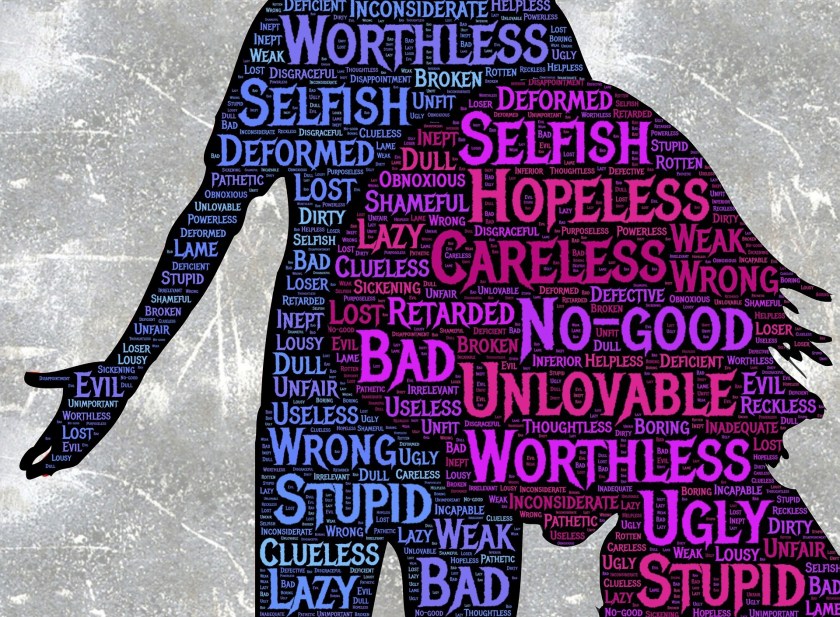
If we already have low self-esteem, then criticism will be especially hurtful and it could take us days to recover from it.

Are you someone who struggles from others’ criticism? Do you find that you always get overly upset when someone criticizes you or overly agree?  Do you avoid contact with that person after the criticism occurs? I would love to hear your experiences.

If you are a childhood abuse survivor, I am especially interested in your experiences. When you have internalised your parents’ negative and unhealthy criticisms, this will then follow you around and will be brought to the surface everytime someone criticizes you. This is actually quite a painful, traumatic reaction because a present criticism can send you into an emotional flashback of your parents’ abuse. This is something I am particularly experienced in through my own recovery from abuse but also through talking to others who still struggle with this internal self-critic.

Love Athina ♥

© All blog posts and images are owned by me and Courage Coaching. Please don’t use without consent and only re-blog if you would like to use the information on here.