Facebook page

Dear friends,

FontCandy (40)

I have added a facebook community page recently, which I am hoping to also use as a platform to talk about issues regarding self-improvement, practicing self-compassion, dealing with dysfunctional/toxic people and how to stop people pleasing!

If you are on facebook, then I would greatly appreciate if you stop by and say hi! 🙂

Love ♥ Athina

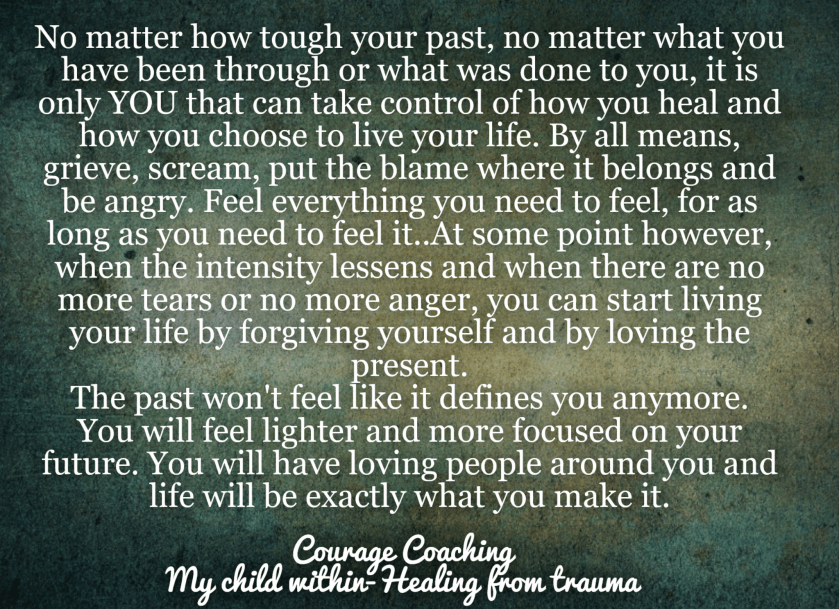
Take control of your own healing

FontCandy (38)

Every healing journey is unique to each person. No journey should be judged, minimised or discounted.

Whether it is childhood abuse, emotional, sexual or physical abuse, domestic abuse, grief, a single trauma or multiple traumas, nobody has the right to criticize someone else’s journey.

If you have compassion and maybe share what helped you, it doesn’t necessarily mean it will help others in the same way. Having compassion and empathy is so crucial. Listening, without trying to fix is also important.

After you reach a certain point in your healing, you will notice that things get easier. The intensity of certain emotions lessen and your sense of self-protection and boundaries are solid. If you suffer from a mental illness, it doesn’t necessarily mean it will go away. You eventually just learn to accept that it is a part of you and that you can handle it in a self-compassionate way.

What is your experience with healing?

Do you believe you will reach a point in your recovery where things eventually feel better?

Are you persistent in practicing self-care and healing with appropriate professional support?

Don’t forget that healing is a very up and down process. It isn’t always straightforward. Sometimes just as you are starting to feel better, something else comes along which needs processing. It might feel that you are back to square one again but this really isn’t the case.

Changes happen in very small ways sometimes and it depends on whether you have regular support.

Always be kind to yourself and others going through a process of healing ♥

Love Athina ♥

© All blog posts and images are owned by me and Courage Coaching. Please don’t use without consent and only re-blog if you would like to use the information on here.


 

Self-care chart

my self-care chart - courage coaching

When you are struggling from a mental illness, self-care can sometimes take a back seat.

You forget or are unable to eat properly. You have trouble sleeping which then results in not having the motivation and energy to do much at all. You can become more isolated when trying to cope and can even forget to ask for support.

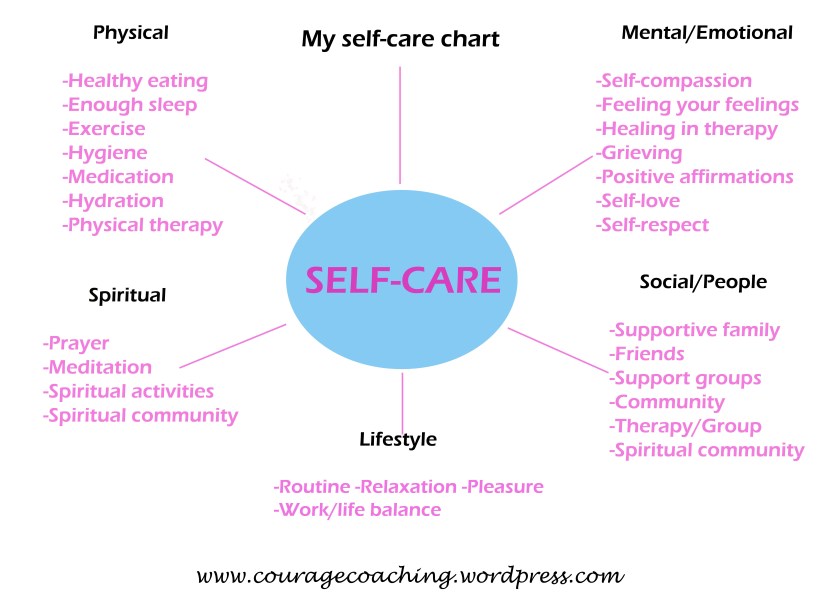
This little chart above gives you a little insight into the important things to consider.

The 2 most important areas in my opinion are physical and mental self-care but a balance amongst all 5 of these areas is crucial, as they are interlinked.

If you feel that there are any areas of self-care that you are particularly struggling with, then please let me know in the comments below. I would be happy to help you come up with an easy action plan, that might enable you to move forward.

Love Athina ♥

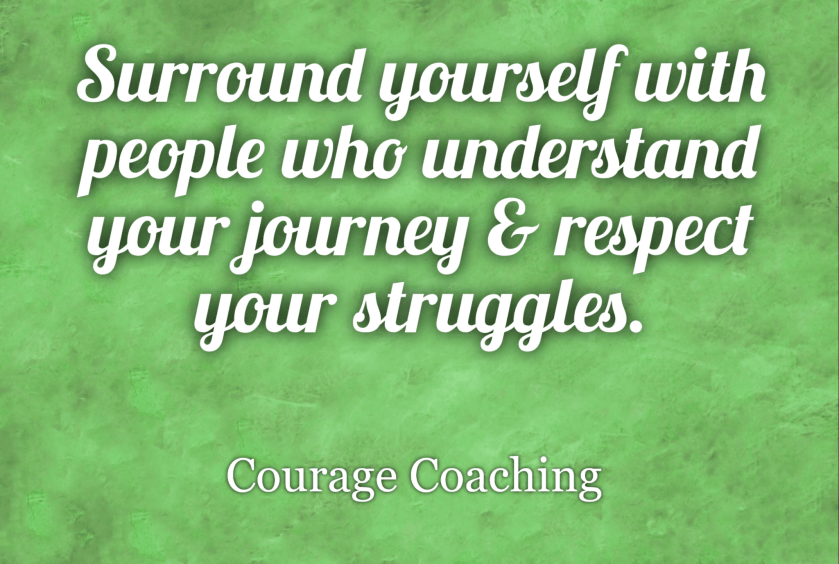
Surround yourself with supportive people

When you suffer from a mental illness it is very difficult to feel hopeful when you are really struggling.Every day can be a battle and those negative thoughts can be very hard to silence. Sometimes feelings can overcome you at the most inappropriate times and others may think you are overreacting or being a drama queen. Paying close attention to the people in your life can determine how much your overall mood is affected. If you are an empath or highly sensitive person, you suck in other peoples’ emotions like a sponge. For this reason, you need to have the right kind of people around you or limit your time with those who aren’t enriching to your life.

Think about how the people in your life make you feel 80% of the time? Are they supportive & uplifting? Are they encouraging and empathetic? Do they understand your struggles and offer to help?

This is very important when you have a low tolerance for stressful situations due to a history of toxic child abuse. When complex trauma is part of your life, you need to feed your brain with the things you were starved of as a child. You should provide yourself with unconditional love, acceptance, validation and comfort. It is also important to have friends and family that can also provide these things for you.  It might feel unnatural at first and almost feel silly to tell yourself that you are worthy and lovable every day, however this is what your brain needs. It needs a new healthy habit!

Recent studies have shown that victims of childhood abuse and combat veterans actually experience physical changes to the hippocampus, a part of the brain involved in learning and memory, as well as in the handling of stress. The hippocampus also works closely with the medial prefrontal cortex, an area of the brain that regulates our emotional response to fear and stress. PTSD sufferers often have impairments in one or both of these brain regions. Studies of children have found that these impairments can lead to problems with learning and academic achievement.

We know that psychotherapy can really help survivors of severe trauma and also we know that EMDR is very helpful for reducing nightmares, flashbacks & overwhelming emotions.What you do for yourself however is equally important as you are the person that feels, thinks and reacts to your surroundings 24/7! It has been proven that with a mixture of validating affirmations, manageable goal setting, therapy and loving relationships, people can improve the quality of their life dramatically, especially in regards to their overall outlook.

FontCandy (29).png

Breaking the cycle of your childhood abuse-Start being kind to yourself

FontCandy (24)

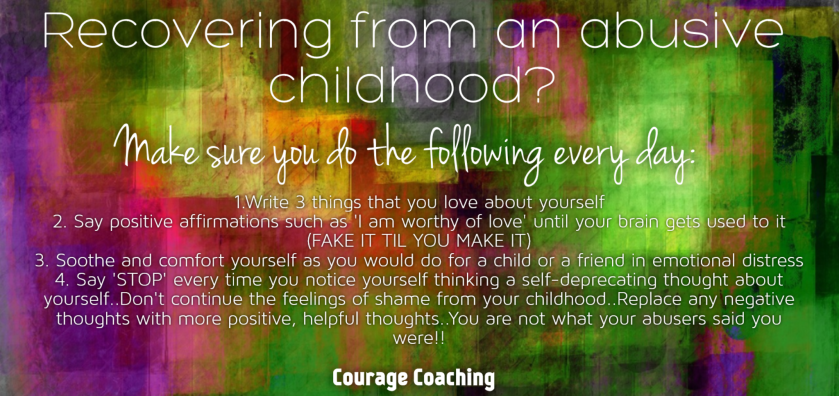
Of course it isn’t as simple as the 4 things written in the photo but it is definetely true that in order to break the horrible pattern of abuse from your childhood, you have to stop abusing yourself. YOU hold the answers to how much you will recover and it is up to you to start changing your thought patterns day by day..Nobody ever said it would be easy but it is possible..

The internalised messages of ‘You are not good enough, you are stupid’ are just repeats of what your abusers told you. They aren’t the ‘real’ you! The real you is a worthwhile person who deserves love and happiness.The real you is a person who deserves to heal and doesn’t need a nasty inner critic. With the help of a therapist or a coach, you can keep yourself on track. By having someone to report to, this might help you be more motivated. It is very important to keep trying as your brain needs sustained effort to learn ‘new, healthier messages’. That is why it is important to practice the above steps every day.

Your brain needs time to destroy the old habit wiring already in existence and then build new wiring for your new empowering positive affirmations.

Whatever your mind keeps hearing, it will eventually accept as truth. So what you want to do is to start repeating your new positive thoughts to yourself. Do it constantly. Do it repeatedly. Do it daily. Do it with passion, conviction and belief.

Mother’s Day when you had an abusive mother

IMG_0926

Practicing self-compassion when you didn’t have a nurturing mother is very important.

To not feel like celebrating your mother on Mother’s day is completely understandable when she was abusive, overly critical, neglectful & selfish.

The same goes for Father’s day or any other major holiday that focuses on the family unit.

If you are still in contact with an abusive parent, please don’t feel guilty about not doing anything if that is how you truly feel. If your mother complains to you about not doing anything, don’t let her complaints affect you.

If you do decide to send your mother a card, please don’t feel guilty if you can’t write anything in it that is warm and loving. Maybe a card that simply states ‘Happy Mother’s Day’ is enough!

In any case, it is a personal choice and nothing is right or wrong.  Just go with your feelings and be kind to yourself.