Women’s only support group – Daughters of narcissistic mothers

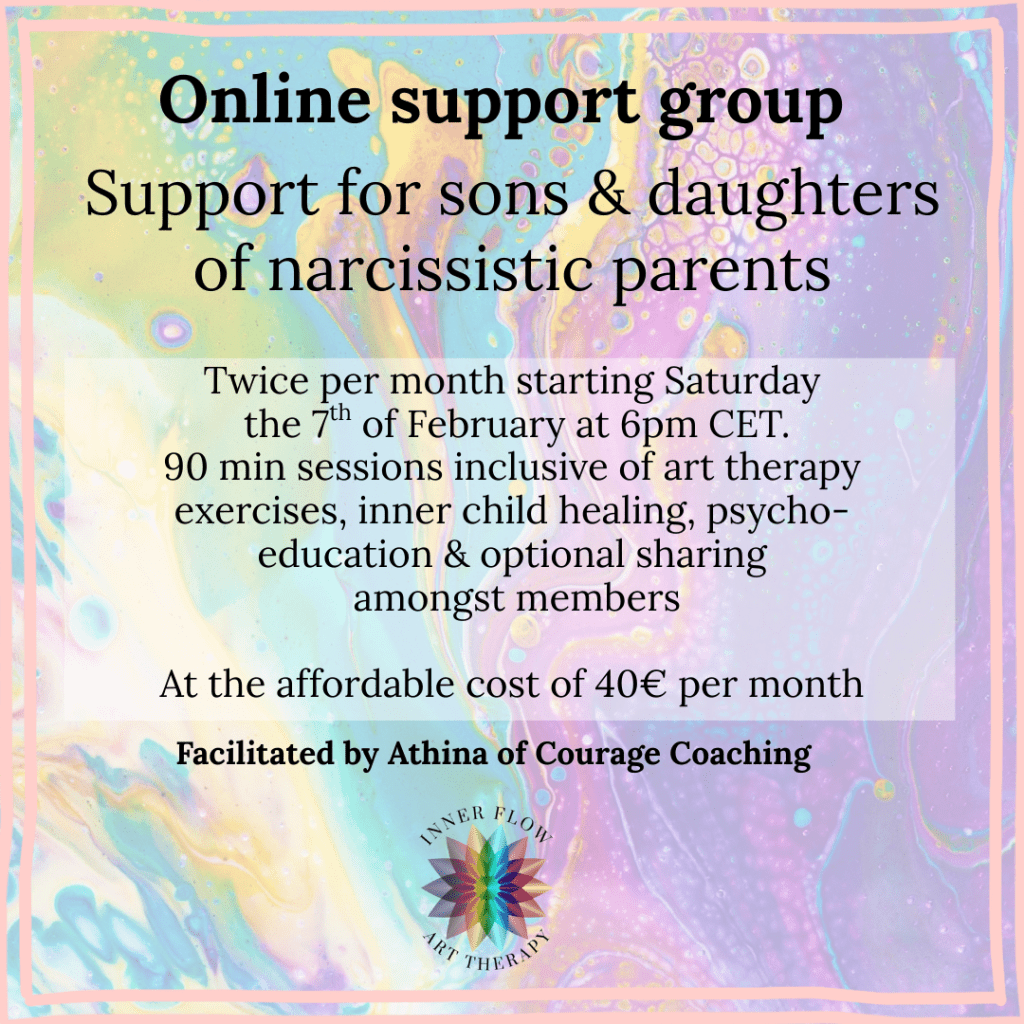
For those of you who didn’t manage to join my 1st support group for adult children of narcissistic mothers, I am also starting a 2nd online support group which is exclusively for daughters of narcissistic mothers.

If you struggle with symptoms of trauma, with feeling isolated on your healing journey and with feelings of shame or low self-worth, then this support group will help you!

Growing up with a narcissistic mother can leave deep wounds — confusion, guilt, low self-worth, and complex grief. This safe online support group is here for daughters recovering from narcissistic maternal abuse, offering understanding, validation, and tools for healing.

💜 What you’ll find here:

A safe, judgment-free space to share your story

Connection with others who truly “get it”

Support for breaking cycles of guilt, shame, and gaslighting

Gentle strategies for boundaries, self-care, and inner healing

There will be two 90min online video calls per month with a maximum of 8 people. This will be a closed support group which fosters a safe, confidential and deeper level of intimacy and trust among members. This means that the same people only will be a part of this group, without any new people joining.

Talking to others in support groups reduces anxiety, improves self-esteem, and helps members’ sense of well-being overall.

It will initially run for a total of 6 sessions, over a period of 3 months and we will then reassess how to move forward.

If you are interested in joining this online support group, please email me at courageisallyouneed@gmail.com or leave a comment below with your name and email.

I will be facilitating this online group and I very much look forward to welcoming you!

Love Athina

NEW online support group for daughters & sons of narcissistic mothers

If you struggle with symptoms of trauma, with feeling isolated on your healing journey and with feelings of shame or low self-worth, then this support group will help you! 

Growing up with a narcissistic mother can leave deep wounds — confusion, guilt, low self-worth, and complex grief. This safe online support group is here for adult children recovering from narcissistic maternal abuse, offering understanding, validation, and tools for healing.

💜 What you’ll find here:

  • A safe, judgment-free space to share your story
  • Connection with others who truly “get it”
  • Support for breaking cycles of guilt, shame, and gaslighting
  • Gentle strategies for boundaries, self-care, and inner healing

There will be two 90min online video calls per month with a maximum of 8 people. 

This will be a closed support group which fosters a safe, confidential and deeper level of intimacy and trust among members. 

This means that the same people only will be a part of this group, without any new people joining. 

Talking to others in support groups reduces anxiety, improves self-esteem, and helps members’ sense of well-being overall.

It will initially run for a total of 6 sessions starting in October (precise dates to be announced) over a period of 3 months. When we are close to the end of the 3 months, I will then reassess how to move forward with the support group.

If you are interested in joining this online support group, please email me at courageisallyouneed@gmail.com or leave a comment below with your name and email.  

I will be facilitating this online group  and very much look forward to welcoming you! 

Athina

Narcissistic mother & passive/enabling father

Growing up with a narcissistic mother is very painful and isolating. If you are lucky enough to at least have an empathetic father, that alone can help you feel a little less alone. What happens however when your father is really loving and caring towards you but unfortunately fails at the part where he has to protect you from your mother’s abuse? When he isn’t strong enough to stand up to his wife’s demands, he also lets you down and enables your mother’s abuse.

It is especially tough when he tells you in private that he knows your mum is a difficult person but still doesn’t protect you from her hurtful actions. This still leaves you feeling hopeless as you don’t truly have your father on your side.

If this is you, then watch my most recent video below.

Love Athina

Parentification

In today’s video, I talk about another type of child abuse known as parentification.

Parentification isn’t always through the known fault of a parent, as sometimes in single parent families or in families with a special needs child, the parent struggles to keep the needs of the child fulfilled appropriately. Sometimes, the parent may be also suffering from a severe disability such as a chronic condition or severe mental health difficulties, and it is only natural that the child may at times become a carer to the parent. This is especially true, if there isn’t an additional parent or family member around to support the child.

Unfortunately, in a family where 1 or both parents suffer with narcissistic personality disorder, this type of abuse is even more prevalent in both a physical and emotional way.

My video describes this in more detail:

If you have experienced parentification, then feel free to share your experience.

If you find this youtube video and blog post useful, then please like, share & subscribe.

Please support my youtube channel on my patreon page. There are exclusive patron only videos on there, which are available specifically to those of you who contribute & become patrons.

https://www.patreon.com/AthinaEhlen

Love Athina ♥

© All blog posts and images are owned by me and Courage Coaching. Please don’t use without consent and only re-blog if you would like to use the information on here.

 

Infantilization

You might have heard of the term infantilization but you may not realise how incredibly abusive it is when a parent does this to their child.

It is only natural for a growing child to start developing independent thoughts, actions and opinions. For a narcissistic parent this can be very threatening, as they want to continue controlling their child and use them for narcissistic supply.

Check out my video for an explanation of what infantilization is.

Some examples of infantilization are as follows:

A parent stops a teenager from socialising with friends or doesn’t allow them any privacy in their bedroom. The parent may still treat them as if they are a young child whereas a teenager needs growing independence and privacy.

A parent buys their child age-inappropriate clothing and/or arranges age-inappropriate activities.

A parent might not allow the child to speak for themselves, when they are asked a question directly by somebody else.

A parent might discourage the child from pursuing new interests as they don’t want the child to become more skilled at new things than they are.

If a parent isn’t able to have healthy relationships, they may try to influence the child against their choice of partner. They can’t allow their child to leave the family nest. The parent wants to continue their enmeshed relationship for as long as possible.

The effects of infantilization are as follows:

  • The adult child ends up having chronically low self-esteem
  • The adult child has difficulties academically
  • The adult child may find getting a job difficult
  • The adult child learns helplessness and enabling
  • The adult child may self-harm
  • The adult child may have poor social skills
  • The adult child may self-sabotage
  • The adult child may become avoidant

If you can relate to any of what I have written or said in the video, then please re-blog so it reaches more people.

Knowledge is power and with knowledge comes healing. To also further promote healing on a larger scale, I have recently signed up to patreon to further support my creations of videos, pdfs & hopefully in the near future, e-books.

Patreon is a platform that enables creators to reach new goals by having their followers & supporters fund their work.

If you find my videos & blog posts helpful, then please check out my patreon page.

It would mean the world to me to be able to reach more people and help them on their journey of recovery.

https://www.patreon.com/AthinaEhlen

dumdum-patreon

Love Athina ♥

© All blog posts and images are owned by me and Courage Coaching. Please don’t use without consent and only re-blog if you would like to use the information on here.

 

Shame

Shame is caused by negative messages. The shame I am highlighting in this video is caused by dysfunctional parents. Shame is insidious and can have detrimental effects on the way we view ourselves and others.

This is something I am very familiar with as a survivor of narcissistic abuse and I want to highlight the cause of shame, so people can maybe identify with what might have been said to them as children and so they can find a way to move forward and heal.

Love ♥ Athina

© All blog posts and images are owned by me and Courage Coaching. Please don’t use without consent and only re-blog if you would like to use the information on here.
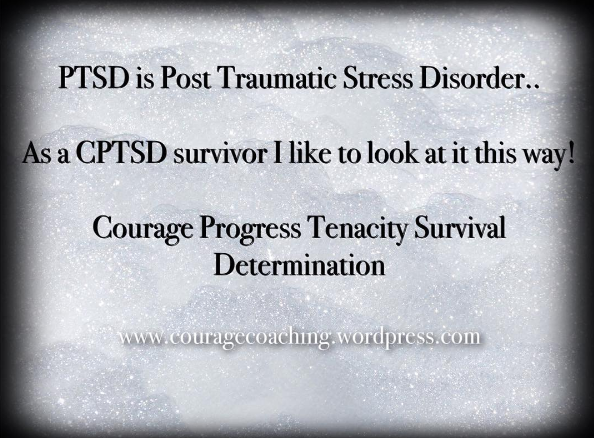
 

CPTSD= Courage Progress Tenacity Survival Determination

mychildwithin-healing_from_trauma-%e2%80%a2s-instagram-photos-and-videos4

Healing from PTSD is tough! Healing from Complex PTSD is even tougher.

In honour of World Suicide Prevention Awareness Day, I want to tell every single one of you survivors out there that you can look at your PTSD & CPTSD differently, just for today! ♥

C-PTSD = COURAGE PROGRESS TENACITY SURVIVAL DETERMINATION

Love ♥ Athina

© All blog posts and images are owned by me and Courage Coaching. Please don’t use without consent and only re-blog if you would like to use the information on here.

 

Recovery from abuse- 3 basic stages & how to identify whether you have reached the acceptance stage of recovery

Happy Monday fellow bloggers. This is quite a late post, so I hope it reaches some of you.

I have just done another video on YouTube, where I talk about the 3 main stages of recovery that someone goes through, in particular concerning the recovery from childhood narcissistic abuse. I also talk a little bit about the acceptance stage of recovery, which I personally found the toughest in my own recovery.

Acceptance that you parents weren’t able to love you unconditionally, is a painful, rejecting reality. It is easier to spend most of your adult life being in denial of this, as it is such an incomprehensible reality to accept.

Once you are able to reach this stage of acceptance however, you feel like a huge burden has been lifted off you.

I wish all of you who struggle with this sort of realisation, to be able to finally reach this stage one day.

Love Athina ♥

© All blog posts and images are owned by me and Courage Coaching. Please don’t use without consent and only re-blog if you would like to use the information on here.
Are you a chronic over-explainer?

Where does over-explaining stem from?

People naturally feel the need to make sure their point of view is clearly understood when in conversation with someone else. Nobody wants to be misunderstood when expressing an opinion or thought.

What happens however when someone feels the need to always over-explain something?

IMG_0926

Is this something that stems from an underlying anxiety, that they will be misunderstood?

Yes

Is this also something that happens because in the past they might have been misunderstood quite a lot and for this reason they have to make sure it doesn’t happen again?

Absolutely..

Does over-explaining ever make you think, that the person doing the over-explaining, must think that the person they are over-explaining to must be stupid. Does this make sense?

I have been on both sides of this. I have over-explained to someone who got what I was saying from the first sentence and said I didn’t need to explain further. They said, I am not stupid, I get it. I have also been over-explained to and could immediately tell that the other person was anxious and insecure about something.

In my experience, many individuals who suffer from low self-esteem or people-pleasing, have an almost compulsive need to over-explain. This usually stems from childhood abuse, where either 1 or both parents were unable to meet the child’s needs and were unable to understand the child’s feelings. If parents don’t have empathy, are self-centered and dont have the ability to genuinely listen and understand, then a child will chronically feel frustrated, misunderstood and alone.

Have you ever tried to explain a simple concept such as sadness or feeling alone to a person who lacks empathy?

The reply is usually uncaring and hurtful.

Have you ever tried to reason with someone who has a low IQ and has intellectual disabilities?

They are not able to understand certain simple concepts because they just aren’t able to and if you insist on trying to make them understand, you can make yourself feel crazy with frustration.

When does over-explaining become chronic?

This usually happens when someone is unable to simply state something, that doesn’t need explaining, to someone who hasn’t even asked for an explanation. It becomes chronic when a person feels the need to explain in great detail and repeats themselves over and over again.It becomes chronic when it is a habitual thing that someone does all the time, even with people that are understanding and empathetic.

The particular thing I would like to highlight in this post, is that over-explaining becomes habitual for people who have suffered narcissistic abuse. If you are constantly around someone who makes you doubt yourself by gaslighting you, who doesn’t validate and understand your feelings and always tries to manipulate you, then it is only natural that you will be chronically frustrated when communicating..

I would love to hear your thoughts on this..

© All blog posts and images are owned by me and Courage Coaching. Please don’t use without consent and only re-blog if you would like to use the information on here.

Much Love Athina ♥

Dealing with elderly narcissistic parents

As narcissists start ageing, things actually get much much worse.When they are no longer able to charm others with their good looks, good health & successful business, they start losing control over others and their mask starts to fall.

FontCandy (69)

Narcissistic people live their life as pathological liars and bullies, so as they age further, instead of maturing, they just get worse. They become more demanding, more cruel and more horrible in their elderly years.They still try to manipulate others but aren’t very good at remembering the lies they have told, so people  catch them out in their lies.Their immaturity and tantrums become even more evident and healthy colleagues,friends & family start distancing themselves even more.

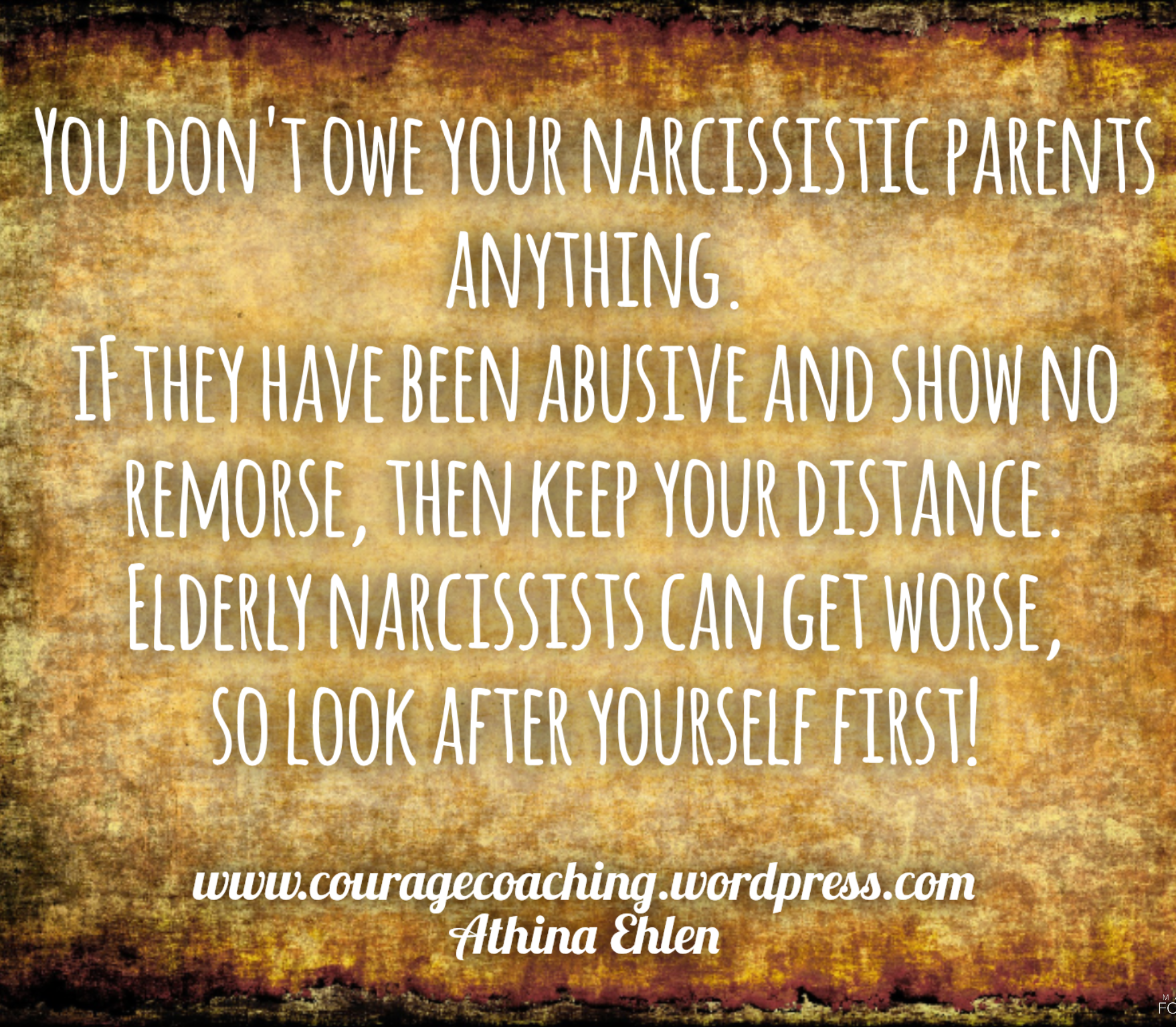
If you are someone who is emotionally struggling with an ageing narcissistic parent, just remember that you don’t owe them anything. You didn’t ask to be born into a family that was abusive. You don’t have to look after them when they are dying or when they are seriously ill. As a healthy son or daughter, your love is unconditional so they might exploit that for their own gain and still treat you like crap.

No matter what you decide to do, don’t do it out of guilt or because you feel you owe them for providing you with food and shelter.

You always have the right to walk away and look after yourself first.It doesn’t mean you stop loving them. It just means that you put your own health first.

Love Athina ♥

© All blog posts and images are owned by me and Courage Coaching. Please don’t use without consent and only re-blog if you would like to use the information on here.