
The aftermath of a traumatic incident

As much as I dislike watching the news and tend to limit what I take in, it is increasingly difficult to not be affected by the constant bombardment of war footage, terrorist attacks, murder and suffering.

When you are a highly sensitive & empathetic person, it is easy to get overwhelmed by the sadness of others. I am very much aware of the cruel injustice in our world and it hurts me deeply to see so many suffering. It is even tougher when this is repeated in your own country. Due to the fact that I know what it feels like to have your life threatened, I decided to make the following video on the aftermath of trauma. This is my small contribution towards all those affected.

Despite my traumatic childhood, I was also once caught up in armed robbery, where a gunshot went off right next to me and a woman was lying on the floor with blood on her leg. The disbelief of what I had witnessed was indescribable. The terror I felt shook me to the core. I couldn’t comprehend how someone could shoot a gun, when everyone at the cashier was cooperating and the robbers had managed to get their money.

This armed robbery happened at a time where I was very vulnerable already as my CPTSD was really bad. All I could think of after this robbery was ‘not again, not another trauma to add to my list’. Life felt so unfair and scary on that day and my mind was telling me that there was more damage done and that I would not recover this time.

If it wasn’t for my kind therapist at the time, to ground me and tell me that I wasn’t going to let this swallow me, I don’t know how I would have coped in the long term.

So this video is for those of you who are new to trauma. It is helpful in understanding yourself after a traumatic experience and it gives you the tools you need to ride the emotional waves that may at times feel like they are taking over.

Although I am not a qualified psychotherapist, I do have a lot of insight into trauma through my own journey and I know the many things that helped me, as well as others. If you are someone who is in deep distress, then please call a qualified mental health professional.

Thank you so much for reading & watching! ♥

Please share this post if you think it will help others.

Check out my patreon page below, if you would like to support the creation of more videos, documents and fact sheets.

https://www.patreon.com/AthinaEhlen

Love Athina ♥

© All blog posts and images are owned by me and Courage Coaching. Please don’t use without consent and only re-blog if you would like to use the information on here.
Finding a balance between self-soothing and running away from emotional pain is tough..

Inspired by a comment made by a friend on her facebook page, I wanted to address the difficulty of finding a balance between self-soothing and running away from emotional pain. I also wanted to write about what it actually means to self-soothe.

Self-soothing is about allowing yourself to experience any uncomfortable emotions by using healthy techniques to comfort and restore balance. Successful self-soothing doesn’t mean that you make the feelings more intense. It means that you will eventually enable the emotions to pass. Self-soothing is about tolerating an uncomfortable experience, without acting in ways that are not helpful in the long run. This is when running away from emotional pain comes in. If you choose to block your emotions or run from them, this will then make the emotions grow in intensity or come out in ways you didn’t intend in the future.

Running away from emotional pain looks like the following:

  • Compulsively drinking, smoking or self-medicating
  • Using meaningless sexual encounters to numb emotional pain or fear of abandonment
  • Compulsively working or keeping busy to avoid feeling
  • Sleeping too much to avoid feeling
  • Comfort or emotional eating – Eating too much sugar or fatty foods whenever you feel low
  • Compulsively exercising
  • Gambling
  • Compulsively shopping

Do you see a pattern here? The more addictively or compulsively you do something, the more it means you are running away from what needs to be dealt with. It’s like an ostrich burying its head in the sand — just because you are hiding from everything and pretending everything is okay, does not mean that it will be okay.

We are all guilty of running away from our emotions. Sometimes they are just too painful to deal with and nobody wants to feel pain of any sort.

My biggest vice seems to still be comfort eating. I love my cakes & biscuits unfortunately, although apart from those, I generally eat a very balanced diet. Chain smoking used to be my biggest coping mechanism from the ages of 15-22 but I am so glad that I was able to quit.

Luckily, I have become better at self-soothing. I have realised that the more I deal with my emotions, the better I feel in the long term.

When feelings are dealt with head on, you talk about them, you cry, you blog about them, you ask a friend for support and you do something in that moment that will help you feel a little better, safer or comforted.

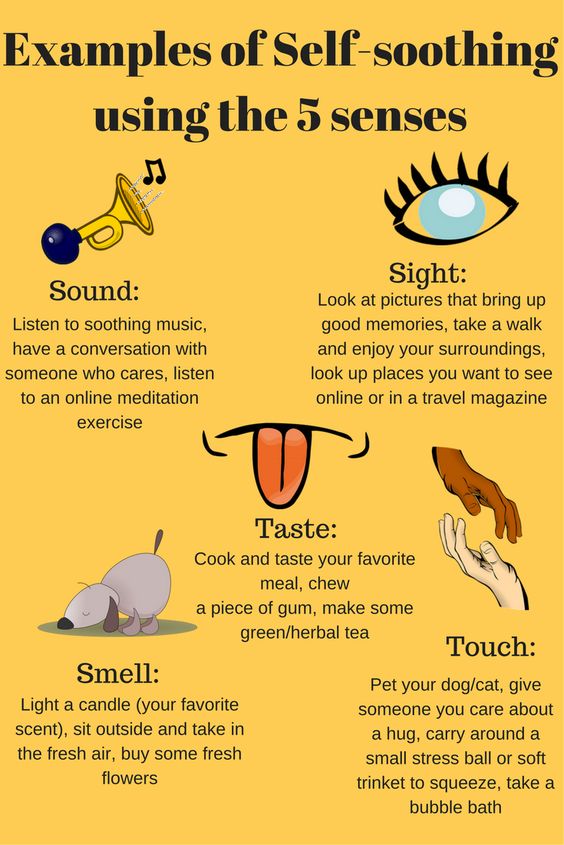
Self-soothing means that you wrap yourself in a blanket and play your favourite music. It means that you take yourself for a walk in nature. It means you find a quiet space in your home and you focus on breathing slowly and deeply and calming yourself down. It means that when you are feeling especially low, you read out some positive affirmations to help empower you. It means that you run a bath with your favourite oil or bath foam.It means that you engage in something creative. It means that you listen to your body.It means that you practice self-compassion and kindness to yourself. Self-soothing can be done using all 5 senses.

86a0c01601368977b6e64d14c8ef2eff
Image source

There are so many ways to self-soothe and everyone has different ways of doing so.

What is your experience?

Do you feel you are somewhere in the middle of self-soothing and running away from your problems or not?

Please share your experiences.

Thanks for reading

Love Athina♥♥

© All blog posts and images are owned by me and Courage Coaching. Please don’t use without consent and only re-blog if you would like to use the information on here.

1 year of Courage Coaching

OXYGEN TANK TUESDAY ‹ Mr Buffy Devane ‹ Reader — WordPress.comToday marks 1 year since I started Courage Coaching and I can definetely say it has been totally worth it!


Although I wasn’t new to wordpress 1 year ago, I was very new to coaching!

Since completing my certification and coaching my first clients, it has been both exciting and challenging.

Through creating my small youtube channel,  I have helped support people, that I would otherwise not have been able to reach.This channel has grown at a steady pace and my videos (and sound quality) have also improved over time (with the help of my viewers 🙂 of course).

It has been a very interesting first year and I have felt very grateful for all the lovely comments, support and exciting opportunities that have been part of my journey so far.

Sharing my knowledge with others and giving people hope, has been a truly humbling experience.

When I myself was in a dark place in the past, all I wanted was hope and guidance. The few but very special people that gave me this hope and guidance, will never truly know what a huge part they played in the successes I now am grateful for.

It is so valuable to know that there is always a tiny speck of light in that neverending darkness we may sometimes face in our life.

Dear readers, I would like to THANK YOU.

Love Athina ♥


Why & How to stop over-explaining

Following on from my post Are you a chronic over-explainer? , I now want to address why & how to actually stop over-explaining.

giphy

As I mentioned in my previous post, many individuals who suffer from low self-esteem or people-pleasing, have an almost compulsive need to over-explain. Others do it, because they have been misunderstood many times in the past when talking.

Using more words should not be a go-to for clarity. It is better to try and use the right words the first time instead of all the words in a stream-of-consciousness style.

Being nervous of what others think of you, will make it hard for you to make simple statements about things you like or don’t like. For example, a new friend of yours who has cats may ask you if you like cats. Instead of your response being ”I don’t really like them” you end up saying ” I am not too fond of cats because I don’t like that they are selfish, although I am not saying that your cats are selfish, I just mean that I prefer dogs to cats because they are more communicative” etc……

It is important to remember that when you over-explain to others, you may at times make them feel stupid. They might think that you are over-explaining things because you are sure they just ‘dont get it’! Over-explaining also makes you look stressed, because you aren’t able to get to your point simply. This will then end up stressing your listener out. It may also make others think you are confused, which will then create confusion in them and eventually lead to even more over-explaining.

The key to stop over-explaining is to just tell yourself ”It is not that important”. If others think of you in a negative way after you state ‘a dislike’ or a particular way of doing things, then that reflects on them, not you.

Another good way to stop it is to try and be precise in the way you communicate. Try and limit your use of words by practicing beforehand (if for example you need to explain things to an intern at work or to someone you have assigned work to).

Thirdly, try and be mindful about whether you are over-thinking. If you are a worrier or an over-thinker, it will come naturally to you to want to over-explain. If you are thinking ”I hope they get what I am saying. I hope they don’t think I am selfish, cruel, stupid etc”. Try and let go of the worries by telling yourself ”So what if they think I am selfish? or ”so what if they get it wrong?”.

By taking time to try and listen more to what the other person is saying, this also helps you to avoid over-explaining, especially if you see that the other person completely ‘gets’ where you are coming from.

Lastly, ask yourself this when explaining ”Am I explaining or am I talking for my own benefit?” If it is the latter, then you are over-explaining!

Thanks for reading

If you like this post, then please like, comment or share.

Love Athina ♥

© All blog posts and images are owned by me and Courage Coaching. Please don’t use without consent and only re-blog if you would like to use the information on here.


Approval seeking

Approval seeking is a very common behaviour that all of us are guilty of at some point in our life. It might be that we are trying to impress someone we like, make a new friend or make a good impression on our new boss. It is perfectly normal to seek approval in others occasionally.

Approval seeking only becomes a problem when we do it chronically. When we constantly seek to be validated externally because we don’t feel comfortable to accept ourselves as we are.

This is the topic of today’s video, which I felt was very important for those of you who are people-pleasers and/or codependents.

Love Athina ♥

© All blog posts and images are owned by me and Courage Coaching. Please don’t use without consent and only re-blog if you would like to use the information on here

Avoidant Personality Disorder

Although it isn’t Monday yet, I have already uploaded Monday’s Youtube video 3 hours early, as tomorrow I am mostly on the go and won’t be checking in much.

As most of my videos focus on CPTSD, Narcissistic abuse, Dysfunctional Relationships and other areas of emotional difficulty, I wanted to address a cluster C disorder this time, as this is something I have experience with. Avoidant Personality is an anxious disorder which can be very pervasive and self-limiting for those who live with it.

It can be caused by childhood trauma and can co-exist with Depression, CPTSD, Dependent Personality Disorder, as well as other disorders.

An individual is diagnosed as having AVPD, if they meet 4 or more of the following 7 criteria.

Definition: A pervasive pattern of social inhibition, feelings of inadequacy, and hypersensitivity to negative evaluation, beginning by early adulthood and present in a variety of contexts, as indicated by four (or more) of the following:

(1) avoids occupational activities that involve significant interpersonal contact, because of fears of criticism, disapproval, or rejection

(2) is unwilling to get involved with people unless certain of being liked

(3) shows restraint within intimate relationships because of the fear of being shamed or ridiculed

(4) is preoccupied with being criticized or rejected in social situations

(5) is inhibited in new interpersonal situations because of feelings of inadequacy

(6) views self as socially inept, personally unappealing, or inferior to others

(7) is unusually reluctant to take personal risks or to engage in any new activities because they may prove embarrassing

As with most personality disorders AVPD isn’t completely curable, although therapy, medication and the right support can help people lead more successful lives.

Is this something you may suffer with? If yes, then get in touch!

Love Athina ♥

© All blog posts and images are owned by me and Courage Coaching. Please don’t use without consent and only re-blog if you would like to use the information on here

Pathological lying & other types of lying

Happy Monday everyone! I hope your week started well 🙂

Today’s video, which unfortunately took me ages to edit due to many interruptions & distractions, is about pathological lying. Although I talk about other types of lying, I particularly wanted to highlight the importance of pathological lying because it is the most destructive form of lying there is. Compulsive lying is also similar, although not as spiteful.

Individuals which are high on the narcissistic spectrum (NPD’d, Malignant narcissists, Psychopaths, ASPD’d) are very skilled pathological liars.

Please like,share & subscribe to my youtube channel if you find this video helpful!

Love Athina ♥

© All blog posts and images are owned by me and Courage Coaching. Please don’t use without consent and only re-blog if you would like to use the information on here


The Link Between Childhood Trauma and Chronic Fatigue Syndrome

sleeping-1159279_1920

Childhood trauma produces physiological effects upon the developing brain that have an adverse effect upon the individual’s stress response system.

Childhood trauma is likely to increase a person’s vulnerability to falling victim to Chronic Fatigue Syndrome (CFS).

FACTS ABOUT CFS.

The symptoms of CFS are as follows :

– persistent fatigue/exhaustion which affects everyday life and is not rectified by sleep or rest

– in the UK, the condition is thought to affect approximately a quarter of a million people

– the condition is more prevalent in females than in males

– it normally affects people between about the ages of 20 – 45 years; however, it can begin during childhood – if so, it normally begins between the ages of 13 and 15 years

CFS can be split into 3 different levels of severity :

– MILD : the person can probably care for him/herself, but may require days off in order to rest

– MODERATE : at this level the individual may well experience reduced mobility, disturbed sleep, as well as a need to sleep in the afternoon

– SEVERE : at this level the person will have significantly decreased mobility, possible impairments to his/her ability to concentrate as well as greatly reduced ability to perform many everyday tasks

Individuals with CFS who were tested in various studies, had higher overall trauma scores than those without CFS.

Exposure to trauma increases the risk of CFS between three and eight times, depending on the type. Emotional neglect and sexual abuse during childhood were most strongly associated with CFS.

It generally appears that CFS is part of a spectrum of disorders that are associated with childhood adversity.

Do you suffer with Chronic Fatigue Syndrome?

As someone who lives with CPTSD, I would say that I suffer from it moderately.

What is your experience?

Love Athina ♥

© All blog posts and images are owned by me and Courage Coaching. Please don’t use without consent and only re-blog if you would like to use the information on here.


Status anxiety

img_0646

How do we each fit into this world?

Are we defined by whether we have a good job? A good marriage?

Do we feel that we constantly have to measure up to our friends’success?

Do we feel that we have to have the latest gadget, a new car or a big house?

Do we feel like a complete failure if we haven’t secured a stable job?

And what about relationships & family? When someone is single past the age of 40, everyone has an opinion about why that person is still single. If someone is jobless, everyone has an opinion on why that is.

STATUS ANXIETY is a constant worry about whether we are good enough in the world we live in. It is an insecurity about whether our life is a failure or whether it is a success.

Status anxiety is a term I came across after watching a video by Alain de Botton.

Status anxiety happens because we allow our environment to affect our inner world. Status anxiety happens when we allow other people to criticize us or the way we choose to live. It is only natural to become anxious, when we start comparing ourselves to others.

One of the most uncomfortable situations which may trigger status anxiety, is at a social event where you don’t know any of the guests. In such events, such as a party, you can only get to know someone initially by making small talk. You may be approached with questions such as ”What do you do? Where do you live?”. These questions may make you feel uncomfortable or inferior, because you don’t think your job is anything special and you don’t currently like the area you live in. In these situations you worry what the person asking the questions might think of you.

Status anxiety is rooted in judgements or how we think others will judge our choices, beliefs, skills and way of life. Nobody really has any control over the thoughts or judgements of others but everybody has control over how they react to others’ judgements.

If we really don’t care what other people think, then we probably won’t have status anxiety.

Status anxiety also frequently causes envy.We tend to envy in others, what we haven’t quite managed to achieve for ourselves. We may secretly envy the person who seems to have the perfect relationship when we are feeling lonely. We may envy the person who is always going on holidays because we can barely pay the bills with our low-wage job. Envy,  can give us insight into a part of our lives we may need to work on.

What is the most important thing to consider when suffering with status anxiety?

Is it more important to worry because we haven’t managed to develop a good career for ourselves? Is success only measured by having a high salary, a perfect marriage and celebrity status?

What is MORE important, is the meaning WE give to our life. If we are happy with all we have achieved (despite all the difficulties or judgements by others), then that is all that matters.

Our judgement of our own life is the most important.

Not everyone is born equally lucky, supported, intelligent, confident or motivated.

The people who are highly successful in business and are making the big bucks, are usually lacking in many other areas in their life. They may lack emotional intelligence and empathy.

If you had a choice in your life, what would it be?

In my personal opinion, success is being a kind & empathetic person.

Success is being able to self-reflect and being able to help others do the same.

Success is being remembered as a good person.

I believe that success shouldn’t be measured by whether you work, have a relationship or have kids.

Success should be measured by the type of person that you are..

When I die in the future, I would much rather be remembered as a good human rather than a successful businesswoman or celebrity. I would much rather be remembered as empathetic, giving, respectful, generous & lovable. I would much rather be remembered as someone who meant something to someone or as someone who inspired others.

If you find that you suffer with status anxiety, make sure that you define your own life in a way that makes you feel comfortable.

At the end of the day, all that really matters is the opinion you have of yourself and the respect and kindness yougive to others.

Love Athina ♥♥

© All blog posts and images are owned by me and Courage Coaching. Please don’t use without consent and only re-blog if you would like to use the information on here.

Happy New Year dear readers!

c1gjrs0xgaaitam
Our journey by car today on a freezing New Year’s day! (Germany,Worms  1-1-17)

Wishing all my readers, fellow bloggers and friends a Happy New Year full of love, health & good memories!

May this year be your strongest, your most loving & your most cared for.

Let there be compassion & understanding for those without a home or a family.

Let there be empathy for those who are suffering with ill health.

Lets support each other in this tough journey called ‘Life’.

Love to you all

Athina ♥