Are you a chronic over-explainer?

Where does over-explaining stem from?

People naturally feel the need to make sure their point of view is clearly understood when in conversation with someone else. Nobody wants to be misunderstood when expressing an opinion or thought.

What happens however when someone feels the need to always over-explain something?

IMG_0926

Is this something that stems from an underlying anxiety, that they will be misunderstood?

Yes

Is this also something that happens because in the past they might have been misunderstood quite a lot and for this reason they have to make sure it doesn’t happen again?

Absolutely..

Does over-explaining ever make you think, that the person doing the over-explaining, must think that the person they are over-explaining to must be stupid. Does this make sense?

I have been on both sides of this. I have over-explained to someone who got what I was saying from the first sentence and said I didn’t need to explain further. They said, I am not stupid, I get it. I have also been over-explained to and could immediately tell that the other person was anxious and insecure about something.

In my experience, many individuals who suffer from low self-esteem or people-pleasing, have an almost compulsive need to over-explain. This usually stems from childhood abuse, where either 1 or both parents were unable to meet the child’s needs and were unable to understand the child’s feelings. If parents don’t have empathy, are self-centered and dont have the ability to genuinely listen and understand, then a child will chronically feel frustrated, misunderstood and alone.

Have you ever tried to explain a simple concept such as sadness or feeling alone to a person who lacks empathy?

The reply is usually uncaring and hurtful.

Have you ever tried to reason with someone who has a low IQ and has intellectual disabilities?

They are not able to understand certain simple concepts because they just aren’t able to and if you insist on trying to make them understand, you can make yourself feel crazy with frustration.

When does over-explaining become chronic?

This usually happens when someone is unable to simply state something, that doesn’t need explaining, to someone who hasn’t even asked for an explanation. It becomes chronic when a person feels the need to explain in great detail and repeats themselves over and over again.It becomes chronic when it is a habitual thing that someone does all the time, even with people that are understanding and empathetic.

The particular thing I would like to highlight in this post, is that over-explaining becomes habitual for people who have suffered narcissistic abuse. If you are constantly around someone who makes you doubt yourself by gaslighting you, who doesn’t validate and understand your feelings and always tries to manipulate you, then it is only natural that you will be chronically frustrated when communicating..

I would love to hear your thoughts on this..

© All blog posts and images are owned by me and Courage Coaching. Please don’t use without consent and only re-blog if you would like to use the information on here.

Much Love Athina ♥

Blogger recognition award-I am humbled!


This blog post today is to officially accept my nomination for the ‘Blogger recognition award‘ by the lovely https://perceptionschange.wordpress.com

I am very humbled by the nomination, especially as this blogger is a mental health blogger. She writes about her own experience with depression & anxiety, offers tips on what helped her and this is very useful for others who also struggle and might find some solace in her writings.

img_5067


Rules for participating in the Blogger Recognition Award

Thank the blogger who nominated you and provide a link to their blog.
Write a post to show your award.

Attach the award to the post.

Give a brief story on how your blog started.

Give a piece of advice or two to new bloggers.

Select 15 other blogs you want to give the award to.

Comment on each blog and let them know you nominated them

TIPS FOR NEW BLOGGERS

If you have the time to interact with your followers, then do so.

If you are able to keep an open mind and be encouraging and positive, then do so.

Make sure you write an  ABOUT ME section on your blog, as it gives the reader a little background on who you are and why you write. I find this very important when checking out new blogs as I feel better connected to the content when I know a little about the writer.

WHAT IS THIS BLOG ABOUT & WHY DID I START IT

This blog is all about sharing free information to help those of you affected by mental illness, abuse from dysfunctional relationships and for those of you who are also interested in personal coaching. This blog is a result of my recent qualification as a life coach and I would be humbled to reach many more people that might need coaching to make changes in their lives. My particular focus is promoting self-care, self-compassion, changing negative thinking patterns & assisting anyone who is struggling with dysfunctional relationships and needs to break free. I create videos on YouTube which are also aimed at providing free advice on many different topics and I hope to help people in the same way I was helped over the years by mental health professionals & other empathetic people

NOMINATIONS

The 15 bloggers I will nominate are inspiring & courageous! Check them out!

https://runrabbitrunptsd.wordpress.com/

www.therichnessofasimplelife.wordpress.com

https://recoverytowellness.wordpress.com/

https://bethanykays.com/

https://atribeuntangled.com/

https://brokenfingernails.com/

https://piecesofbipolar.wordpress.com/

https://frombehindglass.wordpress.com/

https://hannahbolly.wordpress.com/

https://theroamingmind.com/

https://emergingfromthedarknight.wordpress.com/

https://thejourneytowardhealing.wordpress.com/

https://charsgirl.wordpress.com/

https://brokenyetcherished.com/

https://illyspeaks.wordpress.com/
Courage

Today’s post will be short and sweet as unfortunately my internet is playing up and keeps having long disconnection periods. I have barely been able to post anything today due to this, so my apologies if this blog post is a little short. I think short and sweet, will be the theme of this day! 🙂

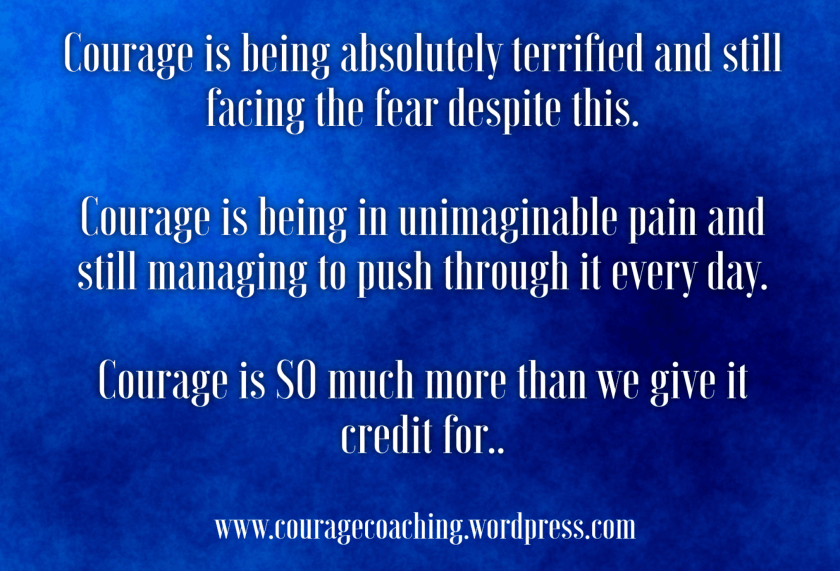
I wanted to write a little bit about why I chose Courage as the name of my Coaching business.

FontCandy (76)

First of all, courage is very important when challenging ourselves at times where we need to make big changes in our personal life, our work or our health.

Courage is necessary when we deal with grief, physical & emotional pain or overwhelming fear.

As survivors of abuse would agree, courage is crucial for getting through the trauma and emotional pain that starts with the abuse, continues throughout the abuse and then unfortunately becomes a part of the long journey of recovery after the abuse.

For those affected by war & overwhelming grief, courage is what keeps them going every day, when all they want is to stop feeling so frightened & devastated.

Courage is important for survival, for better quality of life, for the ability to self-reflect and for getting through adversity.

Below are some definitions that I found online when I was deciding on COURAGE as a name for my business.

Courage is:

  • The ability to do something that frightens one; bravery.
  • Strength in the face of pain or grief
  • The choice and willingness to confront agony, pain, danger, uncertainty or intimidation.
  • The power or quality of dealing with or facing danger, fear, pain, etc..
  • Courage, also called fortitude, is the ability to confront fear, pain, danger, uncertainty or intimidation. It can be divided into “physical courage” — in face of physical pain, hardship, and threat of death — and “moral courage” — in the face of shame, scandal, and discouragement..
  • The state or quality of mind or spirit that enables one to face danger, fear, or vicissitudes with self-possession, confidence, and resolution; bravery.

 I also selected a few of the most inspiring quotes about courage, in my opinion.

”You gain strength, courage, and confidence by every experience in which you really stop to look fear in the face. You are able to say to yourself, ‘I lived through this horror. I can take the next thing that comes along”.
Eleanor Roosevelt
”I learned that courage was not the absence of fear, but the triumph over it. The brave man is not he who does not feel afraid, but he who conquers that fear”.
Nelson Mandela
”Inaction breeds doubt and fear. Action breeds confidence and courage. If you want to conquer fear, do not sit home and think about it. Go out and get busy”.
Dale Carnegie
”You will never do anything in this world without courage. It is the greatest quality of the mind next to honor”.
Aristotle

 What is it about courage that inspires you the most?

Love Athina ♥
© All blog posts and images are owned by me and Courage Coaching. Please don’t use without consent and only re-blog if you would like to use the information on here.

Johnna Janis makes documentary “Invisible Scars” to heal her and others’ childhood trauma

I wanted to re-blog this as I know it will be incredibly helpful to many of you currently healing from child abuse.

Christine Cissy White's avatarACEs Too High

Invisible Scars“It’s about so much more than childhood sexual abuse,” says Johnna Janis about her feature documentary, Invisible Scars, a remarkable film about her own sexual abuse and her journey of recovery.
Janis produced and directed the film with long-time friend, Sergio Myers, an award-winning filmmaker and owner of 7Ponies Productions. Together, they took on topics many would consider too triggering or taboo to address and did so without sensationalizing sexual abuse or trivializing trauma. The result is a personal, powerful and informative movie.

Invisible Scars, which has been a six-year labor of love, will have a red-carpet premiere March 29 at the Harmony Gold Theater in Los Angeles, CA. It received an Award of Merit at IndieFest 2015.

What started in 2010 as a “small little project” about one woman’s healing journey “expanded” when Janis learned about the CDC-Kaiser Permanente Adverse Childhood Experiences Study (ACE…

View original post 1,725 more words

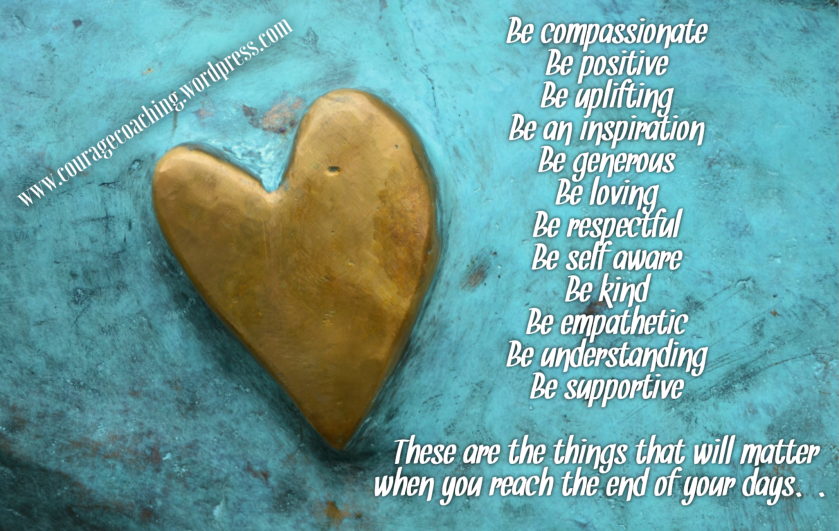
Be an inspiration

FontCandy (75)

Dear friends,

I am back from my brief holiday in Athens and feel happy to get back into blogging, YouTubing & Coaching. I have a 2nd follow up session with a coachee tomorrow and I am hoping she has managed to make some progress and feels a little better about things.

I hope I haven’t missed out on too much in the world of blogging but I definetely aim to catch up on your blog posts and interact with some of you lovely people.This holiday was a little mixed with being ill and dealing with a low mood because of this, but otherwise it felt good to have a change of scenery.

I thought it would be good to start the new week with an uplifting post. How often do you try to be an inspiration to others? How often do you strive to be an overall, good human?!

Some people are just naturally good at spreading positivity, love & and support but others do this less. Does this mean they are bad people? Not necessarily. It might be that they are suffering or overwhelmed by life’s challenges and just have nothing left to give at times..Just because someone isn’t supportive or understanding some of the time, this doesn’t mean that they are bad. On the other hand however, If someone is disrespectful, is always negative, is underminding towards others and generally goes around trying to ruin other peoples’ joy, then you want to stay clear of these people.

There is nothing wrong with having a bad day or feeling a little negative but if you purposely set out to bring others down with you, then this isn’t good.

In my day to day life, I hope to try and bring joy to others, even in the tiniest way. Even if I am struggling emotionally, I find that by spreading positivity in the smallest way, can make such a difference to my mood. This could be anything from leaving a positive comment on a great post, holding the door open for someone or smiling at the cashier in the supermarket.I am not superhuman obviously and neither are you, so we are all allowed days where we are less than perfect. As long as we are not hurting anybody, then it doesn’t really matter what we get up to.

If you had a choice to choose 2 of the 12 things listed in the above photo, which would you choose and why?

Love Athina ♥

© All blog posts and images are owned by me and Courage Coaching. Please don’t use without consent and only re-blog if you would like to use the information on here.

Existential Depression in Gifted adults

Existential depression is a topic I would like to write about today, as it might be useful to some of you who might be feeling depressed and don’t know why. My darling husband has been struggling with this for quite awhile and it is currently affecting our holiday.I just wanted to shed some light on a topic that many people experience but isn’t talked about much.

Existential Depression is very common amongst highly gifted adults and is defined as:

” A depression that arises when an individual confronts certain basic issues of existence. Yalom (1980) describes four such issues (or “ultimate concerns”)–death, freedom, isolation and meaninglessness.”

Source:http://sengifted.org/archives/articles/existential-depression-in-gifted-individual

Gifted adults usually start to experience this in young adulthood and it includes feelings of:

  • Isolation
  • Meaninglessness
  • Lack of focus and direction
  • Alienation

Existential depression is generally understood to be caused by personal, environment and professional mismatches: Typically
A gifted adult’s inability to find a place and/or relationships where “deeper issues” and “bigger problems” can be shared, explored and mastered. This includes the difficulty gifted young adults have in finding inspiring mentors and coaches with whom they can identify
These deeper issues and bigger problems can be:
Social/political
Moral/ethical
Aesthetic/artistic
Spiritual/religious
Philosophical

Rarely described elsewhere but often expressed by our gifted adult patients are other causes of existential depression:
The meaninglessness of accomplishments and achievements
Precocious and impressive as they may be to others, success that occurs without serious challenge and effort can feel worthless
Resolving conflicts between the need for personal gain and the desire to be altruistic:
Feelings of pride, pleasure and the financial rewards that come from actual hard work can conflict with the need to help others and make meaningful social contributions
Conflicts and anxieties about becoming a leader:
Admiration and praise of parents, peers, teachers and even mentors can make a gifted adult feel “too powerful.” This is especially true of gifted young adults who may feel this unusual power is “too much” and has come “ too soon”
Working out fears about the use and misuse of the power and charisma that can often accompany giftedness is vital — unwarranted feelings of guilt can cause the passionate pursuit of a grand vision to feel empty and meaningless
Balancing time for private thought and investigation with the need for social contact with others is an important task
Finding a way to depend on others that does not seem false
Getting comfortable with the intuitive ( sometimes called “extra-cognitive”) aspects of giftedness.
Special abilities to see beyond the ordinary and the capacity for having immediate and spontaneous insights can make gifted adults feel detached, removed and strangely different from others.
For a detailed discussion of the “extra-cognitive” aspects of Giftedness please go to ( create link to the Psychodynamic Psychotherapy article p.117 )
The capacity for unusual insight may extend beyond the academic and artistic to the psychological: At times gifted individuals feel they can “see” beyond social facades and understand what “really” motivates other people. This capacity can begin to develop in childhood and become quite sophisticated in young adulthood but it can also make a gifted young adult feel guilty: possibilities for helping other people can get confused with possibilities for manipulating them. Resolving these conflicts is important so that gifted adults do not abandon their giftedness by concluding that it is too dangerous.

Source: http://psychotherapyservicesforthegifted.com/personality-characteristics-gifted-children-gifted-adolescents-gifted-adults.html

From the above source, you can see that there are specialist psychotherapists that deal with the difficulties gifted adults have, but I must admit that in regards to my husband finding support, it hasn’t been easy.

From my experience, encouraging him to do the things he loves the most, helps his overall mood.

Do you have any experience with someone who suffers with existential depression?

Or are you maybe someone yourself who struggles with it.

I’d love to hear your thoughts

Love Athina ♥

© All blog posts and images are owned by me and Courage Coaching. Please don’t use without consent and only re-blog if you would like to use the information on here.

Start Living

I am currently on holiday in Greece and unfortunately I have also caught my husband’s virus..I am not feeling up to writing proper blog posts, so I thought I would re-blog a few excellent posts from blogs I follow! 🙂 Have a great Sunday dear readers! ❤

itsmesaraa's avatarIt's Me Saraa

What’s up with the “ I’ll do it on Monday” or the  “ Next month I’ll start going to the gym” or “I’ll call him tomorrow”

We all know –and I mean ALL OF US- know that Monday, next month, tomorrow, are just our living lies.

We never seem to start out diet on Monday, we never seem to go to the gym at the start of next month, we never seem to call our friend and hang out tomorrow.. we never do the things we wanna do when we post-pone them.

So to this issue.. I say ENOUGH.

Stop convincing yourself that you’ll do all of the things you wanna do “tomorrow” or “later”, cause next thing you know you’re 70 sitting in your chair watching the news and remembering nothing… cause you have nothing to remember. You spent your days thinking and planning for “tomorrow”, and when “tomorrow”…

View original post 245 more words

The stages of healing-Victim, Survivor, Thriver

For those of you healing from child abuse (narcissistic abuse), this video includes the differences between each healing stage, as listed by Barbara Harris & Charles Whitfield. I found this very useful in my own healing. I am luckily mostly thriving now, with the exception of a few hiccups, here and there. Where do you see yourself on your journey of recovery?

If you find this video useful in any way, then please share on social media ♥

Love Athina ♥

© All blog posts and images are owned by me and Courage Coaching. Please don’t use without consent and only re-blog if you would like to use the information on here.


Dealing with elderly narcissistic parents

As narcissists start ageing, things actually get much much worse.When they are no longer able to charm others with their good looks, good health & successful business, they start losing control over others and their mask starts to fall.

FontCandy (69)

Narcissistic people live their life as pathological liars and bullies, so as they age further, instead of maturing, they just get worse. They become more demanding, more cruel and more horrible in their elderly years.They still try to manipulate others but aren’t very good at remembering the lies they have told, so people  catch them out in their lies.Their immaturity and tantrums become even more evident and healthy colleagues,friends & family start distancing themselves even more.

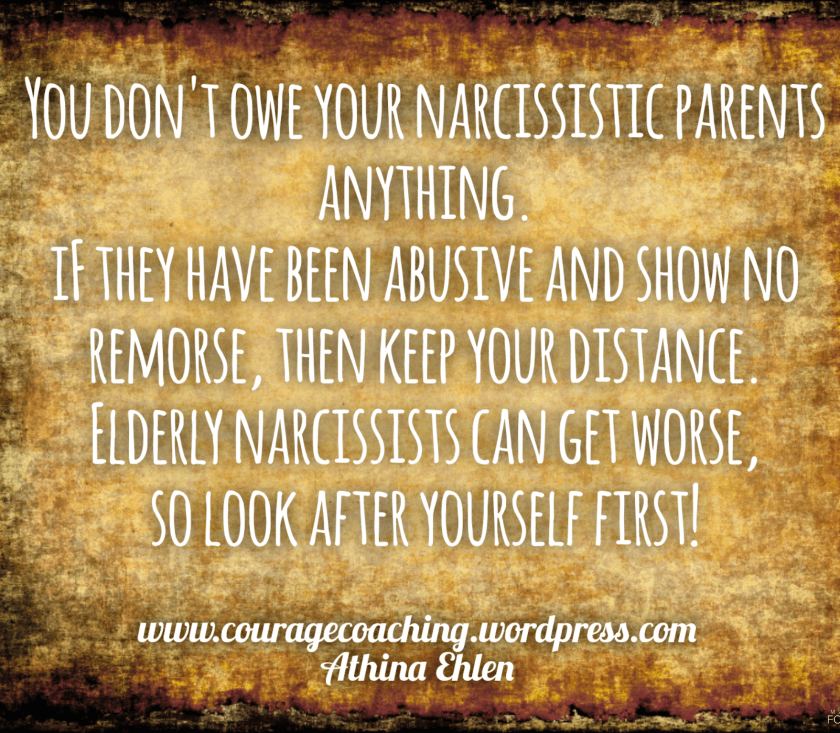
If you are someone who is emotionally struggling with an ageing narcissistic parent, just remember that you don’t owe them anything. You didn’t ask to be born into a family that was abusive. You don’t have to look after them when they are dying or when they are seriously ill. As a healthy son or daughter, your love is unconditional so they might exploit that for their own gain and still treat you like crap.

No matter what you decide to do, don’t do it out of guilt or because you feel you owe them for providing you with food and shelter.

You always have the right to walk away and look after yourself first.It doesn’t mean you stop loving them. It just means that you put your own health first.

Love Athina ♥

© All blog posts and images are owned by me and Courage Coaching. Please don’t use without consent and only re-blog if you would like to use the information on here.