
”The negativity of the world can’t put you down, unless you allow it to get inside you”

13319811_1301290503231574_4191169891370358081_n

The above quote is easier said than done when we are constantly surrounded by negativity, tragedy, pain and loss. If we were raised by mentally ill, abusive parents, the negativity that we carry with us takes years to change in therapy. It is a huge commitment but it is possible to change for the better.

If we have been lucky enough to only have certain certain negative experiences with others and in our life, then this of course makes it easier to not sink into the depths of negativity or despair.

If we have many loving, uplifting people in our life, a good job, a healthy lifestyle and a loving marriage then does negativity affect us less? It probably does but what is also important to consider is the amount of inner resilience and courage we have and the possibility of mental illness or physical illness which can touch anyone.

Every person is unique and each experience is also unique but how prepared are we to challenge that inner voice we might have of worry or destructive thinking? Not everyone is willing to reflect on themselves.

It is difficult to commit to changing a bad habit but if this habit is making us miserable then we should want to put in the effort to change it at whatever cost, right?

One of the biggest things I learnt is that we are the driver in our life. We get to choose what direction we go in and whatever comes our way is up to us how we deal with it. Making excuses in life is easy but when we are really passionate about something, excuses don’t exist.  Maybe we should always aspire to finding passionate purpose in our life.Some of us may choose to dedicate our lives helping those less fortunate. Others may be passionate about art, science or education. Whatever we choose to do in our life, balance is very important, respect of others and ourselves is important and giving back as much as we take, is also important.

Currently, I wake up every morning with the ability to spend my days freely and I feel fortunate in so many ways. Although I have experienced tragedy, trauma and been surrounded by negativity in my immediate family for most of my life, I have chosen to give back, to share, to support and to be grateful for every single thing I have. When I watch the news, I feel overwhelmed with the state of our world. The greed that has destroyed so many lives, the fantasies of wealth and power that continue to kill innocence and safety. The constant lies that we are fed in the media, the poverty, the destruction and the neverending war are enough to erase any hope for a stable future.

What can we do however? Do we turn a blind eye and retreat into our own little bubble of life, work and family or do we make sure that we do one good thing for somebody else each day? If we earn an extra 100 or 200 a month, shall we donate it to charity to help others or do we keep it in case tragedy hits us and we need to pay medical bills?

There are so many questions to answer but the one most important thing I have realised is that we can always give back, that we can assist and share our love and be kind to others as much as possible. Keeping negativity away is very difficult, especially when you are a highly sensitive person but whenever you have the opportunity to help someone in need, then I believe you should do it. It is important to have a good conscience and that is the thing that drives me in most of my decisions.What is yours?

We are not infallible and just like any other person we have days where we feel that we haven’t done enough or could have been a bit more aware of our choices. The important thing however is that we keep learning and we keep growing.

Love Athina ♥

© All blog posts and images are owned by me and Courage Coaching. Please don’t use without consent and only re-blog if you would like to use the information on here.

The importance of persistence

FontCandy (41)

When some of us decide to take on a new goal, we tend to put in a lot of effort at the beginning and then as time progresses we don’t sustain the same effort to reach it. This is sometimes the case when people have New Year resolutions. An initial goal is set at the beginning when motivation is high but when the going gets tough, the less effort is put in. We tend to start procastinating and the more we put something off, the worse it gets.This then results in our failing to reach our goal.

Wanting to make a change, especially when it comes to bad habits, requires commitment, effort and persistence. To really make a change we have to commit to something 7 days a week! This might seem extreme but it really isn’t. Thomas Edison famously remarked that ‘genius is 1% inspiration, 99% perspiration.

Most of us wish there could be a ‘quick fix’ for most things in life but this really isn’t possible when we want to make lasting change. It’s an in-built human urge to free ourselves from painful patterns of behaviour and seek peace, happiness and contentment immediately. When an individual has deep-rooted beliefs and unconscious patterns that have kept them stuck in unhappiness most of their life, this is something that requires persistence to change.It means that an individual would have to keep persevering through the ups and downs, through the disappointments and sometimes inevitable frustration.It means that the same goal might have to be looked at from different angles until a breakthrough happens.

Do you find yourself setting a goal and then getting overwhelmed too quickly?Do you find that the minute you hit a difficulty, you give up straight away? Do you have a low tolerance for frustration?

I would love to hear some of your experiences ♥

© All blog posts and images are owned by me and Courage Coaching. Please don’t use without consent and only re-blog if you would like to use the information on here.
Facebook page

Dear friends,

FontCandy (40)

I have added a facebook community page recently, which I am hoping to also use as a platform to talk about issues regarding self-improvement, practicing self-compassion, dealing with dysfunctional/toxic people and how to stop people pleasing!

If you are on facebook, then I would greatly appreciate if you stop by and say hi! 🙂

Love ♥ Athina

Take control of your own healing

FontCandy (38)

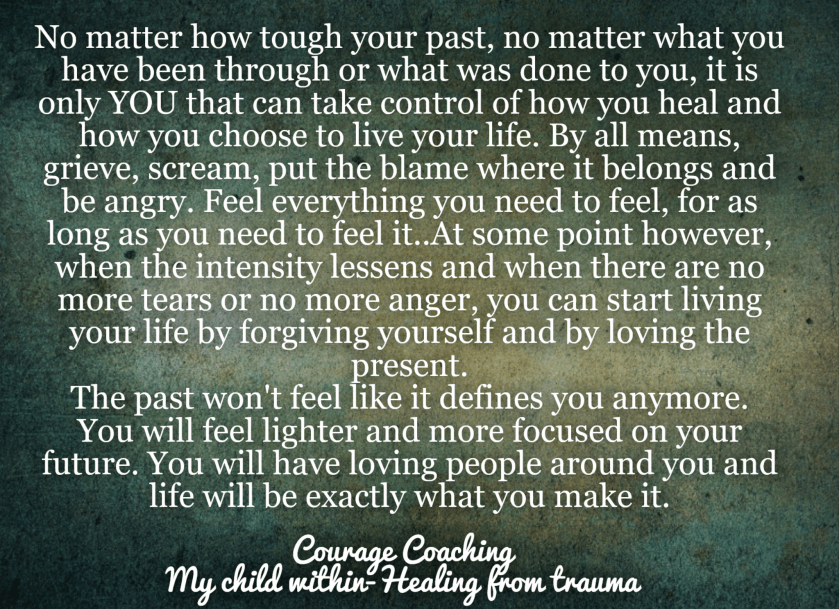
Every healing journey is unique to each person. No journey should be judged, minimised or discounted.

Whether it is childhood abuse, emotional, sexual or physical abuse, domestic abuse, grief, a single trauma or multiple traumas, nobody has the right to criticize someone else’s journey.

If you have compassion and maybe share what helped you, it doesn’t necessarily mean it will help others in the same way. Having compassion and empathy is so crucial. Listening, without trying to fix is also important.

After you reach a certain point in your healing, you will notice that things get easier. The intensity of certain emotions lessen and your sense of self-protection and boundaries are solid. If you suffer from a mental illness, it doesn’t necessarily mean it will go away. You eventually just learn to accept that it is a part of you and that you can handle it in a self-compassionate way.

What is your experience with healing?

Do you believe you will reach a point in your recovery where things eventually feel better?

Are you persistent in practicing self-care and healing with appropriate professional support?

Don’t forget that healing is a very up and down process. It isn’t always straightforward. Sometimes just as you are starting to feel better, something else comes along which needs processing. It might feel that you are back to square one again but this really isn’t the case.

Changes happen in very small ways sometimes and it depends on whether you have regular support.

Always be kind to yourself and others going through a process of healing ♥

Love Athina ♥

© All blog posts and images are owned by me and Courage Coaching. Please don’t use without consent and only re-blog if you would like to use the information on here.
 

Surround yourself with supportive people

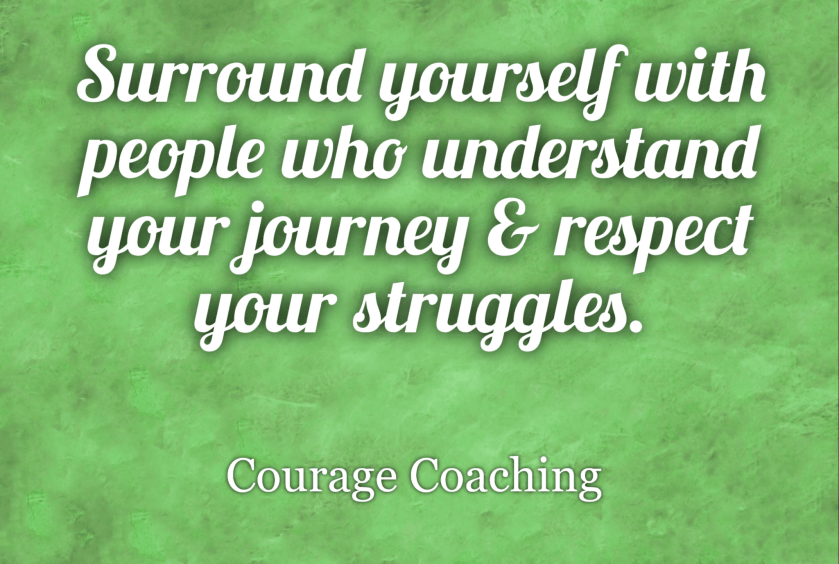
When you suffer from a mental illness it is very difficult to feel hopeful when you are really struggling.Every day can be a battle and those negative thoughts can be very hard to silence. Sometimes feelings can overcome you at the most inappropriate times and others may think you are overreacting or being a drama queen. Paying close attention to the people in your life can determine how much your overall mood is affected. If you are an empath or highly sensitive person, you suck in other peoples’ emotions like a sponge. For this reason, you need to have the right kind of people around you or limit your time with those who aren’t enriching to your life.

Think about how the people in your life make you feel 80% of the time? Are they supportive & uplifting? Are they encouraging and empathetic? Do they understand your struggles and offer to help?

This is very important when you have a low tolerance for stressful situations due to a history of toxic child abuse. When complex trauma is part of your life, you need to feed your brain with the things you were starved of as a child. You should provide yourself with unconditional love, acceptance, validation and comfort. It is also important to have friends and family that can also provide these things for you.  It might feel unnatural at first and almost feel silly to tell yourself that you are worthy and lovable every day, however this is what your brain needs. It needs a new healthy habit!

Recent studies have shown that victims of childhood abuse and combat veterans actually experience physical changes to the hippocampus, a part of the brain involved in learning and memory, as well as in the handling of stress. The hippocampus also works closely with the medial prefrontal cortex, an area of the brain that regulates our emotional response to fear and stress. PTSD sufferers often have impairments in one or both of these brain regions. Studies of children have found that these impairments can lead to problems with learning and academic achievement.

We know that psychotherapy can really help survivors of severe trauma and also we know that EMDR is very helpful for reducing nightmares, flashbacks & overwhelming emotions.What you do for yourself however is equally important as you are the person that feels, thinks and reacts to your surroundings 24/7! It has been proven that with a mixture of validating affirmations, manageable goal setting, therapy and loving relationships, people can improve the quality of their life dramatically, especially in regards to their overall outlook.

FontCandy (29).png

Unhelpful thinking styles/Cognitive distortions

This link below gives you a useful list of all the unhelpful thinking styles that we might use in our daily lives.For those of you who suffer from depression or anxiety, keeping an eye on your thinking style is really important. Try and challenge those negative thoughts by replacing them with more positive or helpful alternative thoughts. With practice, this should help you feel better.

http://media.psychology.tools/worksheets/english_us/unhelpful_thinking_styles_en-us.pdf

Love Athina ♥

Tips on forming a healthy relationship after you’ve experienced an emotionally abusive one

It can be quite worrying to think about a new relationship especially if the previous one was emotionally scarring for you. Emotional abuse in an intimate relationship can erode you self-esteem, your trust and your ability to believe in the possibility of healthy love. I have been there in the past and know really well how difficult this can be to overcome.

Here I have listed a few things that helped me move forward in my own life. I am now happily married after many failed emotionally abusive relationships. Maybe the following tips might help you too.There is always hope!

WHY IDENTIFY ‘WHY’ YOU WERE DRAWN TO AN EMOTIONALLY ABUSIVE PARTNER IN THE PAST, SO YOU CAN AVOID FALLING FOR ONE IN THE FUTURE (Low confidence, vulnerable time of your life, history of trauma)

FORGIVE YOURSELF BE SELF-COMPASSIONATE AND DON’T CRITICIZE YOURSELF FOR HAVING CHOSEN AN ABUSIVE PARTNER.

SELF REFLECTION GET IN TOUCH WITH HOW YOU TREAT YOURSELF FIRST (what is your self-belief system like? Do you respect yourself? )

BELIEFBELIEVE IT IS POSSIBLE TO BE ABLE TO LOVE & BE LOVED IN A HEALTHY WAY.

RED FLAGS MAKE A LIST OF ABUSIVE RED FLAGS TO WATCH OUT FOR IN FUTURE PARTNERS

SUPPORT SYSTEMMAKE SURE YOU HAVE A SUPPORT SYSTEM OF FRIENDS AND FAMILY AROUND YOU THAT ARE HEALTHY OR A THERAPIST TO HELP YOU HEAL FROM YOUR PAST EXPERIENCE

TRUST YOUR INSTINCTS – IF SOMETHING DOESN’T FEEL RIGHT IT PROBABLY ISN’T

MAKE SURE ACTIONS MATCH WORDSMAKE SURE THERE IS CONCISTENCY WITH WHAT SOMEONE SAYS AND WITH HOW THEY ACT

EMOTIONAL FLASHBACKS BE MINDFUL OF WHETHER YOUR REACTIONS ARE ACTUALLY RELATED TO THE PRESENT OR WHETHER THEY ARE CREEPING UP FROM THE PAST.

TESTING THE WATER – TELL YOUR NEW PARTNER ABOUT YOUR PREVIOUS EMOTIONAL ABUSE BEFORE YOU ARE INTIMATE – THEIR REACTION WILL HELP YOU DETERMINE IF THEY ARE A ‘SAFE, CARING PERSON’

I will be talking about these tips in much more detail very soon on my youtube channel. I will post a link to this very soon when it is ready.

Thanks for stopping by!

Love Athina


Our choices have to reflect our values

FontCandy (22)

I have met many people who have very strong morals and values and are stuck working in a company that doesn’t reflect these in the slightest.

I have also met people who are lucky enough to actually have a job that reflects their values but in their personal life this isn’t the case.

What is it that stops people from ditching the uncomfortable situations they find themselves in and going for what they really want? Is it timing or circumstance?Or maybe they are just unlucky in their choices. Things start off well and then things take a turn for the worse.

The reason that people struggle with  changing something in their life is due to the fear of it being the wrong choice again. I mean if it has already happened once, it can happen again right?

This is very common and when it comes to jobs or relationships it is quite understandable that people worry about not finding the right one.

In cognitive behavioural coaching, the coach can help the coachee self-reflect on their thought processes and find the thoughts that may be blocking them from making a decision. It can also assist with the steps that the coachee needs to take to reach their goal.

As always stated in any coaching session, motivation is key. If the coachee isn’t motivated to make a change then change won’t happen.


Tackle goals one at a time

FontCandy (21)

When you have set yourself a goal that you want to reach, you might set the actions you want to take (to achieve your goal) too high! By too high I mean that they aren’t achievable due to many factors such as lack of time, lack of motivation, no confidence etc.

It is generally best to suggest that you break down your ultimate goal into smaller chunks.

Create an action plan by listing small realistic steps that you can actually take to achieve your end-goal.


Real change sometimes requires patience..

FontCandy (20)

How many times have you found yourself trying something new and giving up after the 1st try? What are your thoughts? Do you make excuses to avoid trying again? Are you embarassed because others witnessed you make a mistake? Or are you one of those people who really doesn’t care and keeps trying regardless of the initial result…

Most of the time when we try something new, we are curious and interested in how we will progress and this keeps us moving forward until we get better. This is great!

What happens however, when we have to learn a new language but find it really difficult and don’t have the motivation to really try? Is it ok to just accept that some things are just not for us? How much of a chance do we have to give new things?

In my experience, if you give up too soon you haven’t really given it enough of a chance to become habitual. To make a lasting change in anything we have to keep at it until it becomes automatic. It is like learning to ride a bike. Once we have learned the skill we are able to just do it..

The biggest challenge for people having to learn a new way of thinking or behaving is that they have to be able to sit with any uncomfortable feelings that may arise. Change can be very scary and to try something new that you also aren’t really interested in, makes things a lot harder.Being motivated is very important. If you lack motivation and interest in something, then it makes sense that you will give up straight away.

The more you try, the more experience you gain. You can make many mistakes but that is ok as long as you eventually learn from them. Once you start slowly accumulating small successes in your efforts, the whole learning experience then becomes more comfortable and enjoyable.