5 tips on healing codependency & dysfunctional relationships

This video is the 2nd one of my codependent series on my Youtube channel.

It is mostly informational in text, with the help of a few cute characters! Just the way I like it! ♥

Feel free to re-blog or share 🙂

I love cute things and music…so here you go ♥

Love Athina ♥

© All blog posts and images are owned by me and Courage Coaching. Please don’t use without consent and only re-blog if you would like to use the information on here.

Codependents & Narcissists in a relationship. Why are they so attracted to each other?

Happy Monday to all of you! It’s the 1st of August today and time seems to have flown by so quickly!

Today’s post is about another topic very close to my heart, due to my own healing journey from codependency to healthy love. It most definetely wasn’t easy to get to where I am. It required perseverance, determination and a little bit of hope.

To heal from dysfunctional relationships & codependency, there are 5 steps that are important to take.Having a therapist who specialises in healing from codepedency, is important in guiding you.

  • The first step is becoming AWARE that your choices or actions are dysfunctional.
  • The second step to changing dysfunction is understanding the source of the dysfunction, so where did it come from?
  • The 3rd step is grieving the loss of a healthy childhood. An abusive childhood usually leads to poor choices in relationships & life in general. Without a stable & nurturing childhood you never learn healthy love, healthy boundaries & your emotional regulation is damaged.
  • The 4th step is understanding the complexity of changing self-defeating behaviours & changing certain defense mechanisms, that protected you in your childhood but no longer serve you in adulthood. It takes time, patience and self-compassion.
  • The 5th step is actually trying out new relationships when you have made progress in your healing. You have to make a few more mistakes and discuss these with a therapist by your side, so you can see where you went wrong and how to improve this next time.

When I first found out I was codependent back in 2008, it was like the blindfold was taken off my eyes for the first time. Before learning this, I had a suspicion that something wasn’t right in my relationships but I had no idea how to change this.

I felt like I was in an emotional maze and had no idea which way to go. Everytime I thought I was making better choices in regards to who I was in a relationship with, the more unbearable the heartbreak became.I desperately wanted to be loved but wasn’t able to figure out this painful puzzle! At some point I was so exhausted from the traumatic end of each relationship & the subsequent self abandonment, that I decided to move countries! I wanted a new start…I hoped that I might meet my future husband if I moved away but I never in a million years thought I actually would..Sometimes you need a little bit of luck too!

When I moved back home to Greece after 11 years of living in the UK, I was met with more drama, a flare up of my CPTSD and a father who abandoned me over and over again. I was back in therapy again with a new therapist and was finally diagnosed with CPTSD. I was told both my parents were ’emotionally handicapped’ but that therapist never told me my parents were narcissistic. Maybe she decided at the time that it wasn’t relevant to me.

Despite this she looked after me very well. Each step I took into uncertainty, she held my hand.

I was also entered into a group psychotherapy group and it was extremely beneficial. I was in a group with 5 other people that also had similar backgrounds and it was very healing.

Support is crucial in healing. Without all this I would never have made progress.

The video above is a simple explanation (I hope) of the general dynamics of a codependent & narcissist in a relationship. Maybe you will see yourself in this and get curious. If you do, then please connect with me and I would be happy to have a chat with you.

Please feel free to re-blog this post so it reaches more people! Thank you 🙂

Much Love Athina ♥

© All blog posts and images are owned by me and Courage Coaching. Please don’t use without consent and only re-blog if you would like to use the information on here.


Speak your truth..

IMG_1523

Speak your truth, be yourself and if people don’t accept you then it is their loss, not yours!

If people don’t value your reality, your kindness, your honesty then they don’t deserve your time or your love.

When speaking your truth, have you ever felt overwhelmed with emotion? What has the emotion been? Anger, frustration, sadness, loss, disappointment?

The worst of all these for me was always frustration and then deep sadness..

When talking to a narcissistic parent, you feel all of these times 10!

Continuing to speak your truth despite the pain, frustration, loss and anger is very important…Don’t ever let anyone keep you silent..

Love Athina ♥

© All blog posts and images are owned by me and Courage Coaching. Please don’t use without consent and only re-blog if you would like to use the information on here.

Are you a chronic over-explainer?

Where does over-explaining stem from?

People naturally feel the need to make sure their point of view is clearly understood when in conversation with someone else. Nobody wants to be misunderstood when expressing an opinion or thought.

What happens however when someone feels the need to always over-explain something?

IMG_0926

Is this something that stems from an underlying anxiety, that they will be misunderstood?

Yes

Is this also something that happens because in the past they might have been misunderstood quite a lot and for this reason they have to make sure it doesn’t happen again?

Absolutely..

Does over-explaining ever make you think, that the person doing the over-explaining, must think that the person they are over-explaining to must be stupid. Does this make sense?

I have been on both sides of this. I have over-explained to someone who got what I was saying from the first sentence and said I didn’t need to explain further. They said, I am not stupid, I get it. I have also been over-explained to and could immediately tell that the other person was anxious and insecure about something.

In my experience, many individuals who suffer from low self-esteem or people-pleasing, have an almost compulsive need to over-explain. This usually stems from childhood abuse, where either 1 or both parents were unable to meet the child’s needs and were unable to understand the child’s feelings. If parents don’t have empathy, are self-centered and dont have the ability to genuinely listen and understand, then a child will chronically feel frustrated, misunderstood and alone.

Have you ever tried to explain a simple concept such as sadness or feeling alone to a person who lacks empathy?

The reply is usually uncaring and hurtful.

Have you ever tried to reason with someone who has a low IQ and has intellectual disabilities?

They are not able to understand certain simple concepts because they just aren’t able to and if you insist on trying to make them understand, you can make yourself feel crazy with frustration.

When does over-explaining become chronic?

This usually happens when someone is unable to simply state something, that doesn’t need explaining, to someone who hasn’t even asked for an explanation. It becomes chronic when a person feels the need to explain in great detail and repeats themselves over and over again.It becomes chronic when it is a habitual thing that someone does all the time, even with people that are understanding and empathetic.

The particular thing I would like to highlight in this post, is that over-explaining becomes habitual for people who have suffered narcissistic abuse. If you are constantly around someone who makes you doubt yourself by gaslighting you, who doesn’t validate and understand your feelings and always tries to manipulate you, then it is only natural that you will be chronically frustrated when communicating..

I would love to hear your thoughts on this..

© All blog posts and images are owned by me and Courage Coaching. Please don’t use without consent and only re-blog if you would like to use the information on here.

Much Love Athina ♥

The stages of healing-Victim, Survivor, Thriver

For those of you healing from child abuse (narcissistic abuse), this video includes the differences between each healing stage, as listed by Barbara Harris & Charles Whitfield. I found this very useful in my own healing. I am luckily mostly thriving now, with the exception of a few hiccups, here and there. Where do you see yourself on your journey of recovery?

If you find this video useful in any way, then please share on social media ♥

Love Athina ♥

© All blog posts and images are owned by me and Courage Coaching. Please don’t use without consent and only re-blog if you would like to use the information on here.


Dealing with elderly narcissistic parents

As narcissists start ageing, things actually get much much worse.When they are no longer able to charm others with their good looks, good health & successful business, they start losing control over others and their mask starts to fall.

FontCandy (69)

Narcissistic people live their life as pathological liars and bullies, so as they age further, instead of maturing, they just get worse. They become more demanding, more cruel and more horrible in their elderly years.They still try to manipulate others but aren’t very good at remembering the lies they have told, so people  catch them out in their lies.Their immaturity and tantrums become even more evident and healthy colleagues,friends & family start distancing themselves even more.

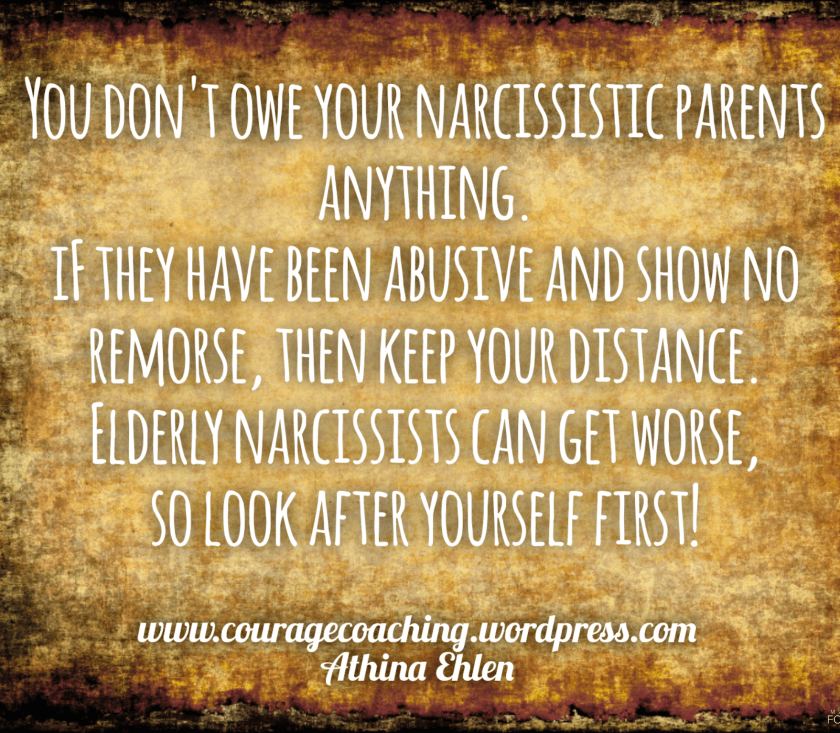
If you are someone who is emotionally struggling with an ageing narcissistic parent, just remember that you don’t owe them anything. You didn’t ask to be born into a family that was abusive. You don’t have to look after them when they are dying or when they are seriously ill. As a healthy son or daughter, your love is unconditional so they might exploit that for their own gain and still treat you like crap.

No matter what you decide to do, don’t do it out of guilt or because you feel you owe them for providing you with food and shelter.

You always have the right to walk away and look after yourself first.It doesn’t mean you stop loving them. It just means that you put your own health first.

Love Athina ♥

© All blog posts and images are owned by me and Courage Coaching. Please don’t use without consent and only re-blog if you would like to use the information on here.

Trauma bonding & love addiction

depression-1241819_1280

In all my previous relationships, I always thought that intensity equaled love. I fell for the same abusive partners over & over again, that were mostly narcissistic & emotionaly unavailable. I had this deep desire within me, to fix and rescue and fight for their love. For many years I thought this was normal! In each relationship, I hoped that they would change and be able to offer me this unconditional love I was so desperately craving. What I didn’t realise at the time however, was that I was only trying to fill the void my parents’ had left after years of neglect and abuse. I was trying to resolve this feeling of not being lovable, through choosing further unsuitable partners that resembled the normality of my childhood abuse.

Each time a relationship ended I felt utterly crushed and devastated. I relived my abandonment over and over again and still had this intense feeling of  bonding with each and every one of my abusive ex’s.

The article in the link below, explains this bonding very well.

The part where it says ”there is a biological craving for intensity than no normal relationship will satisfy” is something that I deeply felt for 20 years and could never shake off..The more excited and addicted I felt to these men, the better..

I was always easily bored and not in any way attracted to healthy & stable men..I felt anxious and uncomfortable around them..This wasn’t my normal..I wasn’t normal..I was traumatised and stuck with what felt comfortable..and unfortunately comfortable for someone who has suffered abuse and trauma, is to crave more abuse and trauma..Sticking with what is familiar is more comfortable than doing something that feels unfamiliar, as us humans are creatures of habit & conditioning.

Growing up in an unsafe home makes later unsafe situations have more holding power. This has a biological basis beyond any cognitive learning. It is trauma in one’s history that makes for trauma bonding. Because trauma (and developmental trauma or early relational trauma is epidemic) cause numbing around many aspects of intimacy, traumatized people often respond positively to a dangerous person or situation because it makes them feel. It is neither rational nor irrational.

..the survivor can come to find that it can be almost impossible to relate to anyone, even family or old friends, except superficially. There is a biological craving for intensity that no normal relationship will satisfy.

http://www.abuseandrelationships.org/Content/Survivors/trauma_bonding.html

When I was first diagnosed as codependent in therapy, in 2008, I started attending a codependents anonymous group in London. I found it helpful inititially when I was recently out of a relationship but as time went on, my therapy was enough. Through the codependent meetings I also learnt about love addiction and being addicted to the need for love..This is something that I remember from the very young age of 13 where I would fantasize about my prince charming taking me away from my family and giving me everything I needed emotionally..As I got older, this intense need transformed into the most important thing in my world..Each boyfriend I subsequently had, became my everything and I felt completely hopeless and depressed without them..

This link below might be useful for some of you to identify whether you might be a love addict..This usually stems from childhood abuse, so don’t be too harsh on yourself! Healing is possible!

https://www.addiction.com/addiction-a-to-z/love-addiction/love-addiction-101/

In 2012 I was healed enough to be attracted to a healthier partner.With the help of more therapy I persevered through the anxiety of unfamiliarity and eventually got married. Marriage was something I was completely against after my parents got divorced.I never believed I could achieve healthy love let alone a marriage. I am still amazed at how much my life has changed. In 2008 I thought that life would never get better again..Now I sit across my husband and feel incredibly blessed to be loved and cherished for the first time in my life..My friends always felt more like family and I can truly say that I finally have a family in my friends and husband.

Any recovery process requires effort, patience and self-insight. It requires commitment, painful exploration and courage. It is possible to reach a deeper level of contentment, so each step forward is extremely important..

 My experience is vast in regards to relationship dynamics and overcoming narcissistic abuse. I am humbled to offer loads of advice on this blog and through my YouTube videos, as I believe that it is important to assist others on their journey. We all heal together..and we can all help each other..Whether some of you are only just starting your recovery process and whether others are ‘healed’, makes no difference..The connection and knowledge is crucial..The exchange of information is powerful..

Love Athina ♥

© All blog posts and images are owned by me and Courage Coaching. Please don’t use without consent and only re-blog if you would like to use the information on here.


Coaching takes courage

This new coaching chapter in my life is giving me great joy and fulfillment. It isn’t something I ever really imagined myself doing a few years ago and now that I am, I am very much enjoying the interaction with people on a one to one basis. I know how much courage is required to push yourself towards achieving a goal or changing something in your life and deciding to have coaching or therapy, is exactly that, courageous!
graffiti-1450798_1920

This blogging platform has been immensely enriching for me both personally through my other blog and also professionally through the creation of this new one.I see a lot of myself in some of my coachees and fellow bloggers/followers and it is wonderfully humbling to be able to make a small difference, through own experience. In the ones that I don’t see myself in,  I learn alot about the difficulties that different personality types may have and this is proving to be a great way to widen my knowledge even further on certain subjects. The thing that I am particularly enjoying at the moment, is that I can also use my skills to help close friends. I enjoy helping people from all walks of life but it makes me even happier to know that I can help the special people in my life as well. Isn’t this something you can all relate to? Helping out a dear friend? For those of you who agree, the fulfillment you gain from this is priceless.

I’d like to talk a little bit about my last job, before I moved to Germany from Bournemouth, England. This is something I mention in the ‘About me’ link of this blog but I just want to talk about it in a little more detail.When I used to work as a Healthcare assistant in an End of Life care home, that is when I realised that I really enjoyed helping people. When I went home after a long day, I knew I was making a difference in a small way and that made my work so important to me. It didn’t matter that I was earning such a low wage, as the smiles of gratitude on the residents’ faces meant so much to me. I worked 12 hour days, barely got a chance to sit down and had to help 10-12 residents with only one other assistant to help me.We were always rushed off our feet and sometimes it was incredibly hard to shower and dress the residents, when 2 or 3 other bells were going off at the same time. Each bell represented a resident who was calling for the toilet, needed help with getting out of bed or who was wanting their breakfast.This was physically & mentally exhausting. It was incredibly tough work, especially because you are someone who cares so deeply and you want to make sure you are helping every resident in an equal and respectful manner.There was never enough time and that is something that bothered me deeply. I enjoyed taking my time with each resident, as that is what I would want myself, if I was in their position.

When you help somebody in such an intimate way and learn their routines, day in day out, it is inevitable you will get attached in some small way. It taught me a lot about patience, inner strength, resilience and practicing self-care. It also taught me a lot about trying to brighten someone’s day a little, making them as comfortable as possible and telling them stories about my own life. These residents needed something else to think about, rather than their own aches and pains. It is difficult to know you are near the end of your life and the only thing you have to look forward to is chatting to the person who cares for you, helps you get dressed & washes you. I got so much from helping these people, as I know that one day I will be the same. I might be alone, with no family left and any attention or communication I get, will give me strength. It is incredibly important to help people sustain their dignity, as every person who grows old was someone’s mother, sister or daughter.When residents you grow closer to over the months, eventually pass away, you feel devastated but also relieved that they aren’t suffering anymore. The bond you develop is unique, especially when you are also the carer who might have to clean and wash the resident after they have actually passed.

Due to my own struggle with Complex PTSD, I had many vivid dreams after I left this job and moved to Germany with my husband. I worried about the remaining residents, wondered how they were doing and learnt of the many changes in their lives. Some of them were now no longer able to walk at all, others passed away and I wished at times that I could have visited again. Living in Germany unfortunately made this too difficult.

Unfortunately, I also had experience working alongside many other carers who were  narcissistic bullies! I couldn’t believe how these people could work in such a job! Their empathy was incredibly fake, as they enjoyed making myself and other friends/colleagues feel small & unimportant.They derived great pleasure from criticising carers in front of the residents, so they could appear better and more in control. They lied to the manager, fabricating stories about myself and other carers because they must have felt threatened by our caring & genuine demeanour. They acted in a racist manner towards one of my Romanian friends/carers and I must admit, it took a lot of strength to ignore them and keep working there. Having Complex PTSD which is a direct result of growing up with Narcissistic parents, meant that working alongside other narcissistic bullies, triggered many uncomfortable feelings. However, knowing who I truly am and ignoring the nastiness of these people, kept me going. Helping the residents was more important than listening to small minded and shallow people.

In my new work, I am very happy to have the freedom to help others in a safe and nurturing way, without the outside distraction of narcissistic bullies. Hurrah!

As a narcissistic abuse survivor, I can tell when someone has low confidence & needs support in developing self-belief. I know this feeling very well myself, through personal experience. I also know how important it is to encourage ‘realistic goal attainment’, rather than trying to achieve something that might be too big a goal.I feel happy to encourage self-compassion and to help people achieve things in small steps, suited to their capabilities. Especially if the clients suffer from debilitating mental illness, it is all about making their lives more manageable by encouraging self-acceptance and by creating plans that suit their daily routines. Having had depression myself, I know how it feels to struggle with every passing hour.You are definetely not alone and nobody should have to feel like they aren’t achieving anything!

I am really interested in finding out what you gain satisfaction from in your life? Is it your work? or your role as a parent? Do you enjoy being a husband/wife? or maybe you are a mum/dad to a furry friend? If you don’t work but volunteer instead, then I’d love to hear about it..

Whatever it is in your life that gives you joy and a sense of fulfillment, then feel free to share your experiences..

If you are someone who suffers from a mental or physical illness, maybe just getting through the day is an achievement in itself! Please let me know if this is something that you are proud of and if not, then I encourage you to try..

Much Love Athina ♥

© All blog posts and images are owned by me and Courage Coaching. Please don’t use without consent and only re-blog if you would like to use the information on here.



Low self-esteem & emotional flashbacks

Healthy self-esteem is essential for good psychological survival. It enables us to feel more fulfilled and secure in our choices, career paths and relationships. When this is lacking however and also goes unchecked, it may lead to mental health issues such as anxiety and depression, sometimes with tragic results.

Perhaps the most well known effect of abuse is low self-esteem.

Low self-esteem means that we have a persistent feeling of worthlessness. It also means that we have a habit of judging & rejecting ourselves constantly which causes us a huge amount of emotional pain. This emotional pain, is something that people with normal levels of self-esteem can’t possibly understand.

For those of us who grew up in abusive homes, this was a daily part of our lives and we considered it to be the norm. We intrinsically felt bad when we weren’t able to do something right, such as get good grades at school or be good at sports.We hated taking part in anything competitive, we always avoided the limelight and hated participating in class conversations, for fear of making a fool of ourselves.We avoided any situation or person who made us feel rejected, hurt and vulnerable.The core of this lack of self-worth was due to our parents telling us on a constant basis that we were not good enough, not smart enough, not lovable enough etc..The more constant and long lasting this was throughout our childhood, the more destructive the damage.This then stays with us for life, unless we have years and years of therapy.Even though most of us are intelligent and full of potential, our nasty inner critic tells us we aren’t good enough.This self-hate, sabotages any chance we may have of making something a success, before we even try it. We actually avoid trying things, to avoid the possibility of failing. To others, this may seem ridiculous. To those of us who have suffered abuse, this isn’t ridiculous at all. We have already suffered a huge amount of emotional pain in childhood which then continued into adulthood. Some things we can heal in therapy but others might be a bit more challenging, as they are so deeply ingrained in us.

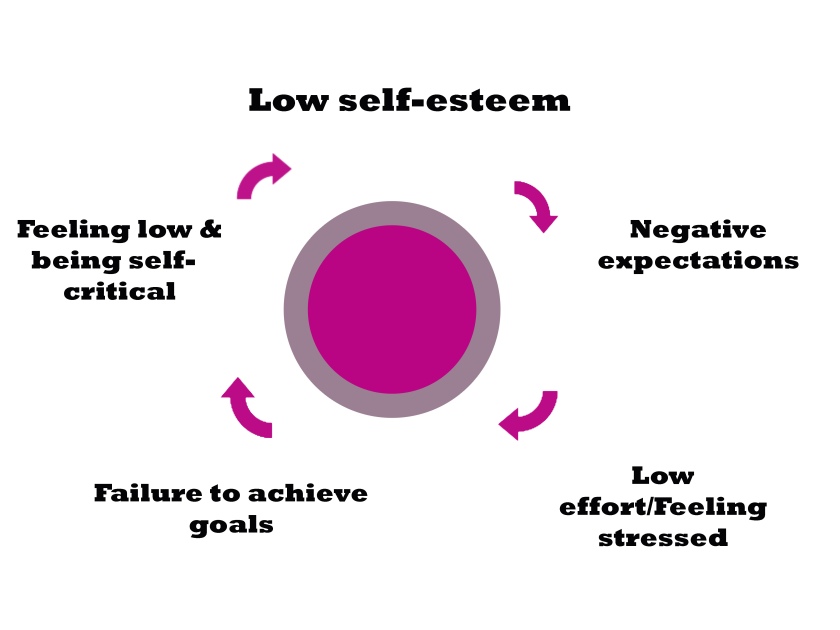
For those of us with low self-esteem, we might notice that as we begin a new project or work on some goal, things begin smoothly and we are filled with optimism. After a little while, however, things start getting harder, we get worried and we start to beat ourselves up.This process repeats itself as we move forward with our goal so that it seems like we’ll never reach it.Too many of us give up at some point because we’re overwhelmed by the feelings of worthlessness.The minute we make a mistake, we fall apart emotionally. In a sense, it gets even harder as we move closer to the goal because during times when things are moving ahead smoothly, we get our hopes up.low selfesteem

This sort of dynamic is what happens after abuse. Although most people are able to deal with obstacles, an abuse history can lead others to feeling overwhelmed by feelings of worthlessness. Most people understand that an obstacle to a goal is part of the process, no matter what creates it, whereas for abuse survivors, an obstacle may be seen as a challenge to our self-esteem, proof that we mess everything up, that we’re not capable as others are. These dark feelings can overwhelm us so much that we give up.

Another effect of abuse, that is linked to low self-worth, is when we have an emotional flashback. In adulthood, a tone of voice, a firm look or a certain opinion about something we have or haven’t done, may trigger us into an emotional flashback of when our abusers told us we couldn’t do something and made us feel worthless. Some ‘red flags’ of an emotional flashback, are when we overreact to a present situation because it brings up feelings from the past. These feelings completely hijack us and it is very hard to control them or realise they are actually from the past.We are usually also overcome by feelings of helplessness & hopelessness and a lot of the time they can be linked to feeling worthless.An emotional flashback can be hugely emotionally painful and once again, others have no idea why we are so upset.

So how do you manage chronic low self-esteem?

Since chronic self-esteem is caused by the vicious inner critic that our abusive parents created in us, we have to learn ways to silence this critic. This critic tells us all the horrible things that our parents made us feel when we were younger.

We have to learn to become aware of it and every time we think a destructive thought, we have to stop it. We have to challenge the negative thoughts that pop up dailyand say ”Stop it” or ”That’s a lie” or ”Your father was wrong, you aren’t worthless”.We also have to give ourselves small challenges that we can work towards. The more we are able to achieve, the better we will slowly feel about our ourselves. The more evidence we start to see of ourselves actually being more adventurous or more successful, the better we will slowly feel about ourselves. This takes a lot of persistence, effort and help from a coach or therapist.

If you are interested about how to cope with emotional flashbacks then please check out my post here: https://couragecoaching.wordpress.com/2016/06/10/child-abuse-complex-ptsd-managing-emotional-flashbacks/

Thanks for reading

Much love Athina ♥

© All blog posts and images are owned by me and Courage Coaching. Please don’t use without consent and only re-blog if you would like to use the information on here.

How to protect yourself from narcissistic parents

A quick 2 minute video on ‘How to protect yourself from narcissistic parents’:

Love Athina ♥

© All blog posts and images are owned by me and Courage Coaching. Please don’t use without consent and only re-blog if you would like to use the information on here.