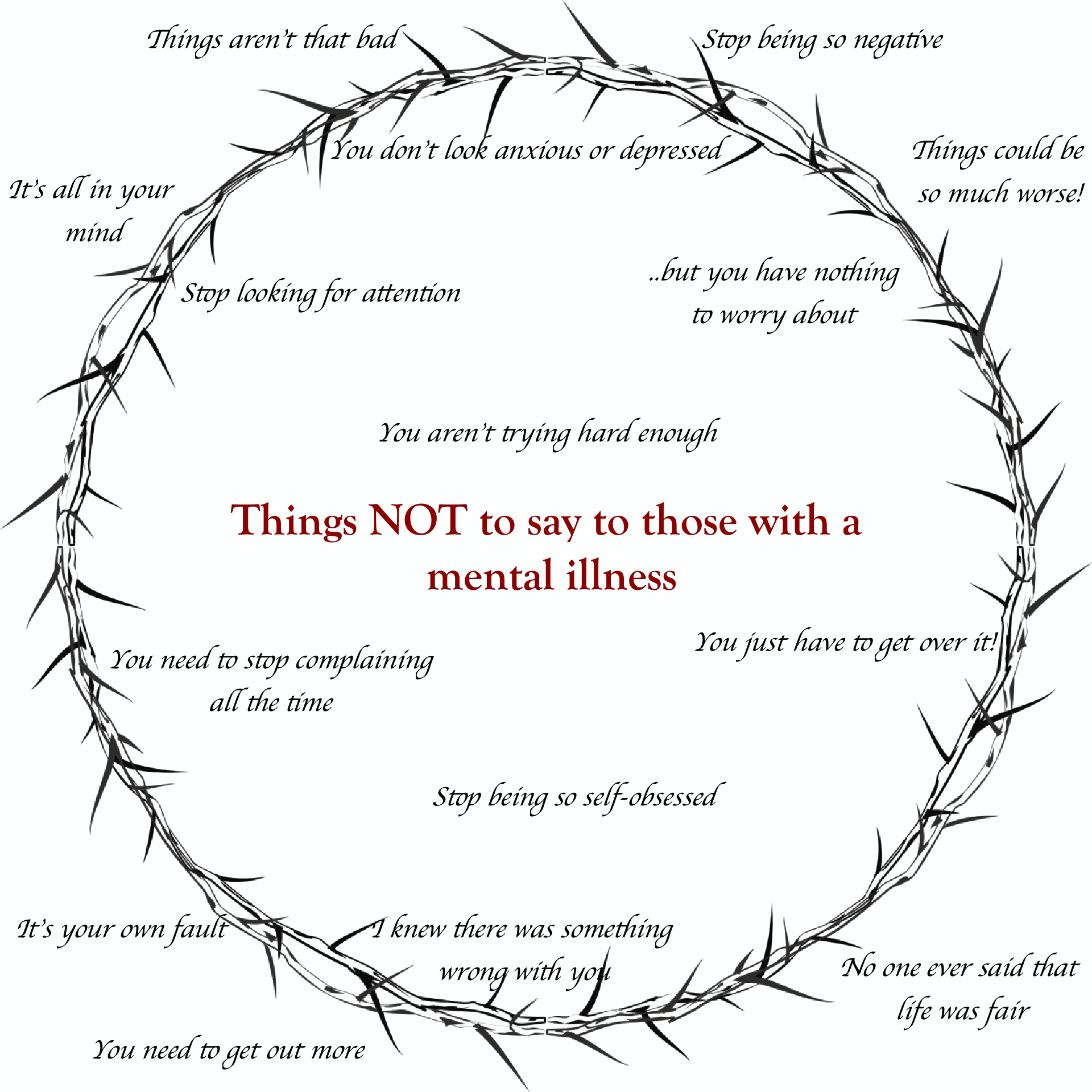
Things not to say to those with a mental illness

Ever since I made my youtube video ‘How does PTSD affect intimate relationships’, I have had so many of you contact me with questions about how to cope and support your partners. The reality is that it takes a very strong person to love someone who lives with PTSD, as they also live with it indirectly.
Loving someone with PTSD can easily takes its’ toll on the relationship and on the partner doing all the supporting. It can affect intimacy, communication & the expression of emotion.
The person with PTSD may not be able to work full time or may not be able to work at all.
It is of course very different for each individual relationship, as the severity of the PTSD is unique to each individual.
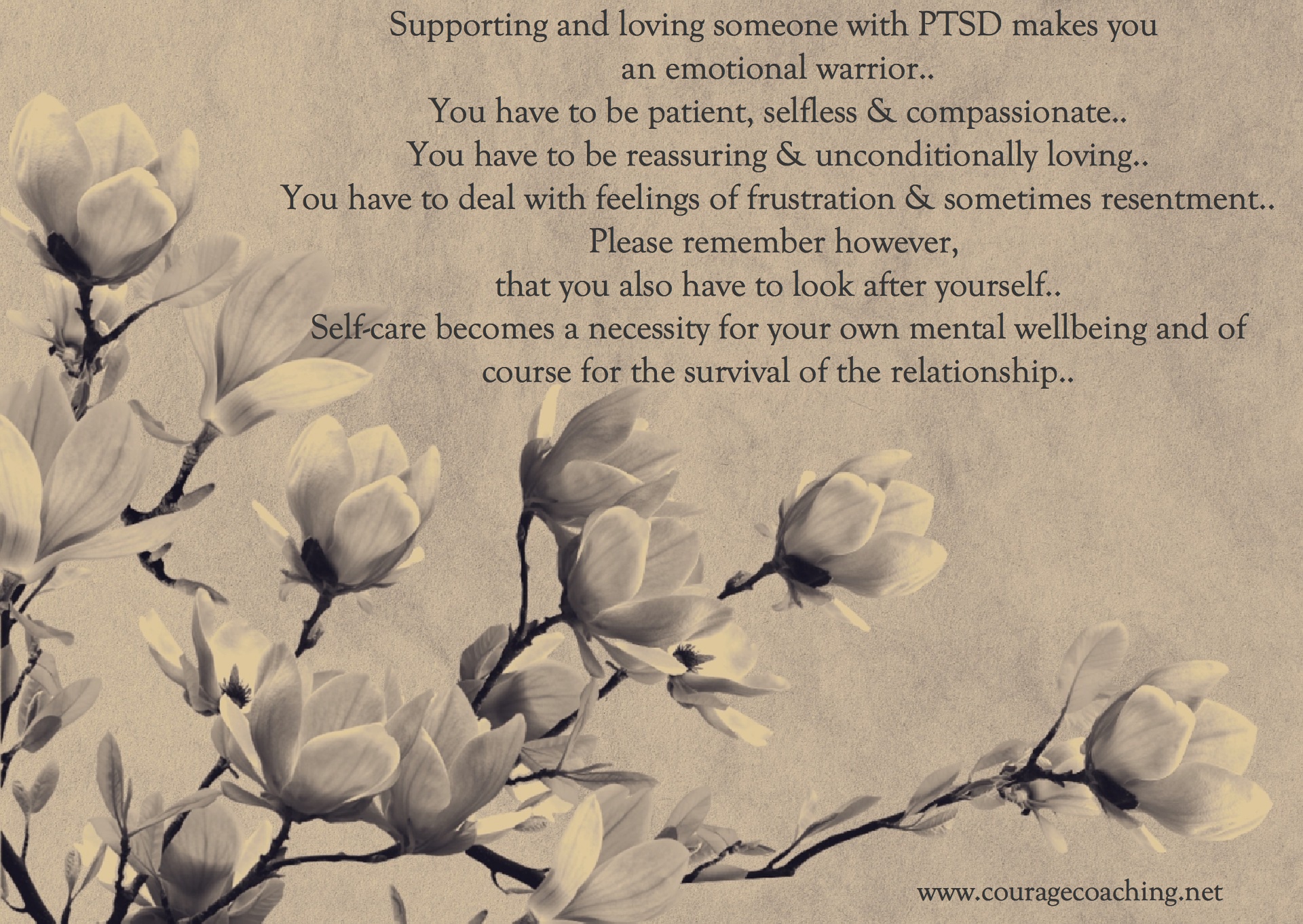
The most important thing to remember is that both partners have to practice self-care..
The one doing the supporting can also end up suffering from depressive episodes or anxiety..They may also generally feel mentally exhausted..
Breaks are very important and the partner of someone with PTSD, may at times need to take a mental holiday away from their partner..This is completely OK and almost necessary for the survival of the relationship.
Thanks so much for reading and please share this post if you think it may help someone!
Love Athina ♥♥
© All blog posts and images are owned by me and Courage Coaching. Please don’t use without consent and only re-blog if you would like to use the information on here.
There are so many occasions from my own personal experience, where I have witnessed this type of amnesia. In most of these occasions, it was with a parent.
Narcissistic selective amnesia is real and extremely damaging.
If you have not heard of this before, then my latest youtube video below, will hopefully help.
When you are in the depths of emotional despair, it can be extremely upsetting dealing with this sort of reaction from the narcissist in your life.
Before you are aware that you are being abused by a narcissist, you are usually blind to the narcissist’s ways of abusing you. You have no idea that you are a dealing with a very harmful individual.
When the narcissist practices selective amnesia in response to something you have pointed out, you feel completely at a loss. The frustration can be infuriating to not feel heard & and to not be understood.
The narcissist isn’t always conscious of their selective amnesia unfortunately, but this doesn’t make it any less harmful.
If you have had experience with a narcissist’s selective amnesia, please share it in the comment section below.
Feel free to share this blog post, if you think it will help others.
Thank you
Love Athina ♥
© All blog posts and images are owned by me and Courage Coaching. Please don’t use without consent and only re-blog if you would like to use the information on here.
Somatic experiencing, helps restore the natural energy balance in our bodies. It helps with restoring the energy flow in our bodies, in places where it is stuck due to stress, injury or trauma.
Somatic Experiencing® (SE™) was developed by Peter A. Levine, PhD to address the effects of trauma. Levine developed this approach after observing that prey animals, whose lives are routinely threatened in the wild, are able to recover readily by physically releasing the energy they accumulate during stressful events. Humans, on the other hand, often override these natural ways of regulating the nervous system with feelings of shame and pervasive thoughts, judgments, and fears. Somatic Experiencing aims to help people move past the place where they might be “stuck” in processing a traumatic event.
The Autonomic Nervous System and Somatic Experiencing Theory
The autonomic nervous system (ANS), which includes the sympathetic nervous system (SNS), the parasympathetic nervous system (PSNS), and the enteric nervous system (ENS), is triggered into action when we’re faced with adversity and it governs the fight, flight, or freeze instinct. Although designed to be self-regulating, the ANS can become dysregulated, particularly when full expression of one’s response to trauma is repressed. As a result, the body continues to respond as if it is under threat. Somatic experiencing contends that negative symptoms of trauma—such as anxiety, hypervigilance, aggression, and shame—result from denying the body the opportunity to fully process the traumatic event.
Though many people who experience traumatic events recover completely, for those who do not, unresolved trauma can lead to larger mental and physical health concerns, such a post-traumatic stress (PTSD),sleep problems, mood swings, or immune system problems. Somatic Experiencing aims to restore the body’s ability to self-regulate in order to achieve balance and integrity.
Method of Somatic Experiencing
Somatic Experiencing sessions involve the introduction of small amounts of traumatic material and the observation of a client’s physical responses to that material, such as shallow breathing or a shift in posture. The therapist will frequently check in with the client to assess and record somatic sensations that may be imperceptible to the practitioner, such as feelings of heaviness, tightness, or dizziness. Practitioners proceed carefully and cautiously to avoid retraumatizing or triggering the client, and they help people to develop and employ self-regulating strategies. A key component to enhancing one’s ability to self-regulate is the practice of alternating, or “pendulating,” between the sensations associated with trauma and those that are a source of strength and comfort.
The SE practitioner will help the client find places of safety, whether that be a place in the body that is not activated by the trauma, or a physical place to retreat to in one’s mind. Experiencing the sensations related to the traumatic event in a safe way allows a person to fully process the trauma. Clients also achieve heightened awareness of their physical responses to stress, and this skill can serve them in everyday life.
The above text is from the goodtherapy.org website and is the best explanation I have found on somatic experiencing.
As somebody who lives with muscular armouring, which is a result of my CPTSD, I know how uncomfortable my body feels, especially around my neck, chest and back. Due to high stress throughout most of my life, this has resulted in a feeling of tightness in my chest, headaches, clinched shoulders, tight upper back and more. I also notice myself neurotically holding my belly muscles, which in turn disrupts my healthy diaphragmatic breathing. Sometimes, I have to remind myself to relax my breathing and in turn relax my muscles but unfortunately this isn’t enough in the long run, as my painful symptoms always return.
Muscular armouring causes Myofascial pain. Myo stands for muscle and fascia is the connective tissue that holds everything together. In more simple terms, when someone is stuck in a hyper vigilant state, this causes intense muscle tightness (muscular armouring) which results in Myofascial pain. Fibromyalgia is also a condition that can develop from prolonged trauma and is very difficult to diagnose in a lot of cases.
For those of you who have suffered trauma in your childhood or any other sort of trauma, it is worth paying attention to your physical symptoms, as body and mind are connected. If you have only tried talking therapy but haven’t tried somatic therapy, then I highly recommend that you consider it.
The theory behind somatic therapy is that the mind, body, spirit, and emotions are all related and connected to each other. Talk therapy is combined with physical techniques, such as deep breathing, relaxation exercises, and meditation. Other techniques used include dance, exercise, yoga, or other types of movement, vocal work, and massage.
It is important to be in touch with your body and to practice self-care as much as possible.
If you found this post useful then please feel free to comment, like or share.
© All blog posts and images are owned by me and Courage Coaching. Please don’t use without consent and only re-blog if you would like to use the information on here.
Love Athina ♥
Wishing all you wonderful readers and fellow bloggers a wonderful Christmas (although a little late) and I really hope that you managed to find beauty & love in your surroundings, even if you were grieving or not having such a good time today. If not, then know you were not alone in your grief! I hope that you were loved or at least were able to spoil yourselves.
Lots of love to you all! ❤️
Athina
Mental illness has always been a part of my life. Whether it is through my own personal journey, through my family’s or watching friends struggle.
Although I haven’t been writing on here much, mental health will always remain a very important cause that I will always talk about. It is crucial for anybody struggling with mental illness to feel heard, to feel validated & to feel safe.
Empathy & understanding are necessary and we must all do our best to listen without judgement.
Life can sometimes throw us a curveball and none of us will ever know when this might happen.
Talk about mental health!
Be open & honest!
Be understanding!
Listen & give plenty of hugs to those struggling!
Sometimes that is enough to make someone’s day a little better!
Love Athina ♥
© All blog posts and images are owned by me and Courage Coaching. Please don’t use without consent and only re-blog if you would like to use the information on here.
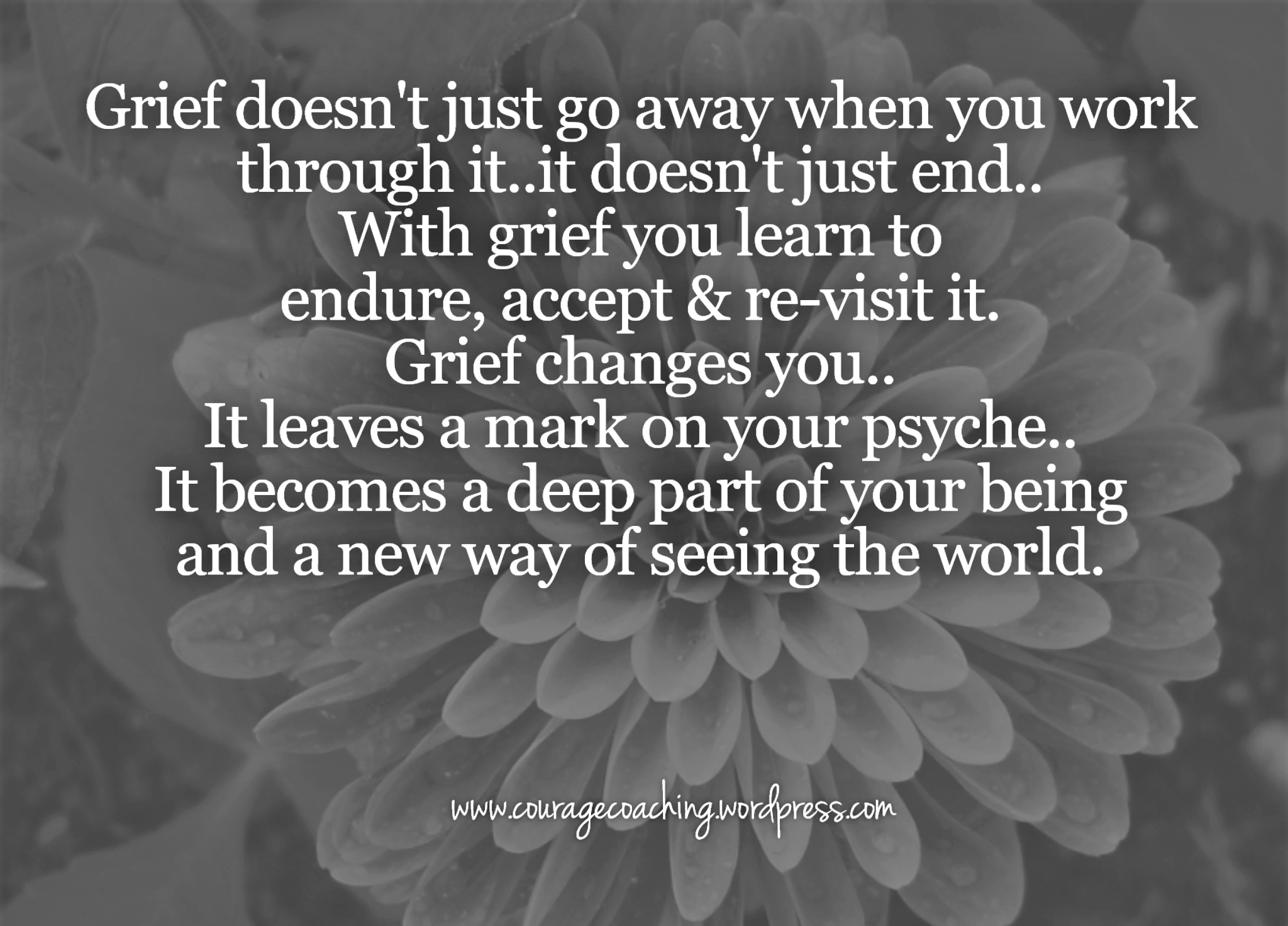
Grief is a huge part of life and yet a very painful one. We all experience it and for some people grief can be an even bigger part of their lives than for others.
Grief can be about so many things, not just the death of a person.
Every new beginning means that there was also an ending and every ending can leave a trail of grief. Grief can be experienced at the end of a relationship, the end of a job, leaving the town you grew up in, saying goodbye to friends or family, saying goodbye to a beloved pet or business or even saying goodbye to life as a single person.
What are your experiences with grief?
Love Athina ♥
© All blog posts and images are owned by me and Courage Coaching. Please don’t use without consent and only re-blog if you would like to use the information on here.
Happy Monday dear friends & followers!
After a wonderful 10 days off work, celebrating my birthday with friends and exploring new places with my husband, I am feeling grateful and refreshed.
Today’s topic is especially important to me, as someone I care about deeply is currently suffering with this type of depression.
Although high functioning depression is a milder form of depression, it is equally as important as other types of depression.
When it comes to depression, many of us envision a person caught in the depths of despair and hopelessness, who wants nothing more than to stay in bed and avoid people and work completely. We envision someone who has lost all interest in the things they love, who may be feeling suicidal and is barely holding it together.
Although the above isn’t inaccurate, it doesn’t portray life as a high functioning depressive.
When someone suffers with mild or high functioning depression, the typical joy and laughter they once felt, is usually replaced by an absence of emotion and a very deep feeling of emptiness.
This is known as anhedonia and it is the loss of interest in previously rewarding or enjoyable activities.
To the outside world they seem like they are coping fine. They are still able to go to work every day and communicate effectively. They are still able to reach goals and get out of bed in the morning.
The most unfortunate part of those with this milder form of depression is that when they talk about their feelings to loved ones and even doctors, they aren’t taken seriously enough.
Unless someone is literally unable to function, they seem to be dismissed as not having anything to worry about. This isn’t good!
When life circumstances change, those experiencing mild depression may be at greater risk for moderate to severe depression if treatment isn’t sought early enough.
This is also discussed in my youtube video, so feel free to share if you think it may help someone you know.
Love Athina ♥
© All blog posts and images are owned by me and Courage Coaching. Please don’t use without consent and only re-blog if you would like to use the information on here.
As much as I dislike watching the news and tend to limit what I take in, it is increasingly difficult to not be affected by the constant bombardment of war footage, terrorist attacks, murder and suffering.
When you are a highly sensitive & empathetic person, it is easy to get overwhelmed by the sadness of others. I am very much aware of the cruel injustice in our world and it hurts me deeply to see so many suffering. It is even tougher when this is repeated in your own country. Due to the fact that I know what it feels like to have your life threatened, I decided to make the following video on the aftermath of trauma. This is my small contribution towards all those affected.
Despite my traumatic childhood, I was also once caught up in armed robbery, where a gunshot went off right next to me and a woman was lying on the floor with blood on her leg. The disbelief of what I had witnessed was indescribable. The terror I felt shook me to the core. I couldn’t comprehend how someone could shoot a gun, when everyone at the cashier was cooperating and the robbers had managed to get their money.
This armed robbery happened at a time where I was very vulnerable already as my CPTSD was really bad. All I could think of after this robbery was ‘not again, not another trauma to add to my list’. Life felt so unfair and scary on that day and my mind was telling me that there was more damage done and that I would not recover this time.
If it wasn’t for my kind therapist at the time, to ground me and tell me that I wasn’t going to let this swallow me, I don’t know how I would have coped in the long term.
So this video is for those of you who are new to trauma. It is helpful in understanding yourself after a traumatic experience and it gives you the tools you need to ride the emotional waves that may at times feel like they are taking over.
Although I am not a qualified psychotherapist, I do have a lot of insight into trauma through my own journey and I know the many things that helped me, as well as others. If you are someone who is in deep distress, then please call a qualified mental health professional.
Thank you so much for reading & watching! ♥
Please share this post if you think it will help others.
Check out my patreon page below, if you would like to support the creation of more videos, documents and fact sheets.
https://www.patreon.com/AthinaEhlen
Love Athina ♥
© All blog posts and images are owned by me and Courage Coaching. Please don’t use without consent and only re-blog if you would like to use the information on here.
 couragecoaching.net