
The loss of what should have been

When you don’t get certain basic needs met in your childhood, there will come a time in your future where you will eventually become awakened to these unmet needs. Although this isn’t the same for everyone, there is usually one feeling which is most prevalent for most: ”The feeling of being ripped off”

This feeling of being ripped off, because you didn’t have a healthy family or because you no longer have a family to turn to, starts a very real and painful journey of mourning.

A lot of people who grew up with abusive parents, or in one parent families, or in families where their parents were chronically ill, learned to ‘live on autopilot’. They either had to push down their feelings to keep the peace, be a confidant or carer to the sick parent or learned that they had to solely rely on themselves. Even when they were scared and had no one to turn to as children, they had to keep going. As early adulthood approached, they may have found many ways to cope with this underlying feeling of sadness or anger, by drinking too much, working too much and generally trying to find ways to numb out any uncomfortable feelings that would creep up.

When an adult child is first awakened to the reality of what really was and what now is, they somehow know that things will never feel the same again. It might be that a certain event in their adult life uncovered feelings that had been buried deep inside them and suddenly the strength that they thought would always keep the safe, slowly starts to crumble. New anxieties, fears & losses start to unfold and the world suddenly starts to feel like a scary & unsafe place.

At this early stage of realisation, when adult children come to terms with the fact that they needed so much more than what they were given emotionally, the grief can feel overwhelming. Grief for adult children is a complex emotion because so much of the loss has been built up over time and they have long learned to adapt to the constant loss of an ideal childhood. Looking into the future feels bleak and they feel as if things are only going to get worse rather than better.

Through my own journey of grief, I learned that it isn’t a straightforward process and that it doesn’t have a certain time limit. When the grief was so overwhelming at times that I couldn’t imagine a better future, I reminded myself that it was necessary for me to truly feel the sadness. When your heart feels broken you have to let it heal and healing requires compassion & patience with yourself.

Pete Walker is a truly Inspirational Psychologist and survivor of childhood abuse. His words below really resonate:

 “…the broken heart that has been healed through grieving is stronger and more loving than the one that has never been injured.  Every heartbreak of my life, including the brokenheartedness of my childhood, has left me a stronger, wiser and more loving person than the one I was before I grieved”

The last thing that is worth mentioning, is that a lot of people don’t start their journey of recovery & grief from childhood trauma, unless it is emotionally safe for them to do so. It might be that they are in a supportive relationship and a stable environment and this enables them to ‘let go’ and just be vulnerable. It might be that they have found a therapist which they feel comfortable enough to be themselves.

Recovery from the losses of one’s childhood is necessary in order to restore balance & new found hope in the future.
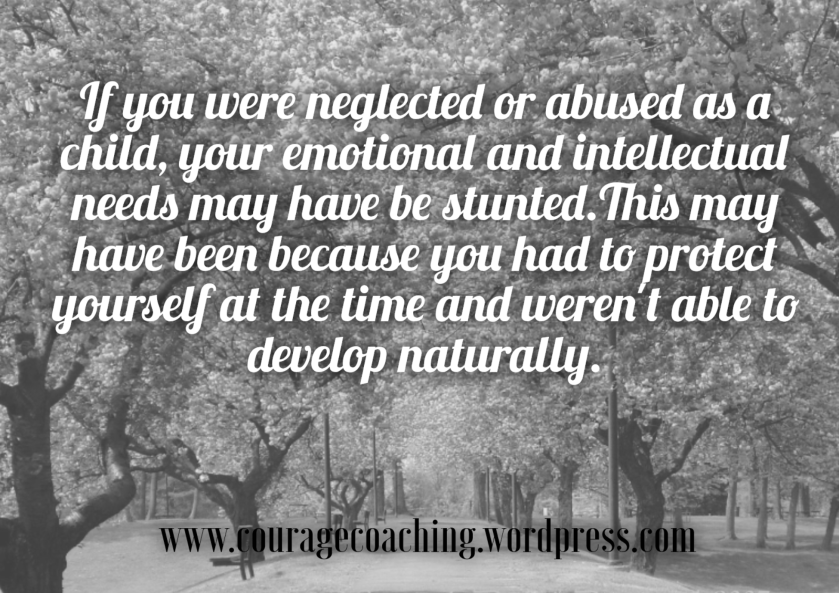
FontCandy (29)

What is your experience?

Love Athina ♥

© All blog posts and images are owned by me and Courage Coaching. Please don’t use without consent and only re-blog if you would like to use the information on here

Psychological Projection-A defense mechanism that people with NPD use often

Dear friends

I am hope you are enjoying your weekend and are generally doing ok.

Before I fly off to Scotland tomorrow, I wanted to upload Monday’s Youtube video early, as I won’t be able to work on it when visiting family.

This week’s video is about an abusive behaviour & defense mechanism that people with narcissistic personality disorder use very frequently.

Projection is something I experienced most of my life from my mother and it is something that was immensely painful.

This is the definition of Projection according to Wikipedia:

Psychological projection is a theory in psychology in which humans defend themselves against their own unconscious impulses or qualities (both positive and negative) by denying their existence in themselves while attributing them to others. For example, a person who is habitually rude may constantly accuse other people of being rude. It incorporates blame shifting.

I hope you find this video helpful.

Love Athina ♥

© All blog posts and images are owned by me and Courage Coaching. Please don’t use without consent and only re-blog if you would like to use the information on here

Pathological lying & other types of lying

Happy Monday everyone! I hope your week started well 🙂

Today’s video, which unfortunately took me ages to edit due to many interruptions & distractions, is about pathological lying. Although I talk about other types of lying, I particularly wanted to highlight the importance of pathological lying because it is the most destructive form of lying there is. Compulsive lying is also similar, although not as spiteful.

Individuals which are high on the narcissistic spectrum (NPD’d, Malignant narcissists, Psychopaths, ASPD’d) are very skilled pathological liars.

Please like,share & subscribe to my youtube channel if you find this video helpful!

Love Athina ♥

© All blog posts and images are owned by me and Courage Coaching. Please don’t use without consent and only re-blog if you would like to use the information on here


A great resource for CPTSD sufferers that have trouble sleeping

moon-769918_1920 I came across this wonderful website & blog known as ‘Beauty after bruises’, which is a voluntary website that provides invaluable support for those with CPTSD and/or Dissociation.



The links I am adding here are very useful for those of you who really struggle with sleeping and generally dread the night time. Please check them out if you think they might help you and feel free to re-blog this post so it also reaches others.

nighttime101

nighttime201

Love Athina ♥

© All blog posts and images are owned by me and Courage Coaching. Please don’t use without consent and only re-blog if you would like to use the information on here.


Parentification

In today’s video, I talk about another type of child abuse known as parentification.

Parentification isn’t always through the known fault of a parent, as sometimes in single parent families or in families with a special needs child, the parent struggles to keep the needs of the child fulfilled appropriately. Sometimes, the parent may be also suffering from a severe disability such as a chronic condition or severe mental health difficulties, and it is only natural that the child may at times become a carer to the parent. This is especially true, if there isn’t an additional parent or family member around to support the child.

Unfortunately, in a family where 1 or both parents suffer with narcissistic personality disorder, this type of abuse is even more prevalent in both a physical and emotional way.

My video describes this in more detail:

If you have experienced parentification, then feel free to share your experience.

If you find this youtube video and blog post useful, then please like, share & subscribe.

Please support my youtube channel on my patreon page. There are exclusive patron only videos on there, which are available specifically to those of you who contribute & become patrons.

https://www.patreon.com/AthinaEhlen

Love Athina ♥

© All blog posts and images are owned by me and Courage Coaching. Please don’t use without consent and only re-blog if you would like to use the information on here.


Infantilization

You might have heard of the term infantilization but you may not realise how incredibly abusive it is when a parent does this to their child.

It is only natural for a growing child to start developing independent thoughts, actions and opinions. For a narcissistic parent this can be very threatening, as they want to continue controlling their child and use them for narcissistic supply.

Check out my video for an explanation of what infantilization is.

Some examples of infantilization are as follows:

A parent stops a teenager from socialising with friends or doesn’t allow them any privacy in their bedroom. The parent may still treat them as if they are a young child whereas a teenager needs growing independence and privacy.

A parent buys their child age-inappropriate clothing and/or arranges age-inappropriate activities.

A parent might not allow the child to speak for themselves, when they are asked a question directly by somebody else.

A parent might discourage the child from pursuing new interests as they don’t want the child to become more skilled at new things than they are.

If a parent isn’t able to have healthy relationships, they may try to influence the child against their choice of partner. They can’t allow their child to leave the family nest. The parent wants to continue their enmeshed relationship for as long as possible.

The effects of infantilization are as follows:

  • The adult child ends up having chronically low self-esteem
  • The adult child has difficulties academically
  • The adult child may find getting a job difficult
  • The adult child learns helplessness and enabling
  • The adult child may self-harm
  • The adult child may have poor social skills
  • The adult child may self-sabotage
  • The adult child may become avoidant

If you can relate to any of what I have written or said in the video, then please re-blog so it reaches more people.

Knowledge is power and with knowledge comes healing. To also further promote healing on a larger scale, I have recently signed up to patreon to further support my creations of videos, pdfs & hopefully in the near future, e-books.

Patreon is a platform that enables creators to reach new goals by having their followers & supporters fund their work.

If you find my videos & blog posts helpful, then please check out my patreon page.

It would mean the world to me to be able to reach more people and help them on their journey of recovery.

https://www.patreon.com/AthinaEhlen

dumdum-patreon

Love Athina ♥

© All blog posts and images are owned by me and Courage Coaching. Please don’t use without consent and only re-blog if you would like to use the information on here.


Narcissistic abuse-Trauma bonding with a parent

giphygf

As many of you already know, my journey to qualifying as a Life Coach, was based on my own recovery from my narcissistically abusive parents.

For those of you who don’t follow my more personal blog, I wanted to just give you a little insight into my own struggles.

In the last few days, I have been struggling with contact again from my father, after 1 year and a half of not speaking.

I sent him a letter, so he could stop harrassing me by phone.

I never exclusively told him I wanted no contact, but after a very traumatic time following his attempted suicide, (as a way of stopping his wife from leaving him) he gave me the silent treatment for a year, so I just went along with it.

I was not willing to respond to him and was already in a grieving process, even though there was no closure of any sort.

When he finally decided to start hoovering me back in with his phonecalls and sudden caring, I continued to ignore his calls. This communication from him went on for 8 months. I finally got fed up with the constant calls that I decided to send him a letter to end our relationship. I briefly explained my reasons and gave him the chance to reply.

I received his reply and it hit me really hard! More than I expected it to.

I realised that I still had a tiny glimmer of hope that he might change his behaviour and this was a huge setback for me. I also realised how incredibly strong the trauma bonding is between us, even more so than with my mother.

As a means of coping with my recent distress and the final letter to him, which I am in the process of writing at the moment, I created the below video!

It outlines what I have been going through and what many other survivors of abuse face all the time.

Please feel free to share it, if you think it may help others.

Just visit my Youtube page and embed it into your page.

Thanks for reading

Love Athina ♥

© All blog posts and images are owned by me and Courage Coaching. Please don’t use without consent and only re-blog if you would like to use the information on here.

GAD (Generalised Anxiety Disorder)

img_0568

Generalised Anxiety Disorder is a long-term condition that causes you to feel anxious about a wide range of situations and issues, rather than one specific event.

People with GAD feel anxious most of the time and often struggle to remember the last time they felt truly relaxed. They are constantly affected by worried thinking, which can affect their daily routines, their work, their appetite and their sleep.

GAD can cause both psychological (mental) and physical symptoms. These vary from person to person, but can include:

  • Dizziness & or heart palpitations
  • Excessive worrying and obsessing
  • Difficulty handling uncertainty
  • Muscle tension
  • Trembling or twitching
  • Headaches
  • Being easily startled
  • Dry mouth
  • Cold or hot sweats
  • Nausea
  • Trouble concentrating
  • Trouble sleeping
  • Anxiety which can at times lead to panic attacks

GAD can commonly also co-occur with other mental health disorders such as social anxiety disorder, panic disorder, (C)PTSD or depression.

GAD can be caused by genetics, by childhood trauma or loss or by an imbalance of serotonin and noradrenaline in the brain.

If you are affected by GAD, then please feel free to share your experience.

I am offering free initial consultations to anyone who is affected and is in need of support.

Love Athina ♥

© All blog posts and images are owned by me and Courage Coaching. Please don’t use without consent and only re-blog if you would like to use the information on here.


Narcissists & their relationship to money

This is a topic I previously covered on my personal blog last year but it is important to highlight again, especially in the current climate.

Most extremely powerful & wealthy people in this world, are usually void of empathy. Politicians, country leaders, business tycoons etc..

Narcissists and especially overt & malignant narcissists, lack empathy, lack self insight and aren’t able to form healthy & reciprocal relationships.

In this video, I talk about the importance of money in a narcissist’s world.

I talk about financial abuse and how narcissists may use this sort of abuse.

Having had first hand experience with a narcissistic & very controlling father, I have witnessed the obsession of a narcissist with his money & how he uses it in his life, to harm those close to him.

If you have experienced financial abuse or known someone who has used money in a harmful way, then please feel free to share this in the comments below.

Love Athina ♥

© All blog posts and images are owned by me and Courage Coaching. Please don’t use without consent and only re-blog if you would like to use the information on here.

Status anxiety

img_0646

How do we each fit into this world?

Are we defined by whether we have a good job? A good marriage?

Do we feel that we constantly have to measure up to our friends’success?

Do we feel that we have to have the latest gadget, a new car or a big house?

Do we feel like a complete failure if we haven’t secured a stable job?

And what about relationships & family? When someone is single past the age of 40, everyone has an opinion about why that person is still single. If someone is jobless, everyone has an opinion on why that is.

STATUS ANXIETY is a constant worry about whether we are good enough in the world we live in. It is an insecurity about whether our life is a failure or whether it is a success.

Status anxiety is a term I came across after watching a video by Alain de Botton.

Status anxiety happens because we allow our environment to affect our inner world. Status anxiety happens when we allow other people to criticize us or the way we choose to live. It is only natural to become anxious, when we start comparing ourselves to others.

One of the most uncomfortable situations which may trigger status anxiety, is at a social event where you don’t know any of the guests. In such events, such as a party, you can only get to know someone initially by making small talk. You may be approached with questions such as ”What do you do? Where do you live?”. These questions may make you feel uncomfortable or inferior, because you don’t think your job is anything special and you don’t currently like the area you live in. In these situations you worry what the person asking the questions might think of you.

Status anxiety is rooted in judgements or how we think others will judge our choices, beliefs, skills and way of life. Nobody really has any control over the thoughts or judgements of others but everybody has control over how they react to others’ judgements.

If we really don’t care what other people think, then we probably won’t have status anxiety.

Status anxiety also frequently causes envy.We tend to envy in others, what we haven’t quite managed to achieve for ourselves. We may secretly envy the person who seems to have the perfect relationship when we are feeling lonely. We may envy the person who is always going on holidays because we can barely pay the bills with our low-wage job. Envy,  can give us insight into a part of our lives we may need to work on.

What is the most important thing to consider when suffering with status anxiety?

Is it more important to worry because we haven’t managed to develop a good career for ourselves? Is success only measured by having a high salary, a perfect marriage and celebrity status?

What is MORE important, is the meaning WE give to our life. If we are happy with all we have achieved (despite all the difficulties or judgements by others), then that is all that matters.

Our judgement of our own life is the most important.

Not everyone is born equally lucky, supported, intelligent, confident or motivated.

The people who are highly successful in business and are making the big bucks, are usually lacking in many other areas in their life. They may lack emotional intelligence and empathy.

If you had a choice in your life, what would it be?

In my personal opinion, success is being a kind & empathetic person.

Success is being able to self-reflect and being able to help others do the same.

Success is being remembered as a good person.

I believe that success shouldn’t be measured by whether you work, have a relationship or have kids.

Success should be measured by the type of person that you are..

When I die in the future, I would much rather be remembered as a good human rather than a successful businesswoman or celebrity. I would much rather be remembered as empathetic, giving, respectful, generous & lovable. I would much rather be remembered as someone who meant something to someone or as someone who inspired others.

If you find that you suffer with status anxiety, make sure that you define your own life in a way that makes you feel comfortable.

At the end of the day, all that really matters is the opinion you have of yourself and the respect and kindness yougive to others.

Love Athina ♥♥

© All blog posts and images are owned by me and Courage Coaching. Please don’t use without consent and only re-blog if you would like to use the information on here.