Mental Health Awareness week

32ce6e_73173c5b28504cf4b73dd1f1d98bd913~mv2

Ending the stigma of mental health is still proving to be a challenge, although in the UK we are getting ever closer to our goal of a deeper understanding, tolerance & acceptance of the importance of talking about our mental health.

As somebody who has never known what life is like without mental health problems, I know how difficult it is to be open and honest about it..People are still uncomfortable with knowing what to say or not say..Even if they try to be understanding, deep down you can sense whether they get it or they don’t..

Every single one of us is touched by stress or anxiety at some point in our lives, whereas others live with it every day…I am one of those people who lives with chronic mental health problems..Complex PTSD isn’t something to be taken lightly..There are still so many moments in my life at the age of 34 that I still learn new things about myself that I am not able to do, that others would find incredibly easy to complete. The hypervigilance and overwhelm never goes away..The chronic fatigue never goes away..The low mood is always lingering in the background..The voice that says ‘you are just not good enough’, pops up a lot when I am working alongside others…

Self-care is so important in these moments and remembering to accept ourselves when we are struggling can make a world of difference!

Walking the same path as others with mental illness really helps people feel less alone..

All the wonderful people who ran the London Marathon raising money for Mental Health are simply incredible..

If you think about how much these runners must have battled with those nasty little voices inside their head, it makes you feel incredibly inspired. The voice of depression or the voice of anxiety is not an easy task to manage..but yet they did it, and in what an admirable way!

I am also blessed to have many friends & fellow bloggers who do so much to raise awareness about mental health! They have all been personally affected however and live with debilitating conditions themselves..

The most crucial part in my opinion of raising awareness, is to also hear more people talking about mental health that don’t have any personal experience with it..People that feel concerned about someone they know but just don’t know how to respond..People that are lucky enough to live with good mental health and are surrounded by people who aren’t that lucky..

If you have experience with ill mental health, stigma or intolerance, then please feel free to comment.

Lastly, I would also like to share my latest information video on defence mechanisms. I was having a bad day yesterday and couldn’t face the camera to film myself talk, so I came up with this instead.

Thanks so much for reading & watching!

Love Athina ♥

© All blog posts and images are owned by me and Courage Coaching. Please don’t use without consent and only re-blog if you would like to use the information on here.


1 year of Courage Coaching

OXYGEN TANK TUESDAY ‹ Mr Buffy Devane ‹ Reader — WordPress.comToday marks 1 year since I started Courage Coaching and I can definetely say it has been totally worth it!

Although I wasn’t new to wordpress 1 year ago, I was very new to coaching!

Since completing my certification and coaching my first clients, it has been both exciting and challenging.

Through creating my small youtube channel,  I have helped support people, that I would otherwise not have been able to reach.This channel has grown at a steady pace and my videos (and sound quality) have also improved over time (with the help of my viewers 🙂 of course).

It has been a very interesting first year and I have felt very grateful for all the lovely comments, support and exciting opportunities that have been part of my journey so far.

Sharing my knowledge with others and giving people hope, has been a truly humbling experience.

When I myself was in a dark place in the past, all I wanted was hope and guidance. The few but very special people that gave me this hope and guidance, will never truly know what a huge part they played in the successes I now am grateful for.

It is so valuable to know that there is always a tiny speck of light in that neverending darkness we may sometimes face in our life.

Dear readers, I would like to THANK YOU.

Love Athina ♥


Dealing with parental estrangement

If you have become estranged from your parents, it’s important to remember that this can be a very vulnerable place to be. Making the decision to become estranged from your family may alleviate some of the instant emotional pain after a huge argument, however, many people find that estrangement is a constant battle in their life, as it can cause them to endlessly think about their situation, even if they do feel an initial sense of relief.

Some people become estranged from their parents because they have been emotionally, physically or sexually abusive during childhood or beyond. This is a difficult decision to make but sometimes a necessary one. It’s immensely tricky to continue a healthy relationship if there has been abuse, and it can be extremely risky to continue a genuine relationship with this family member without the right professional intervention and support.

Others become estranged with their parents or siblings due to conflicts about religion or sexuality. This can also be especially painful, as the adult child isn’t able to truly be who they are. Authenticity is crucial for a happy life.

DSCN3757 (2)

Grieving the estrangement from a parent, no matter what the circumstances, is a very important part of healing from it, as the loss of an accepting & healthy parent is an extremely painful experience, even more so than normal grief. Nothing will ever fill the void of not having had what every child so rightfully deserves. Comfort, validation & unconditional love. Realising that a parent was never truly able to love & accept you, is utterly heartbreaking.

Even if there was abuse, children never stop loving their parent unconditionally and never stop hoping that their parent will change. This is the main reason adult children remain in contact with a parent, despite any abuse that may have occured. They will always long for the unconditional love they never had. In cases when the abuse or invalidation was constant, the trauma bond will also be why the adult child finds it hard to cut ties with their parent.

If the adult child isn’t able to fully grieve the loss of a healthy parent, they will not be able to move forward in a new relationship with them. If the parent continues to be abusive, shows no remorse, shows no understanding and doesn’t make any attempts to make amends, then it is healthier for the relationship to end.

In both cases of estrangement and remaining in contact, grieving is essential. Grieving helps lift the intense painful heaviness of not having had your needs met in childhood. It helps lessen the anger, frustration and injustice.

Most importantly, the adult children who end up going ‘no contact’, have to learn to live with the ‘early death’ of their parent before that parents actually dies. They have to continue living their life, without any communication or knowledge of how that parent is. They have to swallow the grief that creeps up from time to time, during holidays, birthdays, Mother’s day, Father’s day and during other emotional times in their life.

Those adult children who were lucky enough to have had good childhoods, with unconditionally loving parents, will never truly understand the deep pain of those who didn’t have good childhoods.

Family estrangement is a huge challenge and living with it requires support in more ways than one. It is important to have counselling from time to time and to be surrounded by understanding friends or a partner that can truly empathize. Lastly, it is crucial for the estranged, to feel the sadness that emerges and be self-compassionate as much as possible.

Love Athina ♥

© All blog posts and images are owned by me and Courage Coaching. Please don’t use without consent and only re-blog if you would like to use the information on here

The loss of what should have been

When you don’t get certain basic needs met in your childhood, there will come a time in your future where you will eventually become awakened to these unmet needs. Although this isn’t the same for everyone, there is usually one feeling which is most prevalent for most: ”The feeling of being ripped off”

This feeling of being ripped off, because you didn’t have a healthy family or because you no longer have a family to turn to, starts a very real and painful journey of mourning.

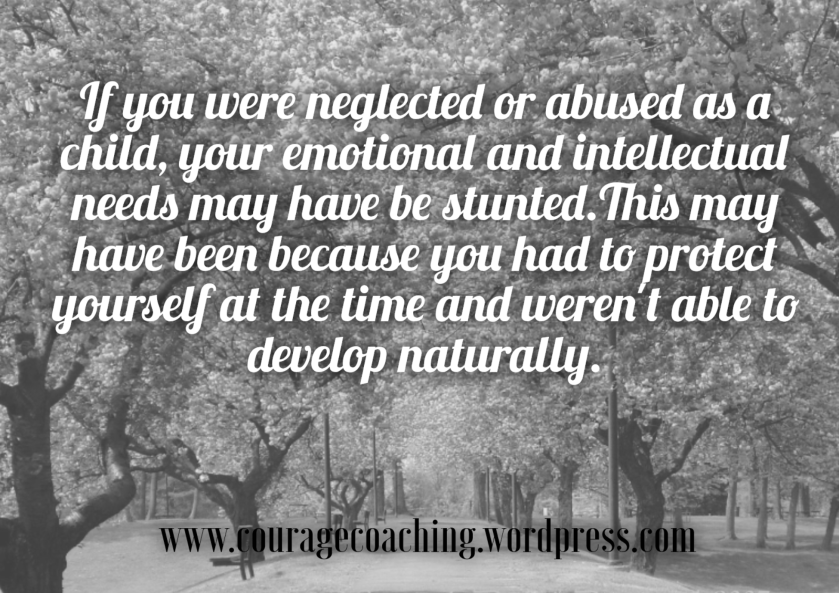
A lot of people who grew up with abusive parents, or in one parent families, or in families where their parents were chronically ill, learned to ‘live on autopilot’. They either had to push down their feelings to keep the peace, be a confidant or carer to the sick parent or learned that they had to solely rely on themselves. Even when they were scared and had no one to turn to as children, they had to keep going. As early adulthood approached, they may have found many ways to cope with this underlying feeling of sadness or anger, by drinking too much, working too much and generally trying to find ways to numb out any uncomfortable feelings that would creep up.

When an adult child is first awakened to the reality of what really was and what now is, they somehow know that things will never feel the same again. It might be that a certain event in their adult life uncovered feelings that had been buried deep inside them and suddenly the strength that they thought would always keep the safe, slowly starts to crumble. New anxieties, fears & losses start to unfold and the world suddenly starts to feel like a scary & unsafe place.

At this early stage of realisation, when adult children come to terms with the fact that they needed so much more than what they were given emotionally, the grief can feel overwhelming. Grief for adult children is a complex emotion because so much of the loss has been built up over time and they have long learned to adapt to the constant loss of an ideal childhood. Looking into the future feels bleak and they feel as if things are only going to get worse rather than better.

Through my own journey of grief, I learned that it isn’t a straightforward process and that it doesn’t have a certain time limit. When the grief was so overwhelming at times that I couldn’t imagine a better future, I reminded myself that it was necessary for me to truly feel the sadness. When your heart feels broken you have to let it heal and healing requires compassion & patience with yourself.

Pete Walker is a truly Inspirational Psychologist and survivor of childhood abuse. His words below really resonate:

 “…the broken heart that has been healed through grieving is stronger and more loving than the one that has never been injured.  Every heartbreak of my life, including the brokenheartedness of my childhood, has left me a stronger, wiser and more loving person than the one I was before I grieved”

The last thing that is worth mentioning, is that a lot of people don’t start their journey of recovery & grief from childhood trauma, unless it is emotionally safe for them to do so. It might be that they are in a supportive relationship and a stable environment and this enables them to ‘let go’ and just be vulnerable. It might be that they have found a therapist which they feel comfortable enough to be themselves.

Recovery from the losses of one’s childhood is necessary in order to restore balance & new found hope in the future.

FontCandy (29)

What is your experience?

Love Athina ♥

© All blog posts and images are owned by me and Courage Coaching. Please don’t use without consent and only re-blog if you would like to use the information on here

Psychological Projection-A defense mechanism that people with NPD use often

Dear friends

I am hope you are enjoying your weekend and are generally doing ok.

Before I fly off to Scotland tomorrow, I wanted to upload Monday’s Youtube video early, as I won’t be able to work on it when visiting family.

This week’s video is about an abusive behaviour & defense mechanism that people with narcissistic personality disorder use very frequently.

Projection is something I experienced most of my life from my mother and it is something that was immensely painful.

This is the definition of Projection according to Wikipedia:

Psychological projection is a theory in psychology in which humans defend themselves against their own unconscious impulses or qualities (both positive and negative) by denying their existence in themselves while attributing them to others. For example, a person who is habitually rude may constantly accuse other people of being rude. It incorporates blame shifting.

I hope you find this video helpful.

Love Athina ♥

© All blog posts and images are owned by me and Courage Coaching. Please don’t use without consent and only re-blog if you would like to use the information on here

Pathological lying & other types of lying

Happy Monday everyone! I hope your week started well 🙂

Today’s video, which unfortunately took me ages to edit due to many interruptions & distractions, is about pathological lying. Although I talk about other types of lying, I particularly wanted to highlight the importance of pathological lying because it is the most destructive form of lying there is. Compulsive lying is also similar, although not as spiteful.

Individuals which are high on the narcissistic spectrum (NPD’d, Malignant narcissists, Psychopaths, ASPD’d) are very skilled pathological liars.

Please like,share & subscribe to my youtube channel if you find this video helpful!

Love Athina ♥

© All blog posts and images are owned by me and Courage Coaching. Please don’t use without consent and only re-blog if you would like to use the information on here


A great resource for CPTSD sufferers that have trouble sleeping

moon-769918_1920 I came across this wonderful website & blog known as ‘Beauty after bruises’, which is a voluntary website that provides invaluable support for those with CPTSD and/or Dissociation.



The links I am adding here are very useful for those of you who really struggle with sleeping and generally dread the night time. Please check them out if you think they might help you and feel free to re-blog this post so it also reaches others.

nighttime101

nighttime201

Love Athina ♥

© All blog posts and images are owned by me and Courage Coaching. Please don’t use without consent and only re-blog if you would like to use the information on here.


How to live with gratitude

WP_20170310_15_41_44_Pro

Gratitude is a very important tool that most of us don’t use as often as we could.

To be grateful for all that we have in our life can bring a certain sense of contentment and peace.

Studies have been done, which show that gratitude improves both mental and physical health. Gratitude can reduce feelings of hopelessness and can greatly improve our relationships with others.

Doing a daily gratitude list just before bed, has been found to not only improve sleep quality but can also help with reducing depressive symptoms in people who are suffering.

”Gratitude makes sense of our past, brings peace for today, and creates a vision for tomorrow” – Melody Beattie

The key to really benefiting from the practice of gratitude, is to write 5 or more things that you are grateful for on each day.The more specific the things you write about, the more beneficial the effects.

One example for this may be ”My friend suprised me with a ‘Thank you’ card today” or ”I enjoyed playing with my cousin’s puppies”.

Another way of practicing gratitude, is to have a little jar and pop daily gratitude notes in it..At the end of the month or after a particularly bad day, it can be useful to return to your gratitude jar and read all the little gratitude notes you put in it.

Do you practice gratitude and if yes, is there something specific you do?

Thanks for reading

Love Athina ♥

© All blog posts and images are owned by me and Courage Coaching. Please don’t use without consent and only re-blog if you would like to use the information on here.

Malignant narcissism

Although this isn’t an actual diagnosis in the DSM, it is very real and it is very destructive.

I have had first hand experience with someone who has this condition and I live with a very real mental illness that was caused by that person.

I made a quick video outlining the basics.

I hope you find it helpful.

Love Athina ♥

© All blog posts and images are owned by me and Courage Coaching. Please don’t use without consent and only re-blog if you would like to use the information on here.

The Link Between Childhood Trauma and Chronic Fatigue Syndrome

sleeping-1159279_1920

Childhood trauma produces physiological effects upon the developing brain that have an adverse effect upon the individual’s stress response system.

Childhood trauma is likely to increase a person’s vulnerability to falling victim to Chronic Fatigue Syndrome (CFS).

FACTS ABOUT CFS.

The symptoms of CFS are as follows :

– persistent fatigue/exhaustion which affects everyday life and is not rectified by sleep or rest

– in the UK, the condition is thought to affect approximately a quarter of a million people

– the condition is more prevalent in females than in males

– it normally affects people between about the ages of 20 – 45 years; however, it can begin during childhood – if so, it normally begins between the ages of 13 and 15 years

CFS can be split into 3 different levels of severity :

– MILD : the person can probably care for him/herself, but may require days off in order to rest

– MODERATE : at this level the individual may well experience reduced mobility, disturbed sleep, as well as a need to sleep in the afternoon

– SEVERE : at this level the person will have significantly decreased mobility, possible impairments to his/her ability to concentrate as well as greatly reduced ability to perform many everyday tasks

Individuals with CFS who were tested in various studies, had higher overall trauma scores than those without CFS.

Exposure to trauma increases the risk of CFS between three and eight times, depending on the type. Emotional neglect and sexual abuse during childhood were most strongly associated with CFS.

It generally appears that CFS is part of a spectrum of disorders that are associated with childhood adversity.

Do you suffer with Chronic Fatigue Syndrome?

As someone who lives with CPTSD, I would say that I suffer from it moderately.

What is your experience?

Love Athina ♥

© All blog posts and images are owned by me and Courage Coaching. Please don’t use without consent and only re-blog if you would like to use the information on here.