The loss of what should have been

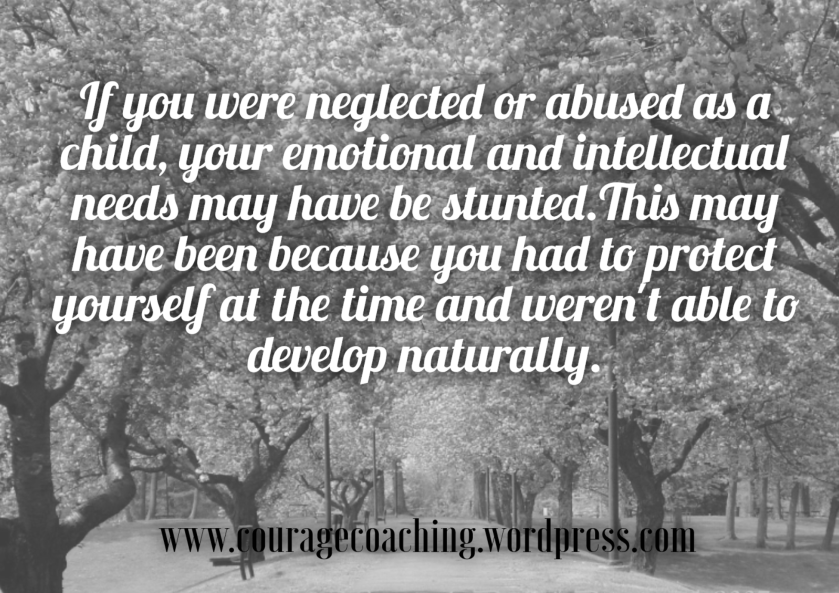
When you don’t get certain basic needs met in your childhood, there will come a time in your future where you will eventually become awakened to these unmet needs. Although this isn’t the same for everyone, there is usually one feeling which is most prevalent for most: ”The feeling of being ripped off”

This feeling of being ripped off, because you didn’t have a healthy family or because you no longer have a family to turn to, starts a very real and painful journey of mourning.

A lot of people who grew up with abusive parents, or in one parent families, or in families where their parents were chronically ill, learned to ‘live on autopilot’. They either had to push down their feelings to keep the peace, be a confidant or carer to the sick parent or learned that they had to solely rely on themselves. Even when they were scared and had no one to turn to as children, they had to keep going. As early adulthood approached, they may have found many ways to cope with this underlying feeling of sadness or anger, by drinking too much, working too much and generally trying to find ways to numb out any uncomfortable feelings that would creep up.

When an adult child is first awakened to the reality of what really was and what now is, they somehow know that things will never feel the same again. It might be that a certain event in their adult life uncovered feelings that had been buried deep inside them and suddenly the strength that they thought would always keep the safe, slowly starts to crumble. New anxieties, fears & losses start to unfold and the world suddenly starts to feel like a scary & unsafe place.

At this early stage of realisation, when adult children come to terms with the fact that they needed so much more than what they were given emotionally, the grief can feel overwhelming. Grief for adult children is a complex emotion because so much of the loss has been built up over time and they have long learned to adapt to the constant loss of an ideal childhood. Looking into the future feels bleak and they feel as if things are only going to get worse rather than better.

Through my own journey of grief, I learned that it isn’t a straightforward process and that it doesn’t have a certain time limit. When the grief was so overwhelming at times that I couldn’t imagine a better future, I reminded myself that it was necessary for me to truly feel the sadness. When your heart feels broken you have to let it heal and healing requires compassion & patience with yourself.

Pete Walker is a truly Inspirational Psychologist and survivor of childhood abuse. His words below really resonate:

 “…the broken heart that has been healed through grieving is stronger and more loving than the one that has never been injured.  Every heartbreak of my life, including the brokenheartedness of my childhood, has left me a stronger, wiser and more loving person than the one I was before I grieved”

The last thing that is worth mentioning, is that a lot of people don’t start their journey of recovery & grief from childhood trauma, unless it is emotionally safe for them to do so. It might be that they are in a supportive relationship and a stable environment and this enables them to ‘let go’ and just be vulnerable. It might be that they have found a therapist which they feel comfortable enough to be themselves.

Recovery from the losses of one’s childhood is necessary in order to restore balance & new found hope in the future.
FontCandy (29)

What is your experience?

Love Athina ♥

© All blog posts and images are owned by me and Courage Coaching. Please don’t use without consent and only re-blog if you would like to use the information on here

The Link Between Childhood Trauma and Chronic Fatigue Syndrome

sleeping-1159279_1920

Childhood trauma produces physiological effects upon the developing brain that have an adverse effect upon the individual’s stress response system.

Childhood trauma is likely to increase a person’s vulnerability to falling victim to Chronic Fatigue Syndrome (CFS).

FACTS ABOUT CFS.

The symptoms of CFS are as follows :

– persistent fatigue/exhaustion which affects everyday life and is not rectified by sleep or rest

– in the UK, the condition is thought to affect approximately a quarter of a million people

– the condition is more prevalent in females than in males

– it normally affects people between about the ages of 20 – 45 years; however, it can begin during childhood – if so, it normally begins between the ages of 13 and 15 years

CFS can be split into 3 different levels of severity :

– MILD : the person can probably care for him/herself, but may require days off in order to rest

– MODERATE : at this level the individual may well experience reduced mobility, disturbed sleep, as well as a need to sleep in the afternoon

– SEVERE : at this level the person will have significantly decreased mobility, possible impairments to his/her ability to concentrate as well as greatly reduced ability to perform many everyday tasks

Individuals with CFS who were tested in various studies, had higher overall trauma scores than those without CFS.

Exposure to trauma increases the risk of CFS between three and eight times, depending on the type. Emotional neglect and sexual abuse during childhood were most strongly associated with CFS.

It generally appears that CFS is part of a spectrum of disorders that are associated with childhood adversity.

Do you suffer with Chronic Fatigue Syndrome?

As someone who lives with CPTSD, I would say that I suffer from it moderately.

What is your experience?

Love Athina ♥

© All blog posts and images are owned by me and Courage Coaching. Please don’t use without consent and only re-blog if you would like to use the information on here.


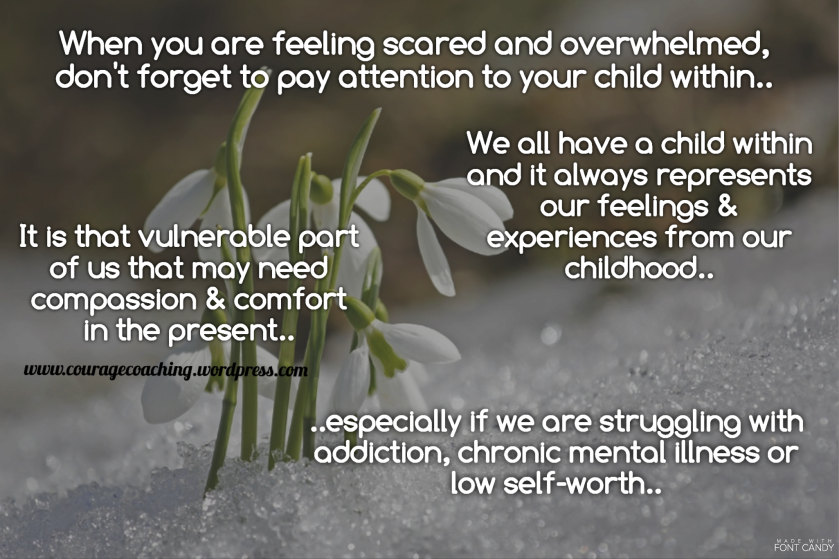
Our child within

fontcandy-11

Love Athina ♥

© All blog posts and images are owned by me and Courage Coaching. Please don’t use without consent and only re-blog if you would like to use the information on here.

Spreading a little awareness sparkle

fontcandy-6

Just a quick post about something that matters as equally as physical health.

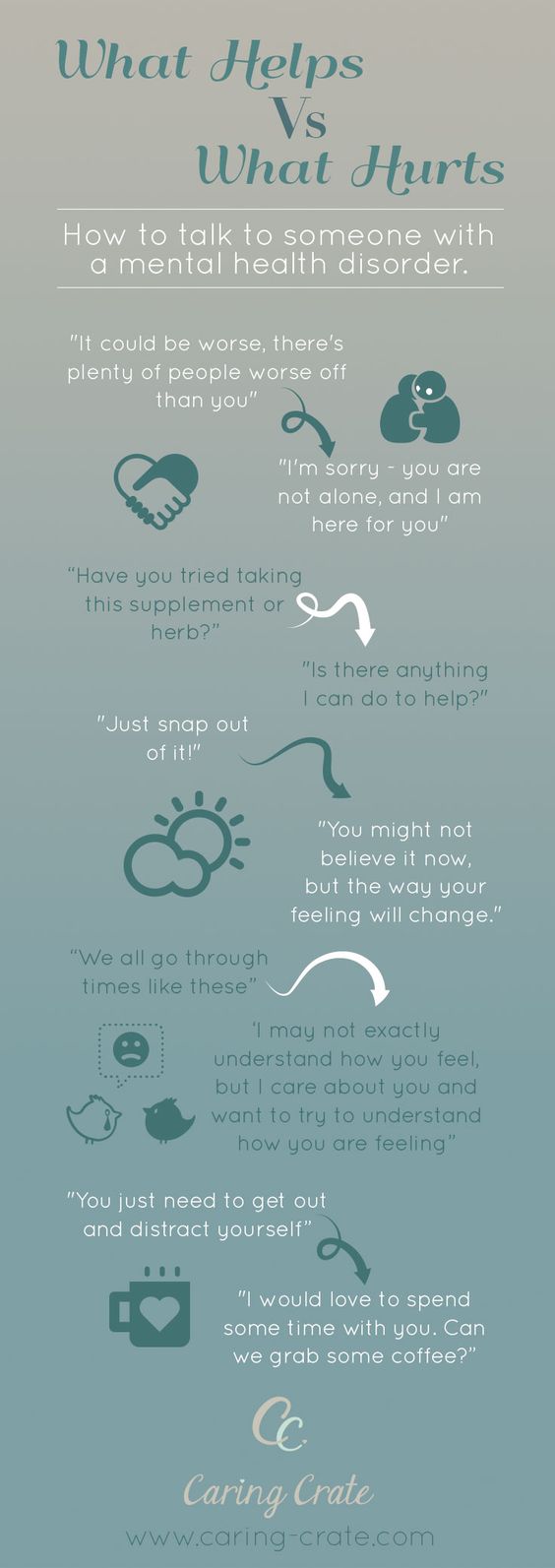
We all live with mental health and mental illness can touch all of us at least once in our lifetime.So how openly do we talk about it and how easily do we feel uncomfortable mentioning our struggles to a co-worker, family member or friend?

I have encountered so many of the below unhelpful phrases from ignorant individuals, so for this reason, I will keep spreading awareness of the importance of validating someone’s struggles with their mental health.

‘Don’t dwell on the past’

‘Aren’t you over it by now?’

‘Can’t you just try and be more happy?’

‘Stop focusing on the negative’

‘Strong people just get on with it’

‘Stop being a hypochondriac’

‘Stop being so self-centered’

‘Just snap out of it!’

‘You are just looking for attention’

IMG_0546

68996263715234a6de2749035a255252

Look after yourselves ♥

Love Athina ♥

© All blog posts and images are owned by me and Courage Coaching. Please don’t use without consent and only re-blog if you would like to use the information on here.

Trauma is a loss, so it must be grieved

Trauma happens to all of us..We all go through life with a few small traumas. Most of the time, small traumas or small losses don’t leave emotional scars. We just keep going and adjust to whatever life throws at us.

If on the other hand, the trauma or loss we suffer is profound, then this means that we will be more deeply affected by it and will need longer to overcome it or learn to live with the affects.

In this video, I touch on the importance of grief and the 3 main stages of grief you go through when dealing with a major loss or trauma.

Love ♥ Athina

© All blog posts and images are owned by me and Courage Coaching. Please don’t use without consent and only re-blog if you would like to use the information on here.

Shame

Shame is caused by negative messages. The shame I am highlighting in this video is caused by dysfunctional parents. Shame is insidious and can have detrimental effects on the way we view ourselves and others.

This is something I am very familiar with as a survivor of narcissistic abuse and I want to highlight the cause of shame, so people can maybe identify with what might have been said to them as children and so they can find a way to move forward and heal.

Love ♥ Athina

© All blog posts and images are owned by me and Courage Coaching. Please don’t use without consent and only re-blog if you would like to use the information on here.


Intolerance to vulnerability is NOT OK!

Intolerance to vulnerability is everywhere.

Dysfunctional homes have this at their core.Children don’t feel safe to express emotions of sadness or pain..Children are taught that it is not ok to have sad or angry emotions..that they will be a burden if they dare to express these emotions..

This is not acceptable..This is emotional abuse..

Physical vulnerability is different to emotional vulnerability..When someone is physically disabled or physically ill, he/she seems to have more understanding from others..because you can see his/her illness physically..When a disability is emotional or mental however, people are quicker to dismiss it..This is where the stigma of mental illness comes in..Every single person out there with a mental disorder, is vulnerable..If they suffer with anxiety or depression, this makes them vulnerable..Just as much as someone who has a heart condition, or cancer or any other condition..

A vulnerable person is someone who struggles with day to day life.

Vulnerability refers to the inability to withstand the effects of a hostile environment (https://en.wikipedia.org/wiki/Vulnerability).

People with mental illness frequently become vulnerable and easy targets of physical and mental abuse.

People with mental illness can have poor boundaries, emotional dysregulation and many other extremely debilitating symptoms. They deserve the same compassion as those with obvious physical disabilities. They deserve the right to be able to talk about their struggles.

Love ♥ Athina

© All blog posts and images are owned by me and Courage Coaching. Please don’t use without consent and only re-blog if you would like to use the information on here.

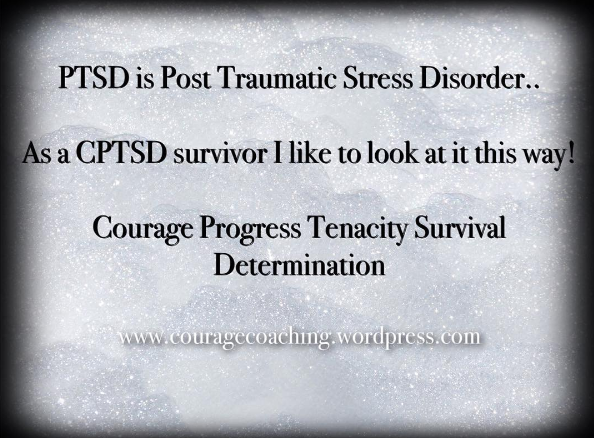
CPTSD= Courage Progress Tenacity Survival Determination

mychildwithin-healing_from_trauma-%e2%80%a2s-instagram-photos-and-videos4

Healing from PTSD is tough! Healing from Complex PTSD is even tougher.

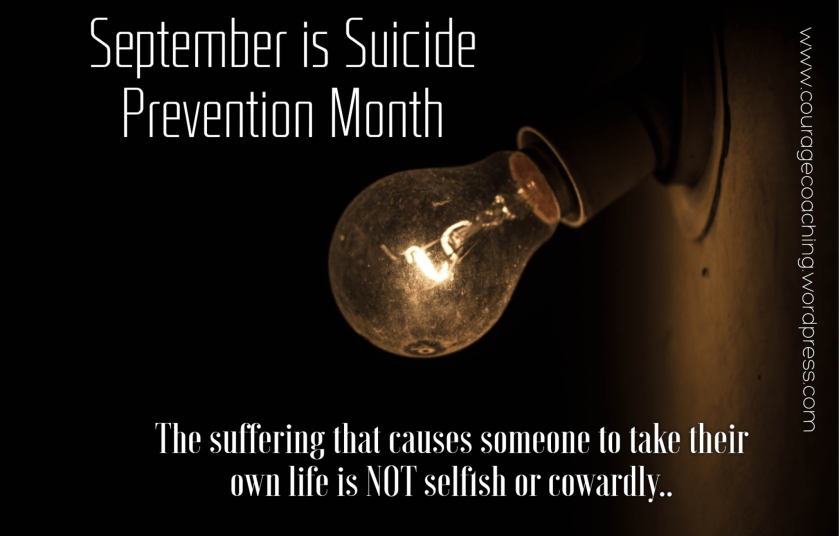
In honour of World Suicide Prevention Awareness Day, I want to tell every single one of you survivors out there that you can look at your PTSD & CPTSD differently, just for today! ♥

C-PTSD = COURAGE PROGRESS TENACITY SURVIVAL DETERMINATION

Love ♥ Athina

© All blog posts and images are owned by me and Courage Coaching. Please don’t use without consent and only re-blog if you would like to use the information on here.


September 10th-World Suicide Prevention Day

fontcandy-3

Recovery from abuse- 3 basic stages & how to identify whether you have reached the acceptance stage of recovery

Happy Monday fellow bloggers. This is quite a late post, so I hope it reaches some of you.

I have just done another video on YouTube, where I talk about the 3 main stages of recovery that someone goes through, in particular concerning the recovery from childhood narcissistic abuse. I also talk a little bit about the acceptance stage of recovery, which I personally found the toughest in my own recovery.

Acceptance that you parents weren’t able to love you unconditionally, is a painful, rejecting reality. It is easier to spend most of your adult life being in denial of this, as it is such an incomprehensible reality to accept.

Once you are able to reach this stage of acceptance however, you feel like a huge burden has been lifted off you.

I wish all of you who struggle with this sort of realisation, to be able to finally reach this stage one day.

Love Athina ♥

© All blog posts and images are owned by me and Courage Coaching. Please don’t use without consent and only re-blog if you would like to use the information on here.