Recovery from abuse- 3 basic stages & how to identify whether you have reached the acceptance stage of recovery

Happy Monday fellow bloggers. This is quite a late post, so I hope it reaches some of you.

I have just done another video on YouTube, where I talk about the 3 main stages of recovery that someone goes through, in particular concerning the recovery from childhood narcissistic abuse. I also talk a little bit about the acceptance stage of recovery, which I personally found the toughest in my own recovery.

Acceptance that you parents weren’t able to love you unconditionally, is a painful, rejecting reality. It is easier to spend most of your adult life being in denial of this, as it is such an incomprehensible reality to accept.

Once you are able to reach this stage of acceptance however, you feel like a huge burden has been lifted off you.

I wish all of you who struggle with this sort of realisation, to be able to finally reach this stage one day.

Love Athina ♥

© All blog posts and images are owned by me and Courage Coaching. Please don’t use without consent and only re-blog if you would like to use the information on here.

Setting boundaries with toxic people

FontCandy (86)

Love Athina ♥

© All blog posts and images are owned by me and Courage Coaching. Please don’t use without consent and only re-blog if you would like to use the information on here.

Eye Movement Desensitization & Reprocessing -EMDR (Short term therapy for trauma)

Happy Monday dear friends! I have reached 100 followers on this page and I am very grateful for those of you who have supported this new venture. My other blog mychildwithin , documents a lot more about my healing journey and has already been around for just over 1 year. For those of you who already follow it, you may have read about how successful EMDR therapy has been for me, in regards to treating my trauma.

I uploaded a very quick informational video on Youtube about what EMDR is. I will be following this video with 2nd one that focuses on EMDR in a little more detail, in which I will talk about how it feels to have EMDR and what the different phases are that you go through.

As a narcissistic childhood abuse survivor, it has helped me neutralise my biggest traumas. That said, it isn’t of course suitable for everyone. I would recommend it through my own positive experience with it but I would urge you to research it really well and only find a qualified therapist who has training in it.

Love Athina ♥

© All blog posts and images are owned by me and Courage Coaching. Please don’t use without consent and only re-blog if you would like to use the information on here.

How to deal with loneliness

lonely-1510265_1920

Loneliness is an unpleasant feeling that a lot of people experience at some point in their lives. Loneliness is a feeling of emptiness or hollowness inside you.You might experience loneliness as a feeling that something is not right, a kind of minor emptiness. Or you might feel loneliness as a very intense deprivation and deep pain.For the most part, it is something that can be remedied quickly by reaching out to family or friends.

What happens however if you have a chronic feeling of loneliness? What happens when you don’t have any supportive family to turn to? or even friends? Do you end up feeling even more isolated? Do you retreat further into your shell and just tell yourself that this is how you are meant to be? Lonely and helpless?

A lot of the time unfortunately this happens. Loneliness is paired with depression and this can lead to further complications.If  you don’t have the appropriate support, the downward spiral gets worse and worse. Loneliness is a passive state.

The most important thing about loneliness is that we have to remind ourselves that it is a state of mind, a feeling, not a fact.So what are we doing to enable our loneliness? This is a really important question to ask ourselves.

If we lost a loved one to death or have grief related to trauma, then it is important to acknowledge our feelings. Acknowledging our feelings of loneliness is the starting point to dealing with them. Expressing these feelings in numerous ways is the bext step. If we don’t have a friend or family member to express these feelings to, then we have to try and find someone else who might listen, like a counselor or mental health volunteer. We can also express our loneliness through art or writing a blog.

As I said before, loneliness is a passive state. So how do you change something passive? Your turn into something active.This might be a simple thing to state and some people might find it hard to make changes, but it is crucial to understand that if you do nothing about it, it won’t change.

Being active means that we reach out to others and that we maybe take up a class doing something we enjoy.This is a good way to connect with other people. It means that we can choose to maybe do some volunteering, as helping others can bring a feeling of fulfillment and reduce the feeling of loneliness. It means practicing different acts of kindness towards people that really need it. It also means the possibility of getting a new pet, or helping in an animal shelter.

It is very helpful to write a list of the things we enjoy and which things in particular helped us feel less lonely in the past.

It also very important to fight those self-defeating thoughts we may have, that tell us we can’t feel better and that we will always be lonely. Even if we are very depressed, we must fight this feeling and push ourselves past the negative feelings of not wanting to leave the house or connect to others. We have to challenge the passiveness and do things that might makes us a little uncomfortable.

What are your experiences of dealing with loneliness?

Love Athina ♥

© All blog posts and images are owned by me and Courage Coaching. Please don’t use without consent and only re-blog if you would like to use the information on here.


Can’t afford Coaching or Therapy? Then try Co-counseling :-)

Apologies for not having posted since Friday..My laptop has been very slow so I have found it extremely hard getting stuff done on it.

In this post I would like to introduce Co-coaching to those of you who have never heard of it..

My YouTube video explains it in more detail and by watching it you can find out more about it. Hint hint 😉

I would love it if this post could reach as many people as possible, so please share away 😉

This is something you can practice with a friend or partner..

It’s free, it helps with personal growth, relieves stress and provides you with a weekly outlet for all your pent up emotions or thoughts.

So what are you waiting for ?

Help me spread awareness on Co-counseling 🙂

Love Athina ♥

© All blog posts and images are owned by me and Courage Coaching. Please don’t use without consent and only re-blog if you would like to use the information on here.

Poor sleep-One of many side effects of CPTSD, anxiety & depression

Are you somebody who struggles to sleep well and ends up waking up exhausted in the morning rather than refreshed? Do you find that you often have vivid stress dreams which can at times disrupt your sleep in the middle of the night?

fairy-tale-1180921_1920

If you are someone who also struggles with depression, anxiety or (C)PTSD, then this will no doubt have an impact on your quality of sleep.

Both anxiety & depression, involve a thinking style known as ruminating. Ruminating means that we go over the same thoughts over and over again,without any resolution. These thoughts are usually negative and if they aren’t resolved with some sort of action, they will then possibly play out in our dreams at night.

Apparently is has been stated that a memory is composed of a situation or thought, the emotions experienced from that situation or thought and then the actions taken. If something happened during the day for example, that was upsetting but you weren’t able to resolve the situation in some way, then this will most likely linger until you go to bed. Since ruminating means that our thoughts and emotions are stuck in a repetitive loop, we will then most likely have an anxiety dream, in which we will try and find a resolution to our initial problem. Our mind just isn’t able to switch off properly until our problem has been solved.

So basically, if you have had a stressful day and there is still stuff that needs to be resolved, you will then most likely be doing this in your sleep as well. Since stress and anxiety can be exhausting during the day, then it is pretty similar at night too.If the brain doesn’t get a chance to ‘switch off’ or relax at night, then you can understand why the quality of your sleep is compromised.

This causes a vicious cycle which looks a bit like this :

Worrying/Rumination → Poor sleep quality → Increase in stress during the day & trouble coping → Worrying/Rumination → Poor quality sleep  .. etc

Too much ruminating can lead to feeling helpless. If you are too focused on the problem you are ruminating about, you tend to get stuck and this affects your actual problem solving skills.

A few tips to calming your worrying mind at night:

  • Try and resolve the problem before going to bed (if this is possible).
  • Talk to a friend or family member about your worries (A different point of view might do wonders)
  • Write down your troublesome thought/s on a piece of paper or type up a document on the computer..This might help you find a solution, by seeing your thoughts clearly written in front of you..
  • Another thing you can do is write a priority list (if your worries are work related). By organising your time and managing your tasks into more urgent, less urgent etc..this might help you relax more.
  • Think about what is in your control and what isn’t..If it isn’t in your control, then try to ‘let it go’..
  • If you are still not able to sleep, use lavender oil on your pillow and find some self-hypnosis tracks you can listen to while lying in bed..


What are your thoughts on this? Are you someone who suffers with ruminating and poor quality sleep?  Do you also suffer with a mental illness? How often would you say you have anxiety dreams on average? Twice a week or more?

Love Athina ♥

© All blog posts and images are owned by me and Courage Coaching. Please don’t use without consent and only re-blog if you would like to use the information on here.


Dealing with elderly narcissistic parents

As narcissists start ageing, things actually get much much worse.When they are no longer able to charm others with their good looks, good health & successful business, they start losing control over others and their mask starts to fall.

FontCandy (69)

Narcissistic people live their life as pathological liars and bullies, so as they age further, instead of maturing, they just get worse. They become more demanding, more cruel and more horrible in their elderly years.They still try to manipulate others but aren’t very good at remembering the lies they have told, so people  catch them out in their lies.Their immaturity and tantrums become even more evident and healthy colleagues,friends & family start distancing themselves even more.

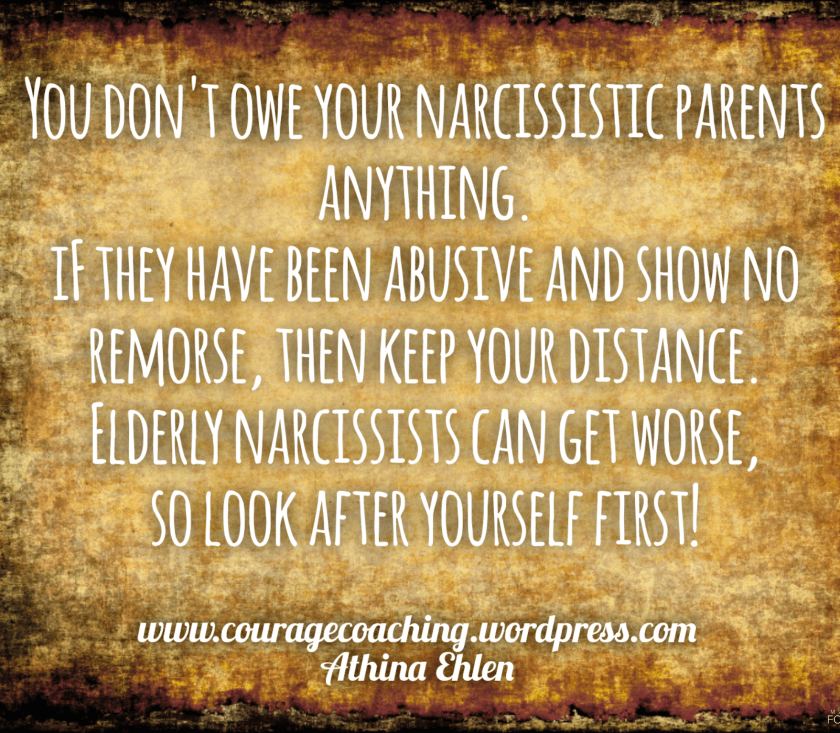
If you are someone who is emotionally struggling with an ageing narcissistic parent, just remember that you don’t owe them anything. You didn’t ask to be born into a family that was abusive. You don’t have to look after them when they are dying or when they are seriously ill. As a healthy son or daughter, your love is unconditional so they might exploit that for their own gain and still treat you like crap.

No matter what you decide to do, don’t do it out of guilt or because you feel you owe them for providing you with food and shelter.

You always have the right to walk away and look after yourself first.It doesn’t mean you stop loving them. It just means that you put your own health first.

Love Athina ♥

© All blog posts and images are owned by me and Courage Coaching. Please don’t use without consent and only re-blog if you would like to use the information on here.

What is hoovering?and why you have to protect yourself


A lot of my posts recently are dedicated to dealing with dysfunctional relationships. I don’t want to lower your mood by any means, but feel it is important to talk about issues that are more common than people think.

woman-74596_1920

For those of you who have unfortunately experienced dysfunctional relationships in your private life, you might have heard of the term ‘silent treatment’. People who suffer from narcissistic personality disorder, usually will shut people out that they are supposed to care about for long periods of time. This usually comes after an argument where the victim (spouse, partner, family member, friend) says or does something that the narcissist doesn’t like. This can be anything from a simple disagreement, to a criticism or to just refusing to do what the narcissist wants.

When the narcissist isn’t getting his/her way, he/she will use the ‘silent treatment’ to control his victim.

The silent treatment is a form of punishment, a way of attempting to control a partner or others into doing what he/she wants them to do. It’s a withdrawal of approval, and can generate much fear in people who are vulnerable to this.

Giving people the silent treatment means that a narcissist shuts down to them, closing his/her heart and refusing to interact with them or acknowledge their presence. He/she acts as if they’re invisible, not responding to them at all or giving them a very minimal and withheld response.

He/she hopes that in treating them this way it will give them the message that they have displeased him/her. They have done something wrong in his/her eyes and deserve punishment, deserve to have his/her “love” taken away.

Of course, what he/she is taking away is not love at all, since love is unconditional. What he/she is taking away is his/her approval, and for approval-dependent people, it is a powerful form of control.

When the narcissistic person decides that the silent treatment is over, usually because they need something from you again, they will then start to use what is known as ”hoovering”.

What is hoovering?

Hoovering is a technique that is named after the Hoover vacuum cleaner, and is used by Narcissists (and other manipulative people) in order to “suck” their victims back into a relationship with them. Hoovering is often done after the silent treatment is given or the victim has left them. This behavior often starts off subtle and unassuming, and is done through voicemail, text messages, email, phone calls, notes, other people, or through any other form of possible communication with the victim. Because the Narcissist knows the victim’s weak spots, they will generally tend to target these areas in order to reopen communication.  Once communication is reopened, the Narcissist generally promises change–which never, ever happens for any length of time.

  • Text messages pretending to be concerned: “How are you?”, “Hey, I’m thinking about you”, “I know things didn’t work out, but you really do mean a lot to me. I just want you to know that.”
  • Text messages acting like nothing happened: “Hey stranger, long time no talk” or “Hey what’s going on?”
  • Text messages on or about special occasions/holidays: “Merry Christmas”, “Hope you are having a good birthday–wish I could be there”, “Are you going to Molly’s wedding next weekend? If you’re going, I won’t go–I don’t want to upset you.”
  • Text messages about the kids (especially if they’re not his): “I was at the park today and saw a cute kid that looked just like Jason. Just wanted to say I miss you guys.” or “I know you hate me, but please tell Ava that I wish her a happy birthday and I’m sorry I can’t be there.”
  • Text messages about an upcoming event: “Hey, I know you said you never wanted to talk to me again, but Disney on Ice is this weekend, I was thinking about taking the kids.” or “Aerosmith is playing next weekend and I have an extra ticket–you wanna go?”
  • Text messages about things you like to do that he’s never been interested in doing with you before: “Hey, there’s a vegetarian cooking class this weekend, you wanna go?” or “Wanna go wine tasting this weekend?”
  • Text messages about bogus family illnesses or some sort of crisis (including his own): “I think I might have cancer, can you talk?” or, “OMG my mom just had a stroke.” or “What does a heart attack feel like? My left arm really hurts,” or, “I can’t handle this anymore, I’m going to kill myself.”
  • Text messages that are supposedly meant for someone else, but sent to you by mistake: “See you in ten minutes xoxo” (Supposedly for his current girlfriend–sent to upset you.) “The boss just moved the meeting to Wednesday at 3pm.” (Supposedly for his coworker–sent so you feel a sense of obligation for the coworker.) Or, “Sam called and said John is in the hospital and to call him immediately.” (Supposedly sent to someone else, but sent to you so you feel a sense of urgency to get back to him.)
  • Text messages that are guilt or pity inducing: “Can’t we work this out? Please give us another chance.” “What about the kids? You know how hard it is having divorced parents–why would you want to do that to them?” “I have a lot of issues. I get that now. I’ll get into therapy. I promise.” “My alcoholism is out of control. I need help.”
  • Text messages about sex/deep connection: “I miss snuggling with you.” “You always be the love of my life.” “You are my soul mate, I’m sorry I let you down.”
  • Text messages that attempt to flip the hoover back on you: “Did u just text me?” or “Did you just call me?” or “Did I just see you drive by?”
  • Text messages, when all else fails, making bogus accusations to get some type of emotional response:  “Why are you calling my mom and bugging her?” or “I just found out you cheated on me.” “I’ve moved on. You need to quit stalking me.”

All of these examples are just one big fat manipulation for you to open the door and let them back into your life. Don’t fall for it!

Source: http://narcissistsupport.com/narcissists-hoovering-techniques/

So far, in my personal life I have had recent contact from my narcissistic father, after a year of the silent treatment. Luckily I have decided on ‘NO CONTACT’ and even though it is still incredibly painful to see how destructive and insensitive my father is, being in control of what happens has been incredibly powerful in my recovery.

I have received 2 voicemail messages so far : Wishing me Happy birthday and asking me how I am.

I haven’t replied to either of them, as I know he doesn’t genuinely mean them..

He using ”Hoovering” as I am the only person ‘he thinks’ will help him. He is abusing my unconditional love & kindness to get his needs met.

Luckily I am recovered and will no longer play a part in his games.

Have you had an experience similiar to this? If not, do you have any friends that might benefit from this information?

Please re-blog this post if you think it could help someone.

Love Athina ♥

© All blog posts and images are owned by me and Courage Coaching. Please don’t use without consent and only re-blog if you would like to use the information on here.


 

Tips on setting boundaries

A useful video for those of you who have trouble saying ‘No’ to others and have a general difficulty in setting boundaries.For those of you who had an abusive childhood, boundaries would have been invaded very often and you wouldn’t have been able to defend yourself. Now that you are an adult you ‘CAN’ protect yourself and practice self-care whenever you need to. It doesn’t matter if it is a family member, partner or best friend. Setting boundaries is essential for good psychological well being!

Much Love Athina ♥

© All blog posts and images are owned by me and Courage Coaching. Please don’t use without consent and only re-blog if you would like to use the information on here.


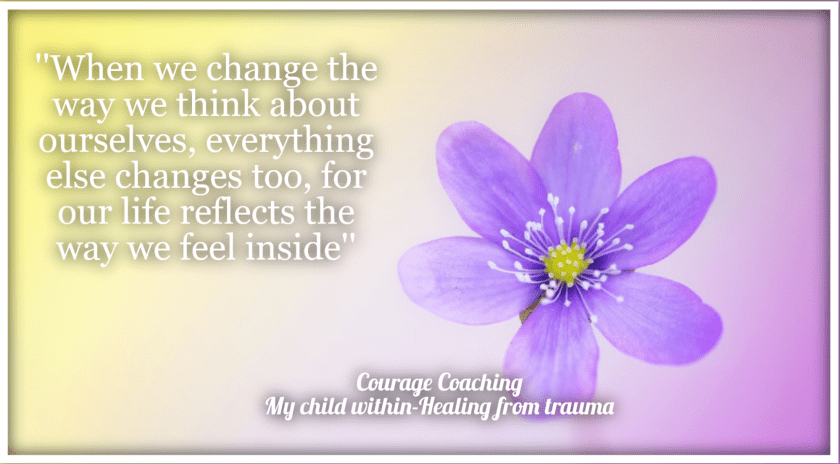
Our life reflects the way we feel inside

FontCandy (59)

How strongly do you believe this to be true?

I believe it is extremely important to treat ourselves with compassion, patience and love.

It is extremely important to replace negative thinking with more positive, constructive thinking.

I believe we must at all times acknowledge our mistakes, acknowledge our emotions and accept that we will attract what we believe about ourselves.

If we believe we are worthless, we will attract people that will treat us badly.

If we believe that we don’t deserve love, then we will attract people who will abandon us.

We have to notice our thoughts, notice our emotions and slowly make changes.

Change can be uncomfortable at the beginning, but it gets easier in time.

Start creating new positive habits in your life, to replace the old destructive ones.

Accept that you are flawed, as all humans have flaws. If your flaws are something that you can change, then change them. If you hurt someone, then make sure you tell them you are genuinely sorry.

If you do find that there are people in your life that treat you badly, then let them go.

Look after yourself first and the rest will fall into place.

Much Love Athina ♥

© All blog posts and images are owned by me and Courage Coaching. Please don’t use without consent and only re-blog if you would like to use the information on here.