
Approval seeking

Approval seeking is a very common behaviour that all of us are guilty of at some point in our life. It might be that we are trying to impress someone we like, make a new friend or make a good impression on our new boss. It is perfectly normal to seek approval in others occasionally.

Approval seeking only becomes a problem when we do it chronically. When we constantly seek to be validated externally because we don’t feel comfortable to accept ourselves as we are.

This is the topic of today’s video, which I felt was very important for those of you who are people-pleasers and/or codependents.

Love Athina ♥

© All blog posts and images are owned by me and Courage Coaching. Please don’t use without consent and only re-blog if you would like to use the information on here

Dealing with parental estrangement

If you have become estranged from your parents, it’s important to remember that this can be a very vulnerable place to be. Making the decision to become estranged from your family may alleviate some of the instant emotional pain after a huge argument, however, many people find that estrangement is a constant battle in their life, as it can cause them to endlessly think about their situation, even if they do feel an initial sense of relief.

Some people become estranged from their parents because they have been emotionally, physically or sexually abusive during childhood or beyond. This is a difficult decision to make but sometimes a necessary one. It’s immensely tricky to continue a healthy relationship if there has been abuse, and it can be extremely risky to continue a genuine relationship with this family member without the right professional intervention and support.

Others become estranged with their parents or siblings due to conflicts about religion or sexuality. This can also be especially painful, as the adult child isn’t able to truly be who they are. Authenticity is crucial for a happy life.

DSCN3757 (2)

Grieving the estrangement from a parent, no matter what the circumstances, is a very important part of healing from it, as the loss of an accepting & healthy parent is an extremely painful experience, even more so than normal grief. Nothing will ever fill the void of not having had what every child so rightfully deserves. Comfort, validation & unconditional love. Realising that a parent was never truly able to love & accept you, is utterly heartbreaking.

Even if there was abuse, children never stop loving their parent unconditionally and never stop hoping that their parent will change. This is the main reason adult children remain in contact with a parent, despite any abuse that may have occured. They will always long for the unconditional love they never had. In cases when the abuse or invalidation was constant, the trauma bond will also be why the adult child finds it hard to cut ties with their parent.

If the adult child isn’t able to fully grieve the loss of a healthy parent, they will not be able to move forward in a new relationship with them. If the parent continues to be abusive, shows no remorse, shows no understanding and doesn’t make any attempts to make amends, then it is healthier for the relationship to end.

In both cases of estrangement and remaining in contact, grieving is essential. Grieving helps lift the intense painful heaviness of not having had your needs met in childhood. It helps lessen the anger, frustration and injustice.

Most importantly, the adult children who end up going ‘no contact’, have to learn to live with the ‘early death’ of their parent before that parents actually dies. They have to continue living their life, without any communication or knowledge of how that parent is. They have to swallow the grief that creeps up from time to time, during holidays, birthdays, Mother’s day, Father’s day and during other emotional times in their life.

Those adult children who were lucky enough to have had good childhoods, with unconditionally loving parents, will never truly understand the deep pain of those who didn’t have good childhoods.

Family estrangement is a huge challenge and living with it requires support in more ways than one. It is important to have counselling from time to time and to be surrounded by understanding friends or a partner that can truly empathize. Lastly, it is crucial for the estranged, to feel the sadness that emerges and be self-compassionate as much as possible.

Love Athina ♥

© All blog posts and images are owned by me and Courage Coaching. Please don’t use without consent and only re-blog if you would like to use the information on here

The loss of what should have been

When you don’t get certain basic needs met in your childhood, there will come a time in your future where you will eventually become awakened to these unmet needs. Although this isn’t the same for everyone, there is usually one feeling which is most prevalent for most: ”The feeling of being ripped off”

This feeling of being ripped off, because you didn’t have a healthy family or because you no longer have a family to turn to, starts a very real and painful journey of mourning.

A lot of people who grew up with abusive parents, or in one parent families, or in families where their parents were chronically ill, learned to ‘live on autopilot’. They either had to push down their feelings to keep the peace, be a confidant or carer to the sick parent or learned that they had to solely rely on themselves. Even when they were scared and had no one to turn to as children, they had to keep going. As early adulthood approached, they may have found many ways to cope with this underlying feeling of sadness or anger, by drinking too much, working too much and generally trying to find ways to numb out any uncomfortable feelings that would creep up.

When an adult child is first awakened to the reality of what really was and what now is, they somehow know that things will never feel the same again. It might be that a certain event in their adult life uncovered feelings that had been buried deep inside them and suddenly the strength that they thought would always keep the safe, slowly starts to crumble. New anxieties, fears & losses start to unfold and the world suddenly starts to feel like a scary & unsafe place.

At this early stage of realisation, when adult children come to terms with the fact that they needed so much more than what they were given emotionally, the grief can feel overwhelming. Grief for adult children is a complex emotion because so much of the loss has been built up over time and they have long learned to adapt to the constant loss of an ideal childhood. Looking into the future feels bleak and they feel as if things are only going to get worse rather than better.

Through my own journey of grief, I learned that it isn’t a straightforward process and that it doesn’t have a certain time limit. When the grief was so overwhelming at times that I couldn’t imagine a better future, I reminded myself that it was necessary for me to truly feel the sadness. When your heart feels broken you have to let it heal and healing requires compassion & patience with yourself.

Pete Walker is a truly Inspirational Psychologist and survivor of childhood abuse. His words below really resonate:

 “…the broken heart that has been healed through grieving is stronger and more loving than the one that has never been injured.  Every heartbreak of my life, including the brokenheartedness of my childhood, has left me a stronger, wiser and more loving person than the one I was before I grieved”

The last thing that is worth mentioning, is that a lot of people don’t start their journey of recovery & grief from childhood trauma, unless it is emotionally safe for them to do so. It might be that they are in a supportive relationship and a stable environment and this enables them to ‘let go’ and just be vulnerable. It might be that they have found a therapist which they feel comfortable enough to be themselves.

Recovery from the losses of one’s childhood is necessary in order to restore balance & new found hope in the future.

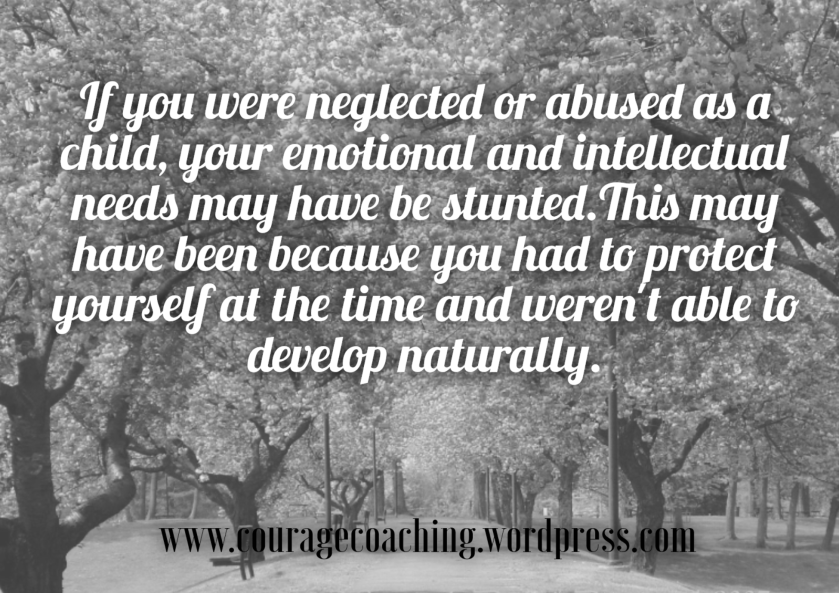
FontCandy (29)

What is your experience?

Love Athina ♥

© All blog posts and images are owned by me and Courage Coaching. Please don’t use without consent and only re-blog if you would like to use the information on here

Psychological Projection-A defense mechanism that people with NPD use often

Dear friends

I am hope you are enjoying your weekend and are generally doing ok.

Before I fly off to Scotland tomorrow, I wanted to upload Monday’s Youtube video early, as I won’t be able to work on it when visiting family.

This week’s video is about an abusive behaviour & defense mechanism that people with narcissistic personality disorder use very frequently.

Projection is something I experienced most of my life from my mother and it is something that was immensely painful.

This is the definition of Projection according to Wikipedia:

Psychological projection is a theory in psychology in which humans defend themselves against their own unconscious impulses or qualities (both positive and negative) by denying their existence in themselves while attributing them to others. For example, a person who is habitually rude may constantly accuse other people of being rude. It incorporates blame shifting.

I hope you find this video helpful.

Love Athina ♥

© All blog posts and images are owned by me and Courage Coaching. Please don’t use without consent and only re-blog if you would like to use the information on here

Infantilization

You might have heard of the term infantilization but you may not realise how incredibly abusive it is when a parent does this to their child.

It is only natural for a growing child to start developing independent thoughts, actions and opinions. For a narcissistic parent this can be very threatening, as they want to continue controlling their child and use them for narcissistic supply.

Check out my video for an explanation of what infantilization is.

Some examples of infantilization are as follows:

A parent stops a teenager from socialising with friends or doesn’t allow them any privacy in their bedroom. The parent may still treat them as if they are a young child whereas a teenager needs growing independence and privacy.

A parent buys their child age-inappropriate clothing and/or arranges age-inappropriate activities.

A parent might not allow the child to speak for themselves, when they are asked a question directly by somebody else.

A parent might discourage the child from pursuing new interests as they don’t want the child to become more skilled at new things than they are.

If a parent isn’t able to have healthy relationships, they may try to influence the child against their choice of partner. They can’t allow their child to leave the family nest. The parent wants to continue their enmeshed relationship for as long as possible.

The effects of infantilization are as follows:

  • The adult child ends up having chronically low self-esteem
  • The adult child has difficulties academically
  • The adult child may find getting a job difficult
  • The adult child learns helplessness and enabling
  • The adult child may self-harm
  • The adult child may have poor social skills
  • The adult child may self-sabotage
  • The adult child may become avoidant

If you can relate to any of what I have written or said in the video, then please re-blog so it reaches more people.

Knowledge is power and with knowledge comes healing. To also further promote healing on a larger scale, I have recently signed up to patreon to further support my creations of videos, pdfs & hopefully in the near future, e-books.

Patreon is a platform that enables creators to reach new goals by having their followers & supporters fund their work.

If you find my videos & blog posts helpful, then please check out my patreon page.

It would mean the world to me to be able to reach more people and help them on their journey of recovery.

https://www.patreon.com/AthinaEhlen

dumdum-patreon

Love Athina ♥

© All blog posts and images are owned by me and Courage Coaching. Please don’t use without consent and only re-blog if you would like to use the information on here.


 

Narcissists & their relationship to money

This is a topic I previously covered on my personal blog last year but it is important to highlight again, especially in the current climate.

Most extremely powerful & wealthy people in this world, are usually void of empathy. Politicians, country leaders, business tycoons etc..

Narcissists and especially overt & malignant narcissists, lack empathy, lack self insight and aren’t able to form healthy & reciprocal relationships.

In this video, I talk about the importance of money in a narcissist’s world.

I talk about financial abuse and how narcissists may use this sort of abuse.

Having had first hand experience with a narcissistic & very controlling father, I have witnessed the obsession of a narcissist with his money & how he uses it in his life, to harm those close to him.

If you have experienced financial abuse or known someone who has used money in a harmful way, then please feel free to share this in the comments below.

Love Athina ♥

© All blog posts and images are owned by me and Courage Coaching. Please don’t use without consent and only re-blog if you would like to use the information on here.
Status anxiety

img_0646

How do we each fit into this world?

Are we defined by whether we have a good job? A good marriage?

Do we feel that we constantly have to measure up to our friends’success?

Do we feel that we have to have the latest gadget, a new car or a big house?

Do we feel like a complete failure if we haven’t secured a stable job?

And what about relationships & family? When someone is single past the age of 40, everyone has an opinion about why that person is still single. If someone is jobless, everyone has an opinion on why that is.

STATUS ANXIETY is a constant worry about whether we are good enough in the world we live in. It is an insecurity about whether our life is a failure or whether it is a success.

Status anxiety is a term I came across after watching a video by Alain de Botton.

Status anxiety happens because we allow our environment to affect our inner world. Status anxiety happens when we allow other people to criticize us or the way we choose to live. It is only natural to become anxious, when we start comparing ourselves to others.

One of the most uncomfortable situations which may trigger status anxiety, is at a social event where you don’t know any of the guests. In such events, such as a party, you can only get to know someone initially by making small talk. You may be approached with questions such as ”What do you do? Where do you live?”. These questions may make you feel uncomfortable or inferior, because you don’t think your job is anything special and you don’t currently like the area you live in. In these situations you worry what the person asking the questions might think of you.

Status anxiety is rooted in judgements or how we think others will judge our choices, beliefs, skills and way of life. Nobody really has any control over the thoughts or judgements of others but everybody has control over how they react to others’ judgements.

If we really don’t care what other people think, then we probably won’t have status anxiety.

Status anxiety also frequently causes envy.We tend to envy in others, what we haven’t quite managed to achieve for ourselves. We may secretly envy the person who seems to have the perfect relationship when we are feeling lonely. We may envy the person who is always going on holidays because we can barely pay the bills with our low-wage job. Envy,  can give us insight into a part of our lives we may need to work on.

What is the most important thing to consider when suffering with status anxiety?

Is it more important to worry because we haven’t managed to develop a good career for ourselves? Is success only measured by having a high salary, a perfect marriage and celebrity status?

What is MORE important, is the meaning WE give to our life. If we are happy with all we have achieved (despite all the difficulties or judgements by others), then that is all that matters.

Our judgement of our own life is the most important.

Not everyone is born equally lucky, supported, intelligent, confident or motivated.

The people who are highly successful in business and are making the big bucks, are usually lacking in many other areas in their life. They may lack emotional intelligence and empathy.

If you had a choice in your life, what would it be?

In my personal opinion, success is being a kind & empathetic person.

Success is being able to self-reflect and being able to help others do the same.

Success is being remembered as a good person.

I believe that success shouldn’t be measured by whether you work, have a relationship or have kids.

Success should be measured by the type of person that you are..

When I die in the future, I would much rather be remembered as a good human rather than a successful businesswoman or celebrity. I would much rather be remembered as empathetic, giving, respectful, generous & lovable. I would much rather be remembered as someone who meant something to someone or as someone who inspired others.

If you find that you suffer with status anxiety, make sure that you define your own life in a way that makes you feel comfortable.

At the end of the day, all that really matters is the opinion you have of yourself and the respect and kindness yougive to others.

Love Athina ♥♥

© All blog posts and images are owned by me and Courage Coaching. Please don’t use without consent and only re-blog if you would like to use the information on here.

15 ways you are resisting therapy or recovery

massage-599532_1920

I wanted to share this great article by Psych Central.

http://blogs.psychcentral.com/caregivers/2017/01/15-ways-you-are-resisting-therapy-or-recovery/

It is ok to not ‘click with a therapist’ or to not be ready for therapy.This can also happen in a coaching relationship too. You find someone to assist you on your journey of change or recovery and the 2 of you just don’t have any rapport.

From my own personal experience, rapport is very important in a therapeutic and coaching relationship.

Sometimes there have been sessions where a client isn’t managing to make any progress. There may be emotions that are too painful to deal with, or memories that haven’t quite resurfaced. It might be that they aren’t as commited as they initially set out to be. It might be that they are afraid of exposing the ‘truest’ part of themselves.

Whatever the reason, the Psych Central article is very insightful.

Let me know what you think 🙂

Love Athina ♥

© All blog posts and images are owned by me and Courage Coaching. Please don’t use without consent and only re-blog if you would like to use the information on here.
When to emotionally detach from a toxic relationship or situation

Hi everyone,

This is my 2nd attempt to write this blog post, after the last one was unfortunately lost. 😦

I hope you all had a good Christmas weekend and managed to relax and enjoy time with your loved ones. For those of you who find Christmas tough due to past trauma or dysfunctional relationships, you have just survived yet another Christmas, so give yourself a pat on the back and treat yourself to something you enjoy. The New Year is nearly here and with it comes new hope and a renewed sense of direction. 🙂

The following youtube video is 1 day late, due to the fact that I allowed myself a little time to relax over the last 3 days. I caught up on some much needed sleep and I started studying for my German exam (which is fast approaching).

In my own recovery back in 2008, I was introduced to the concept of letting go of relationships that no longer served me. I was introduced to the concept of emotionally detaching from a toxic person. Although at first this was extremely hard to do, with practice and with time, I slowly started making changes for the better. I started learning to put my self-care first and to set boundaries. I started noticing the repetitive patterns that were present in my relationships and I started questioning the reasons as to why I couldn’t choose healthier relationships. In my case, the narcissistically abusive background I come from, is what influenced my choice of abusive or unavailable partners, friends & even colleagues.

This video is for those of you who are just starting out in your recovery from dysfunctional relationships, so I really hope it helps ♥

200

Love Athina ♥

© All blog posts and images are owned by me and Courage Coaching. Please don’t use without consent and only re-blog if you would like to use the information on here.

 

Happy Friday evening everyone :-)

fontcandy-20

Can you tell I am ecstatic it’s Friday evening? Well I am..very much so! 🙂

I get to stay in bed tomorrow morning and drink a glass or two of red wine tonight!

I get to catch up on my blogging and go for a meal with a friend.

I get to spend quality time with my hubby which is just perfect.

I am feeling very grateful at the moment, although the gratefulness this time arises after the latest challenge I have set myself.

I finally gave in, after 2,5 years of living in Germany and have just started an intensive German language course.  It is exhausting and at times overwhelming. 6 hours of German, 5 days a week is A LOT. 4 hours in the morning and around 2 hours of study afterwards..I have needed a nap twice this week after my course and been getting more eye strain and headaches than usual. By throwing my CPTSD into the mix as well, I end up giving myself one big fat challenge!

In one of my previous posts, I talked about why I didn’t want to learn German. The reasons were many and I have no shame in admitting that I just don’t like the language because it is hard to learn and I just didn’t have the motivation. However, as hubby and I were discussing whether we were going to stay in Germany or return to the UK, I admitted that the only way for me to really know if I could live in Germany long term, was to actually learn the language!

I promised myself that I would give the intensive course my best shot and if after completing the first part, I still didn’t feel like I could communicate in a basic way, then we would move back to the UK.

Germany has been great for me in the last couple of years and it feels like home now.We are settled and the idea of moving back to the UK is great on one hand as I deeply miss it but on the other hand it is a hassle. Constantly changing addresses is tiresome and renting in the UK isn’t as comfortable as it is in Germany!Settling is important when you get to your mid thirties!

I have another 6 weeks of intensive German classes, so forgive me for my absence in the blogging world over the next weeks. I have already lined up some Youtube videos for each Monday.Some are Q & A videos and some are just informational.

I hope you are all doing well and not letting the upcoming holiday season get you too down! Keeping busy is good for me personally at the moment & feeling grateful also greatly impoves my overall mood.

What challenge have you set yourself recently? How are you coping with the upcoming festive season? Christmas isn’t a joyous time for everyone..

Love Athina ♥