Coaching takes courage

This new coaching chapter in my life is giving me great joy and fulfillment. It isn’t something I ever really imagined myself doing a few years ago and now that I am, I am very much enjoying the interaction with people on a one to one basis. I know how much courage is required to push yourself towards achieving a goal or changing something in your life and deciding to have coaching or therapy, is exactly that, courageous!
graffiti-1450798_1920

This blogging platform has been immensely enriching for me both personally through my other blog and also professionally through the creation of this new one.I see a lot of myself in some of my coachees and fellow bloggers/followers and it is wonderfully humbling to be able to make a small difference, through own experience. In the ones that I don’t see myself in,  I learn alot about the difficulties that different personality types may have and this is proving to be a great way to widen my knowledge even further on certain subjects. The thing that I am particularly enjoying at the moment, is that I can also use my skills to help close friends. I enjoy helping people from all walks of life but it makes me even happier to know that I can help the special people in my life as well. Isn’t this something you can all relate to? Helping out a dear friend? For those of you who agree, the fulfillment you gain from this is priceless.

I’d like to talk a little bit about my last job, before I moved to Germany from Bournemouth, England. This is something I mention in the ‘About me’ link of this blog but I just want to talk about it in a little more detail.When I used to work as a Healthcare assistant in an End of Life care home, that is when I realised that I really enjoyed helping people. When I went home after a long day, I knew I was making a difference in a small way and that made my work so important to me. It didn’t matter that I was earning such a low wage, as the smiles of gratitude on the residents’ faces meant so much to me. I worked 12 hour days, barely got a chance to sit down and had to help 10-12 residents with only one other assistant to help me.We were always rushed off our feet and sometimes it was incredibly hard to shower and dress the residents, when 2 or 3 other bells were going off at the same time. Each bell represented a resident who was calling for the toilet, needed help with getting out of bed or who was wanting their breakfast.This was physically & mentally exhausting. It was incredibly tough work, especially because you are someone who cares so deeply and you want to make sure you are helping every resident in an equal and respectful manner.There was never enough time and that is something that bothered me deeply. I enjoyed taking my time with each resident, as that is what I would want myself, if I was in their position.

When you help somebody in such an intimate way and learn their routines, day in day out, it is inevitable you will get attached in some small way. It taught me a lot about patience, inner strength, resilience and practicing self-care. It also taught me a lot about trying to brighten someone’s day a little, making them as comfortable as possible and telling them stories about my own life. These residents needed something else to think about, rather than their own aches and pains. It is difficult to know you are near the end of your life and the only thing you have to look forward to is chatting to the person who cares for you, helps you get dressed & washes you. I got so much from helping these people, as I know that one day I will be the same. I might be alone, with no family left and any attention or communication I get, will give me strength. It is incredibly important to help people sustain their dignity, as every person who grows old was someone’s mother, sister or daughter.When residents you grow closer to over the months, eventually pass away, you feel devastated but also relieved that they aren’t suffering anymore. The bond you develop is unique, especially when you are also the carer who might have to clean and wash the resident after they have actually passed.

Due to my own struggle with Complex PTSD, I had many vivid dreams after I left this job and moved to Germany with my husband. I worried about the remaining residents, wondered how they were doing and learnt of the many changes in their lives. Some of them were now no longer able to walk at all, others passed away and I wished at times that I could have visited again. Living in Germany unfortunately made this too difficult.

Unfortunately, I also had experience working alongside many other carers who were  narcissistic bullies! I couldn’t believe how these people could work in such a job! Their empathy was incredibly fake, as they enjoyed making myself and other friends/colleagues feel small & unimportant.They derived great pleasure from criticising carers in front of the residents, so they could appear better and more in control. They lied to the manager, fabricating stories about myself and other carers because they must have felt threatened by our caring & genuine demeanour. They acted in a racist manner towards one of my Romanian friends/carers and I must admit, it took a lot of strength to ignore them and keep working there. Having Complex PTSD which is a direct result of growing up with Narcissistic parents, meant that working alongside other narcissistic bullies, triggered many uncomfortable feelings. However, knowing who I truly am and ignoring the nastiness of these people, kept me going. Helping the residents was more important than listening to small minded and shallow people.

In my new work, I am very happy to have the freedom to help others in a safe and nurturing way, without the outside distraction of narcissistic bullies. Hurrah!

As a narcissistic abuse survivor, I can tell when someone has low confidence & needs support in developing self-belief. I know this feeling very well myself, through personal experience. I also know how important it is to encourage ‘realistic goal attainment’, rather than trying to achieve something that might be too big a goal.I feel happy to encourage self-compassion and to help people achieve things in small steps, suited to their capabilities. Especially if the clients suffer from debilitating mental illness, it is all about making their lives more manageable by encouraging self-acceptance and by creating plans that suit their daily routines. Having had depression myself, I know how it feels to struggle with every passing hour.You are definetely not alone and nobody should have to feel like they aren’t achieving anything!

I am really interested in finding out what you gain satisfaction from in your life? Is it your work? or your role as a parent? Do you enjoy being a husband/wife? or maybe you are a mum/dad to a furry friend? If you don’t work but volunteer instead, then I’d love to hear about it..

Whatever it is in your life that gives you joy and a sense of fulfillment, then feel free to share your experiences..

If you are someone who suffers from a mental or physical illness, maybe just getting through the day is an achievement in itself! Please let me know if this is something that you are proud of and if not, then I encourage you to try..

Much Love Athina ♥

© All blog posts and images are owned by me and Courage Coaching. Please don’t use without consent and only re-blog if you would like to use the information on here.
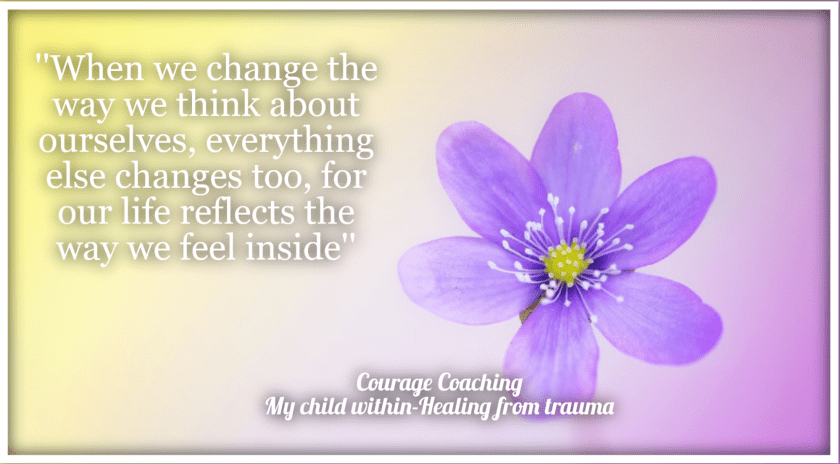


Our life reflects the way we feel inside

FontCandy (59)

How strongly do you believe this to be true?

I believe it is extremely important to treat ourselves with compassion, patience and love.

It is extremely important to replace negative thinking with more positive, constructive thinking.

I believe we must at all times acknowledge our mistakes, acknowledge our emotions and accept that we will attract what we believe about ourselves.

If we believe we are worthless, we will attract people that will treat us badly.

If we believe that we don’t deserve love, then we will attract people who will abandon us.

We have to notice our thoughts, notice our emotions and slowly make changes.

Change can be uncomfortable at the beginning, but it gets easier in time.

Start creating new positive habits in your life, to replace the old destructive ones.

Accept that you are flawed, as all humans have flaws. If your flaws are something that you can change, then change them. If you hurt someone, then make sure you tell them you are genuinely sorry.

If you do find that there are people in your life that treat you badly, then let them go.

Look after yourself first and the rest will fall into place.

Much Love Athina ♥

© All blog posts and images are owned by me and Courage Coaching. Please don’t use without consent and only re-blog if you would like to use the information on here.
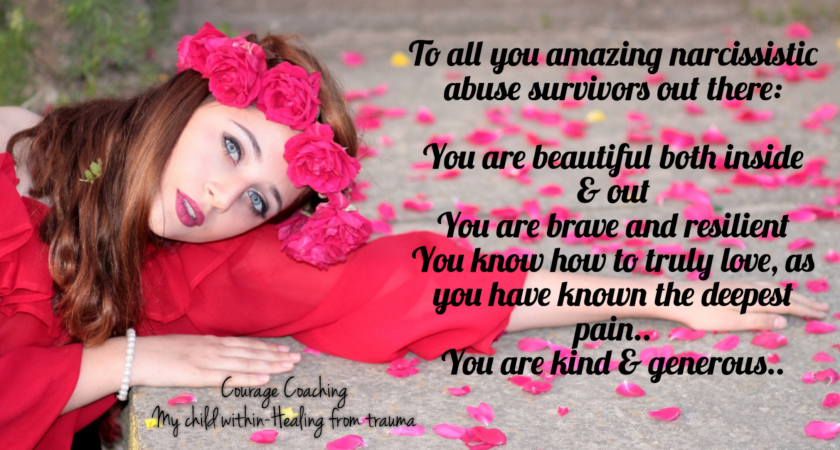
Narcissistic abuse survivors

FontCandy (58)

As some of you already know, I have great insight into narcissistic abuse, after a tumultuous life with 2 narcissistic parents, many narcissistic ex-partners and narcissistic ex friends. Before my father discarded my mother in 2000 and filed for divorce, he had already met his second narcissistic wife. He had already lined her up to fill his emptiness and later had a child with her. The cycle of abuse unfortunately continued and there was nothing I could do to prevent it.He has been married to her for 16 years now and it has been the most destructive, soul destroying relationship I have ever witnessed.

My histrionic/covert narcissistic mother, on the other hand, luckily didn’t re-marry. She just had 2 relationships which didn’t work out.She has remained irritable, negative and critical. She still blames everything & everyone else for her misery and struggles to cope with her own depression.

My childhood in general was always hot & cold.One minute things were relatively normal and my parents would be kind & thoughtful and the next they would be extremely hurtful & abusive. This almost made coping with the abuse harder, as the kind moments would give me hope as a child and then when the abusive moments would come around, I was utterly devastated and confused. I then learnt that whenever my parents were kind, there were always strings attached to this kindness. I was told many times as a child ‘After everything I have done for you, this is how you treat me?’. I felt guilty and ashamed. I felt worthless and no good.

The one thing I know for certain is that for those of you who have also been affected by narcissistic abuse, you have developed a deep sense of self-awareness, a sense of gratefulness for the tiny moments of kindness that others have shown you and a high level of empathy from a young age. Most of you sought out therapy and have always helped and be-friended the shy or needy. Yes you have made many mistakes along the way, by getting involved with people who resembled your family of origin, however this is a logical result of growing up in an abusive or neglectful home.

The thing that helped me the most in my recovery was forgiving myself for struggling so much in my life. Self-compassion is the best gift you can give yourself as an abuse survivor.Recovering from narcissistic abuse means that you have to dig deep to reveal the many layers of trauma. You have to acknowledge that it isn’t going to be easy to go through all the painful realisations of your past but that is extremely important to work through each layer and grieve your losses. Trusting that others won’t hurt you is a huge struggle for those who have been abused. If your primary caregivers let you down so badly, why on earth would you trust complete strangers?

The most important thing to remember is that there is no time frame on healing and that everyone copes and heals differently.

My advice will always be to ask yourself ‘What do I need’? ‘What am I scared of’? ‘How can I look after myself’?

For those of you who can relate and understand, just remind yourselves daily that you survived an unfair childhood and that from now on you can give yourself the unconditional love your parents weren’t able to give you. In every low moment, remind yourself that you are brave and resilient.

Now in my 30’s I have already been through the darkest moments of despair and have healed extensively through many years of trauma therapy. I am now armed with knowledge,coping skills and the most important thing: the knowledge that healing is possible and that you ARE able to live a more fulfilling life. If you had asked me this same question 2 years ago, I wouldn’t be feeling so optimistic.

Now I am putting all my knowledge into helping others and it feels good! It feels good to see that others feel validated & comforted, because this is a feeling I missed out on a lot! It feels good to be there and pass on information, even if it only helps one other person. Free advice is so valuable and we can all do it! So many of us are already doing it!

Love Athina ♥

© All blog posts and images are owned by me and Courage Coaching. Please don’t use without consent and only re-blog if you would like to use the information on here.
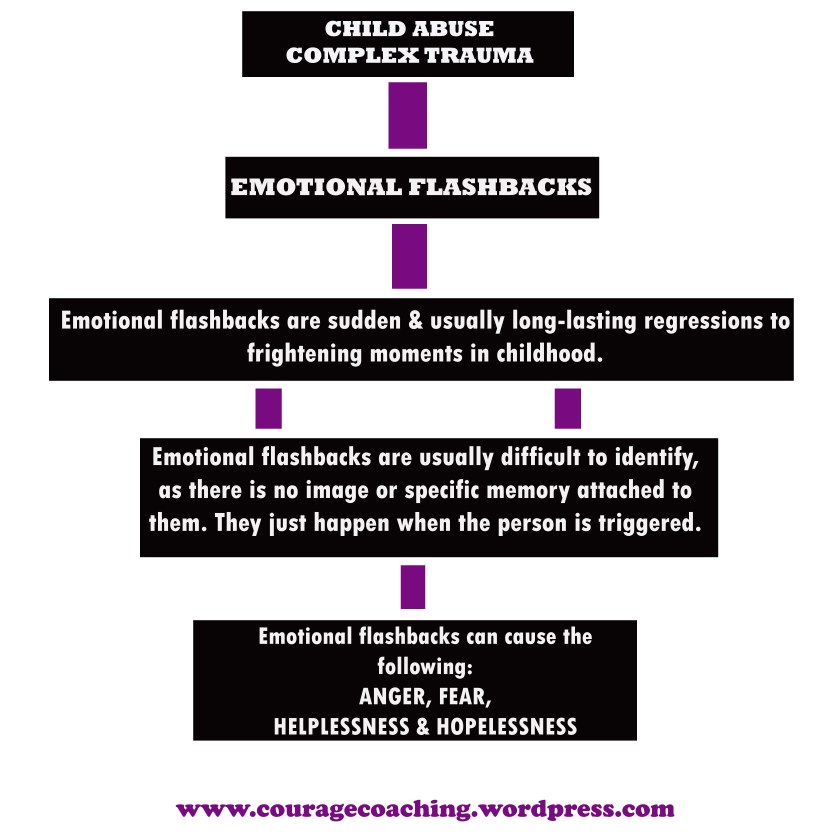
 

Child abuse, Complex PTSD & managing emotional flashbacks

****Please share & re-blog this post to help as many others as possible****

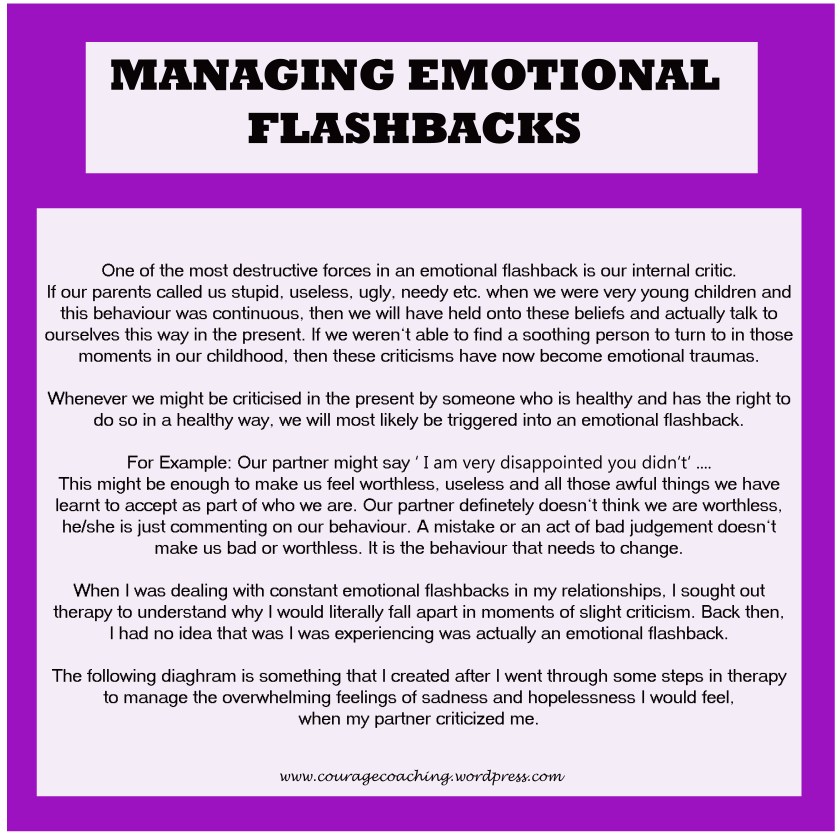
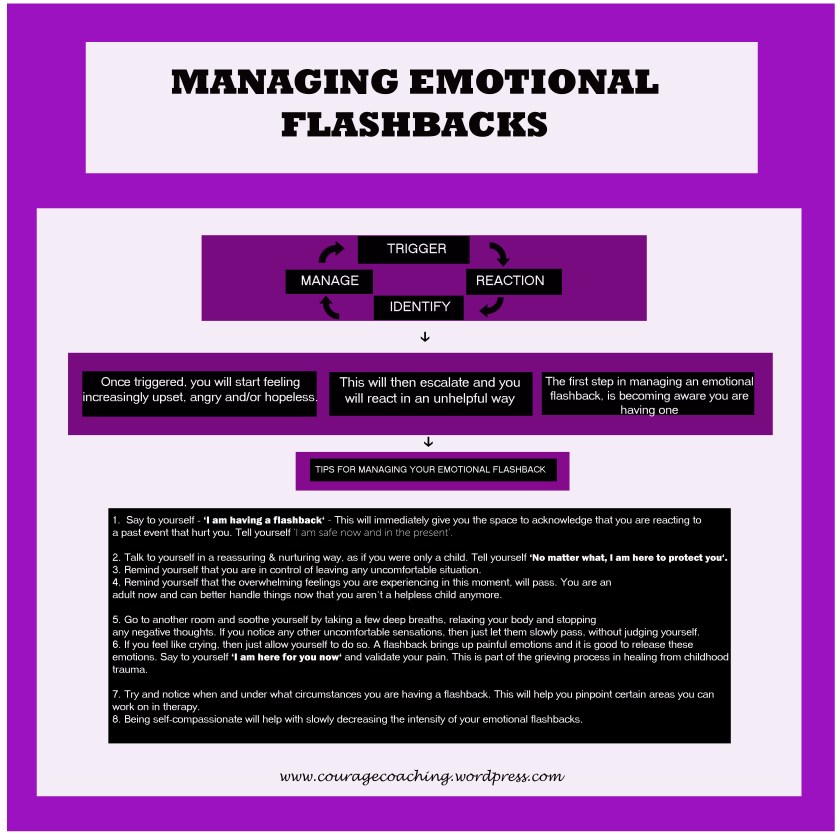
This blog post might be useful to anybody out there who suffers with Complex PTSD, who has suffered from childhood abuse or who has a loved one who suffers with a mental illness. I have created the below charts to assist those of you who might need a clearer map of how complex trauma affects individuals and why they might have moments of overreacting to criticism, an angry tone of voice or a stern look. Emotional flashbacks are explained and a list of coping skills are included, which I have used extensively throughout my own healing over the last 4 years. I find that boxes, colours and diagrams are very useful for me to remember things, especially because my own Complex PTSD affects my memory and cognitive function. Forgive me if there are any errors.

Please note that I have also added links under each image, so you can download these diagrams for your own free use.

Below is also a video I just did on YouTube! It is around 7 minutes long, if you can bare it 😉

emotional flashbacks 2

https://drive.google.com/file/d/0B7k454c6xtmnUWJxaFJZd1VILTQ/view?usp=sharing


emotional flashbacks


https://drive.google.com/file/d/0B7k454c6xtmnQ3VXZmVzOU9fZk0/view?usp=sharing

diagram of emot

https://drive.google.com/file/d/0B7k454c6xtmnMDNDdnQyRUlEeXM/view?usp=sharing


Thanks for reading

Much love Athina ♥

© All blog posts and images are owned by me and Courage Coaching. Please don’t use without consent and only re-blog if you would like to use the information on here.
YouTube video-How to protect yourself from a narcissist

Dealing with a narcissist in a safe way is very important for your well-being, especially if you aren’t able to avoid them and go ‘no contact.

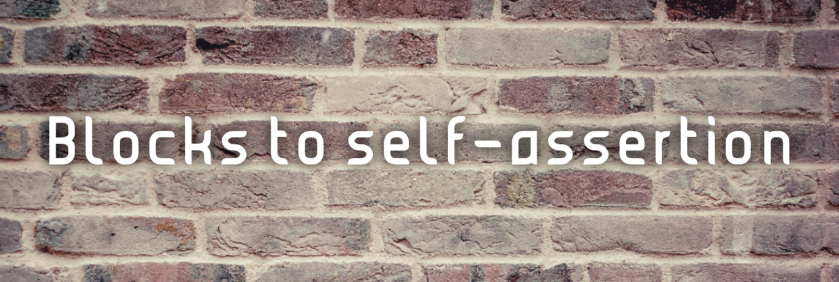
Blocks to healthy self-assertion

Being assertive can come very easily to many of us whilst some of us might have an extreme difficulty in this area, due to many of the following blocks as stated by Hauck (1981b):

FontCandy (49)

1.Fear of injury -Physical violence may be threatened or unleashed in order to keep you in line. This might be the case in an abusive relationship.

2. Fear of failure

3. Fear of hurting other people’s feelings-For example, if I tell him that ‘his gift wrapping is not very good, I might hurt his feelings’

4. Fear of rejection– For example: I couldn’t cope if they criticised me or abandoned me

5.Fear of financial insecurity- For example, you stay in a job you hate because you are worried about financial instability if you leave.

According to Trower et al (2011)there are these 2 blocks:

1.GuiltYou believe it is wrong to assert your own wishes because you believe this is selfish behaviour or you don’t feel worthy enough.

2.Damning anger– You end up blaming others for frustrating you by insulting or hurting them. For example, you might say ‘You are such a lazy and slow worker’ rather than saying ‘I would like to talk about how we could equally distribute the work load between yourself and Adam’

According to Gilbert (2000) there are these blocks to being assertive:

1.Loss of control– Assertion can involve high psychological arousal which might lead to shouting at your partner.

2.Fear of counter attack– After you have asserted your complaints, you fear being overwhelmed by the other person’s response. You fear blushing, you mind going blank or maybe even getting tongue tied. You fear looking worse off after asserting your wishes.

3.Self-blame– You might blame yourself for causing tension or conflict by asserting your needs.

4.Positive self– You view lack of assertiveness as having positive qualities of being kind and caring.

Assertiveness in general will help you get more of what you want and less of what you don’t want but there is the possiblity that it might not always work out in the way that you hope. If you have been someone who isn’t assertive and suddenly start asserting yourself with familiar people in your life, things may become increasingly uncomfortable with those people, as they aren’t used to you being assertive. People don’t like change!

Which of these blocks do you struggle with? If not, feel free to share your experience of being self-assertive.

Thanks for reading

Much love Athina ♥

© All blog posts and images are owned by me and Courage Coaching. Please don’t use without consent and only re-blog if you would like to use the information on here.
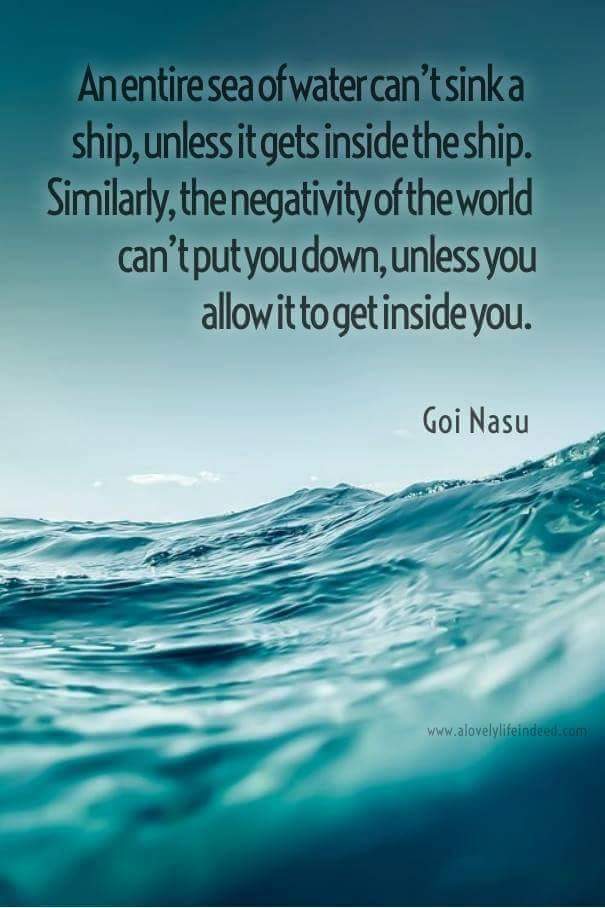
”The negativity of the world can’t put you down, unless you allow it to get inside you”

13319811_1301290503231574_4191169891370358081_n

The above quote is easier said than done when we are constantly surrounded by negativity, tragedy, pain and loss. If we were raised by mentally ill, abusive parents, the negativity that we carry with us takes years to change in therapy. It is a huge commitment but it is possible to change for the better.

If we have been lucky enough to only have certain certain negative experiences with others and in our life, then this of course makes it easier to not sink into the depths of negativity or despair.

If we have many loving, uplifting people in our life, a good job, a healthy lifestyle and a loving marriage then does negativity affect us less? It probably does but what is also important to consider is the amount of inner resilience and courage we have and the possibility of mental illness or physical illness which can touch anyone.

Every person is unique and each experience is also unique but how prepared are we to challenge that inner voice we might have of worry or destructive thinking? Not everyone is willing to reflect on themselves.

It is difficult to commit to changing a bad habit but if this habit is making us miserable then we should want to put in the effort to change it at whatever cost, right?

One of the biggest things I learnt is that we are the driver in our life. We get to choose what direction we go in and whatever comes our way is up to us how we deal with it. Making excuses in life is easy but when we are really passionate about something, excuses don’t exist.  Maybe we should always aspire to finding passionate purpose in our life.Some of us may choose to dedicate our lives helping those less fortunate. Others may be passionate about art, science or education. Whatever we choose to do in our life, balance is very important, respect of others and ourselves is important and giving back as much as we take, is also important.

Currently, I wake up every morning with the ability to spend my days freely and I feel fortunate in so many ways. Although I have experienced tragedy, trauma and been surrounded by negativity in my immediate family for most of my life, I have chosen to give back, to share, to support and to be grateful for every single thing I have. When I watch the news, I feel overwhelmed with the state of our world. The greed that has destroyed so many lives, the fantasies of wealth and power that continue to kill innocence and safety. The constant lies that we are fed in the media, the poverty, the destruction and the neverending war are enough to erase any hope for a stable future.

What can we do however? Do we turn a blind eye and retreat into our own little bubble of life, work and family or do we make sure that we do one good thing for somebody else each day? If we earn an extra 100 or 200 a month, shall we donate it to charity to help others or do we keep it in case tragedy hits us and we need to pay medical bills?

There are so many questions to answer but the one most important thing I have realised is that we can always give back, that we can assist and share our love and be kind to others as much as possible. Keeping negativity away is very difficult, especially when you are a highly sensitive person but whenever you have the opportunity to help someone in need, then I believe you should do it. It is important to have a good conscience and that is the thing that drives me in most of my decisions.What is yours?

We are not infallible and just like any other person we have days where we feel that we haven’t done enough or could have been a bit more aware of our choices. The important thing however is that we keep learning and we keep growing.

Love Athina ♥

© All blog posts and images are owned by me and Courage Coaching. Please don’t use without consent and only re-blog if you would like to use the information on here.
Facebook page

Dear friends,

FontCandy (40)

I have added a facebook community page recently, which I am hoping to also use as a platform to talk about issues regarding self-improvement, practicing self-compassion, dealing with dysfunctional/toxic people and how to stop people pleasing!

If you are on facebook, then I would greatly appreciate if you stop by and say hi! 🙂

Love ♥ Athina

Take control of your own healing

FontCandy (38)

Every healing journey is unique to each person. No journey should be judged, minimised or discounted.

Whether it is childhood abuse, emotional, sexual or physical abuse, domestic abuse, grief, a single trauma or multiple traumas, nobody has the right to criticize someone else’s journey.

If you have compassion and maybe share what helped you, it doesn’t necessarily mean it will help others in the same way. Having compassion and empathy is so crucial. Listening, without trying to fix is also important.

After you reach a certain point in your healing, you will notice that things get easier. The intensity of certain emotions lessen and your sense of self-protection and boundaries are solid. If you suffer from a mental illness, it doesn’t necessarily mean it will go away. You eventually just learn to accept that it is a part of you and that you can handle it in a self-compassionate way.

What is your experience with healing?

Do you believe you will reach a point in your recovery where things eventually feel better?

Are you persistent in practicing self-care and healing with appropriate professional support?

Don’t forget that healing is a very up and down process. It isn’t always straightforward. Sometimes just as you are starting to feel better, something else comes along which needs processing. It might feel that you are back to square one again but this really isn’t the case.

Changes happen in very small ways sometimes and it depends on whether you have regular support.

Always be kind to yourself and others going through a process of healing ♥

Love Athina ♥

© All blog posts and images are owned by me and Courage Coaching. Please don’t use without consent and only re-blog if you would like to use the information on here.

 

The importance of resilience

FontCandy (36)

So what is resilience and is it common?

Resilience can be defined as an individual’s ability to properly adapt to stress and adversity. It is about an individual’s ability to manage difficult emotions that arise in times of difficulty, without supressing them.

Research shows that resilience is actually more common, than uncommon, as life has many ups and downs and people are having to adapt all the time to many difficult situations.

A person’s attitude is the most important element of having resilience. If someone generally has a negative thinking style, this is not helpful to having resilience.

There are a few many important attributes associated with resilience:

  • The capacity to make realistic plans and take steps to carry them out.
  • A positive and self-accepting view of yourself and confidence in your strengths and abilities.
  • Skills in communication and problem solving.
  • The capacity to manage strong feelings and impulses without complaining about any struggles or falling into self-pity when setbacks arise.
  • Adaptability-The ability to act flexibly in changing or challenging circumstances.
  • Asking for support or accepting support from others. Positive, supportive relationships are key to coping in tough times.
  • Having humour- Finding light moments in depressing times can sometimes help lift the mood.
  • Being aware of unhealthy thoughts that may pop up and don’t benefit you in times of adversity.

Now that you are aware of what makes someone resilient, what happens when you need to develop more resilience? What steps could you take?

Here are a few things to keep in mind:

  • Take care of yourself and treat yourself with respect, comfort & acceptance.
  • Try and be hopeful for the future no matter what the current circumstances. A positive outlook is very important.
  • Ask for support from friends or family
  • Look for opportunities of self-discovery. Adversity isn’t obviously welcomed but if something negative happens, look at how you handle it and learn something about yourself.
  • Accept that change is part of living
  • Make decisions or take actions when confronted with a difficult situation. Don’t avoid it!
  • Set small goals that are easy for you to reach. It doesn’t matter how small. The more you achieve, the better you will feel
  • If you are spiritual, use your faith to support you.Prayer or meditation can be very helpful
  • Journaling, blogging, art therapy or other therapies can also be useful in developing resilience.

I would love to hear your thoughts on resilience. Is there anything in particular that happened which improved your resilience? Do you think you are resilient or do you think you could develop better resilience?

♥ Athina

© All blog posts and images are owned by me and Courage Coaching. Please don’t use without consent and only re-blog if you would like to use the information on here.