Dealing with criticism

shame-799099_1920

When someone criticizes us, it tends to touch a nerve and can sometimes leave us feeling very vulnerable, very angry and sometimes both!

This may be because there is absolutely no truth in the criticism and we feel it is completely unfair or actually because there is some truth in the criticism and we are just not ready to deal with it.

Being criticized is also especially difficult when the person criticizing us is someone we hold in high regard. It could be our boss at work or a new partner.

The thing that most people don’t realise is that criticism on it’s own isn’t what makes us upset. The meaning we attach to criticism is what affects us. As I mentioned in one of my previous blog posts, being a people-pleaser means that we give others too much power over our emotions and how we feel about ourselves. If others’ approval is extremely important, then we give them consent to always make us feel bad about ourselves.

In order to stay away from seeking approval, we have to learn to practice self-acceptance and only rate our actions or traits but not ourselves. We are responsible for our reaction to someone’s criticism and it is up to us to change how we respond.

If we already have low self-esteem, then criticism will be especially hurtful and it could take us days to recover from it.

Are you someone who struggles from others’ criticism? Do you find that you always get overly upset when someone criticizes you or overly agree?  Do you avoid contact with that person after the criticism occurs? I would love to hear your experiences.

If you are a childhood abuse survivor, I am especially interested in your experiences. When you have internalised your parents’ negative and unhealthy criticisms, this will then follow you around and will be brought to the surface everytime someone criticizes you. This is actually quite a painful, traumatic reaction because a present criticism can send you into an emotional flashback of your parents’ abuse. This is something I am particularly experienced in through my own recovery from abuse but also through talking to others who still struggle with this internal self-critic.

Love Athina ♥

© All blog posts and images are owned by me and Courage Coaching. Please don’t use without consent and only re-blog if you would like to use the information on here.

The healing journey of Chiron

Very insightful post! Love this quote! Thank you for sharing Deborah.

”On some level we are being asked to die to old ways of being and it may be a tough call. The losing of that habit or thing will have a cost but it will also have a benefit which we can often not see when we are captured by the pain of loss and it may far outweigh the cost of loosing it in the long run”.

emergingfromthedarknight's avatarEmerging From The Dark Night

Chiron

Its part of being human, being part of the natural cycle of things, that all things change and end.  There can be times when we hold onto old ways of being, old habits, old patterns of thought and even old defences that are not really helping us any more.  At one time they may have kept us safe or helped us to cope but as we change and grow we begin to see how old patterns can repeat over and over leading us in circles which do now allow any forward growth.

This is not to imply that the trajectory of growth occurs only in a straight line.  Often we have to cycle and recycle through and around old experiences, re-experiencing the original imprint or wound in a common way, we may have to do this many times, until we spiral up to a new level of consciousness and see the reality of what we have…

View original post 609 more words
The importance of persistence

FontCandy (41)

When some of us decide to take on a new goal, we tend to put in a lot of effort at the beginning and then as time progresses we don’t sustain the same effort to reach it. This is sometimes the case when people have New Year resolutions. An initial goal is set at the beginning when motivation is high but when the going gets tough, the less effort is put in. We tend to start procastinating and the more we put something off, the worse it gets.This then results in our failing to reach our goal.

Wanting to make a change, especially when it comes to bad habits, requires commitment, effort and persistence. To really make a change we have to commit to something 7 days a week! This might seem extreme but it really isn’t. Thomas Edison famously remarked that ‘genius is 1% inspiration, 99% perspiration.

Most of us wish there could be a ‘quick fix’ for most things in life but this really isn’t possible when we want to make lasting change. It’s an in-built human urge to free ourselves from painful patterns of behaviour and seek peace, happiness and contentment immediately. When an individual has deep-rooted beliefs and unconscious patterns that have kept them stuck in unhappiness most of their life, this is something that requires persistence to change.It means that an individual would have to keep persevering through the ups and downs, through the disappointments and sometimes inevitable frustration.It means that the same goal might have to be looked at from different angles until a breakthrough happens.

Do you find yourself setting a goal and then getting overwhelmed too quickly?Do you find that the minute you hit a difficulty, you give up straight away? Do you have a low tolerance for frustration?

I would love to hear some of your experiences ♥

© All blog posts and images are owned by me and Courage Coaching. Please don’t use without consent and only re-blog if you would like to use the information on here.

Facebook page

Dear friends,

FontCandy (40)

I have added a facebook community page recently, which I am hoping to also use as a platform to talk about issues regarding self-improvement, practicing self-compassion, dealing with dysfunctional/toxic people and how to stop people pleasing!

If you are on facebook, then I would greatly appreciate if you stop by and say hi! 🙂

Love ♥ Athina

Take control of your own healing

FontCandy (38)

Every healing journey is unique to each person. No journey should be judged, minimised or discounted.

Whether it is childhood abuse, emotional, sexual or physical abuse, domestic abuse, grief, a single trauma or multiple traumas, nobody has the right to criticize someone else’s journey.

If you have compassion and maybe share what helped you, it doesn’t necessarily mean it will help others in the same way. Having compassion and empathy is so crucial. Listening, without trying to fix is also important.

After you reach a certain point in your healing, you will notice that things get easier. The intensity of certain emotions lessen and your sense of self-protection and boundaries are solid. If you suffer from a mental illness, it doesn’t necessarily mean it will go away. You eventually just learn to accept that it is a part of you and that you can handle it in a self-compassionate way.

What is your experience with healing?

Do you believe you will reach a point in your recovery where things eventually feel better?

Are you persistent in practicing self-care and healing with appropriate professional support?

Don’t forget that healing is a very up and down process. It isn’t always straightforward. Sometimes just as you are starting to feel better, something else comes along which needs processing. It might feel that you are back to square one again but this really isn’t the case.

Changes happen in very small ways sometimes and it depends on whether you have regular support.

Always be kind to yourself and others going through a process of healing ♥

Love Athina ♥

© All blog posts and images are owned by me and Courage Coaching. Please don’t use without consent and only re-blog if you would like to use the information on here.


Thank you for the follows and support!♥

FontCandy (37)

Sending you all warm wishes for a peaceful and hopeful day. I really appreciate your support of this new page and if there are any topics you would like me to talk about, then let me know in the comments below.

♥ Athina

© All blog posts and images are owned by me and Courage Coaching. Please don’t use without consent and only re-blog if you would like to use the information on here.

The importance of resilience

FontCandy (36)

So what is resilience and is it common?

Resilience can be defined as an individual’s ability to properly adapt to stress and adversity. It is about an individual’s ability to manage difficult emotions that arise in times of difficulty, without supressing them.

Research shows that resilience is actually more common, than uncommon, as life has many ups and downs and people are having to adapt all the time to many difficult situations.

A person’s attitude is the most important element of having resilience. If someone generally has a negative thinking style, this is not helpful to having resilience.

There are a few many important attributes associated with resilience:

  • The capacity to make realistic plans and take steps to carry them out.
  • A positive and self-accepting view of yourself and confidence in your strengths and abilities.
  • Skills in communication and problem solving.
  • The capacity to manage strong feelings and impulses without complaining about any struggles or falling into self-pity when setbacks arise.
  • Adaptability-The ability to act flexibly in changing or challenging circumstances.
  • Asking for support or accepting support from others. Positive, supportive relationships are key to coping in tough times.
  • Having humour- Finding light moments in depressing times can sometimes help lift the mood.
  • Being aware of unhealthy thoughts that may pop up and don’t benefit you in times of adversity.

Now that you are aware of what makes someone resilient, what happens when you need to develop more resilience? What steps could you take?

Here are a few things to keep in mind:

  • Take care of yourself and treat yourself with respect, comfort & acceptance.
  • Try and be hopeful for the future no matter what the current circumstances. A positive outlook is very important.
  • Ask for support from friends or family
  • Look for opportunities of self-discovery. Adversity isn’t obviously welcomed but if something negative happens, look at how you handle it and learn something about yourself.
  • Accept that change is part of living
  • Make decisions or take actions when confronted with a difficult situation. Don’t avoid it!
  • Set small goals that are easy for you to reach. It doesn’t matter how small. The more you achieve, the better you will feel
  • If you are spiritual, use your faith to support you.Prayer or meditation can be very helpful
  • Journaling, blogging, art therapy or other therapies can also be useful in developing resilience.

I would love to hear your thoughts on resilience. Is there anything in particular that happened which improved your resilience? Do you think you are resilient or do you think you could develop better resilience?

♥ Athina

© All blog posts and images are owned by me and Courage Coaching. Please don’t use without consent and only re-blog if you would like to use the information on here.

Being assertive

For those of you who struggle with people pleaser syndrome, who are passive, depressed, are experiencing conflict with someone or are having anger issues, assertiveness training can be very beneficial.

When someone is unassertive, this involves violating their own rights by failing to express honest feelings, thoughts or beliefs.It also means that someone might try to express their thoughts and feelings but do it in a very apologetic, modest way and others just disregard them.

Unassertiveness has a lot to do with a lack of self-esteem or due to a threat to one’s self-esteem.

In order to understand what being assertive means, here is a list of some assertive rights. This list was compiled by Palmer & Dryden, (1995).

  • The right to say ‘no’
  • The right to consider my needs important
  • The right to make mistakes
  • The right to express my feelings in an appropriate manner without violating anybody else’s rights
  • The right to take responsibility for my actions
  • The right not to be understood
  • The right to respect myself
  • The right to be me
  • The right to be assertive without feeling guilty
  • The right to set my own priorities

Assertiveness training uses methods such as role-play, modelling and rehearsal before actually trying it out in real life situations.It is something that can be very helpful. Something that is important before the training is for the coach to make sure that the coachee doesn’t have any emotional blocks. If there are emotional blocks then these must be resolved first in coaching and then the coachee can move on to the training.

Love Athina ♥

© All blog posts and images are owned by me and Courage Coaching. Please don’t use without consent and only re-blog if you would like to use the information on here.

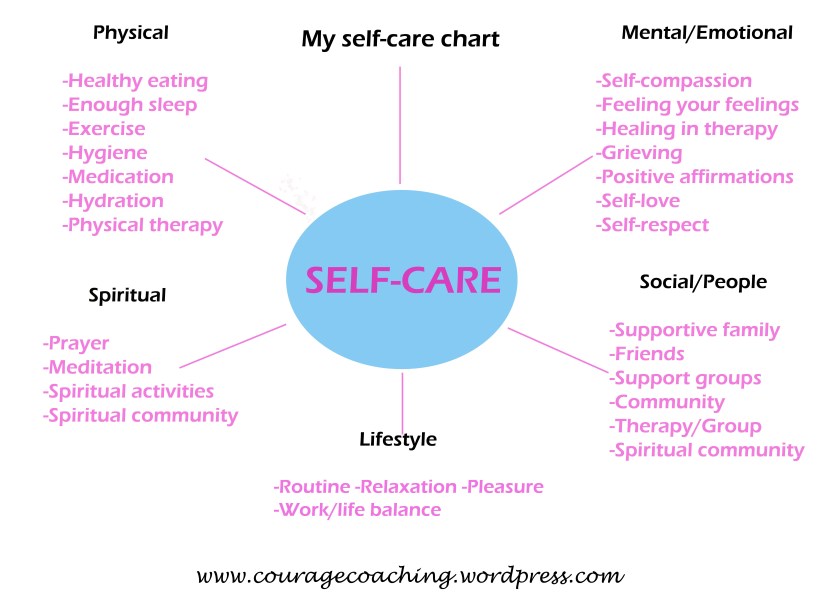
Self-care chart

my self-care chart - courage coaching

When you are struggling from a mental illness, self-care can sometimes take a back seat.

You forget or are unable to eat properly. You have trouble sleeping which then results in not having the motivation and energy to do much at all. You can become more isolated when trying to cope and can even forget to ask for support.

This little chart above gives you a little insight into the important things to consider.

The 2 most important areas in my opinion are physical and mental self-care but a balance amongst all 5 of these areas is crucial, as they are interlinked.

If you feel that there are any areas of self-care that you are particularly struggling with, then please let me know in the comments below. I would be happy to help you come up with an easy action plan, that might enable you to move forward.

Love Athina ♥

Fear of negative emotions & being a People pleaser

If you are afraid of experiencing other peoples’ negative responses or emotions, then you will do everything you can to avoid this.This fear will make it hard for you to say NO to someone and you end up doing things you really don’t want to do.You feel compelled to always do as they say and become completely submissive to their needs. This is the core of being a people pleaser.

These fears usually stem from childhood abuse, where you had an overbearing, manipulative parent or parents. If your parents would punish you severely if you didn’t do what they wanted, then you will have been conditioned to be obedient at all times.

Some really important characteristics of being a people pleaser is when you have low self-esteem, are addicted to others’ approval and are always dependent on them for your self-worth and validation. This happens especially when you might have had a narcissistic/psychopathic parent that criticised you negatively all the time and made you feel excessively guilty and shameful when you didn’t do as they said. With extremely self-centered parents, everything is always about their needs and your needs take a back seat. Every time you want to take a step forward and be more independent in your thinking & behaviour, they will always find a way to pull you back and make you feel dependent on them and their way of thinking.(codependent).It is a very strong type of conditioning that happens in abusive homes and as a young child you aren’t able to escape this environment.

Something that is very common when you are people pleaser is always rationalising peoples’ abusive behaviour to the point of always forgiving it. You always make excuses for others’ bad behaviour and say things like ‘Yes my father beat me but at least he provided a roof over my head’ or ‘I know my mother is very manipulative but deep down she has a good heart’.This has a lot to do with ‘toxic bonding’ or stockholm syndrome’, where you are extremely attached to your abuser in a very emotionally damaging way. You aren’t able to accept the reality of how bad something actually is, because it is extremely painful.

Another couple of traits that make someone a people pleaser and also make them more susceptible to emotional abuse is the fact that they may be emotionally immature and have very weak boundaries. They don’t know what is theirs and what is others’. If they grew up in a home with a parent that would constantly go through their things as a teenager, always invade their space whilst at the same time parentifying them and giving them things to do that weren’t their responsibiliy, this has a detrimental effect on how they view others and how they view themselves. They grow up thinking that it is ok for someone to use them, to take advantage of their lack of assertiveness and self-respect.

A very important part of dealing with manipulative or pushy people is developing self- assertiveness. This is something very useful for people that are constantly submissive to others in an unhealthy way. Assertiveness can be taught and this is something I offer in Coaching.

If you think you might need assertiveness training, then please let me know.

Best Wishes

Athina