
4 tips before going ‘No contact’ with a narcissistic parent

If you are currently considering ‘No contact’ with a narcissistic parent, then this video might be helpful.

Love Athina ♥

© All blog posts and images are owned by me and Courage Coaching. Please don’t use without consent and only re-blog if you would like to use the information on here.
Living as an expat and the additional challenges of those with a mental illness

img_0582

Some of you may have had the experience of moving abroad for the first time to follow your partner’s work. Some of you may have actually been the ones that were offered a job in another country. Whatever your circumstances, being an expat is challenging. If the country you have chosen to move to also speaks another language, then this obviously poses another challenge: that of not being able to communicate effectively.

From my own personal experience, being an expat has been eye-opening and tough at times. My husband has a typical full time work routine and I on the other hand, do some coaching, some voluntary work and the odd child-care. The voluntary work & coaching is mostly from home & online and life has felt very isolating at times. Trying to set up an English speaking business in a German speaking country also has its challenges.

Although learning the language in the country you are living in, is the best option by far, for some of us this just isn’t an option. The reasons for this are many. Some people may only be staying in the country for a short time, 1 or 2 years and will then be moving on to another country. Their job requires constant moving around the globe, so learning a new language each time just isn’t worth the time and effort. Others, aren’t able to learn the language due to health problems, other commitments or a general fear of leaving their comfort zone.

From personal experience and if I am completely honest, I don’t like the language in the country I am living in. I really wish I did but unfortunately I don’t. Secondly I don’t have the motivation to put in the hard work to learn it. This all stems from the fact that when we originally moved abroad with my husband, I was only going to be staying for a year and then moving back home to study. If I had known that I would be abroad for nearly 2,5 years initially, I probably wouldn’t have made the move.

Secondly, due to my mental health and the fact that I live with Complex PTSD, motivating myself to learn a new skill is tough at the best of times, due to the many symptoms of my illness. I am triggered often by my surroundings and feel easily overwhelmed. In order for me to do something well, I have to be determined to learn it and also have an interest in it. This is enough to help me push through the uncomfortable symptoms of my CPTSD. The greater the interest in something, the more motivated I am & the better I become at it.

If you think back to when you were at school, your best subjects were mostly the ones you enjoyed, right? If you were forced to learn things you really didn’t enjoy or even understand, then the result is usually one of frustration or boredom. If on top of that, you also struggled with depression or other mental health problems, your concentration & memory might have also been affected. This was something I was very familiar with for most of my school & subsequent university years. Everything had always been a struggle, due to the neglect and abuse I suffered as a child.

Having a mental illness is a struggle in your daily life even when you are within your comfort zone of ‘HOME’ but when you consider the life as an expat, this can be even more overwhelming. Not only do you feel like a fish out of water and have to deal with homesickness but you also have to get used to the dissapproval you constantly feel for not being what others expect you to be. A fully integrated member of the country you are living in. This obviously means knowing the language, having a job and taking part in some social activities. If however, you aren’t able to be this fully integrated member, this makes you miss home more and more. It can trigger episodes of anxiety & depression and every day becomes even more of a challenge.

We are all different in the way we choose to live our lives and that is totally okay. Some of us have never lived outside our hometown and don’t have an interest in ever doing so. Some of us don’t mind moving around to different cities within our country & others choose to move all around the world and absolutely love it.

I think it is always okay to be honest with ourselves and know our limitations. It is ok to admit that living as an expat might be absolutely terrifying for us.For those of us who are lucky enough to have many friends and family living nearby, we might always value these relationships above moving abroad for a job and that is completely okay!

For me personally, I don’t have a problem living abroad in general but I am just not someone who has an interest in languages. I already speak 2 fluently and have constantly travelled between Greece & England all of my life. I am very content with that. I also am happy to support my husband in his work, which is currently in Germany, as he has created the comfortable lifestyle we have. I am very blessed to be able to share this with him. In future however, I would only move to an English speaking country or back to Greece, which is is where I grew up.

In regards to mental health, when thinking about the difficulties and stigma of mental illness in addition to the difficulties of those of us living as an expat, people need to become more aware of the importance of talking about this and being more understanding.

People need to stop stigmatising those people who are making certain choices in their life, which may differ hugely from others. Expats that choose to live abroad but also struggle with mental health issues, need to cut themselves some slack and be more self-accepting. Other expats who live abroad and have absolutely no mental health issues, need to be aware of those of us who do. It is a big challenge!

It can be very isolating to have mental health problems but even more so when you are living abroad. You will already have your limitations and you will find certain things even tougher than you may have thought of originally. Things that never scared you before will feel absolutely terrifying when you are abroad. If you are also living abroad and don’t have any close friends or family to rely on, then this in itself can be very challenging.

The purpose of this post was to raise awareness of the struggles of those with mental illness that live abroad. I feel no shame in admitting that I am one of those people.

Luckily, despite my struggles, I managed to gain a qualification in CB Coaching and am able to support those with bigger struggles than my own, but in no means should I ignore my own daily living challenges in my life as an expat in Germany.

If you are an expat with mental health issues, then please pop by and say hello!

Love Athina ♥♥

© All blog posts and images are owned by me and Courage Coaching. Please don’t use without consent and only re-blog if you would like to use the information on here.
 

Trauma is a loss, so it must be grieved

Trauma happens to all of us..We all go through life with a few small traumas. Most of the time, small traumas or small losses don’t leave emotional scars. We just keep going and adjust to whatever life throws at us.

If on the other hand, the trauma or loss we suffer is profound, then this means that we will be more deeply affected by it and will need longer to overcome it or learn to live with the affects.

In this video, I touch on the importance of grief and the 3 main stages of grief you go through when dealing with a major loss or trauma.

Love ♥ Athina

© All blog posts and images are owned by me and Courage Coaching. Please don’t use without consent and only re-blog if you would like to use the information on here.
Be there for someone

fontcandy

Today is International World Peace Day. This highlights the destruction that war is currently causing all around the world even more and I feel deeply saddened that things are the way they are. Humans will never learn from their mistakes and greed & power seem to always take the forefront unfortunately.

So what can we do in this ever changing world of destruction, mass murder & grief?

We can’t seem to stop the war & voilence, as world leaders always have the last say in what happens..We can’t always prevent bad things from happening  but we can make a small difference by being kind to others. We can help someone in need & offer them some comfort.

Sometimes people don’t want to or can’t ask for help. They may feel too embarassed, too isolated, too scared. They might be so traumatised that they can’t even speak. They might have learnt the hard way that you can’t trust anyone because they have always been let down.

I have been in a position of vulnerability many times in my life. I used to be someone who was too afraid to trust others. I used to be someone who was too afraid to ask for support. I thought I was a burden because I was made to believe that I was.

How many of you give money to a beggar on the street? How many of you help the homeless? How many of you contribute to bettering the world in some small way by maybe helping the refugees or protecting familes from domestic violence?

I’d love to hear your experiences.

I personally, don’t always give money to the homeless or to beggars. Here in Europe, I know that there are a lot of people who are made to beg for money but don’t get to keep it. Their gang leader keeps it.What I try and do instead is give people items that provide some comfort. A scarf, some food, a hot drink etc..

I also aspire to work in areas where I support others. I am currently looking after a little boy who has a single mother. My heart goes out to them both.I only found out recently that the mother is being emotionally abused by the father of the boy, who is telling her he will turn up on their doorstep after 2 years of ignoring the child. He lies to her and makes threats. I have promised to support her if she needs me. She has asked me to entertain the wee boy at the moment, in case things get akward. This little boy doesn’t even remember his Dad. He has only just turned 4 and it is a delicate matter.

Helping out this small family is my way of giving back to the world and supporting others. I want to care for others, as I know what it feels like to not be cared for. Nobody should feel that way.Nobody should have to feel scared and alone.

Love Athina ♥

© All blog posts and images are owned by me and Courage Coaching. Please don’t use without consent and only re-blog if you would like to use the information on here.

Shame

Shame is caused by negative messages. The shame I am highlighting in this video is caused by dysfunctional parents. Shame is insidious and can have detrimental effects on the way we view ourselves and others.

This is something I am very familiar with as a survivor of narcissistic abuse and I want to highlight the cause of shame, so people can maybe identify with what might have been said to them as children and so they can find a way to move forward and heal.

Love ♥ Athina

© All blog posts and images are owned by me and Courage Coaching. Please don’t use without consent and only re-blog if you would like to use the information on here.


Intolerance to vulnerability is NOT OK!

Intolerance to vulnerability is everywhere.

Dysfunctional homes have this at their core.Children don’t feel safe to express emotions of sadness or pain..Children are taught that it is not ok to have sad or angry emotions..that they will be a burden if they dare to express these emotions..

This is not acceptable..This is emotional abuse..

Physical vulnerability is different to emotional vulnerability..When someone is physically disabled or physically ill, he/she seems to have more understanding from others..because you can see his/her illness physically..When a disability is emotional or mental however, people are quicker to dismiss it..This is where the stigma of mental illness comes in..Every single person out there with a mental disorder, is vulnerable..If they suffer with anxiety or depression, this makes them vulnerable..Just as much as someone who has a heart condition, or cancer or any other condition..

A vulnerable person is someone who struggles with day to day life.

Vulnerability refers to the inability to withstand the effects of a hostile environment (https://en.wikipedia.org/wiki/Vulnerability).

People with mental illness frequently become vulnerable and easy targets of physical and mental abuse.

People with mental illness can have poor boundaries, emotional dysregulation and many other extremely debilitating symptoms. They deserve the same compassion as those with obvious physical disabilities. They deserve the right to be able to talk about their struggles.

Love ♥ Athina

© All blog posts and images are owned by me and Courage Coaching. Please don’t use without consent and only re-blog if you would like to use the information on here.

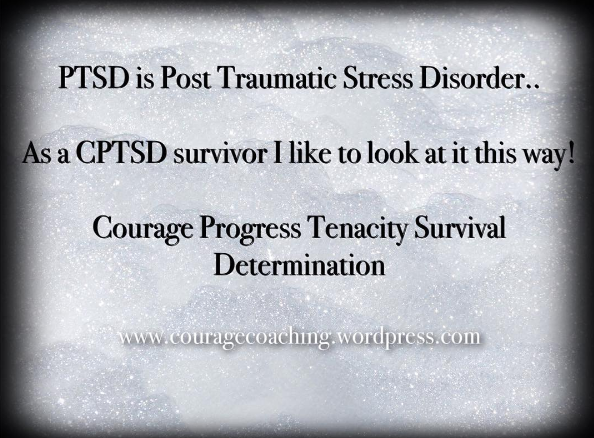
CPTSD= Courage Progress Tenacity Survival Determination

mychildwithin-healing_from_trauma-%e2%80%a2s-instagram-photos-and-videos4

Healing from PTSD is tough! Healing from Complex PTSD is even tougher.

In honour of World Suicide Prevention Awareness Day, I want to tell every single one of you survivors out there that you can look at your PTSD & CPTSD differently, just for today! ♥

C-PTSD = COURAGE PROGRESS TENACITY SURVIVAL DETERMINATION

Love ♥ Athina

© All blog posts and images are owned by me and Courage Coaching. Please don’t use without consent and only re-blog if you would like to use the information on here.


September 10th-World Suicide Prevention Day

fontcandy-3

YouTube video:Is it possible to completely cure Complex PTSD?Tips for a better chance at healing.

I hope you are all enjoying your weekend to the best of your ability.To those of you struggling at the moment, I hope you are doing ok and reaching out for support. The blogging community is filled with wonderful, caring people and it is important to keep this community positive and encouraging. To those of you who need it, I am sending you a big hug! ♥ Take it one step at a time ♥

As some of my regural readers know, I am off to London tomorrow until Thursday to visit family and friends, while my husband is away for work.My Youtube videos are usually posted every Monday, however due to the fact I am off to London tomorrow, I decided to do this one a little earlier.

I talk about Complex PTSD once again, as there are so many of you who suffer with it and I am pretty sure that you need some hope, to keep fighting it and keep moving forward. Through lots of research and from my own personal experience, I talk about the most helpful things you can do to support your healing.

Much love Athina ♥

© All blog posts and images are owned by me and Courage Coaching. Please don’t use without consent and only re-blog if you would like to use the information on here.

Recovery from abuse- 3 basic stages & how to identify whether you have reached the acceptance stage of recovery

Happy Monday fellow bloggers. This is quite a late post, so I hope it reaches some of you.

I have just done another video on YouTube, where I talk about the 3 main stages of recovery that someone goes through, in particular concerning the recovery from childhood narcissistic abuse. I also talk a little bit about the acceptance stage of recovery, which I personally found the toughest in my own recovery.

Acceptance that you parents weren’t able to love you unconditionally, is a painful, rejecting reality. It is easier to spend most of your adult life being in denial of this, as it is such an incomprehensible reality to accept.

Once you are able to reach this stage of acceptance however, you feel like a huge burden has been lifted off you.

I wish all of you who struggle with this sort of realisation, to be able to finally reach this stage one day.

Love Athina ♥

© All blog posts and images are owned by me and Courage Coaching. Please don’t use without consent and only re-blog if you would like to use the information on here.