Narcissistic abuse survivors

FontCandy (58)

As some of you already know, I have great insight into narcissistic abuse, after a tumultuous life with 2 narcissistic parents, many narcissistic ex-partners and narcissistic ex friends. Before my father discarded my mother in 2000 and filed for divorce, he had already met his second narcissistic wife. He had already lined her up to fill his emptiness and later had a child with her. The cycle of abuse unfortunately continued and there was nothing I could do to prevent it.He has been married to her for 16 years now and it has been the most destructive, soul destroying relationship I have ever witnessed.

My histrionic/covert narcissistic mother, on the other hand, luckily didn’t re-marry. She just had 2 relationships which didn’t work out.She has remained irritable, negative and critical. She still blames everything & everyone else for her misery and struggles to cope with her own depression.

My childhood in general was always hot & cold.One minute things were relatively normal and my parents would be kind & thoughtful and the next they would be extremely hurtful & abusive. This almost made coping with the abuse harder, as the kind moments would give me hope as a child and then when the abusive moments would come around, I was utterly devastated and confused. I then learnt that whenever my parents were kind, there were always strings attached to this kindness. I was told many times as a child ‘After everything I have done for you, this is how you treat me?’. I felt guilty and ashamed. I felt worthless and no good.

The one thing I know for certain is that for those of you who have also been affected by narcissistic abuse, you have developed a deep sense of self-awareness, a sense of gratefulness for the tiny moments of kindness that others have shown you and a high level of empathy from a young age. Most of you sought out therapy and have always helped and be-friended the shy or needy. Yes you have made many mistakes along the way, by getting involved with people who resembled your family of origin, however this is a logical result of growing up in an abusive or neglectful home.

The thing that helped me the most in my recovery was forgiving myself for struggling so much in my life. Self-compassion is the best gift you can give yourself as an abuse survivor.Recovering from narcissistic abuse means that you have to dig deep to reveal the many layers of trauma. You have to acknowledge that it isn’t going to be easy to go through all the painful realisations of your past but that is extremely important to work through each layer and grieve your losses. Trusting that others won’t hurt you is a huge struggle for those who have been abused. If your primary caregivers let you down so badly, why on earth would you trust complete strangers?

The most important thing to remember is that there is no time frame on healing and that everyone copes and heals differently.

My advice will always be to ask yourself ‘What do I need’? ‘What am I scared of’? ‘How can I look after myself’?

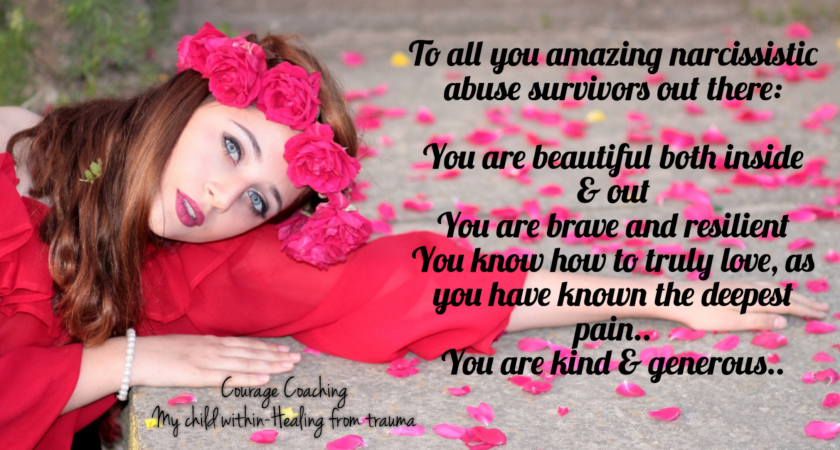
For those of you who can relate and understand, just remind yourselves daily that you survived an unfair childhood and that from now on you can give yourself the unconditional love your parents weren’t able to give you. In every low moment, remind yourself that you are brave and resilient.

Now in my 30’s I have already been through the darkest moments of despair and have healed extensively through many years of trauma therapy. I am now armed with knowledge,coping skills and the most important thing: the knowledge that healing is possible and that you ARE able to live a more fulfilling life. If you had asked me this same question 2 years ago, I wouldn’t be feeling so optimistic.

Now I am putting all my knowledge into helping others and it feels good! It feels good to see that others feel validated & comforted, because this is a feeling I missed out on a lot! It feels good to be there and pass on information, even if it only helps one other person. Free advice is so valuable and we can all do it! So many of us are already doing it!

Love Athina ♥

© All blog posts and images are owned by me and Courage Coaching. Please don’t use without consent and only re-blog if you would like to use the information on here.
 

How to be assertive-Steps to healthy self-assertion

This post is the last one on assertion and hopefully the most useful to those of you who struggle with being a people-pleaser and/or are quite passive in your relationships with others.There is also a YouTube video attached for those of you who are auditory & visual learners.

Here is a quick guide on how to be assertive:

  1. Firstly get the person’s full attention when you are trying to make an important point. This may seem like a given however it is important to ensure there are no distractions.
  2.  Describe in an objective way, what you are having difficulty with in regards to the other person’s behaviour. EXAMPLE: ” I said I wanted to speak to you and you have just turned on the tv”.
  3. Express constructive feelings using ”I” statements. Don’t say ”You completely ignored me”.Instead, choose to say ” I feel upset that you are not listening to me”. It is ok to state feelings of disappointment & annoyance, as these are constructive feelings.
  4. Check your statements & make sure the other person gives you a response. This will hopefully enable some sort of resolution later on. EXAMPLE: ”I feel that you are hiding something from me. What do you think about this”?
  5. Listen to the other person’s response with an open mind and give feedback in a controlled manner.  Avoid dismissing the reply as soon as it is given.
  6. State your preferences clearly. EXAMPLE: ”I would like if you could always be honest with me”.
  7. Request agreement from the other person.If they don’t agree or try to avoid the subject, clearly state ”Are you willing to make any changes?”
  8. Communicate any relevant information concerning future occurences.State what you will do if the same problem re-occurs.

Child abuse, Complex PTSD & managing emotional flashbacks

****Please share & re-blog this post to help as many others as possible****

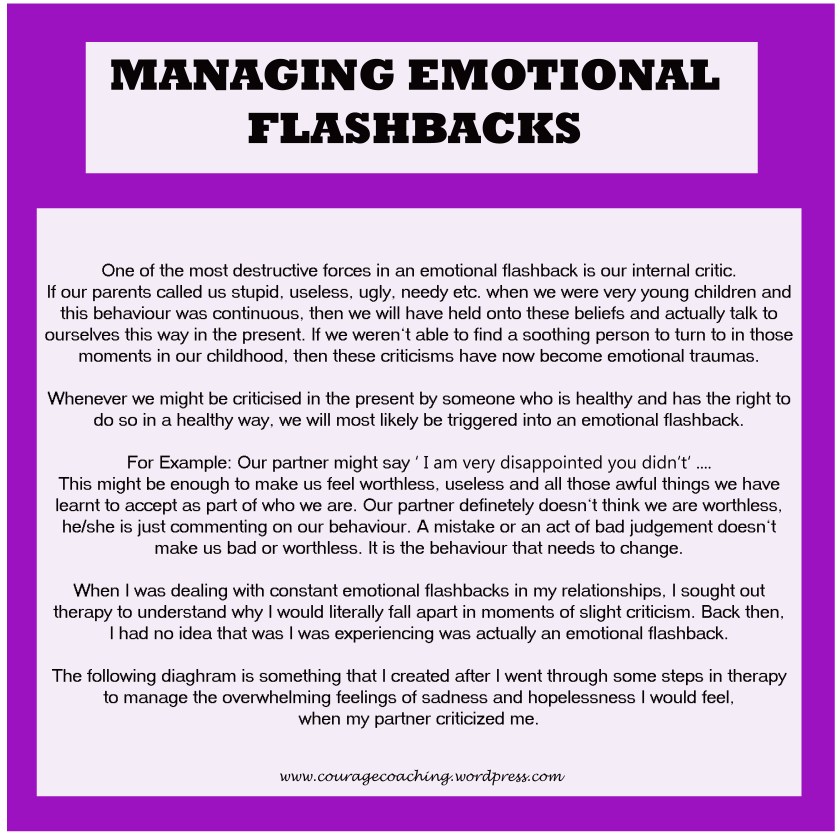
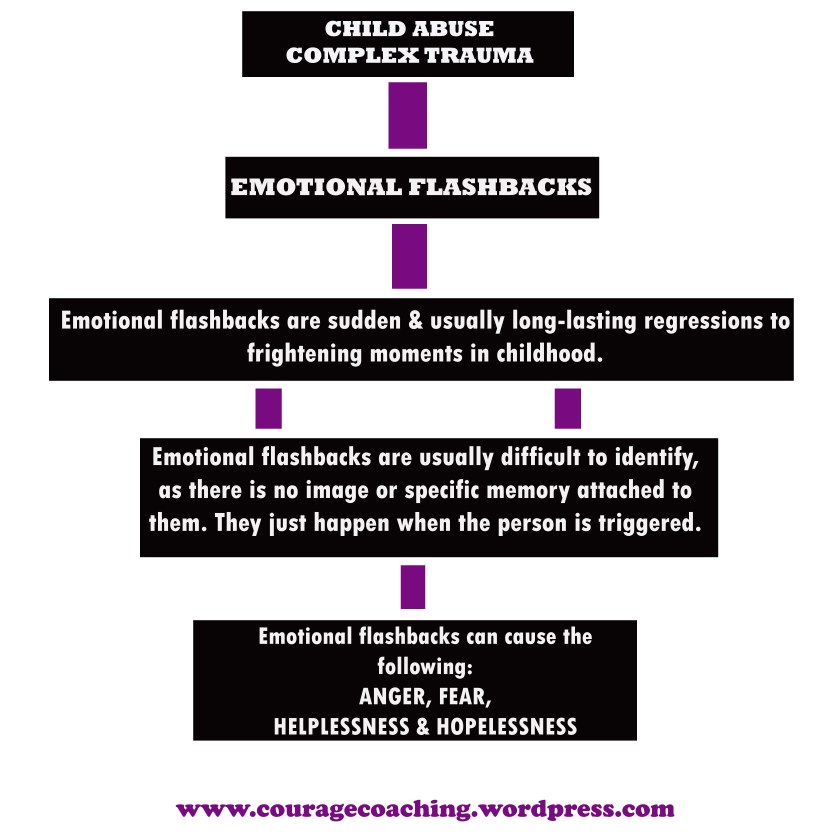
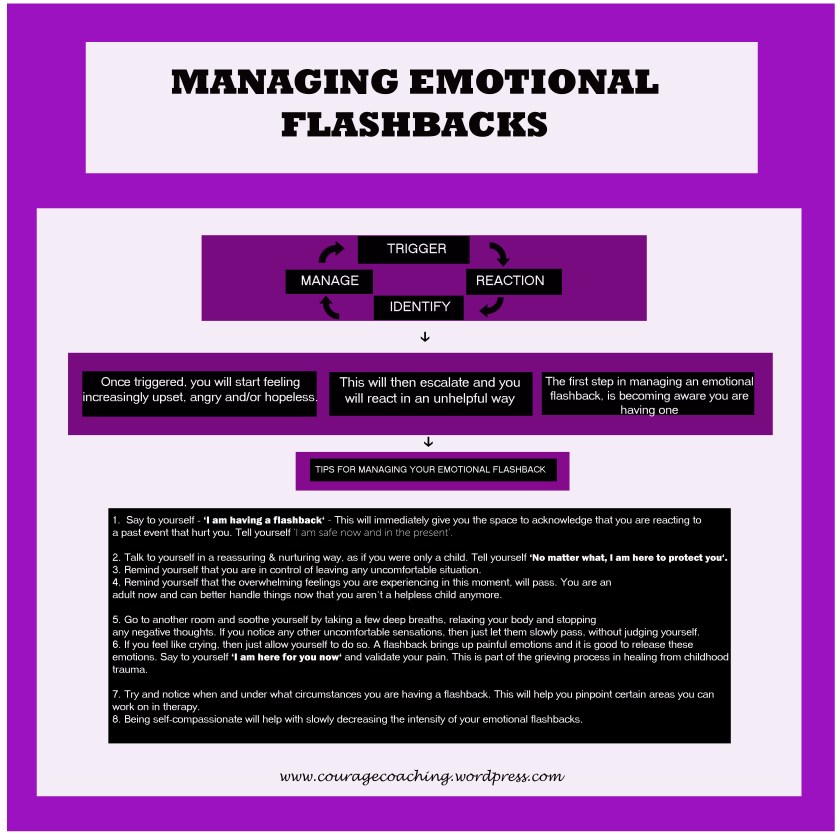
This blog post might be useful to anybody out there who suffers with Complex PTSD, who has suffered from childhood abuse or who has a loved one who suffers with a mental illness. I have created the below charts to assist those of you who might need a clearer map of how complex trauma affects individuals and why they might have moments of overreacting to criticism, an angry tone of voice or a stern look. Emotional flashbacks are explained and a list of coping skills are included, which I have used extensively throughout my own healing over the last 4 years. I find that boxes, colours and diagrams are very useful for me to remember things, especially because my own Complex PTSD affects my memory and cognitive function. Forgive me if there are any errors.

Please note that I have also added links under each image, so you can download these diagrams for your own free use.

Below is also a video I just did on YouTube! It is around 7 minutes long, if you can bare it 😉

emotional flashbacks 2

https://drive.google.com/file/d/0B7k454c6xtmnUWJxaFJZd1VILTQ/view?usp=sharing


emotional flashbacks


https://drive.google.com/file/d/0B7k454c6xtmnQ3VXZmVzOU9fZk0/view?usp=sharing

diagram of emot

https://drive.google.com/file/d/0B7k454c6xtmnMDNDdnQyRUlEeXM/view?usp=sharing


Thanks for reading

Much love Athina ♥

© All blog posts and images are owned by me and Courage Coaching. Please don’t use without consent and only re-blog if you would like to use the information on here.
Take control of your own healing

FontCandy (38)

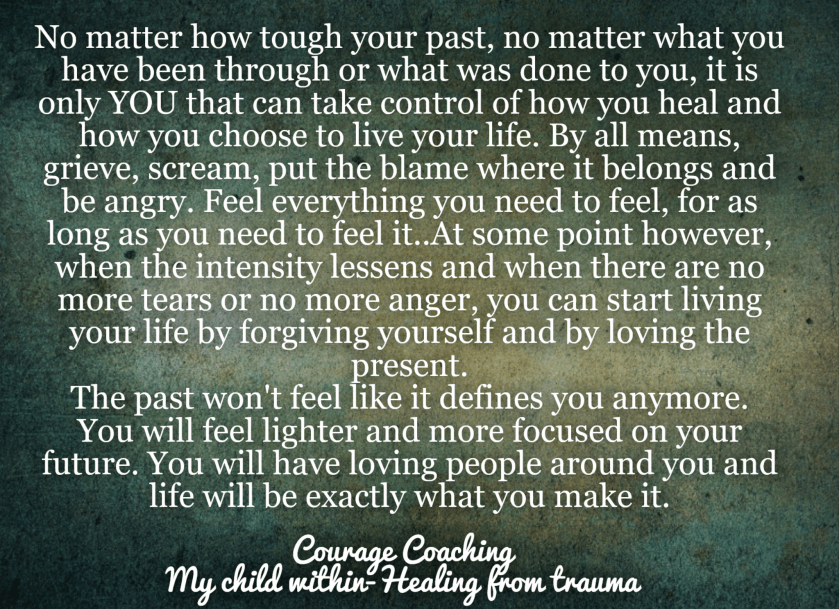
Every healing journey is unique to each person. No journey should be judged, minimised or discounted.

Whether it is childhood abuse, emotional, sexual or physical abuse, domestic abuse, grief, a single trauma or multiple traumas, nobody has the right to criticize someone else’s journey.

If you have compassion and maybe share what helped you, it doesn’t necessarily mean it will help others in the same way. Having compassion and empathy is so crucial. Listening, without trying to fix is also important.

After you reach a certain point in your healing, you will notice that things get easier. The intensity of certain emotions lessen and your sense of self-protection and boundaries are solid. If you suffer from a mental illness, it doesn’t necessarily mean it will go away. You eventually just learn to accept that it is a part of you and that you can handle it in a self-compassionate way.

What is your experience with healing?

Do you believe you will reach a point in your recovery where things eventually feel better?

Are you persistent in practicing self-care and healing with appropriate professional support?

Don’t forget that healing is a very up and down process. It isn’t always straightforward. Sometimes just as you are starting to feel better, something else comes along which needs processing. It might feel that you are back to square one again but this really isn’t the case.

Changes happen in very small ways sometimes and it depends on whether you have regular support.

Always be kind to yourself and others going through a process of healing ♥

Love Athina ♥

© All blog posts and images are owned by me and Courage Coaching. Please don’t use without consent and only re-blog if you would like to use the information on here.
 

The importance of resilience

FontCandy (36)

So what is resilience and is it common?

Resilience can be defined as an individual’s ability to properly adapt to stress and adversity. It is about an individual’s ability to manage difficult emotions that arise in times of difficulty, without supressing them.

Research shows that resilience is actually more common, than uncommon, as life has many ups and downs and people are having to adapt all the time to many difficult situations.

A person’s attitude is the most important element of having resilience. If someone generally has a negative thinking style, this is not helpful to having resilience.

There are a few many important attributes associated with resilience:

  • The capacity to make realistic plans and take steps to carry them out.
  • A positive and self-accepting view of yourself and confidence in your strengths and abilities.
  • Skills in communication and problem solving.
  • The capacity to manage strong feelings and impulses without complaining about any struggles or falling into self-pity when setbacks arise.
  • Adaptability-The ability to act flexibly in changing or challenging circumstances.
  • Asking for support or accepting support from others. Positive, supportive relationships are key to coping in tough times.
  • Having humour- Finding light moments in depressing times can sometimes help lift the mood.
  • Being aware of unhealthy thoughts that may pop up and don’t benefit you in times of adversity.

Now that you are aware of what makes someone resilient, what happens when you need to develop more resilience? What steps could you take?

Here are a few things to keep in mind:

  • Take care of yourself and treat yourself with respect, comfort & acceptance.
  • Try and be hopeful for the future no matter what the current circumstances. A positive outlook is very important.
  • Ask for support from friends or family
  • Look for opportunities of self-discovery. Adversity isn’t obviously welcomed but if something negative happens, look at how you handle it and learn something about yourself.
  • Accept that change is part of living
  • Make decisions or take actions when confronted with a difficult situation. Don’t avoid it!
  • Set small goals that are easy for you to reach. It doesn’t matter how small. The more you achieve, the better you will feel
  • If you are spiritual, use your faith to support you.Prayer or meditation can be very helpful
  • Journaling, blogging, art therapy or other therapies can also be useful in developing resilience.

I would love to hear your thoughts on resilience. Is there anything in particular that happened which improved your resilience? Do you think you are resilient or do you think you could develop better resilience?

♥ Athina

© All blog posts and images are owned by me and Courage Coaching. Please don’t use without consent and only re-blog if you would like to use the information on here.
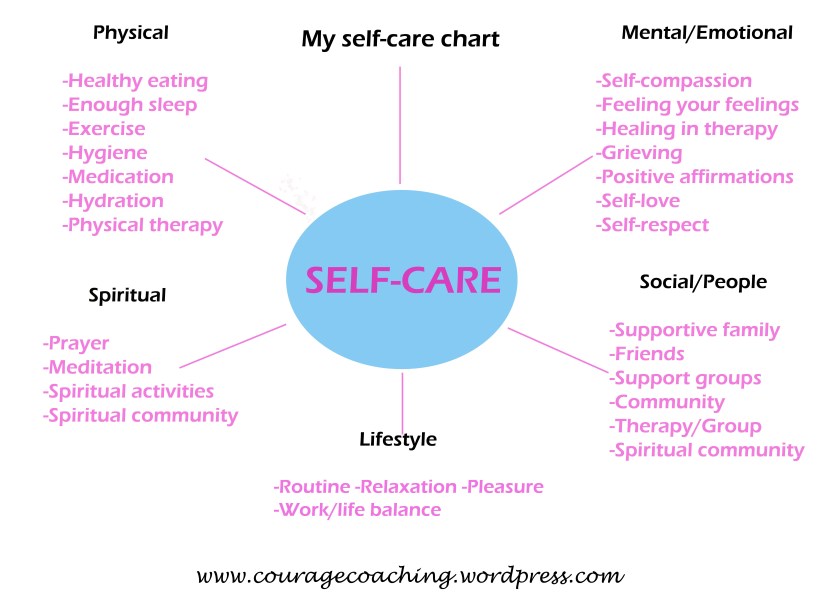
Self-care chart

my self-care chart - courage coaching

When you are struggling from a mental illness, self-care can sometimes take a back seat.

You forget or are unable to eat properly. You have trouble sleeping which then results in not having the motivation and energy to do much at all. You can become more isolated when trying to cope and can even forget to ask for support.

This little chart above gives you a little insight into the important things to consider.

The 2 most important areas in my opinion are physical and mental self-care but a balance amongst all 5 of these areas is crucial, as they are interlinked.

If you feel that there are any areas of self-care that you are particularly struggling with, then please let me know in the comments below. I would be happy to help you come up with an easy action plan, that might enable you to move forward.

Love Athina ♥

Mother’s Day when you had an abusive mother

IMG_0926

Practicing self-compassion when you didn’t have a nurturing mother is very important.

To not feel like celebrating your mother on Mother’s day is completely understandable when she was abusive, overly critical, neglectful & selfish.

The same goes for Father’s day or any other major holiday that focuses on the family unit.

If you are still in contact with an abusive parent, please don’t feel guilty about not doing anything if that is how you truly feel. If your mother complains to you about not doing anything, don’t let her complaints affect you.

If you do decide to send your mother a card, please don’t feel guilty if you can’t write anything in it that is warm and loving. Maybe a card that simply states ‘Happy Mother’s Day’ is enough!

In any case, it is a personal choice and nothing is right or wrong.  Just go with your feelings and be kind to yourself.

Thanks for stopping by

IMG_1001

For any newly created site there is always a bit of a delay in the initial interaction. I am currently in Germany but hoping to reach more people via this platform.Since I am already familiar with wordpress and the people on here are very friendly, I decided that the creation of a page here would be ideal. I also have another blog site on here which focuses on trauma and healing from abuse. It is an anonymous blog so please be respectful of this if you know it. I will be creating YouTube videos very soon so bare with me.

Feedback is always wonderful so look forward to hearing from you!