How to deal with loneliness

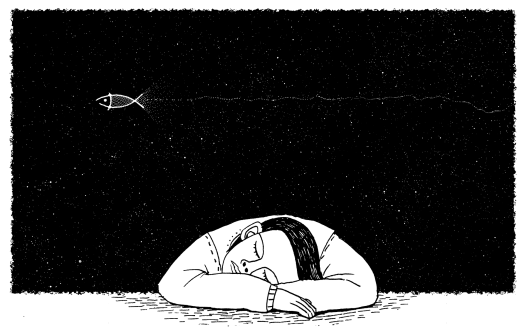
lonely-1510265_1920

Loneliness is an unpleasant feeling that a lot of people experience at some point in their lives. Loneliness is a feeling of emptiness or hollowness inside you.You might experience loneliness as a feeling that something is not right, a kind of minor emptiness. Or you might feel loneliness as a very intense deprivation and deep pain.For the most part, it is something that can be remedied quickly by reaching out to family or friends.

What happens however if you have a chronic feeling of loneliness? What happens when you don’t have any supportive family to turn to? or even friends? Do you end up feeling even more isolated? Do you retreat further into your shell and just tell yourself that this is how you are meant to be? Lonely and helpless?

A lot of the time unfortunately this happens. Loneliness is paired with depression and this can lead to further complications.If  you don’t have the appropriate support, the downward spiral gets worse and worse. Loneliness is a passive state.

The most important thing about loneliness is that we have to remind ourselves that it is a state of mind, a feeling, not a fact.So what are we doing to enable our loneliness? This is a really important question to ask ourselves.

If we lost a loved one to death or have grief related to trauma, then it is important to acknowledge our feelings. Acknowledging our feelings of loneliness is the starting point to dealing with them. Expressing these feelings in numerous ways is the bext step. If we don’t have a friend or family member to express these feelings to, then we have to try and find someone else who might listen, like a counselor or mental health volunteer. We can also express our loneliness through art or writing a blog.

As I said before, loneliness is a passive state. So how do you change something passive? Your turn into something active.This might be a simple thing to state and some people might find it hard to make changes, but it is crucial to understand that if you do nothing about it, it won’t change.

Being active means that we reach out to others and that we maybe take up a class doing something we enjoy.This is a good way to connect with other people. It means that we can choose to maybe do some volunteering, as helping others can bring a feeling of fulfillment and reduce the feeling of loneliness. It means practicing different acts of kindness towards people that really need it. It also means the possibility of getting a new pet, or helping in an animal shelter.

It is very helpful to write a list of the things we enjoy and which things in particular helped us feel less lonely in the past.

It also very important to fight those self-defeating thoughts we may have, that tell us we can’t feel better and that we will always be lonely. Even if we are very depressed, we must fight this feeling and push ourselves past the negative feelings of not wanting to leave the house or connect to others. We have to challenge the passiveness and do things that might makes us a little uncomfortable.

What are your experiences of dealing with loneliness?

Love Athina ♥

© All blog posts and images are owned by me and Courage Coaching. Please don’t use without consent and only re-blog if you would like to use the information on here.



What 5 things make you the happiest? Practice gratitude

200op

I’m sure there are many things that make you happy. Hot bubble baths, holidays, hugs with your loved one, a favourite pet, a child’s giggle or even indulging in a favourite dessert.

If you could only choose 5 things that make you the happiest and that you couldn’t imagine yourself living without, what would those 5 things be?

When I started thinking about my 5 things, I must admit I got really stuck..

I started thinking about my feelings in certain situations..The moments where I have felt the deepest sadness..The moments where the things that made me the happiest, were no longer there…

To think of the things that make you happiest in my opinion, you have to think of the things you couldn’t bare to lose…

My 5 things would be:

  1. My husband, as he is my best friend – He enriches my life and provides me with the family I never had growing up.
  2. A beloved pet -I love animals and feel such a strong connection to them.
  3. Close friends that I can be myself around
  4. Kindness- I value kindness so much as I didn’t experience much kindness growing up.
  5. Most things creative (music, film, art, doodling, dancing etc) – Creativity has been a constant in my life from a young age.It is a part of who I am and it brings me peace & happiness.

What are your 5 things? Thinking about the things that make us the happiest is good for practicing gratitude.

Love Athina ♥

© All blog posts and images are owned by me and Courage Coaching. Please don’t use without consent and only re-blog if you would like to use the information on here.

Childhood trauma leads to lifelong chronic illness — so why isn’t the medical community helping patients?

Extremely useful blog post on the link between childhood trauma & lifelong physical illness..

Donna Jackson Nakazawa's avatarACEs Too High

ADonnaDadWhen I was twelve, I was coming home from swimming at my neighbor’s dock when I saw an ambulance’s flashing lights in our driveway. I still remember the asphalt burning my feet as I stood, paralyzed, and watched the paramedics take away my father. It was as if I knew those flashing lights were a harbinger that my childhood was over.

At the hospital, a surgeon performed “minor” elective bowel surgery on my young dad. The surgeon made an error, and instead of my father coming home to the “welcome home” banners we’d painted, he died.

The medical care system failed my father miserably. Then the medical care system began to fail me.

At fourteen, I started fainting. The doctors implied I was trying to garner attention. In college I began having full seizures. I kept them to myself, fearful of seeming a modern Camille. I’d awaken on the floor…

View original post 945 more words

How to Deal with Emotional Vampires

I am reblogging this great post by Eric from MakeitUltra! Emotional vampires are exhausting to be around. In my case, I grew up with parents who had NPD (one of the most draining emotional vampires) , which eventually led to me developing Complex PTSD & Depression. I have come very far on my recovery journey due to incredibly helpful articles like this one, so I feel it is important to share it on my blog too!

Dr. Eric Perry's avatarDr. Eric Perry’s Blog

vampire3.jpg“Anyone can give up, it’s the easiest thing in the world to do. But to hold it together when everyone else would understand if you fell apart, that’s true strength.” ~Unknown

1. Don’t be guilted or show pity
Emotional vampires are great at using guilt or pity to control and manipulate others. If you show any sign of guilt or pity, you become an easy target. It is important to be decisive, direct and non-reactive when dealing with emotional vampires. Remember, emotional vampires can be quite charming. Establishing boundaries early will help. But, don’t be afraid to set a new precedent with an emotional vampire, even if you know they will react negatively. Set an intention that you will not be an emotional prisoner to anyone.

2. Replenish yourself after every interaction
After interacting with an emotional vampire it is common to feel completely drained. It is important to keep this in mind before skipping the evening walk or…

View original post 361 more words

Trauma bonding

Trauma bonding is the reason people choose abusive partners time and time again.

Trauma bonding is also known as Stockholm syndrome, something that is mentioned a lot when someone has been abducted.

Trauma bonding is something that starts in a person’s childhood, if they have suffered abuse or neglect.

If you are someone who keeps choosing emotionally unavailable partners or abusive partners, then this is why.

Love Athina ♥

© All blog posts and images are owned by me and Courage Coaching. Please don’t use without consent and only re-blog if you would like to use the information on here.
It is wrong to silence survivors of abuse

As a survivor of narcissistic abuse, and in honour of some of my followers who are also survivors of abuse, I want to do a short but very important post today about the unfortunate shaming & silencing that happens to survivors.

13934736_1212221458848183_2926432622871302405_n

It is absolutely horrendous to deny someone of their right to freely talk about their abuse and to deny them the ability to heal.Every time a survivor talks about the abuse to someone who validates them and acknowledges their pain, there is a small layer of healing taking place.

On the other hand, every time a survivor shares their story and isn’t believed, is shamed for not forgiving their abuser or is told to not go public about their abuse, it is destructive & extremely painful. It shows that the person shaming the survivor lacks empathy & understanding for the pain & trauma they have been through. It is re-traumatising and makes the survivor feel isolated & abused once again.

For those of you out there, who don’t know much about child abuse because you have been fortunate enough to grow up with healthy, loving parents please understand this:

Survivors require acknowledgement of their pain & suffering

Survivors require kindness & empathy

Survivors need to hear ‘I am so sorry for what you have been through’

Survivors need to be shown healthy lovely, healthy boundaries because they never learned these in their childhood..

Survivors DON’T want to be told to forgive their abusers

Survivors DON’T want to be told to stop talking about what happened to them just because you are uncomfortable with it.

Survivors DON’T want to be told to ‘Get over it because it was a long time ago’

Survivors DON’T need any more abuse, silencing or shaming.

Much love Athina ♥

© All blog posts and images are owned by me and Courage Coaching. Please don’t use without consent and only re-blog if you would like to use the information on here.

Can’t afford Coaching or Therapy? Then try Co-counseling :-)

Apologies for not having posted since Friday..My laptop has been very slow so I have found it extremely hard getting stuff done on it.

In this post I would like to introduce Co-coaching to those of you who have never heard of it..

My YouTube video explains it in more detail and by watching it you can find out more about it. Hint hint 😉

I would love it if this post could reach as many people as possible, so please share away 😉

This is something you can practice with a friend or partner..

It’s free, it helps with personal growth, relieves stress and provides you with a weekly outlet for all your pent up emotions or thoughts.

So what are you waiting for ?

Help me spread awareness on Co-counseling 🙂

Love Athina ♥

© All blog posts and images are owned by me and Courage Coaching. Please don’t use without consent and only re-blog if you would like to use the information on here.

Poor sleep-One of many side effects of CPTSD, anxiety & depression

Are you somebody who struggles to sleep well and ends up waking up exhausted in the morning rather than refreshed? Do you find that you often have vivid stress dreams which can at times disrupt your sleep in the middle of the night?

fairy-tale-1180921_1920

If you are someone who also struggles with depression, anxiety or (C)PTSD, then this will no doubt have an impact on your quality of sleep.

Both anxiety & depression, involve a thinking style known as ruminating. Ruminating means that we go over the same thoughts over and over again,without any resolution. These thoughts are usually negative and if they aren’t resolved with some sort of action, they will then possibly play out in our dreams at night.

Apparently is has been stated that a memory is composed of a situation or thought, the emotions experienced from that situation or thought and then the actions taken. If something happened during the day for example, that was upsetting but you weren’t able to resolve the situation in some way, then this will most likely linger until you go to bed. Since ruminating means that our thoughts and emotions are stuck in a repetitive loop, we will then most likely have an anxiety dream, in which we will try and find a resolution to our initial problem. Our mind just isn’t able to switch off properly until our problem has been solved.

So basically, if you have had a stressful day and there is still stuff that needs to be resolved, you will then most likely be doing this in your sleep as well. Since stress and anxiety can be exhausting during the day, then it is pretty similar at night too.If the brain doesn’t get a chance to ‘switch off’ or relax at night, then you can understand why the quality of your sleep is compromised.

This causes a vicious cycle which looks a bit like this :

Worrying/Rumination → Poor sleep quality → Increase in stress during the day & trouble coping → Worrying/Rumination → Poor quality sleep  .. etc

Too much ruminating can lead to feeling helpless. If you are too focused on the problem you are ruminating about, you tend to get stuck and this affects your actual problem solving skills.

A few tips to calming your worrying mind at night:

  • Try and resolve the problem before going to bed (if this is possible).
  • Talk to a friend or family member about your worries (A different point of view might do wonders)
  • Write down your troublesome thought/s on a piece of paper or type up a document on the computer..This might help you find a solution, by seeing your thoughts clearly written in front of you..
  • Another thing you can do is write a priority list (if your worries are work related). By organising your time and managing your tasks into more urgent, less urgent etc..this might help you relax more.
  • Think about what is in your control and what isn’t..If it isn’t in your control, then try to ‘let it go’..
  • If you are still not able to sleep, use lavender oil on your pillow and find some self-hypnosis tracks you can listen to while lying in bed..


What are your thoughts on this? Are you someone who suffers with ruminating and poor quality sleep?  Do you also suffer with a mental illness? How often would you say you have anxiety dreams on average? Twice a week or more?

Love Athina ♥

© All blog posts and images are owned by me and Courage Coaching. Please don’t use without consent and only re-blog if you would like to use the information on here.


The importance of feeling our feelings

a6d7f1c996ab656267d279e27cbb667e

If we were able to count how many times we avoided our own suffering, I think we would fail miserably..

We have all at some point avoided emotions that are uncomfortable, by distracting ourselves, by numbing ourselves and by completely ignoring what is really going on..

This makes complete sense..Humans don’t like suffering..

By avoiding pain, we are temporarily soothing ourselves so we can better cope with what is bubbling under the surface. We might drink alcohol, do drugs, eat too much food, watch too much tv or spend too much time on the internet. We might develop addictions to numerous things and not even realise it.This is how we cope and in society at the moment, a huge percentage of us are addicted to the internet. If we are feeling down, we go online to search for clues as to what might make us feel better.If we are lonely, we announce it to the world on social media to get attention, instead of just reaching out to a caring friend. If we are happy, we also go online and share it with the world, instead of just enjoying the moment.

Since the focus of this post is on uncomfortable feelings, we need to acknowledge how often we avoid them..How will we ever grow and better ourselves if we constantly hide behind our suffering?

Distractions are good sometimes, don’t get me wrong..and also connecting with people online, blogging, watching videos etc..The important thing to remember is however, that we still need to be aware of what we still need to improve or change in our lives and actually do it!

For those of us who suffer with a mental illness, it is even more challenging to not run from suffering..Especially if it is a constant part of our lives to feel really low, anxious, terrified, lonely etc..If we have a history of trauma, no matter how much we try to ‘numb ourselves’, this will eventually start seeping out..

If we have been made to feel small, unimportant or ashamed in our childhood, then this will be incredibly tough to run from or avoid..We will feel it in the depth of our being..It will reveal itself in every step forward we may try to take..No matter what we do in our life, we will never feel good enough, lovable enough, deserving enough..It is a tough reality to bare..

Avoiding our feelings gives us temporary relief but with a whole life ahead of us, this isn’t enough..

If you are suffering at the moment, then face the pain..cry…ask for a hug..have human contact..Talk to someone who will genuinely listen..Don’t bury your suffering inside a tv or by reading about how you can make it better on numerous sites….This can also become addictive..gathering information about a certain area constantly but without actually taking any actions to improve that area of our suffering, is also avoiding pain..

Yes, of course we need validation for our suffering but make sure that you are making progress..If you want to deal with your anxiety, then take active steps to improve this..Talk to a qualified Coach or Therapist..Practice daily positive affirmations..Take ACTUAL STEPS to accept and manage your feelings..ACCEPTANCE is very important but ACTION is too!

If you want to change jobs but feel too scared, then face your discomfort head on and start applying for new ones..Attend interviews..Keep trying..

If you are scared of heights but would love to go trekking, then find a way to face your fear..

The list goes on..and applies to many areas of our lives..

No matter what uncomfortable feelings you are avoiding, face them..The longer you avoid them, the longer they will remain..

We have to face discomfort..

We have to face reality..

We have to face our fears..

This is how we will grow..heal..get better

This is how we will improve our confidence, reduce our suffering and release our fears..

and lastly, if a situation is unchangeable due to our lack of control over it,  learn to ACCEPT it for what it is..

Love Athina ♥

© All blog posts and images are owned by me and Courage Coaching. Please don’t use without consent and only re-blog if you would like to use the information on here.

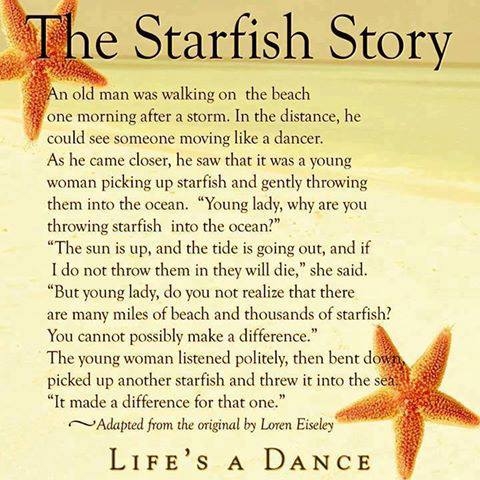
Starfish Story

Belle Papillon 24/7's avatarBelle Papillon 24/7

32146-The-Starfish-Story

This is one of my favorite stories. My mom always said that “No act of kindness, no matter how small, is ever wasted.“(Aesop) so it shouldn’t stop us from trying to help others every chance we get. So I practice RAK — Random Acts of Kindness everywhere I go. I have raised my children doing that as my parents have raised me and my siblings. I also believe that this is a small step towards “world peace”…  it is all connected… we are all connected…

Namaste!

Live  ❤ Laugh … Belle Papillon 

PS –I just want to dedicate this post to a blogger friend, Imani, who has started a supportive and caring revolution for people who are going through depression & suicidality @ #GO FIX . Please check out her blog, write your own post on it, talk to people you know about it. If everyone initiates  a conversation with one person they know…

View original post 10 more words