The aftermath of a traumatic incident

As much as I dislike watching the news and tend to limit what I take in, it is increasingly difficult to not be affected by the constant bombardment of war footage, terrorist attacks, murder and suffering.

When you are a highly sensitive & empathetic person, it is easy to get overwhelmed by the sadness of others. I am very much aware of the cruel injustice in our world and it hurts me deeply to see so many suffering. It is even tougher when this is repeated in your own country. Due to the fact that I know what it feels like to have your life threatened, I decided to make the following video on the aftermath of trauma. This is my small contribution towards all those affected.

Despite my traumatic childhood, I was also once caught up in armed robbery, where a gunshot went off right next to me and a woman was lying on the floor with blood on her leg. The disbelief of what I had witnessed was indescribable. The terror I felt shook me to the core. I couldn’t comprehend how someone could shoot a gun, when everyone at the cashier was cooperating and the robbers had managed to get their money.

This armed robbery happened at a time where I was very vulnerable already as my CPTSD was really bad. All I could think of after this robbery was ‘not again, not another trauma to add to my list’. Life felt so unfair and scary on that day and my mind was telling me that there was more damage done and that I would not recover this time.

If it wasn’t for my kind therapist at the time, to ground me and tell me that I wasn’t going to let this swallow me, I don’t know how I would have coped in the long term.

So this video is for those of you who are new to trauma. It is helpful in understanding yourself after a traumatic experience and it gives you the tools you need to ride the emotional waves that may at times feel like they are taking over.

Although I am not a qualified psychotherapist, I do have a lot of insight into trauma through my own journey and I know the many things that helped me, as well as others. If you are someone who is in deep distress, then please call a qualified mental health professional.

Thank you so much for reading & watching! ♥

Please share this post if you think it will help others.

Check out my patreon page below, if you would like to support the creation of more videos, documents and fact sheets.

https://www.patreon.com/AthinaEhlen

Love Athina ♥

© All blog posts and images are owned by me and Courage Coaching. Please don’t use without consent and only re-blog if you would like to use the information on here.

Why is going ‘no contact’ so hard?

It’s been an extremely busy few days for me recently, which means my blog posts and youtube videos have had to take a back seat.

Work has been a priority, with little time for writing and reflecting.

I have also had an influx of emails from people needing immediate support dealing with narcissistic individuals. It always deeply saddens me to hear all the grief so many are currently experiencing and sometimes I wish I could just take all their pain away.

The ‘No contact’ question has been popping up a lot, so in this video I stress the importance of acceptance. Acceptance in this case, of the fact that a narcissist isn’t able to love or empathize and isn’t going to change and treat you better.

Once you manage to reach a place of acceptance through grief and talking with a professional, it is then easier to make the decision to go ‘no contact’.

Thanks for watching and reading

Love Athina ♥♥

© All blog posts and images are owned by me and Courage Coaching. Please don’t use without consent and only re-blog if you would like to use the information on here.

Mental Health Awareness week

32ce6e_73173c5b28504cf4b73dd1f1d98bd913~mv2

Ending the stigma of mental health is still proving to be a challenge, although in the UK we are getting ever closer to our goal of a deeper understanding, tolerance & acceptance of the importance of talking about our mental health.

As somebody who has never known what life is like without mental health problems, I know how difficult it is to be open and honest about it..People are still uncomfortable with knowing what to say or not say..Even if they try to be understanding, deep down you can sense whether they get it or they don’t..

Every single one of us is touched by stress or anxiety at some point in our lives, whereas others live with it every day…I am one of those people who lives with chronic mental health problems..Complex PTSD isn’t something to be taken lightly..There are still so many moments in my life at the age of 34 that I still learn new things about myself that I am not able to do, that others would find incredibly easy to complete. The hypervigilance and overwhelm never goes away..The chronic fatigue never goes away..The low mood is always lingering in the background..The voice that says ‘you are just not good enough’, pops up a lot when I am working alongside others…

Self-care is so important in these moments and remembering to accept ourselves when we are struggling can make a world of difference!

Walking the same path as others with mental illness really helps people feel less alone..

All the wonderful people who ran the London Marathon raising money for Mental Health are simply incredible..

If you think about how much these runners must have battled with those nasty little voices inside their head, it makes you feel incredibly inspired. The voice of depression or the voice of anxiety is not an easy task to manage..but yet they did it, and in what an admirable way!

I am also blessed to have many friends & fellow bloggers who do so much to raise awareness about mental health! They have all been personally affected however and live with debilitating conditions themselves..

The most crucial part in my opinion of raising awareness, is to also hear more people talking about mental health that don’t have any personal experience with it..People that feel concerned about someone they know but just don’t know how to respond..People that are lucky enough to live with good mental health and are surrounded by people who aren’t that lucky..

If you have experience with ill mental health, stigma or intolerance, then please feel free to comment.

Lastly, I would also like to share my latest information video on defence mechanisms. I was having a bad day yesterday and couldn’t face the camera to film myself talk, so I came up with this instead.

Thanks so much for reading & watching!

Love Athina ♥

© All blog posts and images are owned by me and Courage Coaching. Please don’t use without consent and only re-blog if you would like to use the information on here.


1 year of Courage Coaching

OXYGEN TANK TUESDAY ‹ Mr Buffy Devane ‹ Reader — WordPress.comToday marks 1 year since I started Courage Coaching and I can definetely say it has been totally worth it!

Although I wasn’t new to wordpress 1 year ago, I was very new to coaching!

Since completing my certification and coaching my first clients, it has been both exciting and challenging.

Through creating my small youtube channel,  I have helped support people, that I would otherwise not have been able to reach.This channel has grown at a steady pace and my videos (and sound quality) have also improved over time (with the help of my viewers 🙂 of course).

It has been a very interesting first year and I have felt very grateful for all the lovely comments, support and exciting opportunities that have been part of my journey so far.

Sharing my knowledge with others and giving people hope, has been a truly humbling experience.

When I myself was in a dark place in the past, all I wanted was hope and guidance. The few but very special people that gave me this hope and guidance, will never truly know what a huge part they played in the successes I now am grateful for.

It is so valuable to know that there is always a tiny speck of light in that neverending darkness we may sometimes face in our life.

Dear readers, I would like to THANK YOU.

Love Athina ♥


Approval seeking

Approval seeking is a very common behaviour that all of us are guilty of at some point in our life. It might be that we are trying to impress someone we like, make a new friend or make a good impression on our new boss. It is perfectly normal to seek approval in others occasionally.

Approval seeking only becomes a problem when we do it chronically. When we constantly seek to be validated externally because we don’t feel comfortable to accept ourselves as we are.

This is the topic of today’s video, which I felt was very important for those of you who are people-pleasers and/or codependents.

Love Athina ♥

© All blog posts and images are owned by me and Courage Coaching. Please don’t use without consent and only re-blog if you would like to use the information on here

The loss of what should have been

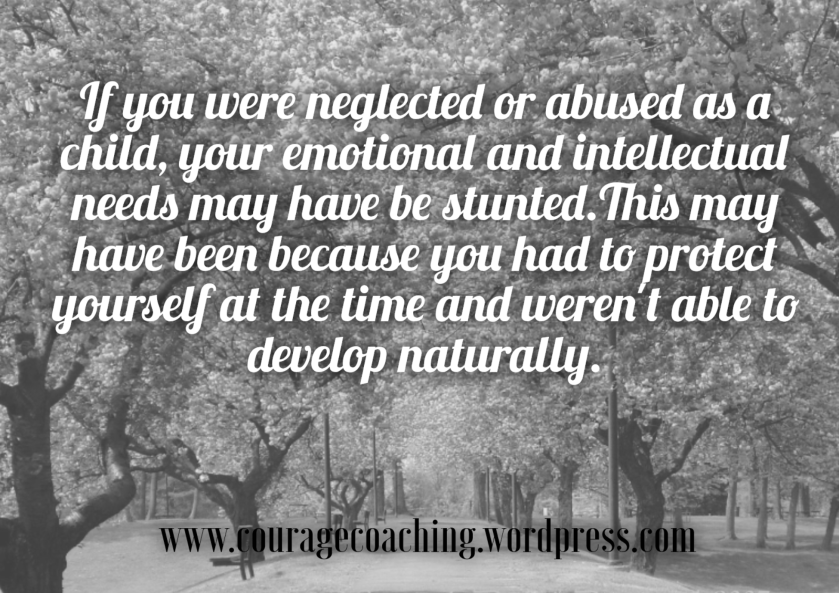
When you don’t get certain basic needs met in your childhood, there will come a time in your future where you will eventually become awakened to these unmet needs. Although this isn’t the same for everyone, there is usually one feeling which is most prevalent for most: ”The feeling of being ripped off”

This feeling of being ripped off, because you didn’t have a healthy family or because you no longer have a family to turn to, starts a very real and painful journey of mourning.

A lot of people who grew up with abusive parents, or in one parent families, or in families where their parents were chronically ill, learned to ‘live on autopilot’. They either had to push down their feelings to keep the peace, be a confidant or carer to the sick parent or learned that they had to solely rely on themselves. Even when they were scared and had no one to turn to as children, they had to keep going. As early adulthood approached, they may have found many ways to cope with this underlying feeling of sadness or anger, by drinking too much, working too much and generally trying to find ways to numb out any uncomfortable feelings that would creep up.

When an adult child is first awakened to the reality of what really was and what now is, they somehow know that things will never feel the same again. It might be that a certain event in their adult life uncovered feelings that had been buried deep inside them and suddenly the strength that they thought would always keep the safe, slowly starts to crumble. New anxieties, fears & losses start to unfold and the world suddenly starts to feel like a scary & unsafe place.

At this early stage of realisation, when adult children come to terms with the fact that they needed so much more than what they were given emotionally, the grief can feel overwhelming. Grief for adult children is a complex emotion because so much of the loss has been built up over time and they have long learned to adapt to the constant loss of an ideal childhood. Looking into the future feels bleak and they feel as if things are only going to get worse rather than better.

Through my own journey of grief, I learned that it isn’t a straightforward process and that it doesn’t have a certain time limit. When the grief was so overwhelming at times that I couldn’t imagine a better future, I reminded myself that it was necessary for me to truly feel the sadness. When your heart feels broken you have to let it heal and healing requires compassion & patience with yourself.

Pete Walker is a truly Inspirational Psychologist and survivor of childhood abuse. His words below really resonate:

 “…the broken heart that has been healed through grieving is stronger and more loving than the one that has never been injured.  Every heartbreak of my life, including the brokenheartedness of my childhood, has left me a stronger, wiser and more loving person than the one I was before I grieved”

The last thing that is worth mentioning, is that a lot of people don’t start their journey of recovery & grief from childhood trauma, unless it is emotionally safe for them to do so. It might be that they are in a supportive relationship and a stable environment and this enables them to ‘let go’ and just be vulnerable. It might be that they have found a therapist which they feel comfortable enough to be themselves.

Recovery from the losses of one’s childhood is necessary in order to restore balance & new found hope in the future.
FontCandy (29)

What is your experience?

Love Athina ♥

© All blog posts and images are owned by me and Courage Coaching. Please don’t use without consent and only re-blog if you would like to use the information on here

A great resource for CPTSD sufferers that have trouble sleeping

moon-769918_1920 I came across this wonderful website & blog known as ‘Beauty after bruises’, which is a voluntary website that provides invaluable support for those with CPTSD and/or Dissociation.



The links I am adding here are very useful for those of you who really struggle with sleeping and generally dread the night time. Please check them out if you think they might help you and feel free to re-blog this post so it also reaches others.

nighttime101

nighttime201

Love Athina ♥

© All blog posts and images are owned by me and Courage Coaching. Please don’t use without consent and only re-blog if you would like to use the information on here.


Infantilization

You might have heard of the term infantilization but you may not realise how incredibly abusive it is when a parent does this to their child.

It is only natural for a growing child to start developing independent thoughts, actions and opinions. For a narcissistic parent this can be very threatening, as they want to continue controlling their child and use them for narcissistic supply.

Check out my video for an explanation of what infantilization is.

Some examples of infantilization are as follows:

A parent stops a teenager from socialising with friends or doesn’t allow them any privacy in their bedroom. The parent may still treat them as if they are a young child whereas a teenager needs growing independence and privacy.

A parent buys their child age-inappropriate clothing and/or arranges age-inappropriate activities.

A parent might not allow the child to speak for themselves, when they are asked a question directly by somebody else.

A parent might discourage the child from pursuing new interests as they don’t want the child to become more skilled at new things than they are.

If a parent isn’t able to have healthy relationships, they may try to influence the child against their choice of partner. They can’t allow their child to leave the family nest. The parent wants to continue their enmeshed relationship for as long as possible.

The effects of infantilization are as follows:

  • The adult child ends up having chronically low self-esteem
  • The adult child has difficulties academically
  • The adult child may find getting a job difficult
  • The adult child learns helplessness and enabling
  • The adult child may self-harm
  • The adult child may have poor social skills
  • The adult child may self-sabotage
  • The adult child may become avoidant

If you can relate to any of what I have written or said in the video, then please re-blog so it reaches more people.

Knowledge is power and with knowledge comes healing. To also further promote healing on a larger scale, I have recently signed up to patreon to further support my creations of videos, pdfs & hopefully in the near future, e-books.

Patreon is a platform that enables creators to reach new goals by having their followers & supporters fund their work.

If you find my videos & blog posts helpful, then please check out my patreon page.

It would mean the world to me to be able to reach more people and help them on their journey of recovery.

https://www.patreon.com/AthinaEhlen

dumdum-patreon

Love Athina ♥

© All blog posts and images are owned by me and Courage Coaching. Please don’t use without consent and only re-blog if you would like to use the information on here.


Narcissistic abuse-Trauma bonding with a parent

giphygf

As many of you already know, my journey to qualifying as a Life Coach, was based on my own recovery from my narcissistically abusive parents.

For those of you who don’t follow my more personal blog, I wanted to just give you a little insight into my own struggles.

In the last few days, I have been struggling with contact again from my father, after 1 year and a half of not speaking.

I sent him a letter, so he could stop harrassing me by phone.

I never exclusively told him I wanted no contact, but after a very traumatic time following his attempted suicide, (as a way of stopping his wife from leaving him) he gave me the silent treatment for a year, so I just went along with it.

I was not willing to respond to him and was already in a grieving process, even though there was no closure of any sort.

When he finally decided to start hoovering me back in with his phonecalls and sudden caring, I continued to ignore his calls. This communication from him went on for 8 months. I finally got fed up with the constant calls that I decided to send him a letter to end our relationship. I briefly explained my reasons and gave him the chance to reply.

I received his reply and it hit me really hard! More than I expected it to.

I realised that I still had a tiny glimmer of hope that he might change his behaviour and this was a huge setback for me. I also realised how incredibly strong the trauma bonding is between us, even more so than with my mother.

As a means of coping with my recent distress and the final letter to him, which I am in the process of writing at the moment, I created the below video!

It outlines what I have been going through and what many other survivors of abuse face all the time.

Please feel free to share it, if you think it may help others.

Just visit my Youtube page and embed it into your page.

Thanks for reading

Love Athina ♥

© All blog posts and images are owned by me and Courage Coaching. Please don’t use without consent and only re-blog if you would like to use the information on here.

GAD (Generalised Anxiety Disorder)

img_0568

Generalised Anxiety Disorder is a long-term condition that causes you to feel anxious about a wide range of situations and issues, rather than one specific event.

People with GAD feel anxious most of the time and often struggle to remember the last time they felt truly relaxed. They are constantly affected by worried thinking, which can affect their daily routines, their work, their appetite and their sleep.

GAD can cause both psychological (mental) and physical symptoms. These vary from person to person, but can include:

  • Dizziness & or heart palpitations
  • Excessive worrying and obsessing
  • Difficulty handling uncertainty
  • Muscle tension
  • Trembling or twitching
  • Headaches
  • Being easily startled
  • Dry mouth
  • Cold or hot sweats
  • Nausea
  • Trouble concentrating
  • Trouble sleeping
  • Anxiety which can at times lead to panic attacks

GAD can commonly also co-occur with other mental health disorders such as social anxiety disorder, panic disorder, (C)PTSD or depression.

GAD can be caused by genetics, by childhood trauma or loss or by an imbalance of serotonin and noradrenaline in the brain.

If you are affected by GAD, then please feel free to share your experience.

I am offering free initial consultations to anyone who is affected and is in need of support.

Love Athina ♥

© All blog posts and images are owned by me and Courage Coaching. Please don’t use without consent and only re-blog if you would like to use the information on here.