Eye Movement Desensitization & Reprocessing -EMDR (Short term therapy for trauma)

Happy Monday dear friends! I have reached 100 followers on this page and I am very grateful for those of you who have supported this new venture. My other blog mychildwithin , documents a lot more about my healing journey and has already been around for just over 1 year. For those of you who already follow it, you may have read about how successful EMDR therapy has been for me, in regards to treating my trauma.

I uploaded a very quick informational video on Youtube about what EMDR is. I will be following this video with 2nd one that focuses on EMDR in a little more detail, in which I will talk about how it feels to have EMDR and what the different phases are that you go through.

As a narcissistic childhood abuse survivor, it has helped me neutralise my biggest traumas. That said, it isn’t of course suitable for everyone. I would recommend it through my own positive experience with it but I would urge you to research it really well and only find a qualified therapist who has training in it.

Love Athina ♥

© All blog posts and images are owned by me and Courage Coaching. Please don’t use without consent and only re-blog if you would like to use the information on here.

How to deal with loneliness

lonely-1510265_1920

Loneliness is an unpleasant feeling that a lot of people experience at some point in their lives. Loneliness is a feeling of emptiness or hollowness inside you.You might experience loneliness as a feeling that something is not right, a kind of minor emptiness. Or you might feel loneliness as a very intense deprivation and deep pain.For the most part, it is something that can be remedied quickly by reaching out to family or friends.

What happens however if you have a chronic feeling of loneliness? What happens when you don’t have any supportive family to turn to? or even friends? Do you end up feeling even more isolated? Do you retreat further into your shell and just tell yourself that this is how you are meant to be? Lonely and helpless?

A lot of the time unfortunately this happens. Loneliness is paired with depression and this can lead to further complications.If  you don’t have the appropriate support, the downward spiral gets worse and worse. Loneliness is a passive state.

The most important thing about loneliness is that we have to remind ourselves that it is a state of mind, a feeling, not a fact.So what are we doing to enable our loneliness? This is a really important question to ask ourselves.

If we lost a loved one to death or have grief related to trauma, then it is important to acknowledge our feelings. Acknowledging our feelings of loneliness is the starting point to dealing with them. Expressing these feelings in numerous ways is the bext step. If we don’t have a friend or family member to express these feelings to, then we have to try and find someone else who might listen, like a counselor or mental health volunteer. We can also express our loneliness through art or writing a blog.

As I said before, loneliness is a passive state. So how do you change something passive? Your turn into something active.This might be a simple thing to state and some people might find it hard to make changes, but it is crucial to understand that if you do nothing about it, it won’t change.

Being active means that we reach out to others and that we maybe take up a class doing something we enjoy.This is a good way to connect with other people. It means that we can choose to maybe do some volunteering, as helping others can bring a feeling of fulfillment and reduce the feeling of loneliness. It means practicing different acts of kindness towards people that really need it. It also means the possibility of getting a new pet, or helping in an animal shelter.

It is very helpful to write a list of the things we enjoy and which things in particular helped us feel less lonely in the past.

It also very important to fight those self-defeating thoughts we may have, that tell us we can’t feel better and that we will always be lonely. Even if we are very depressed, we must fight this feeling and push ourselves past the negative feelings of not wanting to leave the house or connect to others. We have to challenge the passiveness and do things that might makes us a little uncomfortable.

What are your experiences of dealing with loneliness?

Love Athina ♥

© All blog posts and images are owned by me and Courage Coaching. Please don’t use without consent and only re-blog if you would like to use the information on here.


Trauma bonding

Trauma bonding is the reason people choose abusive partners time and time again.

Trauma bonding is also known as Stockholm syndrome, something that is mentioned a lot when someone has been abducted.

Trauma bonding is something that starts in a person’s childhood, if they have suffered abuse or neglect.

If you are someone who keeps choosing emotionally unavailable partners or abusive partners, then this is why.

Love Athina ♥

© All blog posts and images are owned by me and Courage Coaching. Please don’t use without consent and only re-blog if you would like to use the information on here.

It is wrong to silence survivors of abuse

As a survivor of narcissistic abuse, and in honour of some of my followers who are also survivors of abuse, I want to do a short but very important post today about the unfortunate shaming & silencing that happens to survivors.

13934736_1212221458848183_2926432622871302405_n

It is absolutely horrendous to deny someone of their right to freely talk about their abuse and to deny them the ability to heal.Every time a survivor talks about the abuse to someone who validates them and acknowledges their pain, there is a small layer of healing taking place.

On the other hand, every time a survivor shares their story and isn’t believed, is shamed for not forgiving their abuser or is told to not go public about their abuse, it is destructive & extremely painful. It shows that the person shaming the survivor lacks empathy & understanding for the pain & trauma they have been through. It is re-traumatising and makes the survivor feel isolated & abused once again.

For those of you out there, who don’t know much about child abuse because you have been fortunate enough to grow up with healthy, loving parents please understand this:

Survivors require acknowledgement of their pain & suffering

Survivors require kindness & empathy

Survivors need to hear ‘I am so sorry for what you have been through’

Survivors need to be shown healthy lovely, healthy boundaries because they never learned these in their childhood..

Survivors DON’T want to be told to forgive their abusers

Survivors DON’T want to be told to stop talking about what happened to them just because you are uncomfortable with it.

Survivors DON’T want to be told to ‘Get over it because it was a long time ago’

Survivors DON’T need any more abuse, silencing or shaming.

Much love Athina ♥

© All blog posts and images are owned by me and Courage Coaching. Please don’t use without consent and only re-blog if you would like to use the information on here.

5 tips to better deal with rejection

Rejection hurts, no matter what the context.

So how do you deal with it in a more constructive way?

Here are 5 tips that might be helpful:

  1. If you never get rejected, it means that you aren’t pushing past your comfort zone enough. Being rejected means that you are putting yourself out there and that takes guts. Rejection acts as proof that you are pushing your limits.
  2. When being rejected, it is much better to acknowledge and accept the emotions that come with the rejection rather than supress or ignore the emotions. It is better to feel the disappointment, sadness or frustration than try to run from it or make excuses to avoid the emotions.
  3. Self-compassion is very important whenever we are having a hard time. To better deal with the rejection, make sure you are paying attention to the way you are talking to yourself. If you get rejected after a job interview and think ‘I will never get a job, I’m just not good enough’ then that doesn’t make you feel better does it? Instead re-frame your thinking to something more positive, such as ‘ That’s a shame, but I have plenty more chances and I am sure I can do better’.
  4. Learning from rejection and asking yourself ‘What can I learn from this’?, is very useful for growth and for doing better next time.
  5. Self-approval is the most important thing when being rejected. If you are comfortable and happy with yourself as a person, then somebody else’s rejection won’t sting as much, because at the end of the day you have yourself to turn to when things feel disappointing.


Love Athina ♥

© All blog posts and images are owned by me and Courage Coaching. Please don’t use without consent and only re-blog if you would like to use the information on here.

Speak your truth..

IMG_1523

Speak your truth, be yourself and if people don’t accept you then it is their loss, not yours!

If people don’t value your reality, your kindness, your honesty then they don’t deserve your time or your love.

When speaking your truth, have you ever felt overwhelmed with emotion? What has the emotion been? Anger, frustration, sadness, loss, disappointment?

The worst of all these for me was always frustration and then deep sadness..

When talking to a narcissistic parent, you feel all of these times 10!

Continuing to speak your truth despite the pain, frustration, loss and anger is very important…Don’t ever let anyone keep you silent..

Love Athina ♥

© All blog posts and images are owned by me and Courage Coaching. Please don’t use without consent and only re-blog if you would like to use the information on here.

Are you a chronic over-explainer?

Where does over-explaining stem from?

People naturally feel the need to make sure their point of view is clearly understood when in conversation with someone else. Nobody wants to be misunderstood when expressing an opinion or thought.

What happens however when someone feels the need to always over-explain something?

IMG_0926

Is this something that stems from an underlying anxiety, that they will be misunderstood?

Yes

Is this also something that happens because in the past they might have been misunderstood quite a lot and for this reason they have to make sure it doesn’t happen again?

Absolutely..

Does over-explaining ever make you think, that the person doing the over-explaining, must think that the person they are over-explaining to must be stupid. Does this make sense?

I have been on both sides of this. I have over-explained to someone who got what I was saying from the first sentence and said I didn’t need to explain further. They said, I am not stupid, I get it. I have also been over-explained to and could immediately tell that the other person was anxious and insecure about something.

In my experience, many individuals who suffer from low self-esteem or people-pleasing, have an almost compulsive need to over-explain. This usually stems from childhood abuse, where either 1 or both parents were unable to meet the child’s needs and were unable to understand the child’s feelings. If parents don’t have empathy, are self-centered and dont have the ability to genuinely listen and understand, then a child will chronically feel frustrated, misunderstood and alone.

Have you ever tried to explain a simple concept such as sadness or feeling alone to a person who lacks empathy?

The reply is usually uncaring and hurtful.

Have you ever tried to reason with someone who has a low IQ and has intellectual disabilities?

They are not able to understand certain simple concepts because they just aren’t able to and if you insist on trying to make them understand, you can make yourself feel crazy with frustration.

When does over-explaining become chronic?

This usually happens when someone is unable to simply state something, that doesn’t need explaining, to someone who hasn’t even asked for an explanation. It becomes chronic when a person feels the need to explain in great detail and repeats themselves over and over again.It becomes chronic when it is a habitual thing that someone does all the time, even with people that are understanding and empathetic.

The particular thing I would like to highlight in this post, is that over-explaining becomes habitual for people who have suffered narcissistic abuse. If you are constantly around someone who makes you doubt yourself by gaslighting you, who doesn’t validate and understand your feelings and always tries to manipulate you, then it is only natural that you will be chronically frustrated when communicating..

I would love to hear your thoughts on this..

© All blog posts and images are owned by me and Courage Coaching. Please don’t use without consent and only re-blog if you would like to use the information on here.

Much Love Athina ♥

Courage

Today’s post will be short and sweet as unfortunately my internet is playing up and keeps having long disconnection periods. I have barely been able to post anything today due to this, so my apologies if this blog post is a little short. I think short and sweet, will be the theme of this day! 🙂

I wanted to write a little bit about why I chose Courage as the name of my Coaching business.

FontCandy (76)

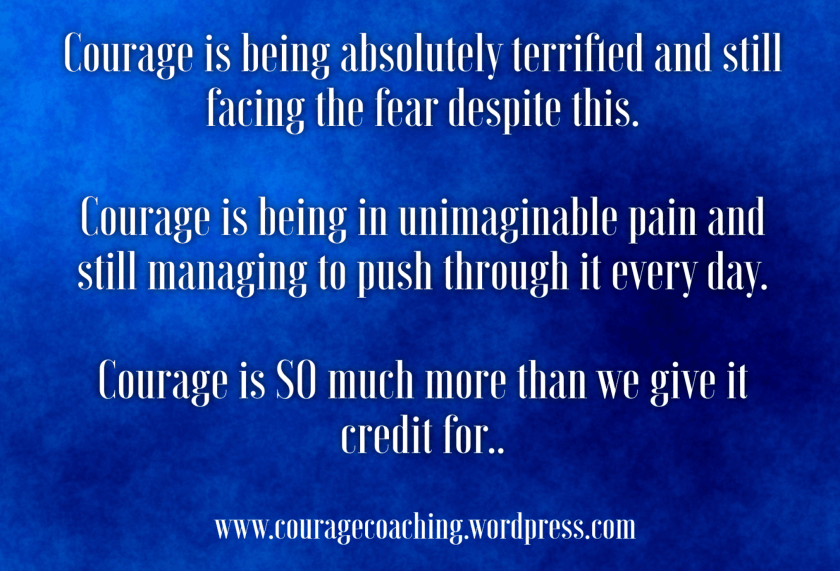
First of all, courage is very important when challenging ourselves at times where we need to make big changes in our personal life, our work or our health.

Courage is necessary when we deal with grief, physical & emotional pain or overwhelming fear.

As survivors of abuse would agree, courage is crucial for getting through the trauma and emotional pain that starts with the abuse, continues throughout the abuse and then unfortunately becomes a part of the long journey of recovery after the abuse.

For those affected by war & overwhelming grief, courage is what keeps them going every day, when all they want is to stop feeling so frightened & devastated.

Courage is important for survival, for better quality of life, for the ability to self-reflect and for getting through adversity.

Below are some definitions that I found online when I was deciding on COURAGE as a name for my business.

Courage is:

  • The ability to do something that frightens one; bravery.
  • Strength in the face of pain or grief
  • The choice and willingness to confront agony, pain, danger, uncertainty or intimidation.
  • The power or quality of dealing with or facing danger, fear, pain, etc..
  • Courage, also called fortitude, is the ability to confront fear, pain, danger, uncertainty or intimidation. It can be divided into “physical courage” — in face of physical pain, hardship, and threat of death — and “moral courage” — in the face of shame, scandal, and discouragement..
  • The state or quality of mind or spirit that enables one to face danger, fear, or vicissitudes with self-possession, confidence, and resolution; bravery.

 I also selected a few of the most inspiring quotes about courage, in my opinion.

”You gain strength, courage, and confidence by every experience in which you really stop to look fear in the face. You are able to say to yourself, ‘I lived through this horror. I can take the next thing that comes along”.
Eleanor Roosevelt
”I learned that courage was not the absence of fear, but the triumph over it. The brave man is not he who does not feel afraid, but he who conquers that fear”.
Nelson Mandela
”Inaction breeds doubt and fear. Action breeds confidence and courage. If you want to conquer fear, do not sit home and think about it. Go out and get busy”.
Dale Carnegie
”You will never do anything in this world without courage. It is the greatest quality of the mind next to honor”.
Aristotle

 What is it about courage that inspires you the most?

Love Athina ♥
© All blog posts and images are owned by me and Courage Coaching. Please don’t use without consent and only re-blog if you would like to use the information on here.

Tips on setting boundaries

A useful video for those of you who have trouble saying ‘No’ to others and have a general difficulty in setting boundaries.For those of you who had an abusive childhood, boundaries would have been invaded very often and you wouldn’t have been able to defend yourself. Now that you are an adult you ‘CAN’ protect yourself and practice self-care whenever you need to. It doesn’t matter if it is a family member, partner or best friend. Setting boundaries is essential for good psychological well being!

Much Love Athina ♥

© All blog posts and images are owned by me and Courage Coaching. Please don’t use without consent and only re-blog if you would like to use the information on here.


Low self-esteem & emotional flashbacks

Healthy self-esteem is essential for good psychological survival. It enables us to feel more fulfilled and secure in our choices, career paths and relationships. When this is lacking however and also goes unchecked, it may lead to mental health issues such as anxiety and depression, sometimes with tragic results.

Perhaps the most well known effect of abuse is low self-esteem.

Low self-esteem means that we have a persistent feeling of worthlessness. It also means that we have a habit of judging & rejecting ourselves constantly which causes us a huge amount of emotional pain. This emotional pain, is something that people with normal levels of self-esteem can’t possibly understand.

For those of us who grew up in abusive homes, this was a daily part of our lives and we considered it to be the norm. We intrinsically felt bad when we weren’t able to do something right, such as get good grades at school or be good at sports.We hated taking part in anything competitive, we always avoided the limelight and hated participating in class conversations, for fear of making a fool of ourselves.We avoided any situation or person who made us feel rejected, hurt and vulnerable.The core of this lack of self-worth was due to our parents telling us on a constant basis that we were not good enough, not smart enough, not lovable enough etc..The more constant and long lasting this was throughout our childhood, the more destructive the damage.This then stays with us for life, unless we have years and years of therapy.Even though most of us are intelligent and full of potential, our nasty inner critic tells us we aren’t good enough.This self-hate, sabotages any chance we may have of making something a success, before we even try it. We actually avoid trying things, to avoid the possibility of failing. To others, this may seem ridiculous. To those of us who have suffered abuse, this isn’t ridiculous at all. We have already suffered a huge amount of emotional pain in childhood which then continued into adulthood. Some things we can heal in therapy but others might be a bit more challenging, as they are so deeply ingrained in us.

For those of us with low self-esteem, we might notice that as we begin a new project or work on some goal, things begin smoothly and we are filled with optimism. After a little while, however, things start getting harder, we get worried and we start to beat ourselves up.This process repeats itself as we move forward with our goal so that it seems like we’ll never reach it.Too many of us give up at some point because we’re overwhelmed by the feelings of worthlessness.The minute we make a mistake, we fall apart emotionally. In a sense, it gets even harder as we move closer to the goal because during times when things are moving ahead smoothly, we get our hopes up.low selfesteem
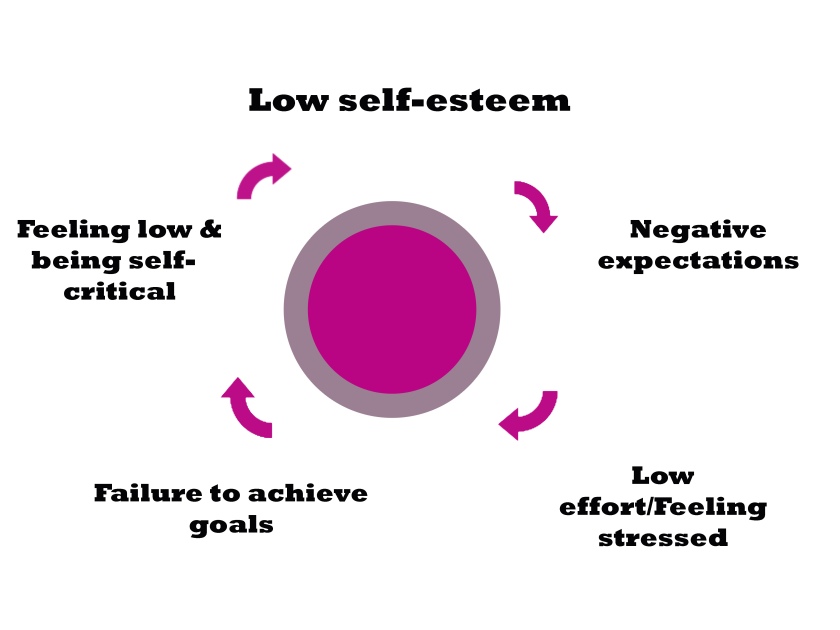
This sort of dynamic is what happens after abuse. Although most people are able to deal with obstacles, an abuse history can lead others to feeling overwhelmed by feelings of worthlessness. Most people understand that an obstacle to a goal is part of the process, no matter what creates it, whereas for abuse survivors, an obstacle may be seen as a challenge to our self-esteem, proof that we mess everything up, that we’re not capable as others are. These dark feelings can overwhelm us so much that we give up.

Another effect of abuse, that is linked to low self-worth, is when we have an emotional flashback. In adulthood, a tone of voice, a firm look or a certain opinion about something we have or haven’t done, may trigger us into an emotional flashback of when our abusers told us we couldn’t do something and made us feel worthless. Some ‘red flags’ of an emotional flashback, are when we overreact to a present situation because it brings up feelings from the past. These feelings completely hijack us and it is very hard to control them or realise they are actually from the past.We are usually also overcome by feelings of helplessness & hopelessness and a lot of the time they can be linked to feeling worthless.An emotional flashback can be hugely emotionally painful and once again, others have no idea why we are so upset.

So how do you manage chronic low self-esteem?

Since chronic self-esteem is caused by the vicious inner critic that our abusive parents created in us, we have to learn ways to silence this critic. This critic tells us all the horrible things that our parents made us feel when we were younger.

We have to learn to become aware of it and every time we think a destructive thought, we have to stop it. We have to challenge the negative thoughts that pop up dailyand say ”Stop it” or ”That’s a lie” or ”Your father was wrong, you aren’t worthless”.We also have to give ourselves small challenges that we can work towards. The more we are able to achieve, the better we will slowly feel about our ourselves. The more evidence we start to see of ourselves actually being more adventurous or more successful, the better we will slowly feel about ourselves. This takes a lot of persistence, effort and help from a coach or therapist.

If you are interested about how to cope with emotional flashbacks then please check out my post here: https://couragecoaching.wordpress.com/2016/06/10/child-abuse-complex-ptsd-managing-emotional-flashbacks/

Thanks for reading

Much love Athina ♥

© All blog posts and images are owned by me and Courage Coaching. Please don’t use without consent and only re-blog if you would like to use the information on here.