
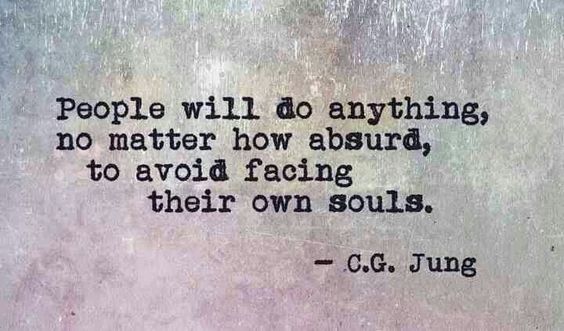
The importance of feeling our feelings

a6d7f1c996ab656267d279e27cbb667e

If we were able to count how many times we avoided our own suffering, I think we would fail miserably..

We have all at some point avoided emotions that are uncomfortable, by distracting ourselves, by numbing ourselves and by completely ignoring what is really going on..

This makes complete sense..Humans don’t like suffering..

By avoiding pain, we are temporarily soothing ourselves so we can better cope with what is bubbling under the surface. We might drink alcohol, do drugs, eat too much food, watch too much tv or spend too much time on the internet. We might develop addictions to numerous things and not even realise it.This is how we cope and in society at the moment, a huge percentage of us are addicted to the internet. If we are feeling down, we go online to search for clues as to what might make us feel better.If we are lonely, we announce it to the world on social media to get attention, instead of just reaching out to a caring friend. If we are happy, we also go online and share it with the world, instead of just enjoying the moment.

Since the focus of this post is on uncomfortable feelings, we need to acknowledge how often we avoid them..How will we ever grow and better ourselves if we constantly hide behind our suffering?

Distractions are good sometimes, don’t get me wrong..and also connecting with people online, blogging, watching videos etc..The important thing to remember is however, that we still need to be aware of what we still need to improve or change in our lives and actually do it!

For those of us who suffer with a mental illness, it is even more challenging to not run from suffering..Especially if it is a constant part of our lives to feel really low, anxious, terrified, lonely etc..If we have a history of trauma, no matter how much we try to ‘numb ourselves’, this will eventually start seeping out..

If we have been made to feel small, unimportant or ashamed in our childhood, then this will be incredibly tough to run from or avoid..We will feel it in the depth of our being..It will reveal itself in every step forward we may try to take..No matter what we do in our life, we will never feel good enough, lovable enough, deserving enough..It is a tough reality to bare..

Avoiding our feelings gives us temporary relief but with a whole life ahead of us, this isn’t enough..

If you are suffering at the moment, then face the pain..cry…ask for a hug..have human contact..Talk to someone who will genuinely listen..Don’t bury your suffering inside a tv or by reading about how you can make it better on numerous sites….This can also become addictive..gathering information about a certain area constantly but without actually taking any actions to improve that area of our suffering, is also avoiding pain..

Yes, of course we need validation for our suffering but make sure that you are making progress..If you want to deal with your anxiety, then take active steps to improve this..Talk to a qualified Coach or Therapist..Practice daily positive affirmations..Take ACTUAL STEPS to accept and manage your feelings..ACCEPTANCE is very important but ACTION is too!

If you want to change jobs but feel too scared, then face your discomfort head on and start applying for new ones..Attend interviews..Keep trying..

If you are scared of heights but would love to go trekking, then find a way to face your fear..

The list goes on..and applies to many areas of our lives..

No matter what uncomfortable feelings you are avoiding, face them..The longer you avoid them, the longer they will remain..

We have to face discomfort..

We have to face reality..

We have to face our fears..

This is how we will grow..heal..get better

This is how we will improve our confidence, reduce our suffering and release our fears..

and lastly, if a situation is unchangeable due to our lack of control over it,  learn to ACCEPT it for what it is..

Love Athina ♥

© All blog posts and images are owned by me and Courage Coaching. Please don’t use without consent and only re-blog if you would like to use the information on here.

5 tips on healing codependency & dysfunctional relationships

This video is the 2nd one of my codependent series on my Youtube channel.

It is mostly informational in text, with the help of a few cute characters! Just the way I like it! ♥

Feel free to re-blog or share 🙂

I love cute things and music…so here you go ♥

Love Athina ♥

© All blog posts and images are owned by me and Courage Coaching. Please don’t use without consent and only re-blog if you would like to use the information on here.
Speak your truth..

IMG_1523

Speak your truth, be yourself and if people don’t accept you then it is their loss, not yours!

If people don’t value your reality, your kindness, your honesty then they don’t deserve your time or your love.

When speaking your truth, have you ever felt overwhelmed with emotion? What has the emotion been? Anger, frustration, sadness, loss, disappointment?

The worst of all these for me was always frustration and then deep sadness..

When talking to a narcissistic parent, you feel all of these times 10!

Continuing to speak your truth despite the pain, frustration, loss and anger is very important…Don’t ever let anyone keep you silent..

Love Athina ♥

© All blog posts and images are owned by me and Courage Coaching. Please don’t use without consent and only re-blog if you would like to use the information on here.
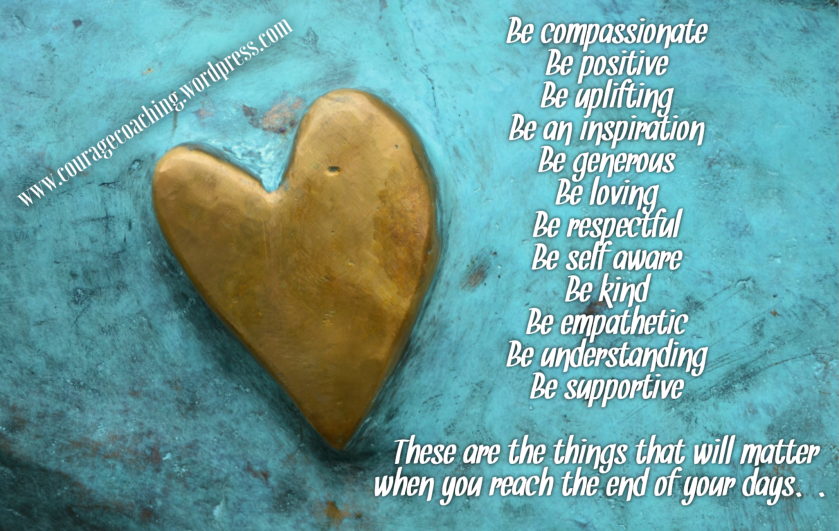
Be an inspiration

FontCandy (75)

Dear friends,

I am back from my brief holiday in Athens and feel happy to get back into blogging, YouTubing & Coaching. I have a 2nd follow up session with a coachee tomorrow and I am hoping she has managed to make some progress and feels a little better about things.

I hope I haven’t missed out on too much in the world of blogging but I definetely aim to catch up on your blog posts and interact with some of you lovely people.This holiday was a little mixed with being ill and dealing with a low mood because of this, but otherwise it felt good to have a change of scenery.

I thought it would be good to start the new week with an uplifting post. How often do you try to be an inspiration to others? How often do you strive to be an overall, good human?!

Some people are just naturally good at spreading positivity, love & and support but others do this less. Does this mean they are bad people? Not necessarily. It might be that they are suffering or overwhelmed by life’s challenges and just have nothing left to give at times..Just because someone isn’t supportive or understanding some of the time, this doesn’t mean that they are bad. On the other hand however, If someone is disrespectful, is always negative, is underminding towards others and generally goes around trying to ruin other peoples’ joy, then you want to stay clear of these people.

There is nothing wrong with having a bad day or feeling a little negative but if you purposely set out to bring others down with you, then this isn’t good.

In my day to day life, I hope to try and bring joy to others, even in the tiniest way. Even if I am struggling emotionally, I find that by spreading positivity in the smallest way, can make such a difference to my mood. This could be anything from leaving a positive comment on a great post, holding the door open for someone or smiling at the cashier in the supermarket.I am not superhuman obviously and neither are you, so we are all allowed days where we are less than perfect. As long as we are not hurting anybody, then it doesn’t really matter what we get up to.

If you had a choice to choose 2 of the 12 things listed in the above photo, which would you choose and why?

Love Athina ♥

© All blog posts and images are owned by me and Courage Coaching. Please don’t use without consent and only re-blog if you would like to use the information on here.
How to be assertive-Steps to healthy self-assertion

This post is the last one on assertion and hopefully the most useful to those of you who struggle with being a people-pleaser and/or are quite passive in your relationships with others.There is also a YouTube video attached for those of you who are auditory & visual learners.

Here is a quick guide on how to be assertive:

  1. Firstly get the person’s full attention when you are trying to make an important point. This may seem like a given however it is important to ensure there are no distractions.
  2.  Describe in an objective way, what you are having difficulty with in regards to the other person’s behaviour. EXAMPLE: ” I said I wanted to speak to you and you have just turned on the tv”.
  3. Express constructive feelings using ”I” statements. Don’t say ”You completely ignored me”.Instead, choose to say ” I feel upset that you are not listening to me”. It is ok to state feelings of disappointment & annoyance, as these are constructive feelings.
  4. Check your statements & make sure the other person gives you a response. This will hopefully enable some sort of resolution later on. EXAMPLE: ”I feel that you are hiding something from me. What do you think about this”?
  5. Listen to the other person’s response with an open mind and give feedback in a controlled manner.  Avoid dismissing the reply as soon as it is given.
  6. State your preferences clearly. EXAMPLE: ”I would like if you could always be honest with me”.
  7. Request agreement from the other person.If they don’t agree or try to avoid the subject, clearly state ”Are you willing to make any changes?”
  8. Communicate any relevant information concerning future occurences.State what you will do if the same problem re-occurs.

Dealing with criticism

shame-799099_1920

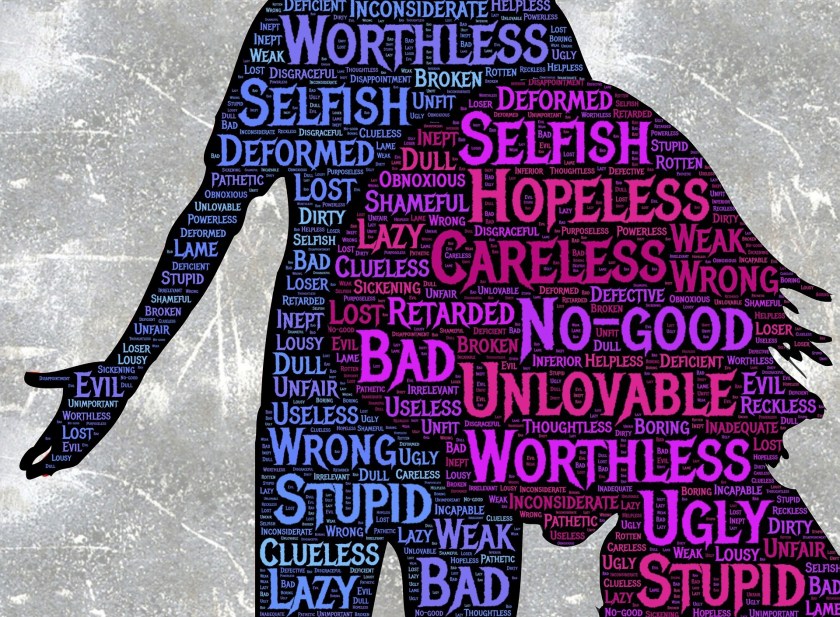
When someone criticizes us, it tends to touch a nerve and can sometimes leave us feeling very vulnerable, very angry and sometimes both!

This may be because there is absolutely no truth in the criticism and we feel it is completely unfair or actually because there is some truth in the criticism and we are just not ready to deal with it.

Being criticized is also especially difficult when the person criticizing us is someone we hold in high regard. It could be our boss at work or a new partner.

The thing that most people don’t realise is that criticism on it’s own isn’t what makes us upset. The meaning we attach to criticism is what affects us. As I mentioned in one of my previous blog posts, being a people-pleaser means that we give others too much power over our emotions and how we feel about ourselves. If others’ approval is extremely important, then we give them consent to always make us feel bad about ourselves.

In order to stay away from seeking approval, we have to learn to practice self-acceptance and only rate our actions or traits but not ourselves. We are responsible for our reaction to someone’s criticism and it is up to us to change how we respond.

If we already have low self-esteem, then criticism will be especially hurtful and it could take us days to recover from it.

Are you someone who struggles from others’ criticism? Do you find that you always get overly upset when someone criticizes you or overly agree?  Do you avoid contact with that person after the criticism occurs? I would love to hear your experiences.

If you are a childhood abuse survivor, I am especially interested in your experiences. When you have internalised your parents’ negative and unhealthy criticisms, this will then follow you around and will be brought to the surface everytime someone criticizes you. This is actually quite a painful, traumatic reaction because a present criticism can send you into an emotional flashback of your parents’ abuse. This is something I am particularly experienced in through my own recovery from abuse but also through talking to others who still struggle with this internal self-critic.

Love Athina ♥

© All blog posts and images are owned by me and Courage Coaching. Please don’t use without consent and only re-blog if you would like to use the information on here.
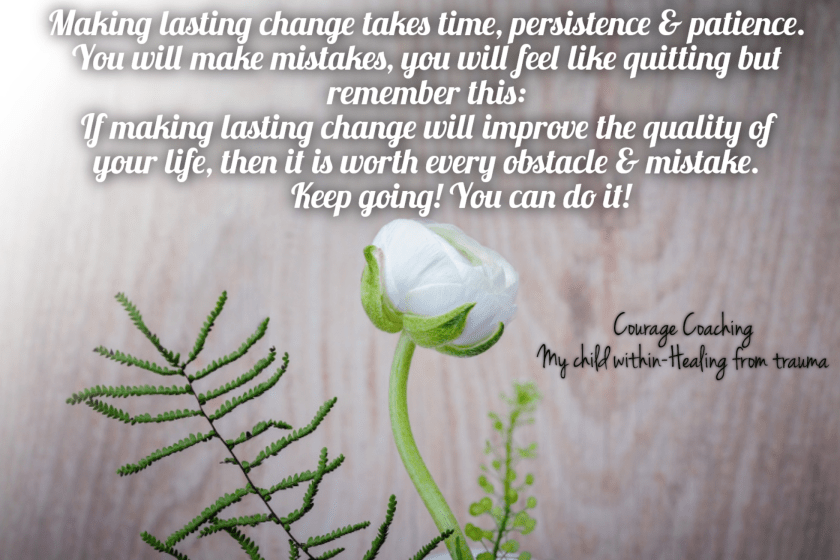
The importance of persistence

FontCandy (41)

When some of us decide to take on a new goal, we tend to put in a lot of effort at the beginning and then as time progresses we don’t sustain the same effort to reach it. This is sometimes the case when people have New Year resolutions. An initial goal is set at the beginning when motivation is high but when the going gets tough, the less effort is put in. We tend to start procastinating and the more we put something off, the worse it gets.This then results in our failing to reach our goal.

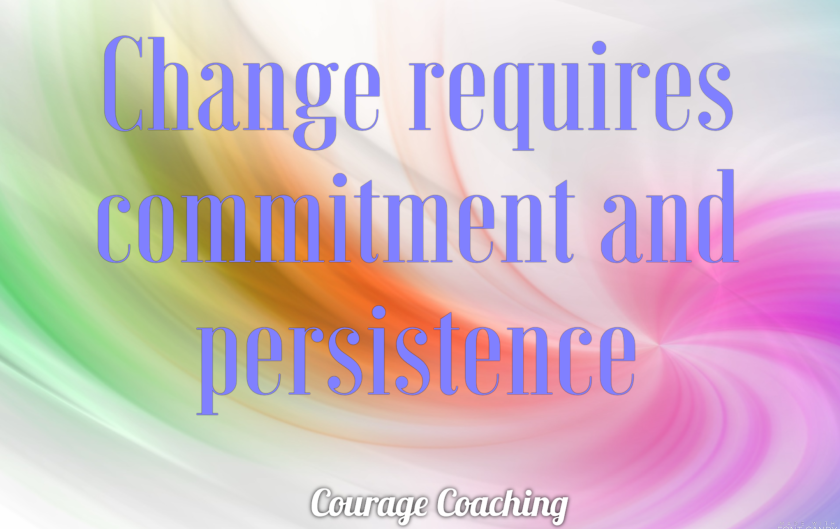
Wanting to make a change, especially when it comes to bad habits, requires commitment, effort and persistence. To really make a change we have to commit to something 7 days a week! This might seem extreme but it really isn’t. Thomas Edison famously remarked that ‘genius is 1% inspiration, 99% perspiration.

Most of us wish there could be a ‘quick fix’ for most things in life but this really isn’t possible when we want to make lasting change. It’s an in-built human urge to free ourselves from painful patterns of behaviour and seek peace, happiness and contentment immediately. When an individual has deep-rooted beliefs and unconscious patterns that have kept them stuck in unhappiness most of their life, this is something that requires persistence to change.It means that an individual would have to keep persevering through the ups and downs, through the disappointments and sometimes inevitable frustration.It means that the same goal might have to be looked at from different angles until a breakthrough happens.

Do you find yourself setting a goal and then getting overwhelmed too quickly?Do you find that the minute you hit a difficulty, you give up straight away? Do you have a low tolerance for frustration?

I would love to hear some of your experiences ♥

© All blog posts and images are owned by me and Courage Coaching. Please don’t use without consent and only re-blog if you would like to use the information on here.
The importance of resilience

FontCandy (36)

So what is resilience and is it common?

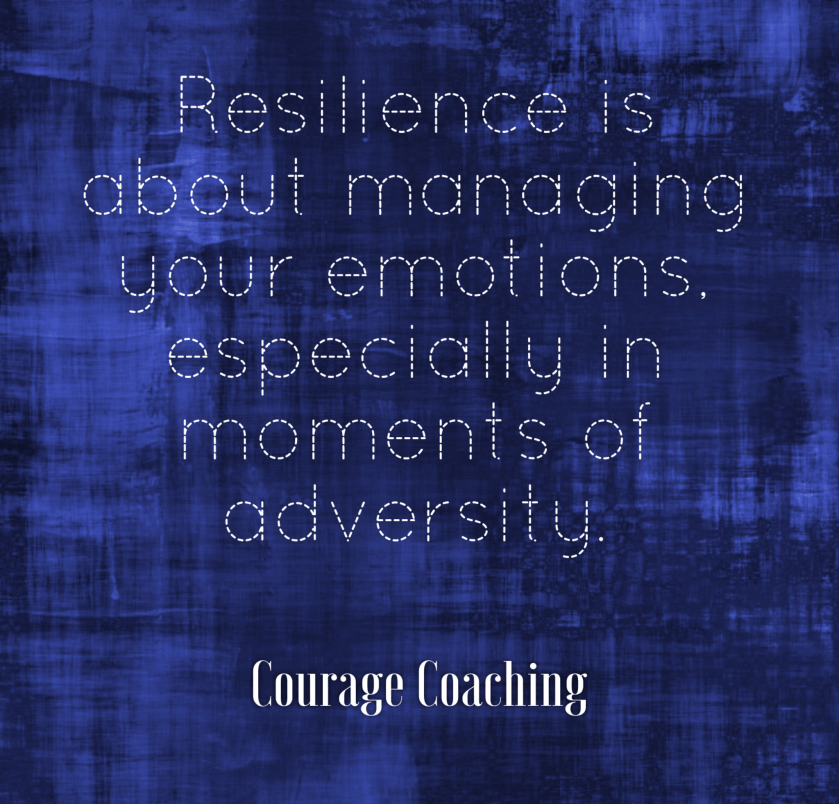
Resilience can be defined as an individual’s ability to properly adapt to stress and adversity. It is about an individual’s ability to manage difficult emotions that arise in times of difficulty, without supressing them.

Research shows that resilience is actually more common, than uncommon, as life has many ups and downs and people are having to adapt all the time to many difficult situations.

A person’s attitude is the most important element of having resilience. If someone generally has a negative thinking style, this is not helpful to having resilience.

There are a few many important attributes associated with resilience:

  • The capacity to make realistic plans and take steps to carry them out.
  • A positive and self-accepting view of yourself and confidence in your strengths and abilities.
  • Skills in communication and problem solving.
  • The capacity to manage strong feelings and impulses without complaining about any struggles or falling into self-pity when setbacks arise.
  • Adaptability-The ability to act flexibly in changing or challenging circumstances.
  • Asking for support or accepting support from others. Positive, supportive relationships are key to coping in tough times.
  • Having humour- Finding light moments in depressing times can sometimes help lift the mood.
  • Being aware of unhealthy thoughts that may pop up and don’t benefit you in times of adversity.

Now that you are aware of what makes someone resilient, what happens when you need to develop more resilience? What steps could you take?

Here are a few things to keep in mind:

  • Take care of yourself and treat yourself with respect, comfort & acceptance.
  • Try and be hopeful for the future no matter what the current circumstances. A positive outlook is very important.
  • Ask for support from friends or family
  • Look for opportunities of self-discovery. Adversity isn’t obviously welcomed but if something negative happens, look at how you handle it and learn something about yourself.
  • Accept that change is part of living
  • Make decisions or take actions when confronted with a difficult situation. Don’t avoid it!
  • Set small goals that are easy for you to reach. It doesn’t matter how small. The more you achieve, the better you will feel
  • If you are spiritual, use your faith to support you.Prayer or meditation can be very helpful
  • Journaling, blogging, art therapy or other therapies can also be useful in developing resilience.

I would love to hear your thoughts on resilience. Is there anything in particular that happened which improved your resilience? Do you think you are resilient or do you think you could develop better resilience?

♥ Athina

© All blog posts and images are owned by me and Courage Coaching. Please don’t use without consent and only re-blog if you would like to use the information on here.