Grief

FontCandy (20)

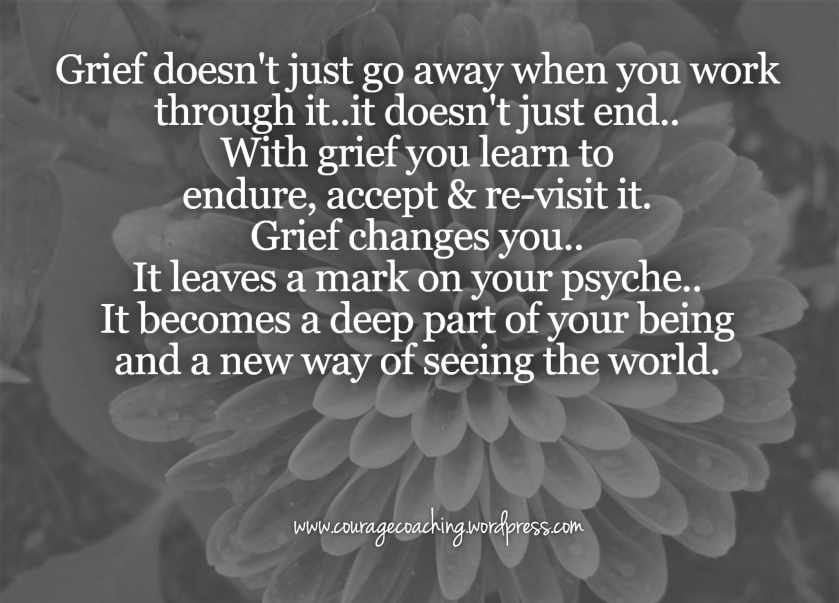
Grief is a huge part of life and yet a very painful one. We all experience it and for some people grief can be an even bigger part of their lives than for others.

Grief can be about so many things, not just the death of a person.

Every new beginning means that there was also an ending and every ending can leave a trail of grief. Grief can be experienced at the end of a relationship, the end of a job, leaving the town you grew up in, saying goodbye to friends or family, saying goodbye to a beloved pet or business or even saying goodbye to life as a single person.

What are your experiences with grief?

Love Athina ♥

© All blog posts and images are owned by me and Courage Coaching. Please don’t use without consent and only re-blog if you would like to use the information on here.

High functioning depression

Happy Monday dear friends & followers!

After a wonderful 10 days off work, celebrating my birthday with friends and exploring new places with my husband, I am feeling grateful and refreshed.

Today’s topic is especially important to me, as someone I care about deeply is currently suffering with this type of depression.

Although high functioning depression is a milder form of depression, it is equally as important as other types of depression.

When it comes to depression, many of us envision a person caught in the depths of despair and hopelessness, who wants nothing more than to stay in bed and avoid people and work completely. We envision someone who has lost all interest in the things they love, who may be feeling suicidal and is barely holding it together.

Although the above isn’t inaccurate, it doesn’t portray life as a high functioning depressive.

When someone suffers with mild or high functioning depression, the typical joy and laughter they once felt, is usually replaced by an absence of emotion and a very deep feeling of emptiness.
This is known as anhedonia and it is the loss of interest in previously rewarding or enjoyable activities.

To the outside world they seem like they are coping fine. They are still able to go to work every day and communicate effectively. They are still able to reach goals and get out of bed in the morning.

The most unfortunate part of those with this milder form of depression is that when they talk about their feelings to loved ones and even doctors, they aren’t taken seriously enough.

Unless someone is literally unable to function, they seem to be dismissed as not having anything to worry about. This isn’t good!

When life circumstances change, those experiencing mild depression may be at greater risk for moderate to severe depression if treatment isn’t sought early enough.

This is also discussed in my youtube video, so feel free to share if you think it may help someone you know.

Love Athina ♥

© All blog posts and images are owned by me and Courage Coaching. Please don’t use without consent and only re-blog if you would like to use the information on here.

The aftermath of a traumatic incident

As much as I dislike watching the news and tend to limit what I take in, it is increasingly difficult to not be affected by the constant bombardment of war footage, terrorist attacks, murder and suffering.

When you are a highly sensitive & empathetic person, it is easy to get overwhelmed by the sadness of others. I am very much aware of the cruel injustice in our world and it hurts me deeply to see so many suffering. It is even tougher when this is repeated in your own country. Due to the fact that I know what it feels like to have your life threatened, I decided to make the following video on the aftermath of trauma. This is my small contribution towards all those affected.

Despite my traumatic childhood, I was also once caught up in armed robbery, where a gunshot went off right next to me and a woman was lying on the floor with blood on her leg. The disbelief of what I had witnessed was indescribable. The terror I felt shook me to the core. I couldn’t comprehend how someone could shoot a gun, when everyone at the cashier was cooperating and the robbers had managed to get their money.

This armed robbery happened at a time where I was very vulnerable already as my CPTSD was really bad. All I could think of after this robbery was ‘not again, not another trauma to add to my list’. Life felt so unfair and scary on that day and my mind was telling me that there was more damage done and that I would not recover this time.

If it wasn’t for my kind therapist at the time, to ground me and tell me that I wasn’t going to let this swallow me, I don’t know how I would have coped in the long term.

So this video is for those of you who are new to trauma. It is helpful in understanding yourself after a traumatic experience and it gives you the tools you need to ride the emotional waves that may at times feel like they are taking over.

Although I am not a qualified psychotherapist, I do have a lot of insight into trauma through my own journey and I know the many things that helped me, as well as others. If you are someone who is in deep distress, then please call a qualified mental health professional.

Thank you so much for reading & watching! ♥

Please share this post if you think it will help others.

Check out my patreon page below, if you would like to support the creation of more videos, documents and fact sheets.

https://www.patreon.com/AthinaEhlen

Love Athina ♥

© All blog posts and images are owned by me and Courage Coaching. Please don’t use without consent and only re-blog if you would like to use the information on here.

Why is going ‘no contact’ so hard?

It’s been an extremely busy few days for me recently, which means my blog posts and youtube videos have had to take a back seat.

Work has been a priority, with little time for writing and reflecting.

I have also had an influx of emails from people needing immediate support dealing with narcissistic individuals. It always deeply saddens me to hear all the grief so many are currently experiencing and sometimes I wish I could just take all their pain away.

The ‘No contact’ question has been popping up a lot, so in this video I stress the importance of acceptance. Acceptance in this case, of the fact that a narcissist isn’t able to love or empathize and isn’t going to change and treat you better.

Once you manage to reach a place of acceptance through grief and talking with a professional, it is then easier to make the decision to go ‘no contact’.

Thanks for watching and reading

Love Athina ♥♥

© All blog posts and images are owned by me and Courage Coaching. Please don’t use without consent and only re-blog if you would like to use the information on here.

Avoidant Personality-Video II

In yesterday’s video, I decided to talk about Avoidant Personality in a little more detail, as my first video became very popular in a short amount of time and many viewers reached out to me with questions .

In this video I discuss some examples of what avoidance may look like, not only in full blown Avoidant Personality Disorder but also with people who just have a lot of the avoidant traits. I also talk about what specifically causes avoidant traits and what the consequences are.

Thanks for watching ❤

Love Athina ♥

© All blog posts and images are owned by me and Courage Coaching. Please don’t use without consent and only re-blog if you would like to use the information on here.

Mental Health Awareness week

32ce6e_73173c5b28504cf4b73dd1f1d98bd913~mv2

Ending the stigma of mental health is still proving to be a challenge, although in the UK we are getting ever closer to our goal of a deeper understanding, tolerance & acceptance of the importance of talking about our mental health.

As somebody who has never known what life is like without mental health problems, I know how difficult it is to be open and honest about it..People are still uncomfortable with knowing what to say or not say..Even if they try to be understanding, deep down you can sense whether they get it or they don’t..

Every single one of us is touched by stress or anxiety at some point in our lives, whereas others live with it every day…I am one of those people who lives with chronic mental health problems..Complex PTSD isn’t something to be taken lightly..There are still so many moments in my life at the age of 34 that I still learn new things about myself that I am not able to do, that others would find incredibly easy to complete. The hypervigilance and overwhelm never goes away..The chronic fatigue never goes away..The low mood is always lingering in the background..The voice that says ‘you are just not good enough’, pops up a lot when I am working alongside others…

Self-care is so important in these moments and remembering to accept ourselves when we are struggling can make a world of difference!

Walking the same path as others with mental illness really helps people feel less alone..

All the wonderful people who ran the London Marathon raising money for Mental Health are simply incredible..

If you think about how much these runners must have battled with those nasty little voices inside their head, it makes you feel incredibly inspired. The voice of depression or the voice of anxiety is not an easy task to manage..but yet they did it, and in what an admirable way!

I am also blessed to have many friends & fellow bloggers who do so much to raise awareness about mental health! They have all been personally affected however and live with debilitating conditions themselves..

The most crucial part in my opinion of raising awareness, is to also hear more people talking about mental health that don’t have any personal experience with it..People that feel concerned about someone they know but just don’t know how to respond..People that are lucky enough to live with good mental health and are surrounded by people who aren’t that lucky..

If you have experience with ill mental health, stigma or intolerance, then please feel free to comment.

Lastly, I would also like to share my latest information video on defence mechanisms. I was having a bad day yesterday and couldn’t face the camera to film myself talk, so I came up with this instead.

Thanks so much for reading & watching!

Love Athina ♥

© All blog posts and images are owned by me and Courage Coaching. Please don’t use without consent and only re-blog if you would like to use the information on here.


Approval seeking

Approval seeking is a very common behaviour that all of us are guilty of at some point in our life. It might be that we are trying to impress someone we like, make a new friend or make a good impression on our new boss. It is perfectly normal to seek approval in others occasionally.

Approval seeking only becomes a problem when we do it chronically. When we constantly seek to be validated externally because we don’t feel comfortable to accept ourselves as we are.

This is the topic of today’s video, which I felt was very important for those of you who are people-pleasers and/or codependents.

Love Athina ♥

© All blog posts and images are owned by me and Courage Coaching. Please don’t use without consent and only re-blog if you would like to use the information on here

Dealing with parental estrangement

If you have become estranged from your parents, it’s important to remember that this can be a very vulnerable place to be. Making the decision to become estranged from your family may alleviate some of the instant emotional pain after a huge argument, however, many people find that estrangement is a constant battle in their life, as it can cause them to endlessly think about their situation, even if they do feel an initial sense of relief.

Some people become estranged from their parents because they have been emotionally, physically or sexually abusive during childhood or beyond. This is a difficult decision to make but sometimes a necessary one. It’s immensely tricky to continue a healthy relationship if there has been abuse, and it can be extremely risky to continue a genuine relationship with this family member without the right professional intervention and support.

Others become estranged with their parents or siblings due to conflicts about religion or sexuality. This can also be especially painful, as the adult child isn’t able to truly be who they are. Authenticity is crucial for a happy life.

DSCN3757 (2)

Grieving the estrangement from a parent, no matter what the circumstances, is a very important part of healing from it, as the loss of an accepting & healthy parent is an extremely painful experience, even more so than normal grief. Nothing will ever fill the void of not having had what every child so rightfully deserves. Comfort, validation & unconditional love. Realising that a parent was never truly able to love & accept you, is utterly heartbreaking.

Even if there was abuse, children never stop loving their parent unconditionally and never stop hoping that their parent will change. This is the main reason adult children remain in contact with a parent, despite any abuse that may have occured. They will always long for the unconditional love they never had. In cases when the abuse or invalidation was constant, the trauma bond will also be why the adult child finds it hard to cut ties with their parent.

If the adult child isn’t able to fully grieve the loss of a healthy parent, they will not be able to move forward in a new relationship with them. If the parent continues to be abusive, shows no remorse, shows no understanding and doesn’t make any attempts to make amends, then it is healthier for the relationship to end.

In both cases of estrangement and remaining in contact, grieving is essential. Grieving helps lift the intense painful heaviness of not having had your needs met in childhood. It helps lessen the anger, frustration and injustice.

Most importantly, the adult children who end up going ‘no contact’, have to learn to live with the ‘early death’ of their parent before that parents actually dies. They have to continue living their life, without any communication or knowledge of how that parent is. They have to swallow the grief that creeps up from time to time, during holidays, birthdays, Mother’s day, Father’s day and during other emotional times in their life.

Those adult children who were lucky enough to have had good childhoods, with unconditionally loving parents, will never truly understand the deep pain of those who didn’t have good childhoods.

Family estrangement is a huge challenge and living with it requires support in more ways than one. It is important to have counselling from time to time and to be surrounded by understanding friends or a partner that can truly empathize. Lastly, it is crucial for the estranged, to feel the sadness that emerges and be self-compassionate as much as possible.

Love Athina ♥

© All blog posts and images are owned by me and Courage Coaching. Please don’t use without consent and only re-blog if you would like to use the information on here

Avoidant Personality Disorder

Although it isn’t Monday yet, I have already uploaded Monday’s Youtube video 3 hours early, as tomorrow I am mostly on the go and won’t be checking in much.

As most of my videos focus on CPTSD, Narcissistic abuse, Dysfunctional Relationships and other areas of emotional difficulty, I wanted to address a cluster C disorder this time, as this is something I have experience with. Avoidant Personality is an anxious disorder which can be very pervasive and self-limiting for those who live with it.

It can be caused by childhood trauma and can co-exist with Depression, CPTSD, Dependent Personality Disorder, as well as other disorders.

An individual is diagnosed as having AVPD, if they meet 4 or more of the following 7 criteria.

Definition: A pervasive pattern of social inhibition, feelings of inadequacy, and hypersensitivity to negative evaluation, beginning by early adulthood and present in a variety of contexts, as indicated by four (or more) of the following:

(1) avoids occupational activities that involve significant interpersonal contact, because of fears of criticism, disapproval, or rejection

(2) is unwilling to get involved with people unless certain of being liked

(3) shows restraint within intimate relationships because of the fear of being shamed or ridiculed

(4) is preoccupied with being criticized or rejected in social situations

(5) is inhibited in new interpersonal situations because of feelings of inadequacy

(6) views self as socially inept, personally unappealing, or inferior to others

(7) is unusually reluctant to take personal risks or to engage in any new activities because they may prove embarrassing

As with most personality disorders AVPD isn’t completely curable, although therapy, medication and the right support can help people lead more successful lives.

Is this something you may suffer with? If yes, then get in touch!

Love Athina ♥

© All blog posts and images are owned by me and Courage Coaching. Please don’t use without consent and only re-blog if you would like to use the information on here
Psychological Projection-A defense mechanism that people with NPD use often

Dear friends

I am hope you are enjoying your weekend and are generally doing ok.

Before I fly off to Scotland tomorrow, I wanted to upload Monday’s Youtube video early, as I won’t be able to work on it when visiting family.

This week’s video is about an abusive behaviour & defense mechanism that people with narcissistic personality disorder use very frequently.

Projection is something I experienced most of my life from my mother and it is something that was immensely painful.

This is the definition of Projection according to Wikipedia:

Psychological projection is a theory in psychology in which humans defend themselves against their own unconscious impulses or qualities (both positive and negative) by denying their existence in themselves while attributing them to others. For example, a person who is habitually rude may constantly accuse other people of being rude. It incorporates blame shifting.

I hope you find this video helpful.

Love Athina ♥

© All blog posts and images are owned by me and Courage Coaching. Please don’t use without consent and only re-blog if you would like to use the information on here