Question & Answer- YouTube videos

Today I am starting off my series of Q & A videos, where my viewers and subscribers are able to get their questions answered by me, in a video each week. Please feel free to ask me questions on the following topics:

  • Complex PTSD
  • Narcissistic abuse
  • Dysfunctional relatioships
  • Negative thinking
  • Dealing with emotional flashbacks
  • Anxiety
  • Depression
  • Trauma Bonding
  • Toxic shame
  • Codependency

I also am happy to answer questions on how to :

  • Better manage your time
  • Practice self-compassion
  • Develop resilience
  • Stop self-defeating thinking patterns
  • Better manage your workload
  • Build confidence
  • Set boundaries
  • Deal with toxic people

Here is the first video on a question asked by one of my viewers:

Please note: **I will always keep the identity of my viewers confidential**

Thanks for reading and watching

Love Athina ♥

© All blog posts and images are owned by me and Courage Coaching. Please don’t use without consent and only re-blog if you would like to use the information on here.


Recovery is not a destination

I wanted to write a quick post on the topic of recovery. I have embraced and accepted my own journey of recovery but not without many difficult years of wanting to see big changes, too soon..

52171

I know there are a lot of you battling with the struggles of mental health daily and wishing that you could achieve more.

I also know how disheartened you must feel when you don’t seem to reach your destination of being ”recovered”…This is where the problem lies..Recovery isn’t a destination..it is an ongoing, changing process with ups and downs..

Recovery doesn’t mean you will reach a day where you are recovered completely.What it DOES mean is that you will reach a point in your life where every struggle is much smaller and you will be able to feel better on more days than usual. If you suffered child abuse or neglect, you will most likely have ongoing mental health issues but this doesn’t mean you will suffer in the same way, as you grieve and progress in your healing. If you are a recovering alcoholic or drug addict, you will also know how much of a challenge it is to stop yourself from returning to the one thing that was able to numb you in the past..You are aware that your recovery from the drug of your choice will always be a constant in your life.

Before you are too harsh on yourself and have huge expectations on where you think you should be in your recovery, just remind yourself that everything is unfolding exactly as it should..that there are many small positive shifts happening in your mental health and that no matter how awful the tears, flashbacks, triggers, depression and anxiety are, that there are better days to come..Remind yourself of this when you are particularly low!

If you are recovering from any mental health issues, then this post is for you.

Be self-compassionate, give yourself a pat on the back and keep moving forward in your journey of recovery..Keep looking for resources that may help you along  your journey, seek out a therapist or coach who is experienced and validating and keep all abusive & toxic people away from your life.

Love Athina ♥

© All blog posts and images are owned by me and Courage Coaching. Please don’t use without consent and only re-blog if you would like to use the information on here.


YouTube video:Is it possible to completely cure Complex PTSD?Tips for a better chance at healing.

I hope you are all enjoying your weekend to the best of your ability.To those of you struggling at the moment, I hope you are doing ok and reaching out for support. The blogging community is filled with wonderful, caring people and it is important to keep this community positive and encouraging. To those of you who need it, I am sending you a big hug! ♥ Take it one step at a time ♥

As some of my regural readers know, I am off to London tomorrow until Thursday to visit family and friends, while my husband is away for work.My Youtube videos are usually posted every Monday, however due to the fact I am off to London tomorrow, I decided to do this one a little earlier.

I talk about Complex PTSD once again, as there are so many of you who suffer with it and I am pretty sure that you need some hope, to keep fighting it and keep moving forward. Through lots of research and from my own personal experience, I talk about the most helpful things you can do to support your healing.

Much love Athina ♥

© All blog posts and images are owned by me and Courage Coaching. Please don’t use without consent and only re-blog if you would like to use the information on here.

Trauma bonding

Trauma bonding is the reason people choose abusive partners time and time again.

Trauma bonding is also known as Stockholm syndrome, something that is mentioned a lot when someone has been abducted.

Trauma bonding is something that starts in a person’s childhood, if they have suffered abuse or neglect.

If you are someone who keeps choosing emotionally unavailable partners or abusive partners, then this is why.

Love Athina ♥

© All blog posts and images are owned by me and Courage Coaching. Please don’t use without consent and only re-blog if you would like to use the information on here.

Speak your truth..

IMG_1523

Speak your truth, be yourself and if people don’t accept you then it is their loss, not yours!

If people don’t value your reality, your kindness, your honesty then they don’t deserve your time or your love.

When speaking your truth, have you ever felt overwhelmed with emotion? What has the emotion been? Anger, frustration, sadness, loss, disappointment?

The worst of all these for me was always frustration and then deep sadness..

When talking to a narcissistic parent, you feel all of these times 10!

Continuing to speak your truth despite the pain, frustration, loss and anger is very important…Don’t ever let anyone keep you silent..

Love Athina ♥

© All blog posts and images are owned by me and Courage Coaching. Please don’t use without consent and only re-blog if you would like to use the information on here.

What is hoovering?and why you have to protect yourself


A lot of my posts recently are dedicated to dealing with dysfunctional relationships. I don’t want to lower your mood by any means, but feel it is important to talk about issues that are more common than people think.

woman-74596_1920

For those of you who have unfortunately experienced dysfunctional relationships in your private life, you might have heard of the term ‘silent treatment’. People who suffer from narcissistic personality disorder, usually will shut people out that they are supposed to care about for long periods of time. This usually comes after an argument where the victim (spouse, partner, family member, friend) says or does something that the narcissist doesn’t like. This can be anything from a simple disagreement, to a criticism or to just refusing to do what the narcissist wants.

When the narcissist isn’t getting his/her way, he/she will use the ‘silent treatment’ to control his victim.

The silent treatment is a form of punishment, a way of attempting to control a partner or others into doing what he/she wants them to do. It’s a withdrawal of approval, and can generate much fear in people who are vulnerable to this.

Giving people the silent treatment means that a narcissist shuts down to them, closing his/her heart and refusing to interact with them or acknowledge their presence. He/she acts as if they’re invisible, not responding to them at all or giving them a very minimal and withheld response.

He/she hopes that in treating them this way it will give them the message that they have displeased him/her. They have done something wrong in his/her eyes and deserve punishment, deserve to have his/her “love” taken away.

Of course, what he/she is taking away is not love at all, since love is unconditional. What he/she is taking away is his/her approval, and for approval-dependent people, it is a powerful form of control.

When the narcissistic person decides that the silent treatment is over, usually because they need something from you again, they will then start to use what is known as ”hoovering”.

What is hoovering?

Hoovering is a technique that is named after the Hoover vacuum cleaner, and is used by Narcissists (and other manipulative people) in order to “suck” their victims back into a relationship with them. Hoovering is often done after the silent treatment is given or the victim has left them. This behavior often starts off subtle and unassuming, and is done through voicemail, text messages, email, phone calls, notes, other people, or through any other form of possible communication with the victim. Because the Narcissist knows the victim’s weak spots, they will generally tend to target these areas in order to reopen communication.  Once communication is reopened, the Narcissist generally promises change–which never, ever happens for any length of time.

  • Text messages pretending to be concerned: “How are you?”, “Hey, I’m thinking about you”, “I know things didn’t work out, but you really do mean a lot to me. I just want you to know that.”
  • Text messages acting like nothing happened: “Hey stranger, long time no talk” or “Hey what’s going on?”
  • Text messages on or about special occasions/holidays: “Merry Christmas”, “Hope you are having a good birthday–wish I could be there”, “Are you going to Molly’s wedding next weekend? If you’re going, I won’t go–I don’t want to upset you.”
  • Text messages about the kids (especially if they’re not his): “I was at the park today and saw a cute kid that looked just like Jason. Just wanted to say I miss you guys.” or “I know you hate me, but please tell Ava that I wish her a happy birthday and I’m sorry I can’t be there.”
  • Text messages about an upcoming event: “Hey, I know you said you never wanted to talk to me again, but Disney on Ice is this weekend, I was thinking about taking the kids.” or “Aerosmith is playing next weekend and I have an extra ticket–you wanna go?”
  • Text messages about things you like to do that he’s never been interested in doing with you before: “Hey, there’s a vegetarian cooking class this weekend, you wanna go?” or “Wanna go wine tasting this weekend?”
  • Text messages about bogus family illnesses or some sort of crisis (including his own): “I think I might have cancer, can you talk?” or, “OMG my mom just had a stroke.” or “What does a heart attack feel like? My left arm really hurts,” or, “I can’t handle this anymore, I’m going to kill myself.”
  • Text messages that are supposedly meant for someone else, but sent to you by mistake: “See you in ten minutes xoxo” (Supposedly for his current girlfriend–sent to upset you.) “The boss just moved the meeting to Wednesday at 3pm.” (Supposedly for his coworker–sent so you feel a sense of obligation for the coworker.) Or, “Sam called and said John is in the hospital and to call him immediately.” (Supposedly sent to someone else, but sent to you so you feel a sense of urgency to get back to him.)
  • Text messages that are guilt or pity inducing: “Can’t we work this out? Please give us another chance.” “What about the kids? You know how hard it is having divorced parents–why would you want to do that to them?” “I have a lot of issues. I get that now. I’ll get into therapy. I promise.” “My alcoholism is out of control. I need help.”
  • Text messages about sex/deep connection: “I miss snuggling with you.” “You always be the love of my life.” “You are my soul mate, I’m sorry I let you down.”
  • Text messages that attempt to flip the hoover back on you: “Did u just text me?” or “Did you just call me?” or “Did I just see you drive by?”
  • Text messages, when all else fails, making bogus accusations to get some type of emotional response:  “Why are you calling my mom and bugging her?” or “I just found out you cheated on me.” “I’ve moved on. You need to quit stalking me.”

All of these examples are just one big fat manipulation for you to open the door and let them back into your life. Don’t fall for it!

Source: http://narcissistsupport.com/narcissists-hoovering-techniques/

So far, in my personal life I have had recent contact from my narcissistic father, after a year of the silent treatment. Luckily I have decided on ‘NO CONTACT’ and even though it is still incredibly painful to see how destructive and insensitive my father is, being in control of what happens has been incredibly powerful in my recovery.

I have received 2 voicemail messages so far : Wishing me Happy birthday and asking me how I am.

I haven’t replied to either of them, as I know he doesn’t genuinely mean them..

He using ”Hoovering” as I am the only person ‘he thinks’ will help him. He is abusing my unconditional love & kindness to get his needs met.

Luckily I am recovered and will no longer play a part in his games.

Have you had an experience similiar to this? If not, do you have any friends that might benefit from this information?

Please re-blog this post if you think it could help someone.

Love Athina ♥

© All blog posts and images are owned by me and Courage Coaching. Please don’t use without consent and only re-blog if you would like to use the information on here.


 

Narcissistic abuse survivors

FontCandy (58)

As some of you already know, I have great insight into narcissistic abuse, after a tumultuous life with 2 narcissistic parents, many narcissistic ex-partners and narcissistic ex friends. Before my father discarded my mother in 2000 and filed for divorce, he had already met his second narcissistic wife. He had already lined her up to fill his emptiness and later had a child with her. The cycle of abuse unfortunately continued and there was nothing I could do to prevent it.He has been married to her for 16 years now and it has been the most destructive, soul destroying relationship I have ever witnessed.

My histrionic/covert narcissistic mother, on the other hand, luckily didn’t re-marry. She just had 2 relationships which didn’t work out.She has remained irritable, negative and critical. She still blames everything & everyone else for her misery and struggles to cope with her own depression.

My childhood in general was always hot & cold.One minute things were relatively normal and my parents would be kind & thoughtful and the next they would be extremely hurtful & abusive. This almost made coping with the abuse harder, as the kind moments would give me hope as a child and then when the abusive moments would come around, I was utterly devastated and confused. I then learnt that whenever my parents were kind, there were always strings attached to this kindness. I was told many times as a child ‘After everything I have done for you, this is how you treat me?’. I felt guilty and ashamed. I felt worthless and no good.

The one thing I know for certain is that for those of you who have also been affected by narcissistic abuse, you have developed a deep sense of self-awareness, a sense of gratefulness for the tiny moments of kindness that others have shown you and a high level of empathy from a young age. Most of you sought out therapy and have always helped and be-friended the shy or needy. Yes you have made many mistakes along the way, by getting involved with people who resembled your family of origin, however this is a logical result of growing up in an abusive or neglectful home.

The thing that helped me the most in my recovery was forgiving myself for struggling so much in my life. Self-compassion is the best gift you can give yourself as an abuse survivor.Recovering from narcissistic abuse means that you have to dig deep to reveal the many layers of trauma. You have to acknowledge that it isn’t going to be easy to go through all the painful realisations of your past but that is extremely important to work through each layer and grieve your losses. Trusting that others won’t hurt you is a huge struggle for those who have been abused. If your primary caregivers let you down so badly, why on earth would you trust complete strangers?

The most important thing to remember is that there is no time frame on healing and that everyone copes and heals differently.

My advice will always be to ask yourself ‘What do I need’? ‘What am I scared of’? ‘How can I look after myself’?

For those of you who can relate and understand, just remind yourselves daily that you survived an unfair childhood and that from now on you can give yourself the unconditional love your parents weren’t able to give you. In every low moment, remind yourself that you are brave and resilient.

Now in my 30’s I have already been through the darkest moments of despair and have healed extensively through many years of trauma therapy. I am now armed with knowledge,coping skills and the most important thing: the knowledge that healing is possible and that you ARE able to live a more fulfilling life. If you had asked me this same question 2 years ago, I wouldn’t be feeling so optimistic.

Now I am putting all my knowledge into helping others and it feels good! It feels good to see that others feel validated & comforted, because this is a feeling I missed out on a lot! It feels good to be there and pass on information, even if it only helps one other person. Free advice is so valuable and we can all do it! So many of us are already doing it!

Love Athina ♥

© All blog posts and images are owned by me and Courage Coaching. Please don’t use without consent and only re-blog if you would like to use the information on here.
 

10 tips – How to choose a healthy partner after an emotionally abusive relationship


DSM traits of someone with narcissistic personality disorder (NPD)


In this video I state the criteria that someone needs to have, to be diagnosed as having NPD (at least 5 or more to qualify ).

If you or someone you know has suffered greatly due to someone with this disorder, please leave a comment or share your experience. More and more people are realising that they have been abused by such pathologically ill individuals.

Most of the time, these individuals know that they are being abusive as they try to hide their actions in public. They are very good at turning people against the victim of such abuse if they dare speak out and making them out to be the abusive one.

Take care, always ♥

Love Athina

© All blog posts and images are owned by me and Courage Coaching. Please don’t use without consent and only re-blog if you would like to use the information on here.
Take control of your own healing

FontCandy (38)

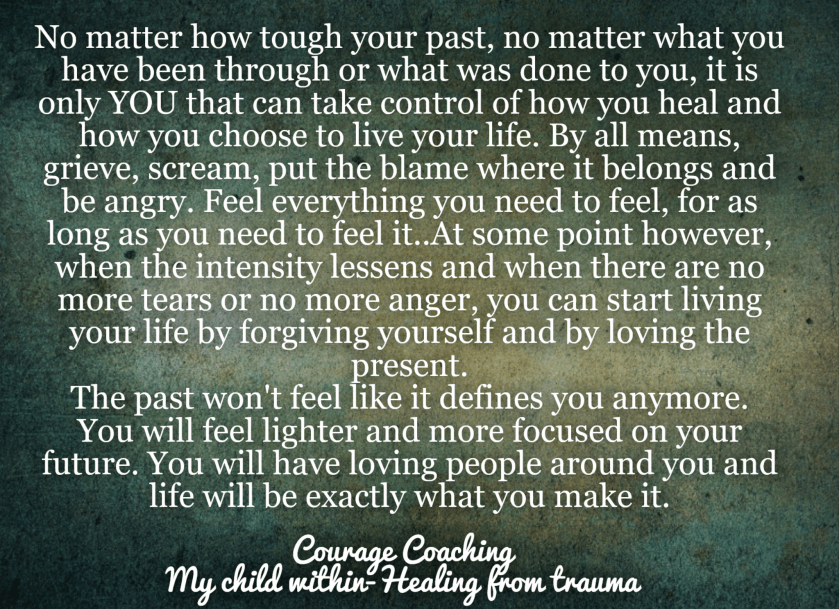
Every healing journey is unique to each person. No journey should be judged, minimised or discounted.

Whether it is childhood abuse, emotional, sexual or physical abuse, domestic abuse, grief, a single trauma or multiple traumas, nobody has the right to criticize someone else’s journey.

If you have compassion and maybe share what helped you, it doesn’t necessarily mean it will help others in the same way. Having compassion and empathy is so crucial. Listening, without trying to fix is also important.

After you reach a certain point in your healing, you will notice that things get easier. The intensity of certain emotions lessen and your sense of self-protection and boundaries are solid. If you suffer from a mental illness, it doesn’t necessarily mean it will go away. You eventually just learn to accept that it is a part of you and that you can handle it in a self-compassionate way.

What is your experience with healing?

Do you believe you will reach a point in your recovery where things eventually feel better?

Are you persistent in practicing self-care and healing with appropriate professional support?

Don’t forget that healing is a very up and down process. It isn’t always straightforward. Sometimes just as you are starting to feel better, something else comes along which needs processing. It might feel that you are back to square one again but this really isn’t the case.

Changes happen in very small ways sometimes and it depends on whether you have regular support.

Always be kind to yourself and others going through a process of healing ♥

Love Athina ♥

© All blog posts and images are owned by me and Courage Coaching. Please don’t use without consent and only re-blog if you would like to use the information on here.